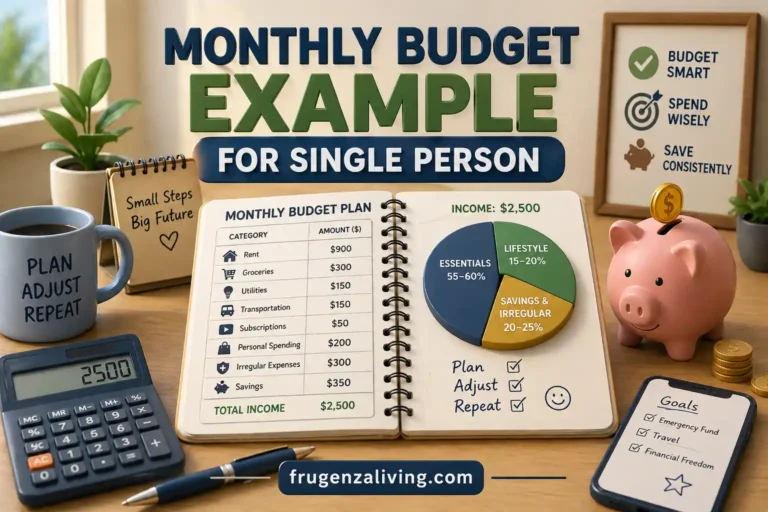
“I make money every month—but I still don’t know where it all goes.”
If that sounds familiar, you’re not alone.
A lot of people try budgeting, but get stuck at the same point:
- How much should go to rent?
- How much is too much for food?
- Am I saving enough—or just guessing?
Most budgeting advice feels too generic or too strict.
And that confusion is exactly why most budgets fail before they even become a habit.
What actually helps is seeing a real monthly budget example for a single person—with numbers that reflect real life, not perfection.
Because budgeting isn’t about control.
It’s about clarity.
What Is a Monthly Budget Example for a Single Person?
A monthly budget example for a single person shows how income is divided into essential expenses, lifestyle spending, and savings. It provides a realistic breakdown of categories like rent, groceries, utilities, and savings so you can manage money in a simple and flexible way.
Key Takeaways
- A budget is a guide, not a restriction
- Realistic numbers matter more than perfect ratios
- Flexibility makes budgeting sustainable
- Clarity reduces financial stress
Quick Budget Summary
For a simple monthly budget, a single person can usually start with this structure:
- Essentials: around 55–60%
- Lifestyle: around 15–20%
- Savings + irregular expenses: around 20–25%
This is not a strict rule. It’s a flexible starting point that you can adjust based on your income, location, and real monthly expenses.
A large part of any monthly plan is your grocery budget for one person, which often takes up a big portion of expenses.
A Budget Is a Flexible Guide, Not a Strict Rule
Most budgets fail for one reason: they’re too rigid.
People try to follow exact percentages or strict rules every month. But real life doesn’t follow a script.
Some months are heavier:
- unexpected bills
- social events
- higher groceries
- repairs
A realistic budget adapts.
Instead of forcing your spending into a perfect system, you adjust your system to match your life.
That’s why a simple monthly budget for a single person works better than a perfect one.
What a Monthly Budget for a Single Person Looks Like
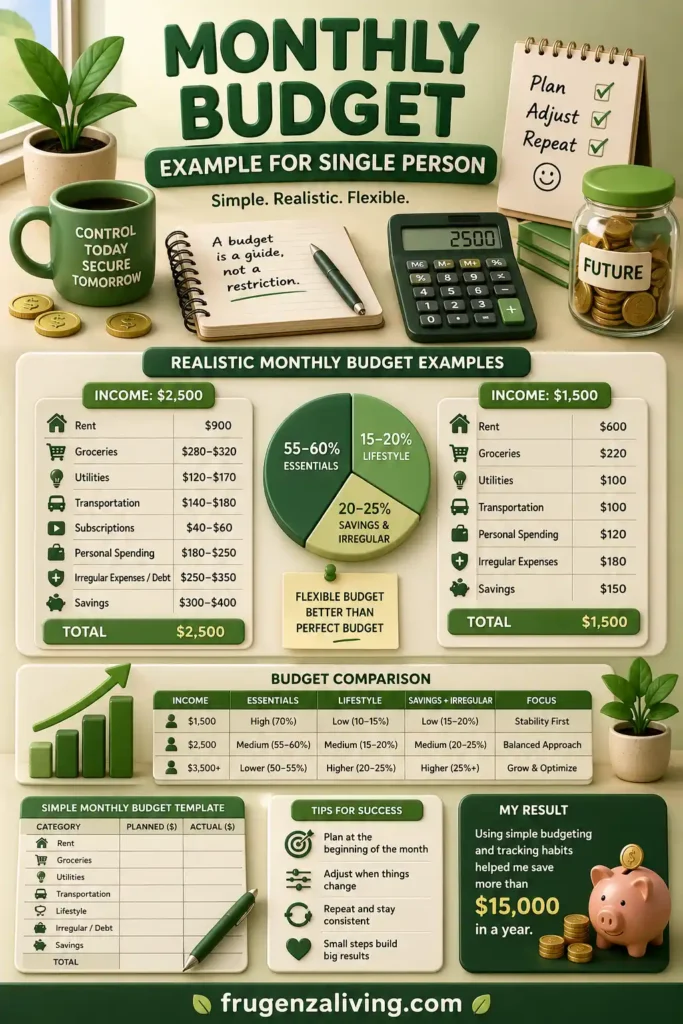
A practical budget usually includes three core groups:
- Essentials
- Lifestyle
- Future (savings + irregular expenses)
| Category | Amount ($) | Percentage |
|---|---|---|
| Essentials | $1,350–$1,500 | 55–60% |
| Lifestyle | $400–$550 | 15–22% |
| Future (Savings + Irregular) | $550–$700 | 22–28% |
In reality, these numbers shift slightly every month.
And that’s normal. If you’re new, it’s important to start with a basic budgeting setup approach before adding details.
Realistic Monthly Budget Example (Based on $2,500 Income)
Here’s a quick breakdown you can scan in seconds:
| Category | Amount ($) |
|---|---|
| Rent | $900 |
| Groceries | $280–$320 |
| Utilities | $120–$170 |
| Transportation | $140–$180 |
| Subscriptions | $40–$60 |
| Personal Spending | $180–$250 |
| Irregular Expenses / Debt | $250–$350 |
| Savings | $300–$400 |
This example works well as a monthly budget example for a single person after tax, since it reflects take-home income rather than gross salary.
The numbers aren’t perfectly clean—and that’s the point.
This is what real budgeting looks like. A budget becomes more effective when paired with practical monthly saving plan.
Monthly Budget Example for Single Person (Lower Income – $1,500)
If your income is lower, your budget will naturally shift.
| Category | Amount ($) |
|---|---|
| Rent | $600 |
| Groceries | $220 |
| Utilities | $100 |
| Transportation | $100 |
| Personal Spending | $120 |
| Irregular Expenses | $180 |
| Savings | $150 |
This is a realistic example of how to budget monthly for one person with a tighter income.
The savings are smaller—but still consistent.
Budget Example Comparison (Why Realistic Budgets Work)
| Income | Savings | Lifestyle | Notes |
|---|---|---|---|
| $1,500 | $150 | Low | Focus on stability |
| $2,500 | $300–$400 | Moderate | Balanced approach |
| $3,500+ | $500+ | Flexible | More room to optimize |
Budgets scale with income—but the structure stays similar.
Why Budget Numbers Feel Harder When You Live Alone
Solo Monthly Budget Builder
Build a realistic one-person budget, see how much of your take-home income is committed to fixed costs, and find out how much money is still unassigned before the month begins.
Your numbers stay in your browser. This tool does not send your budget to an external service. Fixed-cost ranges are planning signals, not universal financial rules.
| Budget Category | Type | Planned | % of Income |
|---|
This planner is designed to organize a monthly budget and highlight cash-flow pressure. It is not individualized financial advice. Appropriate spending and savings levels vary with income, location, debt, goals, benefits, and personal circumstances.
Most budget benchmarks are built around shared households.
The standard advice — spend 30% on rent, 15% on food, 10% on savings — was designed for a context where fixed costs are split between two or more people.
When you live alone, those same fixed costs land entirely on one income. Rent is not divided. Utilities are not shared. The internet bill does not get cut in half.
This is why a single person earning $2,500 per month can follow a “textbook budget” and still feel financially stretched, while a couple earning $3,500 combined feels more comfortable. The math is not wrong. The benchmark is just not built for one.
There is a practical way to read your own numbers more accurately.
Instead of comparing your budget to general percentages, look at your fixed cost ratio — the portion of your income already committed before the month begins.
Add your rent, minimum debt payments, utilities, and any subscription you cannot cancel this month. Divide that by your take-home income.
If that number is above 60%, your budget is not a behavior problem. It is a fixed cost problem. The realistic solution is not to cut groceries further — it is to reduce one fixed expense over the next three to six months, or to find a way to increase income by a small amount.
If your fixed cost ratio is below 50%, you have more flexibility than your spending patterns may suggest. The issue in this case is usually untracked variable spending, not the budget structure itself.
Knowing which situation you are in changes what you actually do next
How to Adjust This Budget Based on Your Situation
Your budget will always be personal.
If your income is lower:
- focus on essentials
- keep savings small but consistent
If your income is higher:
- increase savings gradually
- avoid lifestyle inflation
This approach works especially well for a single person living alone, where fixed costs take up a large portion of income.
This structure is especially helpful if you’re budgeting on a low income and need something practical.
The Most Common Budget Categories You Should Include
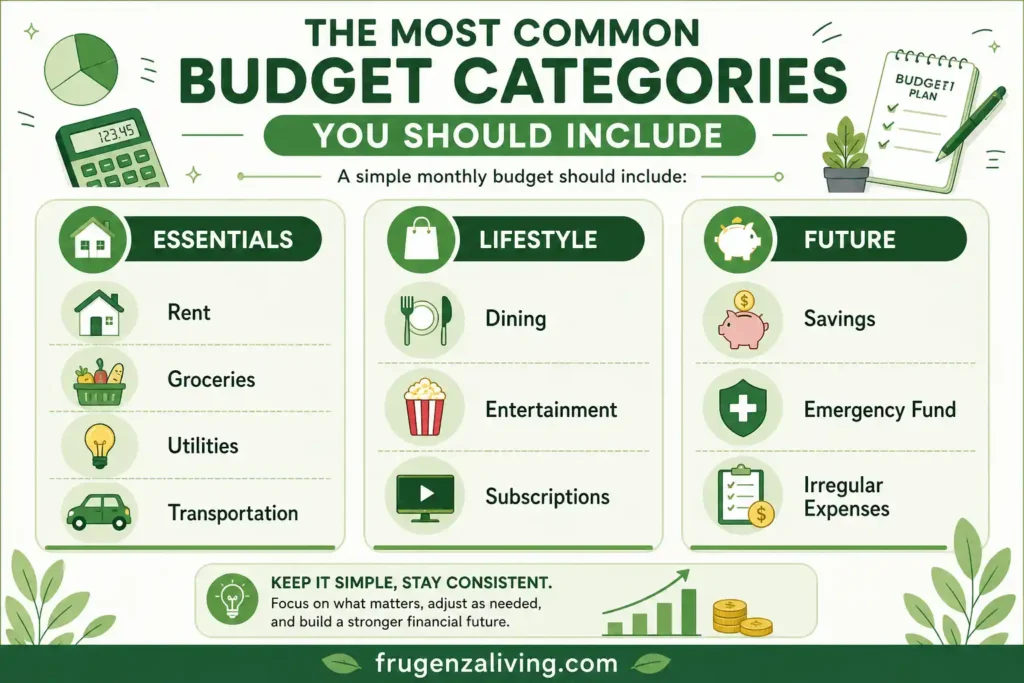
A simple monthly budget should include:
Essentials
- rent
- groceries
- utilities
- transportation
Lifestyle
- dining
- entertainment
- subscriptions
Future
- savings
- emergency fund
- irregular expenses
You don’t need too many categories.
Simple is easier to maintain. If you want more structure, you can try simple zero-based budgeting to assign every dollar a purpose
A Simple Monthly Budget Template You Can Follow
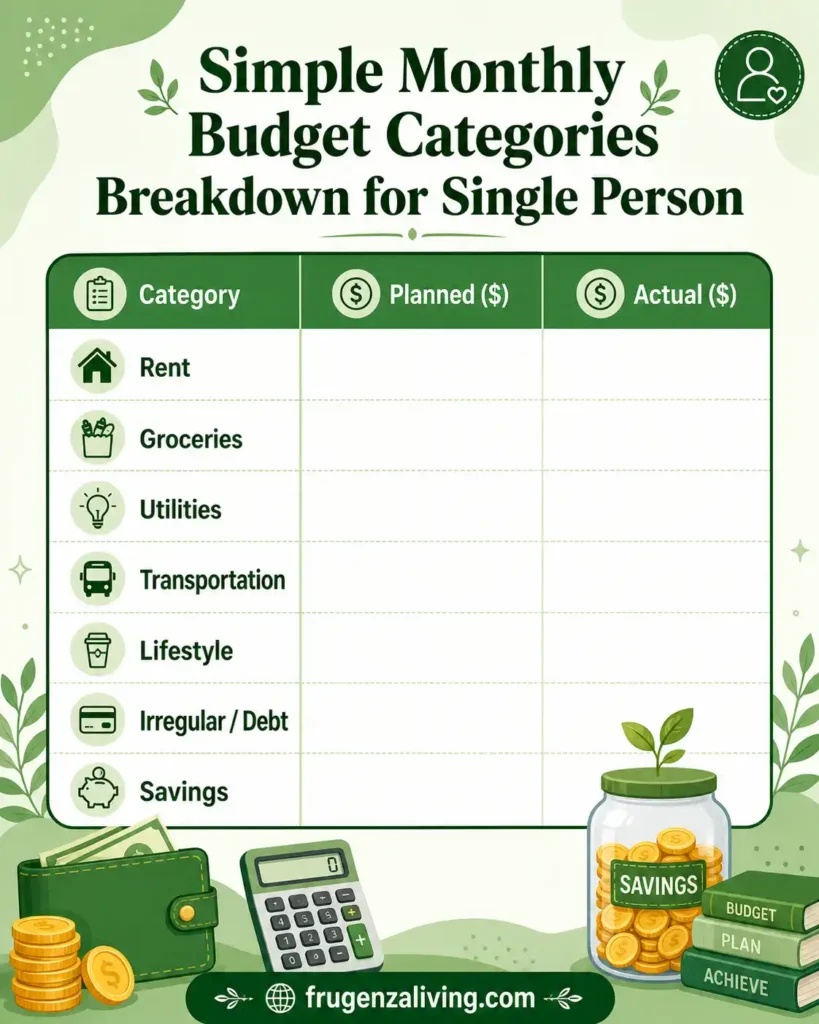
If you’re unsure where your money is going, learning how to track expenses easily can help you fill this in more accurately.
Want to keep using these numbers after you leave this page? Use the Solo Monthly Budget Builder above and download your completed budget as a CSV file. You can open it in Excel or Google Sheets and update it throughout the month.
What I Noticed After Using a Simple Budget
At first, I thought budgeting would feel restrictive.
But it didn’t.
It made things clearer.
Instead of guessing, I could see patterns:
- where I overspent
- what I could adjust
- what actually mattered
The biggest shift wasn’t saving more immediately.
It was consistency.
Saving $300 felt manageable. Repeating it felt realistic.
Over time, that consistency is exactly what helped me build savings of over $15,000 in a year.
Not from one perfect month.
But from repeating simple decisions.
That didn’t happen overnight. It came from sticking to a flexible system I could follow—even during imperfect months.
Common Budgeting Mistakes for Single People
Most people don’t fail because budgeting is hard.
They struggle because the approach isn’t realistic.
Common mistakes include:
- being too strict
- using too many categories
- ignoring irregular expenses
A budget should match real life—not fight it.
How to Make Your Budget Work Every Month
Use a simple loop:
Plan → Adjust → Repeat
Plan your spending at the beginning of the month.
Adjust when needed.
Repeat next month.
That’s how budgeting becomes sustainable.
How This Connects to Your Money System
Budgeting works best when combined with simple systems.
When you track expenses easily, you gain awareness.
When you control spending habits, you reduce money leaks.
When you apply realistic ways to save money every month, your budget turns into real progress.
You can also reduce daily expenses at home to create more flexibility.
Everything works together.
FAQ
What is a monthly budget for a single person?
A monthly budget for a single person is a plan that divides income into essentials, lifestyle spending, irregular expenses, and savings so you can manage money clearly each month.
How much should a single person spend monthly?
Spending depends on income, location, and lifestyle. Most people prioritize essentials first, then adjust lifestyle and savings accordingly.
How to budget with low income?
Focus on essentials, keep categories simple, and save small amounts consistently. Flexibility matters more than strict rules.
What is a simple monthly budget example?
A simple monthly budget example includes rent, groceries, utilities, transportation, lifestyle spending, irregular expenses, and savings.
What is a realistic budget for one person?
A realistic budget is one that reflects actual income and expenses and can be adjusted each month without feeling restrictive.
Conclusion
Budgeting doesn’t need to be complicated.
You don’t need perfect numbers.
You don’t need strict rules.
You need something that works in real life.
Start simple.
Adjust often.
Stay consistent.
Because a budget isn’t about control.
It’s about clarity.

The ideas shared here come from real-life experience and practical habits that actually work.
→ Read more about Jeffi
- No Spend Month Challenge for Beginners: A 30-Day Plan - September 24, 2026
- Low Buy Month Challenge: Realistic Rules for 30 Days - September 23, 2026
- How to Stop Buying Groceries You Already Have - September 20, 2026