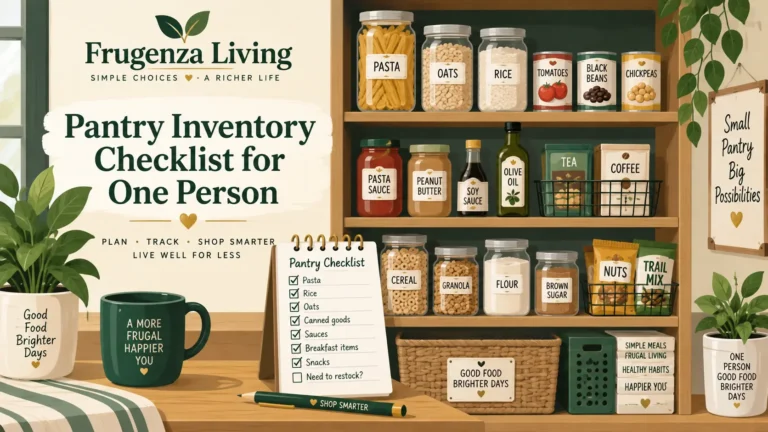
You write “pasta sauce” on your grocery list, then move a cereal box and discover an unopened jar behind it.
Next to that is a half-used jar. Two cans of tomatoes are sitting on another shelf.
The pantry was not empty. You simply could not see what you owned well enough to let it influence the next shopping trip.
A pantry inventory checklist for one person should solve that problem without turning your kitchen into a warehouse database. Its job is to show what you already have, what is genuinely running low, what should be used first, and what does not need another purchase yet.
For broader store and spending strategies, pair this with cheap grocery list for one person. Here, the focus stays on the few minutes before you shop.
A solo pantry does not need to look fully stocked. It needs to tell you what not to buy twice.
Why a One-Person Pantry Needs Different Inventory Rules
A family may move through pasta, cereal, beans, sauces, and snacks quickly.
One person can take weeks or months to finish the same package.
That changes what “well stocked” means.
Keeping two backups of everything may feel organized, but for a solo household it can mean months of excess inventory. Large packages remain open longer. Specialty ingredients survive several grocery cycles. A sale can create a backup that is still sitting there when the same sale appears again.
So avoid universal rules such as:
“Always keep two cans.”
“Replace rice when one bag remains.”
Instead ask:
Do I have enough to last until my next realistic grocery trip?
If you are deciding which foods deserve pantry space in the first place, use a guide to cheap pantry staples for one person rather than turning this inventory into a list of foods everyone supposedly needs.
Give Every Item a Next-Shop Status
Recording inventory is useful only if it changes a decision.
Use four statuses.
| Status | What it means | What to do |
|---|---|---|
| Enough | You have enough for the next normal grocery cycle | Skip it |
| Buy Next Shop | A regularly used item is genuinely running low | Add it to your list |
| Use First | Open, older, partial, or forgotten stock needs attention | Use before replacing |
| Pause Rebuy | The item moves slowly, is duplicated, or is rarely used | Do not replace yet |
This is more useful than recording:
Pasta — yes
An empty shelf is not automatically a grocery need. Sometimes it is simply an empty shelf.
Keeping an inventory is especially useful if you often buy groceries you already have, because it gives you something quick to check before making a list or entering the store.
Package Count Is Not the Same as Usable Stock
Suppose your inventory says:
Pasta — Quantity: 2
That sounds comfortable.
But one box contains about 15% and another about 20%. Together, they may not equal one full package.
For most one-person households, exact weights are unnecessary. A simple amount-left scale is usually enough:
- Full / Unopened
- More Than Half
- About Half
- Less Than Half
- Almost Empty
That gives you useful visibility without weighing rice after every dinner.
Track enough detail to guide the next grocery trip—not enough detail to run a warehouse.
Solo Pantry Inventory Checklist
You do not need to record every spice jar or tea bag.
Start with foods that can actually change the next shopping list:
- grains, pasta, rice, and oats;
- canned foods;
- sauces and condiments;
- baking supplies;
- breakfast foods;
- snacks;
- shelf-stable beverages;
- hidden backups;
- specialty ingredients that tend to linger.
The checklist below saves your entries in the current browser. Add or remove items as your pantry changes, then let Buy Next Shop become the starting point for your grocery list.
Solo Pantry Inventory Checklist
Track only the foods that can change your next grocery decision. Your entries are saved automatically in this browser.
Choose each Next-Shop Status based on how much is left, how often you use it, and whether it should last until your next normal grocery trip. Your inventory is stored only in this browser on this device. Clearing site data or using private browsing may remove it, so download the CSV if you want a backup.
Use a Personal Rebuy Trigger
The same amount of food can lead to different shopping decisions.
Consider three examples.
Oats: You eat them most mornings, only two breakfasts remain, and you plan to shop in four days.
→ Buy Next Shop
Rice: Half of a large bag remains and you use it twice per week.
→ Enough
Specialty sauce: Half a bottle remains, but you used it once in the last month.
→ Pause Rebuy
Before restocking, consider:
- how often you actually use the food;
- how much is realistically left;
- when you expect to shop again;
- whether another food can fill the same role.
Restock based on consumption, not shelf symmetry.
Slow Inventory Is Purchasing Feedback
Some ingredients survive pantry check after pantry check.
That does not automatically make them bad purchases. It does tell you something about how quickly your household uses them.
A family-size package may have looked cheap per ounce but taken six months to finish. A specialty condiment may have been useful for one recipe and then ignored. You may own several products that can serve roughly the same purpose.
Marking these items Pause Rebuy prevents your pantry inventory from becoming an automatic refill list.
If the checklist reveals that you already have much more food than expected, a shop your pantry challenge can help reduce that stock before normal replenishment resumes.
Do Not Let Printed Dates Run the Entire Pantry
Printed dates can help identify food that deserves attention, but they should not become an automatic discard button.
The USDA Food Safety and Inspection Service explains that, except for infant formula, federal food product dating generally relates to quality rather than automatically meaning food becomes unsafe on that date.
That does not mean questionable food should be eaten.
Proper handling, package condition, and signs of spoilage still matter. If storage and visibility are the recurring issue, use a dedicated guide to making groceries last longer rather than adding more fields to this checklist.
A date is useful when it helps you decide what deserves attention.
Keep the Inventory Lighter Than the Pantry
A spreadsheet with twelve columns can look impressive on the day you build it and be abandoned by the third shopping trip.
For one person, focus on inventory that can change a purchase:
- regular-use foods;
- costly duplicates;
- hidden backups;
- slow-moving foods;
- items likely to appear on the next list.
You probably do not need to count every spice or record exact weights after every serving.
And if your entire pantry fits on one visible shelf and you rarely buy duplicates, you may not need a permanent inventory at all. A quick pre-shopping scan may be enough.
Inventory accuracy matters less than shopping usefulness.
Do a Three-Minute Pre-Shop Scan
Before your normal grocery trip:
Minute 1: Check foods you regularly buy.
Minute 2: Look for opened packages, partial stock, and hidden backups.
Minute 3: Update only the statuses that changed.
Because the checklist is saved in your browser, you do not have to rebuild it every time. Remove foods you no longer need to track and add new ones only when they can influence a future shopping decision.
Then start the grocery list with Buy Next Shop instead of relying on memory.
That is enough.
A pantry inventory checklist for one person is successful when it prevents small, repeatable mistakes: the second jar bought because the first was hidden, the bulk package replaced months too early, or the specialty ingredient restocked even though you barely use it.
Your pantry does not need to look full.
It needs to be visible enough to make the next grocery decision easier.

The ideas shared here come from real-life experience and practical habits that actually work.
→ Read more about Jeffi
- No Spend Month Challenge for Beginners: A 30-Day Plan - September 24, 2026
- Low Buy Month Challenge: Realistic Rules for 30 Days - September 23, 2026
- How to Stop Buying Groceries You Already Have - September 20, 2026