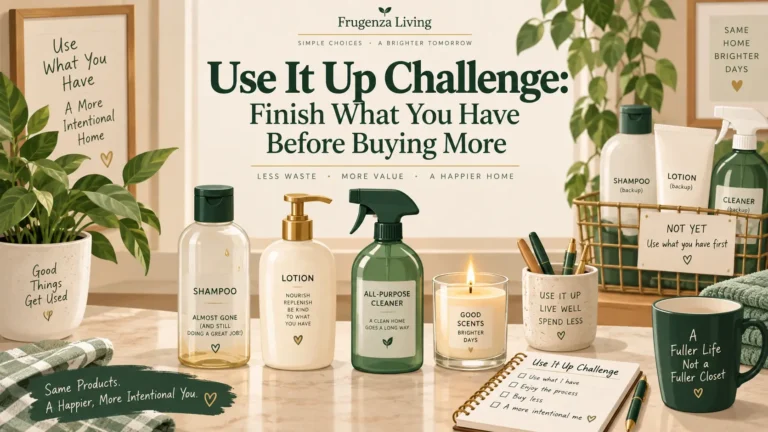
The shopping list says you need shampoo. Yet one bottle is almost empty in the shower, another is half-used under the sink, and an unopened backup is already in a drawer.
That gap between what you own and what you remember owning is where a use it up challenge becomes useful.
A use it up challenge is a temporary frugal-living experiment: choose a small group of consumables you already own, use them normally, decide what should happen to each product, and only then decide what—if anything—should replace it. It works well with toiletries, skincare, cleaning and laundry supplies, candles, stationery, craft materials, and other household consumables.
The empty container is not the financial win. The better replacement decision is.
A Use It Up Challenge Is Not Just a Shopping Ban
You may buy less during the challenge, but refusing to spend money is not the objective.
The more useful question is:
What should happen to the consumables I already own before another one enters the house?
Necessary hygiene, medical, and safety products can still be tracked for inventory awareness, but never ration normal use or delay a needed replacement just to continue the challenge.
Beauty fans may recognize Project Pan, where people deliberately work through makeup or skincare they already own. A whole-home challenge applies the same attention more broadly, then adds a second question: should this category or product be bought again?
A no spend month challenge becomes easier when you also use up food, toiletries, and household supplies already sitting at home.
How to Start a Use It Up Challenge
Do not begin by auditing every cabinet.
Choose two or three categories where duplicates or half-used products actually exist. Toiletries plus cleaning supplies may be enough. Beauty plus candles may be enough. Laundry products plus stationery may be enough.
Toiletries are a good place to start because partially used bottles are easy to forget, and learning to save money on toiletries can prevent unnecessary replacements.
A 30-day use it up challenge is easy to remember, while two to four weeks is a manageable starting window for noticing duplicates, slow-moving products, and replacement habits.
Every selected item does not have to become empty. A large detergent bottle, candle, serum, or notebook may still be useful at the end. Progress means you know what should happen next instead of forcing everything to zero.
Food is better handled separately because meals, spoilage, and grocery replenishment create different decisions. If food is where unused inventory is accumulating, use the dedicated shop your pantry challenge instead.
First Decide What Happens to the Product You Already Own
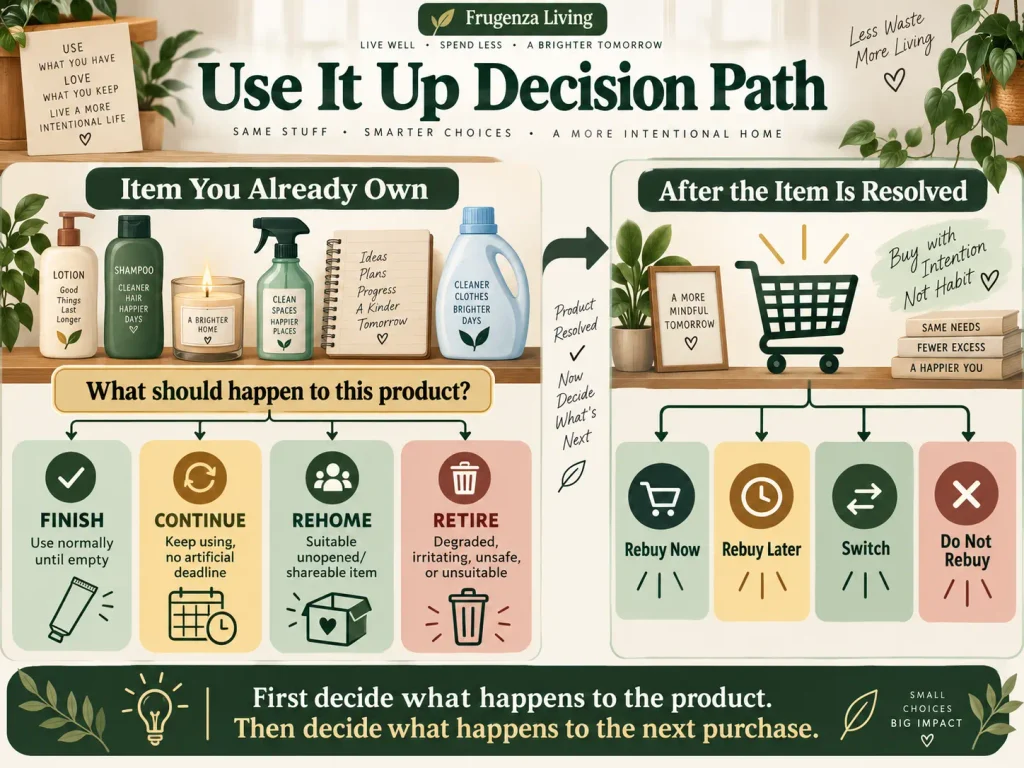
Give each item one current-product outcome.
| Current outcome | When it fits | What happens |
|---|---|---|
| Finish | Safe, useful, and practical to finish | Use normally until empty |
| Continue | Useful but slow-moving | Keep using without an artificial deadline |
| Rehome | Appropriate unopened or safely shareable item you will not realistically use | Move it to someone who can use it |
| Retire | Degraded, irritating, unsafe, damaged, contaminated, or unsuitable | Dispose of it appropriately |
Notice what is missing:
Do Not Rebuy.
That belongs to the second layer—the next purchase decision—not to the fate of the current bottle.
A body lotion can be Finish now → Do Not Rebuy later.
A cleaner can be Retire now → Switch later.
Separating those decisions makes the challenge much more useful because finishing something does not automatically mean it deserves another place in your budget.
Once you start finishing what you already own, a low buy month challenge can help you keep new purchases from immediately replacing everything you used up.
Do Not Use Products Faster Just to Create Empties
A use-it-up challenge can reward the wrong behavior if the goal becomes producing empty containers.
Using twice as much shampoo, over-pouring detergent, burning a candle unnecessarily, or applying skincare more frequently than directed may create empties faster. It can also move the next purchase closer.
The better rule is:
Use normally. Finish intentionally.
Your normal consumption rate is useful information.
If one moisturizer lasts most of a year, buying three backups because they were discounted may be a storage problem disguised as savings.
Slow use can reveal another buying mistake: stocking up based on how attractive a deal looked rather than how quickly your household actually consumes the product.
Use It Up Focus Queue
Choose a small number of products and track two separate decisions:
- What happens to the item you already own?
- What happens to the next purchase?
The tool also keeps replacement spending postponed separate from Do Not Rebuy decisions so delayed purchases are not automatically labeled savings.
Use It Up Focus Queue
Track what happens to products you already own and what you decide about their future replacements.
Add your focus products to begin.
Replacement spending postponed counts only resolved items marked Finish → Rebuy Later when a replacement price is entered and no replacement was purchased during the challenge. It is not permanent savings. Do Not Rebuy decisions are counted separately. Your entries stay in your browser.
The postponed-spending figure is deliberately narrow.
For example, if you finish a product, decide Rebuy Later, and do not buy the replacement during the challenge, the likely replacement price can appear as spending postponed.
If you choose Do Not Rebuy, the tool counts the decision instead of pretending the price is already permanent savings.
Finishing a $12 Product Does Not Save $12
Suppose you bought a bottle of lotion for $12 several months ago and finally finish it this month.
You did not just save $12. That money left your account when you bought the lotion.
Three different financial effects can happen.
Value Recovered
You received more use from something already paid for.
That matters if the alternative was allowing it to sit unused until it was discarded, but value recovered is not new cash.
Replacement Spending Postponed
Suppose the likely replacement costs $15, but you choose Rebuy Later because another suitable product is already open or the category is not currently urgent.
That $15 purchase has been postponed.
If you buy it next month, the challenge changed timing rather than necessarily changing total long-term spending.
Spending Avoided
Finishing the lotion may reveal that another moisturizer already does the same job, or that you do not value the category enough to replace it.
If the future purchase genuinely disappears instead of shifting to another month, spending may have been avoided.
That is why original purchase prices should never simply be added together and called money saved.
Before You Replace It, Check the Backup
The current item has now been resolved.
The second decision is what, if anything, comes next.
Rebuy Now: You genuinely need and use it, and no appropriate backup remains.
Rebuy Later: The product or category is useful, but there is no reason to purchase it yet.
Switch: The category deserves a place in the budget, but this particular product was poor value, unpleasant, or did not work well.
Do Not Rebuy: Your household functions perfectly well without replacing it.
Before choosing, ask whether another usable version is already at home, whether you liked the product enough to buy it again, and whether the category needs a replacement at all.
If you finish a $10 cleaning spray while two suitable cleaners remain in the cabinet, buying another immediately makes the challenge mostly cosmetic: one bottle left and another arrived.
For medicines, medically necessary products, critical hygiene items, and safety supplies, follow label or professional guidance rather than delaying a necessary replacement.
Cleaning products are another easy category to overbuy, so using each bottle fully can help you save money on cleaning supplies without changing how often you clean.
Safety Is a Valid Challenge Outcome
Money already spent can make a questionable product difficult to discard. That sunk cost should not decide whether you continue using it.
The FDA guidance on cosmetic shelf life explains that shelf life varies according to the type of cosmetic, how it is used, and how it is stored. Products can degrade over time, and moisture, heat, air, repeated finger contact, and applicators can affect them.
If a cosmetic has degraded, changed noticeably, become irritating, or otherwise seems questionable, Retire can be the correct outcome.
Follow cleaning-product labels, never combine household chemicals merely to use them up, and never increase usage just to empty a container faster.
Safety is worth more than another empty bottle.
Stop Creating Parallel Half-Used Products
One quiet source of household clutter is having several similar products open at once.
There may be three lotions in rotation, two open shampoos, several half-used sprays, and samples that never get reached.
Where practical, keep one obvious finish next product visible and leave backups closed until needed.
This is not a universal minimalist rule. Separate bathrooms or genuinely different product purposes may justify multiples.
The useful question is whether opening another item creates real convenience or simply turns one product backlog into two half-used products.
Let the Challenge Change the Next Purchase
When the challenge ends, do not judge it by the number of containers in the recycling bin.
Look at what changed.
Did you discover a backup before buying another product?
Did a slow-moving item prove that bulk buying was unnecessary?
Did one category disappear from the shopping list entirely?
Did you learn that one reliable product can replace two overlapping ones?
Those lessons matter more than an impressive empties photo.
The best result is not an empty cabinet.
It is a cabinet no longer crowded with slow-moving backups, unnecessary replacements, and forgotten duplicates.

The ideas shared here come from real-life experience and practical habits that actually work.
→ Read more about Jeffi
- No Spend Month Challenge for Beginners: A 30-Day Plan - September 24, 2026
- Low Buy Month Challenge: Realistic Rules for 30 Days - September 23, 2026
- How to Stop Buying Groceries You Already Have - September 20, 2026