A bathroom cabinet can hold half-open bottles while toothpaste or deodorant still runs out unexpectedly. Sales encourage backups, yet similar products may sit unfinished for months.
Learning how to save money on toiletries starts with the replacement rhythm: when a product is opened, how long it lasts, whether it is safely finished, how many people use it, and when another is genuinely needed. Track frequent purchases, separate flexible routines from label-directed products, and buy larger sizes only after a product fits your routine.
This guide focuses on toiletries and consumer guidance in the United States. Product labels, taxes, assistance options, and regulations may differ elsewhere.
Start With the Replacement Rhythm, Not the Sale
Choose five products you replace often, such as shampoo, deodorant, toothpaste, body wash, and moisturizer. Write the opening date on each package or keep it in a phone note. Record the finishing date and number of regular users before opening the replacement.
A successful finish means the product remained suitable, safe, and useful. Do not keep using something that causes irritation, appears contaminated, or has changed in smell, color, or texture.
Calculate:
Product lifespan = number of calendar days from opening through finishing
For a spreadsheet:
Product lifespan = finish date − open date + 1
Then calculate:
Average daily replacement cost = amount paid ÷ product lifespan
Normalized 30-day cost = average daily replacement cost × 30
Suppose Product A costs $8 and lasts 24 calendar days. Its average daily replacement cost is about $0.33, and its normalized 30-day cost is about $10.
Product B costs $11 and lasts 55 days. Its average daily replacement cost is $0.20, and its normalized 30-day cost is about $6. In this illustration, the higher-priced product costs less over time.
The normalized figure compares products with different lifespans. It is not necessarily the amount spent each month or the cost per use.
Compare products serving the same purpose, producing acceptable results, and used by roughly the same number of people. A bottle shared by three people cannot be fairly compared with one used by one person. This log can support a realistic monthly toiletry budget.
Keep personal-care spending separate from household cleaners by learning how to separate personal-care spending from household cleaning supplies.
Where Toiletry Money Usually Disappears
Most waste appears in three forms.
A product may disappear unusually fast because of overpouring, an oversized pump, repeated application, or several household members using it.
Several products with the same function may be open at once, leaving one forgotten. A discounted product may become an expensive failure when its scent, texture, comfort, or performance causes abandonment.
Consider this composite household example. Two shampoos are open because someone wanted a new scent. A deodorant multipack was bought before the first stick proved comfortable. A bargain moisturizer was abandoned. A large sunscreen bottle was stored in excessive heat. Toothpaste then ran out, causing an unplanned convenience-store purchase.
The problem is not one luxurious item. It is fast replacement, parallel products, failed purchases, and poor timing.
Your Toiletry Replacement Rhythm
Track one suitable package from opening to replacement before changing size, brand, or backup quantity.
Open
Write the date and number of regular users. Keep one primary product unless another has a distinct label-directed purpose.
Observe
Record the finishing date. Note overpouring, parallel use, irritation, product changes, or abandonment.
Compare
Divide the amount paid by the inclusive calendar days. Compare products used for the same purpose and by roughly the same number of people.
Replace
Add it to a planned trip. Buy a larger size only after one acceptable full finish.
Follow product-specific safety directions: apply and reapply sunscreen as directed; use medicated products according to their labels; do not reuse contact lens solution or disposable menstrual products; and do not share toothbrushes or razors.
Do not add water to cosmetic products unless the label explicitly permits dilution. Use fluoride toothpaste, prescription items, and other label-directed products according to their instructions or professional guidance. This planner estimates spending patterns and does not replace product labels, dental advice, medical advice, or manufacturer instructions.
Separate Flexible Routines From Label-Directed Use
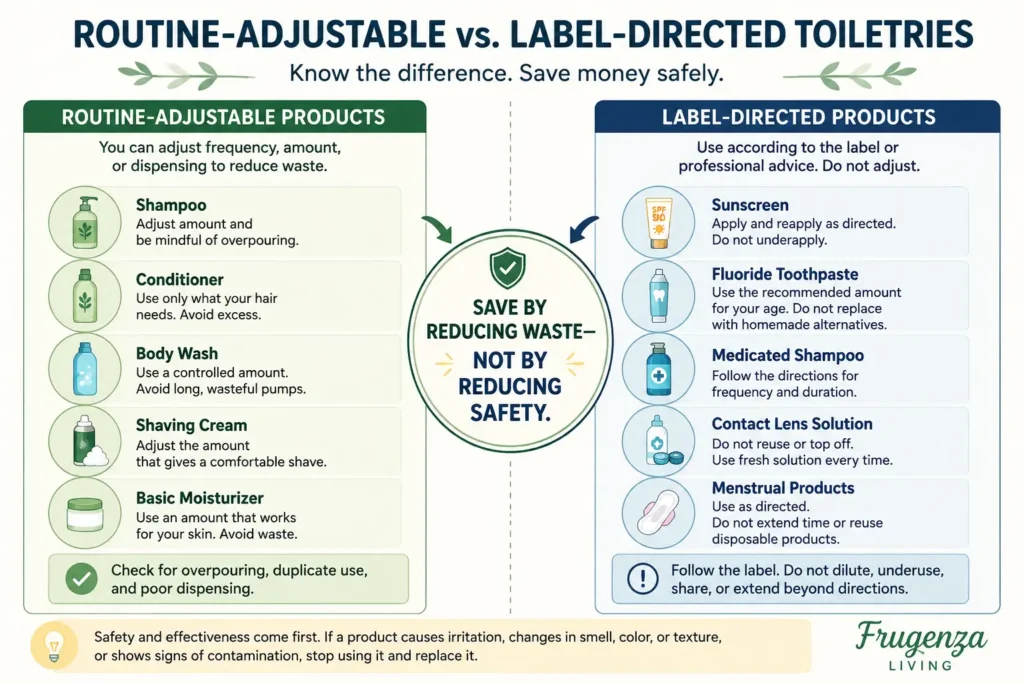
“Use less” is not a safe universal rule.
For basic shampoo, conditioner, body wash, shaving cream, non-medicated soap, or moisturizer, look for avoidable waste rather than forcing a fixed dose. A controlled dispenser may reduce overpouring, while finishing one suitable product may reduce duplicate use. Frequency should reflect personal needs and instructions.
Other products are direction-sensitive. Sunscreen, fluoride toothpaste, medicated dandruff shampoo, acne treatments, prescription products, contact lens solution, menstrual products, and products with a Drug Facts label should be used according to their directions or professional advice.
FDA sunscreen guidance says to apply and reapply sunscreen as directed. Saving money should not mean underapplying, diluting, or stretching the interval.
Cosmetics can change with age, heat, moisture, air exposure, and contamination. FDA guidance on cosmetic shelf life explains that storage conditions can affect quality. Do not force yourself to finish a product that has changed or caused a reaction.
Small routines like checking toiletries, cleaning supplies, and pantry items can become simple home-saving habits throughout the year.
Compare Replacement Cost Over Time, Not Bottle Price Alone
Shelf price, sale price, and unit price are useful, but incomplete.
A larger body wash may have a lower cost per ounce but be replaced faster if its opening encourages overpouring. A cheap moisturizer is not a bargain if abandoned. A coupon does not make an unsuitable product economical.
Use unit price to compare package value, then use the replacement log to check whether the lower unit price actually reduced spending. Record the amount paid, open date, finish date, regular users, whether it was safely finished, and why it was abandoned if it was not.
Use the result after one complete, acceptable package. Stop earlier when safety, irritation, or product condition requires it.
If you already review toiletries, it also makes sense to spend less on bathroom supplies like toilet paper.
Let the Product Prove Itself Before You Buy More
Buying toiletries in bulk can work when the product is proven, the unit price is lower, storage is suitable, and the household will finish it.
For an unfamiliar shampoo, deodorant, razor system, or moisturizer, start with a smaller or normal package. Finish one acceptable cycle, then compare the larger size or multipack.
Store brands may lower the shelf price, but compare purpose, active ingredients when applicable, directions, package size, and finish rate. Test one package before buying a multipack; generic and name-brand products are not automatically interchangeable.
Check total cost, cash flow, storage, shelf life, bathroom conditions, compatibility, and replacement rate. Travel sizes may cost more per ounce but can reduce the risk of a failed full-size purchase. Avoid unreliable sellers and damaged or tampered packaging.
Reduce Product Overlap by Function
Group products by function—cleansing, conditioning, moisturizing, odor control, oral care, shaving, sun protection, and menstrual care—then ask whether each has a distinct role.
Two items are not automatically duplicates. A regular shampoo and a medicated shampoo may have different directions. Facial moisturizer and sunscreen are not automatically interchangeable. Body wash and hand soap may have different intended uses.
The goal is not forced minimalism. It is to stop buying near-duplicates while the first remains unfinished.
Before buying a new scent, formula, or “upgrade,” decide which current product it will replace. This can help you stop buying replacements before they are needed.
Set a Replacement Window
Once you know a product’s usual lifespan, stop waiting for an emergency.
Suppose shampoo generally lasts 35–45 days and you shop for toiletries every 14 days. If the bottle is likely to run out before the shopping trip after next, add it to the next planned trip. A range is more realistic than one exact date when usage varies.
For proven essentials, one open product and no more than one backup may be enough for many households. Disability needs, remote locations, delivery delays, or limited availability may justify a different buffer.
Planned replacement helps avoid convenience prices, shipping fees, unsuitable substitutes, and several categories hitting the budget together.
Apply the Rhythm to Common Bathroom Essentials
Hair and Body Care
Track calendar days, regular users, and whether the pump or opening changes the replacement rate. Finish one suitable bottle before opening another with the same role.
Compare bars, refills, and liquids by actual lifespan. There is no universal shampoo amount or washing schedule. Do not add water unless the label explicitly permits dilution. FDA guidance on microbiological safety in cosmetics explains why contamination matters.
For deodorant, record how long one stick or container lasts and whether discomfort, residue, scent, or poor performance caused abandonment before buying a multipack.
Oral Care
Record open and finish dates, but use toothpaste according to its label and the person’s needs. Compare store brands by active purpose, package size, and any dental recommendation.
Do not replace fluoride toothpaste with homemade powder. Current ADA toothpaste guidance recommends a rice-sized smear from the eruption of the first tooth until age 3 and a pea-sized amount from ages 3 to 6, with adult supervision to encourage spitting rather than swallowing.
Shaving
Track the weeks between blade or cartridge purchases instead of following a universal schedule. Compare systems by comfort, replacement frequency, handle cost, and accessories.
CDC advises against sharing personal items that may contact blood, including razors and toothbrushes.
Skincare and Sun Protection
Record whether each package was finished, abandoned, or replaced because its condition changed. Reduce overlapping cosmetic claims before cutting products with a defined role.
Test unfamiliar skincare in a smaller package when practical. Follow sunscreen directions, keep it away from excessive heat, and stop using a cosmetic that changes noticeably or causes irritation.
Paper and Menstrual Essentials
Track how long sealed paper goods or menstrual supplies last before deciding whether bulk pricing helps. Unit price matters, but so do storage and available cash.
Do not extend menstrual-product use beyond directions or reuse disposable products. Reusable options may suit some people, but they are not universal.
When Basic Toiletries Are Unaffordable
Needing help with basic hygiene products is not a personal failure.
Some food banks and community organizations may offer soap, toothpaste, menstrual products, toilet paper, or other essentials. Availability varies. Feeding America recommends asking a local food bank about personal-care supplies, while 211 can connect people with local assistance.
Call before traveling and ask specifically about hygiene kits or personal-care products. Do not assume every location stocks the same items.
Avoid payday loans, buy-now-pay-later plans, or revolving debt to build a toiletry stockpile. Use assistance for the immediate need, then restart the replacement rhythm when possible.
Start With Five Products This Month
Choose five frequently replaced products. Record the opening date, number of users, and finishing date. Keep one suitable primary product active for each role unless another has a distinct label-directed purpose.
Calculate the average daily replacement cost and normalized 30-day cost, then set a realistic replacement window based on observed use.
That is how to save money on toiletries without sacrificing basic hygiene: improve timing, reduce failed purchases, avoid unnecessary overlap, and buy products that fit the routine.
Then apply the same habit-based approach to reduce other repeated daily expenses.

Read about Jeffi and Frugenza Living
- How to Budget a 10-Month Salary Over 12 Months - October 16, 2026
- Pet Adoption Budget Checklist: What You Still Need to Pay - October 16, 2026
- Proportional Bill Split Calculator for Two Incomes - October 15, 2026