PAPER TOWELS · A TASK-FIRST GUIDE
Before you pull, pick the job.
Keep the convenience that matters. Cut the sheets that habit spends.
A new roll can disappear without one dramatic spill to explain it. The real drain is often a series of small pulls: two sections for clean water, a full sheet for crumbs, or an automatic handful before anyone checks what the job needs.
Learning how to save money on paper towels starts with noticing those pulls, not hunting for the cheapest roll. Route low-risk messes to tools that can handle them, keep disposable sheets for jobs where they offer real hygiene value, and compare packages by total area and section size. The goal is not zero paper towels. It is fewer unnecessary sheets without making cleanup slower, inconvenient, or less safe.
This guide focuses on U.S. households. Package sizes, unit labels, prices, taxes, promotions, and availability vary by retailer and location.
The Roll Is Not the Problem—The Default Is
Paper towels become the default because the roll is visible, nearby, and ready. A cloth may be in a drawer, while the dustpan is across the room. The easiest tool usually becomes the most frequently used tool.
That is a setup problem, not a character flaw. Give common low-risk jobs an equally convenient alternative. Dry crumbs may need a brush. Clean water may suit a washable cloth. A tiny grease mark may need one small disposable section. A contamination-sensitive spill may still justify paper.
This is the Paper Towel Use Map: route the mess first, then choose the least expensive tool that can handle it safely and effectively.
Tag Your Next 20 Paper Towel Pulls
Instead of tracking every household paper product for a week, tag the next 20 times someone reaches for the roll. This may take one day in a busy family or much longer in a single-person household.
For each pull, note the task, number of sheets or perforated sections, whether the whole piece was used, and whether another suitable tool was already within reach. Also mark whether the mess involved only water or crumbs, or included grease, raw-food juices, body fluids, pet waste, or another contamination concern.
Sort the 20 pulls into four categories:
- no towel needed;
- washable tool suitable;
- small disposable section sufficient;
- disposable use justified.
Here is a clearly labeled illustrative example, not household research: six pulls handled dry crumbs or clean-hand water, seven covered low-risk spills, four involved small greasy spots, and three involved contamination-sensitive cleanup. The first two groups would be the safest place to review before changing the contamination-sensitive uses.
Do not set a universal sheet allowance. Cooking frequency, children, pets, disability needs, and household health considerations can change legitimate usage.
Cutting back on paper towels may seem small, but it can still help you reduce household expenses over time.
Route the Mess Before Reaching for a Sheet
The route depends on the task, not on whether paper or cloth is always “better.”
Dry crumbs, loose debris, or clean items that can appropriately air-dry may need no towel. Clean-water spills, routine counter wiping, dusting, or drying clean dishes may suit a clean washable cloth. Small greasy or sticky spots may still benefit from disposable material but often need only one small section.
Reserve disposable use for situations where a cloth could spread contamination or create an unreasonable hygiene burden. Raw meat or poultry juices are an important example. Discard paper immediately after contact; do not carry it to another counter, handle, or appliance. The sheet contains the mess but does not replace cleaning or sanitizing the surface as directed.
The visual map below summarizes the choices without turning them into a zero-paper rule.
What Should Handle This Mess?
These are four task categories, not steps that must be followed in order.
Skip the Towel
Is the mess dry or easy to remove without an absorbent product?
Examples: dry crumbs, loose debris, or appropriate air-drying.
Use no product when the task does not need one.
Choose Washable
Is it a low-risk spill that a clean cloth can handle?
Examples: clean water, routine wiping, or table crumbs.
Keep clean cloths close to low-risk messes.
Use a Small Section
Does a small greasy or sticky spot still need disposable material?
Examples: minor splatter, oil blotting, or sticky residue.
Match the section size to the mess.
Reserve Disposable
Could a washable cloth spread contamination or create a hygiene burden?
Examples: raw-food juices or highly unsanitary waste.
Disposability has value when it solves a real hygiene problem.
Keep contamination contained: discard contaminated paper immediately. Remove contaminated cloths from active use, keep them separate from clean cloths, and launder them before reuse. Do not carry either item to another surface.
Clean kitchen cloths regularly and follow current food-safety and product-label instructions. This task map is a household decision aid, not a substitute for public-health guidance.
Compare Packages Without Being Fooled by Roll Count
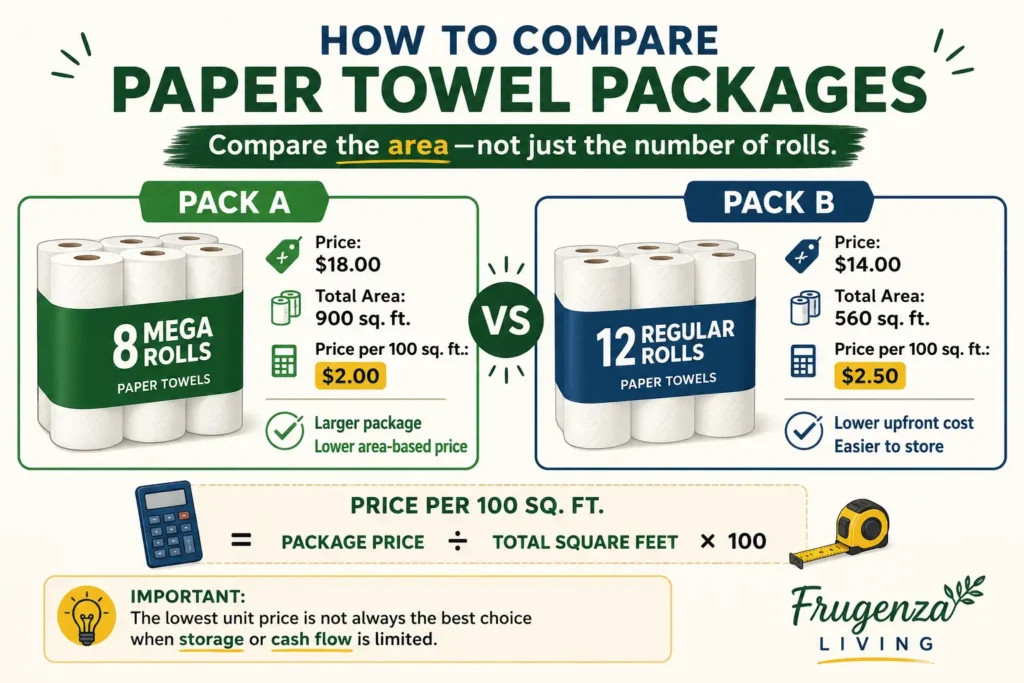
“Eight rolls” and “twelve rolls” are not enough for comparison. Rolls differ in width, sheet count, sheet dimensions, perforation size, ply, and total square footage. Labels such as “double” or “mega” are product-line comparisons, not universal measuring units.
Use total area as the primary price comparison:
Price per 100 square feet = amount paid ÷ total square feet × 100
This follows the same-unit comparison principle in the NIST Unit Pricing Guide, which includes area-based units such as 100 square feet. Use the same area unit for both packages.
The prices below are illustrative USD assumptions, not current offers. Assume no added tax or delivery charge. In your own calculation, include applicable tax and allocated delivery, subtract only confirmed discounts, and count each charge once.
Pack A costs $18 and contains 900 square feet:
$18 ÷ 900 × 100 = $2 per 100 square feet
Pack B costs $14 and contains 560 square feet:
$14 ÷ 560 × 100 = $2.50 per 100 square feet
Pack A has the lower area-based price. It may still be the wrong purchase when storage is limited, the larger package strains cash flow, or the household routinely overuses its sheet format.
A secondary calculation can help after you understand your pulling habits:
Price per manufacturer-perforated section = amount paid ÷ total perforated sections
Use this calculation only when the package states the section count or when it can be derived reliably from the label. As a separate illustrative example, a $12 package containing 600 sections costs $0.02 per section. Assume no additional tax or delivery fee for this example.
Use section cost only to understand how a particular package fits your household. It is not a reliable standalone cross-brand measure when section dimensions differ. If people usually pull two small sections together, compare that combined cost with the larger section from another package.
Photograph the package label or save the figures in a phone note so promotional roll counts do not erase the useful comparison.
Paper towels are not the only household paper product that can add up; you can also save money on toilet paper by tracking usage and buying more intentionally.
A Repeatable Clean-Water Check
Package math cannot show how a towel behaves in your home. Before buying a case or subscription, conduct a simple low-risk observation.
Pour ¼ cup of clean water onto the same wipeable surface. Use the same tester and blotting motion without wringing or pressing unusually hard. Run three trials for each format and record the typical number of sections needed to remove pooled water.
This is a household comparison, not a laboratory absorbency test or general brand rating. Do not use raw food, bleach, mixed cleaners, or contaminated material. Do not publish one household’s result as a universal claim about a brand.
Combine the result with price per 100 square feet, section size, storage, and cash flow. A thicker towel may need fewer sections for a larger wet spill but offer no advantage for dry crumbs. Test a small package before assuming that premium, higher-ply, or store-brand towels will perform a certain way.
Are Reusable Paper Towels Actually Cheaper?
They may be cheaper when you use cloths you already own, reserve them for low-risk messes, and wash them inside an appropriate existing load. They may save little if you buy a large specialty set or run extra laundry cycles for a few cloths.
Place a small basket of clean cloths near ordinary water spills and routine wiping. Keep a separate container for used cloths, and separate kitchen cloths from bathroom, pet, and floor cloths.
A cloth that contacts raw-food juices or another contaminated mess should leave active use immediately. Keep it separate from clean cloths and launder it before reuse. Do not carry it to another surface.
Do not hide the paper towel roll so completely that it becomes hard to reach when disposability has real value. Make washable tools easiest for low-risk jobs while keeping paper available for tasks that justify it.
Existing cotton cloths or old T-shirts may work when clean, surface-appropriate, and not releasing excessive lint or dye. Reusable is not automatically free: laundering uses water, energy, detergent, machine capacity, and time. When practical, add cloths to a suitable existing load rather than running a nearly empty cycle. For more detail, avoid turning reusable cloths into inefficient extra laundry.
A SEPARATE ILLUSTRATION · 100 MATCHED LOW-RISK TASKS
Count the laundry before calling it a saving.
Use the illustrative $12, 600-section pack above: $0.02 per section. Keep the same section size and cleanup tasks in both cases. Contamination-sensitive uses are outside this comparison and stay unchanged.
| For the same 100 tasks | Paper only | Half switched to cloth |
|---|---|---|
| Paper sections used | 100 tasks × 2 = 200 | 50 tasks × 2 = 100 |
| Paper cost allocated | 200 × $0.02 = $4.00 | 100 × $0.02 = $2.00 |
| Cloth washing cost | $0 | 50 uses × $0.03 = $1.50 |
| Total for these tasks | $4.00 | $3.50 |
$0.50 lower in this model. The $2.00 of paper avoided is reduced by $1.50 of extra washing cost. If washing instead costs $0.08 per cloth use, the cloth option totals $6.00—$2.00 more than paper only.
The $0.03 is an assumed incremental washing cost covering detergent, water, and energy in an appropriate existing load, not a universal rate. Assume suitable cloths are already owned and need no replacement during the test. No extra machine cycle, new equipment, or paid labor is assumed; time is not priced. Add any cost that actually changes, including a dedicated laundry load or replacement cloth.
A lower use cost is not an immediate cash saving. Buying the paper pack still requires $12, and both cases leave sections in stock. A new $5 cloth set would require an additional $5 upfront, exceeding this test’s $0.50 operating-cost reduction. The comparison does not promise an immediate cash saving or a monthly result.
Keep a Disposable Boundary for Food Safety
FoodSafety.gov’s kitchen-safety guidance recommends keeping raw meat and poultry juices away from other foods and washing surfaces and utensils with hot, soapy water after use, especially after contact with raw foods.
The same guidance advises washing dishcloths often on the hot cycle. Choose cloths that can tolerate the required care. Reusable cloths are not inherently unsafe, and paper towels do not automatically disinfect. Prevent a contaminated item from traveling to another task.
After containing a raw-food spill, wash your hands, clean the surface, and follow the cleaner or disinfectant label. EPA explains that cleaning, sanitizing, and disinfecting are different actions and advises users to follow the disinfectant label and contact time. Do not shorten the stated wet time, skip required pre-cleaning, or mix products unless the label directs it.
Keep paper-towel decisions separate from cleaner selection by learning how to separate disposable paper use from cleaning-product use.
Are Premium, Select-a-Size, or Bulk Towels Worth It?
Are expensive paper towels worth it? Only when the higher price is offset by fewer sections for the household’s actual tasks. A stronger towel that handles one large spill with one section may be economical yet wasteful for dry crumbs or a tiny mark.
Do select-a-size paper towels save money? They can when household members consistently choose the smaller section for smaller jobs. Perforations do not create savings if people automatically pull two or three sections.
Is buying in bulk cheaper? It may be when the price per 100 square feet is lower, the product has already performed well at home, storage is available, and the purchase fits current cash flow. A large supply can also encourage generous pulling when no one notices how quickly rolls disappear.
Store brands deserve the same test. Compare area, section dimensions, strength during normal tasks, and how many sections people actually use. Coupons and subscriptions lower the purchase price, but they do not correct poor fit or automatic overuse.
For a subscription, verify the next delivery price, shipping, minimum order, renewal timing, and skip or cancellation terms. If a paid membership is needed solely for the deal, include that extra cost before claiming a saving.
Change One Default, Then Recount
Use the first 20 pulls to identify the largest low-risk category. Change only that default. To measure the effect, record the next 20 comparable cleanup tasks, including tasks completed with cloths or no towel, rather than waiting for 20 more paper-towel pulls.
Move cloths closer for clean-water spills, put a small brush near the area where crumbs collect, or make the smaller perforation the normal choice for minor greasy spots. Keep contamination-sensitive uses unchanged.
Compare matched task types and similar mess sizes, or keep the task mix comparable between observations. Count total perforated sections, cloth uses, and any extra laundry; a pull is not a standard quantity. If the task mix differs, compare only like-for-like tasks instead of claiming a reduction from the totals. Do not turn a short household observation into an annual saving or a general brand claim.
Use Fewer Sheets Without Chasing Zero
Return to the 20-pull check whenever rolls begin disappearing faster. Route the task before reaching, compare packages primarily by area, use section cost only with context, and maintain a disposable boundary for contamination-sensitive messes.
That is how to save money on paper towels without making cleanup harder: stop spending a disposable sheet on jobs that need no product or that a clean washable tool can handle just as well.
The goal is not to make every paper towel feel forbidden. It is to preserve convenience where it has real value and remove it where habit alone drives the cost.
Then use the same practical approach to reduce other small household expenses that repeat every week.

Read about Jeffi and Frugenza Living
- Return Deadline Tracker Template: Track Returns and Refunds - November 12, 2026
- Recipe Cost Calculator for Home Cooking - November 10, 2026
- How to Save for a Car Insurance Deductible - November 9, 2026