
A laundry load can become expensive long before the clothes are dry. Detergent poured by eye may leave residue. A missed stain can send the entire load through the washer again, while towels mixed with lightweight shirts may leave part of the load needing another dryer cycle.
Learning how to save money on laundry requires more than choosing the cheapest detergent or always selecting cold water. A lower-cost routine finishes each load with fewer avoidable repeats, measured products, an appropriate drying plan, and less unnecessary wear.
What Actually Drives the Cost of One Laundry Load?
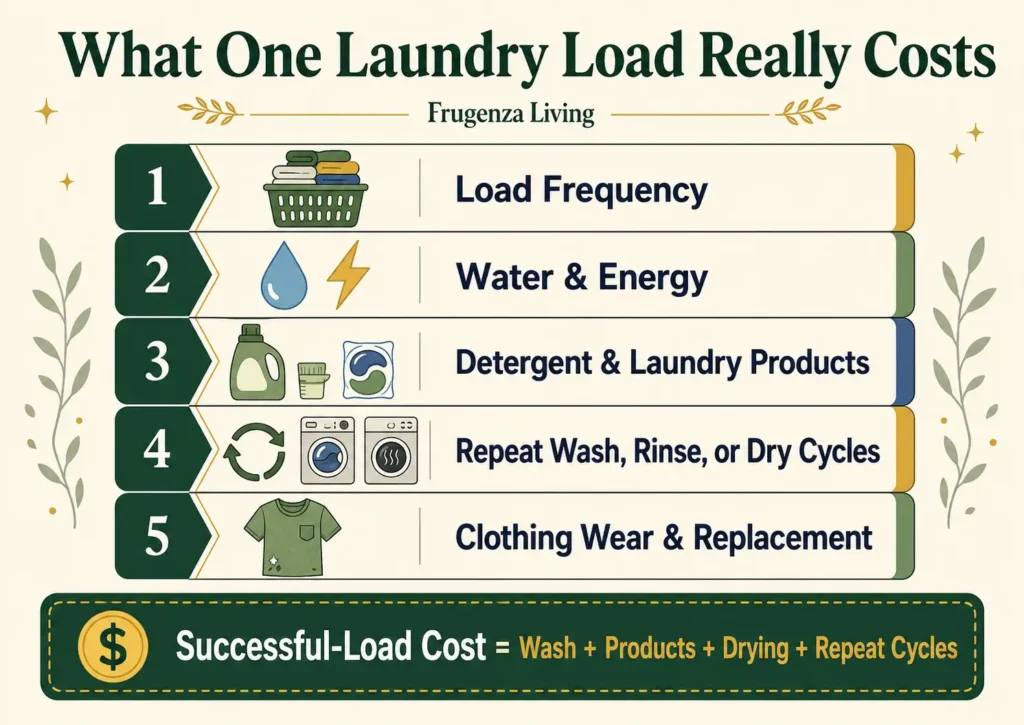
Use this household cost map:
Successful-load cost = base wash cost + laundry product cost + drying cost + the cost of any additional wash, rinse, or dry cycle
Utility rates, machine efficiency, product prices, and drying methods vary. The formula’s purpose is to attach a repeated cycle to the load that caused it rather than counting that repeat as a separate success.
The main cost layers are:
- Load frequency: how often the washer runs and whether loads are unnecessarily small.
- Wash inputs: water, energy, detergent, stain treatment, and optional additives.
- Repeat-cycle costs: another wash, extra rinse, or second drying period.
- Clothing-life costs: shrinking, fading, fiber wear, and earlier replacement.
Laundry may seem like a small expense, but lowering it can be part of a broader plan to reduce household expenses throughout the month.
ENERGY STAR estimates that the average American family washes about 300 loads per year. That will not describe every household, but it shows why a small mistake repeated across many loads can matter.
Under the one-pass method, a successful load becomes appropriately clean and fully dry without an avoidable repeat wash, unnecessary extra rinse, or unplanned drying cycle.
Audit Your Last Seven Loads
Before buying a different detergent or blaming the machine, review your last seven loads. For each one, record:
- what was washed;
- whether the load was partial, appropriately full, or overloaded;
- the cycle and water temperature;
- whether detergent was measured;
- whether another wash, rinse, or drying period was needed;
- whether anything remained stained, damp, shrunken, or heavily wrinkled.
Give each load one result:
- Completed as planned
- Needed another wash
- Needed an extra rinse
- Needed more drying
A Composite Seven-Load Scenario
Consider a household reviewing seven loads from one week. Two small clothing loads could have waited and been combined. One load is washed again because a visible stain was not treated first. Towels mixed with lightweight shirts need another dryer cycle. Detergent was measured for only three loads.
The household can first test four changes: wait for a compatible load, inspect stains, separate items with sharply different drying times, and measure detergent consistently.
Your audit may reveal a different pattern. Start with the issue that occurred most often or caused the most expensive repeat cycle.
Find Your Biggest Laundry Cost Leak
Check every issue that appeared at least once. Use your seven-load notes to identify which checked problem happened most often or caused the most expensive repeat cycle.
What to do next: Review the issues you checked. Start with the one that appeared most often in your seven-load notes or caused a complete repeat wash or drying cycle.
This card is a household decision aid, not a replacement for care labels, detergent directions, appliance manuals, or health guidance.
Build a Load That Is More Likely to Finish Once
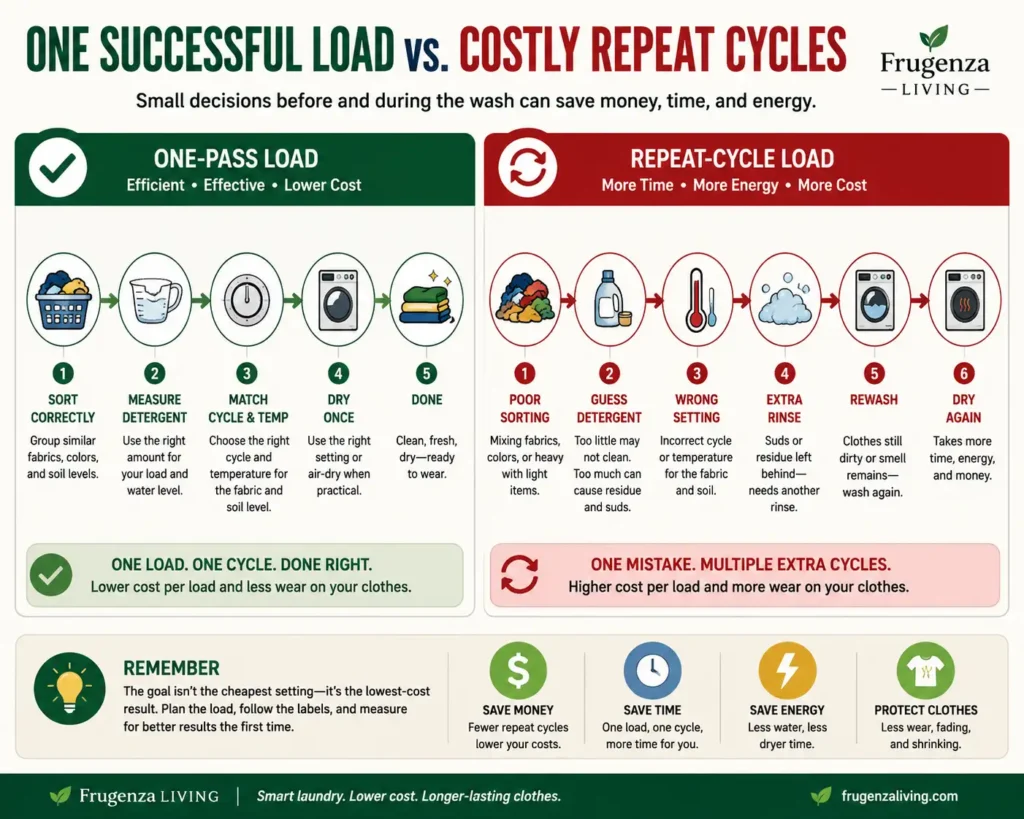
Decide Whether the Item Belongs in the Wash
Items with visible soil, sweat, odor, or a specific hygiene need generally belong in the wash. Garments worn briefly in low-soil conditions may be suitable for airing and reassessment, depending on the fabric, weather, activity, care label, and personal needs.
Avoid universal wear-count rules. The aim is not to delay necessary washing, but to avoid creating a small load simply because an otherwise clean item was automatically dropped into the hamper.
One of the easiest ways to reduce laundry water use is to avoid washing small loads unless the machine has an appropriate setting.
Make the Load Full but Movable
Combining compatible items can reduce unnecessary loads, but “full” does not mean packed tightly. Clothes need room to move so the washer can clean and rinse as designed. Overloading creates false savings when weak results lead to another wash.
Some machines sense the load and adjust water automatically; others require a water-level choice. Follow the appliance manual rather than one rule for every washer.
The U.S. Department of Energy recommends full loads when practical, an appropriate water setting for smaller loads, and separating towels and heavier cottons from lighter clothes when drying times differ.
Match Temperature and Cycle to the Actual Load
Cold water is often a lower-energy option for ordinary clothing when the care label, soil level, machine, and detergent directions support it. It is not the right default for every load.
Warm or hot water may be appropriate when care instructions, heavy soil, product directions, or illness-related hygiene needs call for it. Heavy-duty and quick cycles should also be reserved for suitable loads.
The FTC’s Care Labeling Rule requires manufacturers and importers to provide regular care instructions for covered clothing and textile goods. Use those instructions as a boundary when selecting washing, bleaching, drying, or ironing methods.
For clothing or linens used by someone who is sick, CDC guidance says to use the warmest appropriate water setting and dry items completely.
Treat the Problem Before Washing the Whole Load
Inspect clothing before it enters the washer. A targeted pretreatment that follows the garment and product directions may prevent one visible stain from causing a full repeat wash.
Do not assume one treatment works for every stain, color, or fiber, and do not mix laundry chemicals.
Measure Detergent Instead of Guessing
There is no universal detergent dose. The appropriate amount can depend on product concentration, washer type, load size, soil level, water hardness, and manufacturer directions.
Using less than the product and appliance guidance calls for may contribute to poor results in some loads, just as overdosing can waste product or contribute to suds and residue. Measure for the actual load rather than automatically filling the cap.
If you use a front-loading washer or high-efficiency top-loader, use detergent labeled for HE machines and follow both the washer and detergent instructions. The Department of Energy explains that HE detergents are low-sudsing and quick-dispersing for machines that use less water.
Compare detergent by cost per successfully cleaned load, not only by cost per pod, strip, scoop, or ounce. Test a different formula or store brand in a manageable size before buying in bulk.
The same measured-use principle can help reduce waste from household cleaning products.
Treat Drying as a Separate Spending Decision
A successful wash can still become expensive during drying.
Use an appropriate final spin setting, subject to fabric and machine instructions. When towels and lightweight clothes repeatedly dry unevenly, separating them may prevent another drying period.
The Department of Energy recommends avoiding over-drying, using a moisture sensor when available, cleaning the lint screen after every load, and periodically checking the dryer vent for blockage. It also suggests air-drying suitable fabrics when practical.
Air-drying does not need to replace the dryer completely. A household might air-dry suitable shirts while machine-drying towels. Indoor drying needs enough space and ventilation for moisture to disperse.
Changing the time of day saves money only when the electricity plan uses time-of-use or off-peak pricing. Check the current utility plan rather than assuming a late-night load is automatically cheaper.
Follow the washer manual’s cleaning schedule too. If residue or odor repeatedly causes rewashing, maintenance may be part of the cost problem.
Protect the Value of the Clothes
Laundry spending includes the garments themselves. Saving a small amount on one cycle is not meaningful if a frequently worn sweater shrinks and must be replaced.
Follow care labels, avoid unnecessary high heat, and use a cycle suited to the fabric. Do not leave damp laundry sitting long enough to develop an odor that triggers another wash.
The goal is not to preserve clothes by leaving them dirty. It is to avoid preventable wear from unnecessary washing, harsh settings, and repeated drying.
Reusable cloths instead of paper towels can work well when you already have an affordable way to wash and rotate them.
If You Pay at a Laundromat
Sort and inspect clothing at home, handle stains according to directions, and bring measured detergent.
Choose a machine by its stated capacity and the actual load, not only by the lowest fee. Do not pack clothing tightly to avoid paying for another machine. If heavy and lightweight items have very different drying times, separating them may prevent another paid dryer period.
Use rewards or discounted hours only when the laundromat actually offers them. Bring a clean bag or hangers for finished clothing.
Use a Four-Question Laundry Check
Before pressing Start, ask:
- Can this item wait for an appropriate, compatible load?
- Is the load full enough to be efficient but loose enough to wash and rinse?
- Do the cycle, temperature, and measured detergent match the fabric and soil?
- What is the lowest-cost drying method that will finish this load correctly?
The cheapest isolated setting is not necessarily the cheapest completed result.
Change One Repeat Cycle First
To learn how to save money on laundry, review your last seven loads and identify the one that needed another wash, rinse, or drying period. Change the decision that caused it before overhauling the rest of the routine.
That may mean waiting for a compatible load, treating a stain first, measuring detergent, using HE detergent in an HE machine, checking the washer manual, or separating towels from lightweight clothes.
The most durable savings come from fewer repeat cycles, measured inputs, drying choices that fit the load, and clothing that remains useful longer. Once the routine is stable, use the same thinking to lower other repeated household costs without extreme cuts.

Read about Jeffi and Frugenza Living
- How to Budget a 10-Month Salary Over 12 Months - October 16, 2026
- Pet Adoption Budget Checklist: What You Still Need to Pay - October 16, 2026
- Proportional Bill Split Calculator for Two Incomes - October 15, 2026