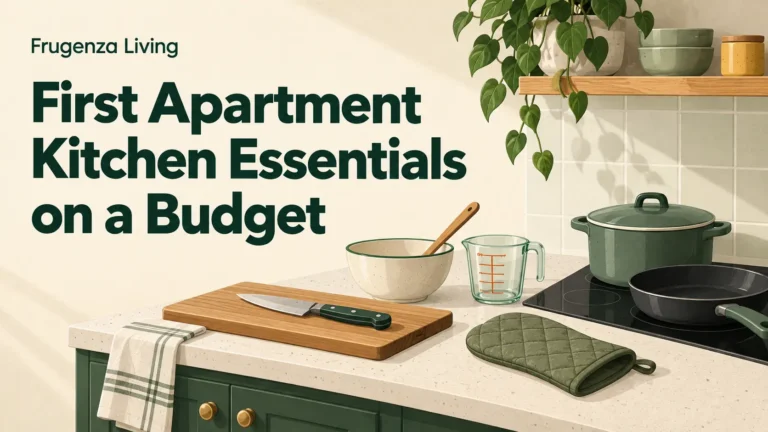
First apartment kitchen essentials on a budget start with the meals you plan to cook: a pot with a lid, a skillet when needed, a knife and cutting board, suitable utensils and measures, and basics for eating, storing food, washing dishes, and handling hot cookware. Check what you already have before buying each group.
The useful minimum depends on your kitchen and menu. A pan set can leave you without a can opener; a bargain shopping list can use up the money meant for food. The checklist and worked example below connect the tools to meals and account for the whole shopping trip.
Check the kitchen before buying anything
Confirm which appliances work, what the rental includes, and which shared tools you can actually use. A roommate’s pot belongs on your available list only when sharing it is agreed. Count a promised loan after you confirm the item and when it will arrive.
Check the cooktop before buying cookware. For induction, look for the manufacturer’s compatibility marking and check the base size against your hob’s instructions. IKEA’s induction cookware guidance explains these checks; stainless steel alone does not guarantee compatibility.
Measure storage space with handles included. For example, IKEA lists a 9-inch TAGGHAJ pan as 15 inches long including its handle. A drawer that fits the pan’s advertised diameter may not fit the whole pan.
The examples below assume a working sink, refrigerator, and cooktop. If those are unavailable, choose a suitable menu before pricing this kit or purchasing another appliance.
Choose the meals you will cook first
Write down three meals you want to make, then identify their equipment. These examples illustrate tool requirements; they are not a complete meal plan or kitchen-tested recipes.
| Meal | Tools it needs | Purchase it does not require |
|---|---|---|
| Stovetop oatmeal with peanut butter and banana | Pot, cooking spoon, suitable measures, bowl and eating spoon; knife/board for slicing | Toaster or sheet pan |
| Rice and canned beans bowl | Pot/lid for rice, cookware for warming beans, suitable measures, bowl/spoon, opener if needed | Rice cooker |
| Cabbage-and-bean quesadilla | Skillet, turner, knife/board, plate, opener if needed | Oven or blender |
Use simple meals for one to choose dishes before adding equipment. Follow the recipe and package directions. With one burner, plan the cooking order; a second pot does not create another burner. For a quesadilla, choose a tortilla that fits the pan’s cooking surface.
Check measurements too. A marked measuring cup is different from an unmarked mug. If a chosen recipe gives only weights, include access to an accurate scale rather than guessing a grams-to-cups conversion.
Build a starter kit around those meals
The checklist groups purchases by function. A group may contain several items: dining basics, for instance, could mean one bowl, plate, cup, fork, and spoon. Enter the cost of the whole group you still need. Mark it Have only when its required pieces are available; owning one fork does not cover the entire dining group.
For these meals, begin with one pot and lid, one skillet, one knife you can comfortably control, a stable cutting board, and a cooking spoon and turner suitable for your pan. A 2–3-quart pot is a starting size to examine, not a rule for every cook. Check capacity, burner requirements, handling, and storage before choosing it.
A serving bowl can also handle some mixing jobs if it is large enough for the task. A can opener can wait when your chosen packages open without one. Food containers matter when you will reserve opened ingredients or cooked portions; choose suitable containers with lids instead of buying a large set automatically.
Include dishwashing supplies and dry potholders or oven mitts. Illinois Extension recommends dry heat protection; a damp towel is not a budget substitute. These practical needs belong in the shopping calculation alongside cookware.
Mark Later when you are postponing a group, then check what that changes. Deferring the skillet leaves the quesadilla unsupported. A lower total is useful only when the meals you still intend to make have the tools they need.
Leave room for the whole shopping trip
Set a kitchen cash limit after required moving payments and household bills are funded. If you are saving before the move, include kitchen setup in your moving fund once, rather than assigning the same money to two plans.
Consider this illustrative $120 allocation, not a store-priced kit. The checklist’s example assigns $18 to a pot/lid, $16 to a skillet, $8 to a knife, and $42 across the other nine groups: $84 in goods. Every amount is an assumption to replace with a quote.
It also assigns $25 for grocery checkout, $5 for obtaining the purchases, and a $5 reserve. The example applies a hypothetical 8% tax to goods only. Your actual tax treatment and acquisition costs may differ; the grocery allowance should include its applicable checkout charges.
| Calculation | All example goods bought new | Suitable pot/lid already available |
|---|---|---|
| Goods | $84.00 | $66.00 |
| Illustrative tax | $6.72 | $5.28 |
| Pickup/delivery/travel | $5.00 | $5.00 |
| Grocery checkout allowance | $25.00 | $25.00 |
| Planned spending | $120.72 | $101.28 |
| Unspent reserve | $5.00 | $5.00 |
| Total allocated | $125.72 | $106.28 |
| Unassigned from $120 | −$5.72 | $13.72 |
The all-new example exceeds the cash limit by $0.72 before keeping a reserve. Maintaining the chosen $5 reserve makes the plan $5.72 short. The reserve remains your money; it is not a fee.
Using a suitable pot already available removes its assumed $18 purchase and changes the illustrative tax. That brings the allocation to $106.28, leaving $13.72 unassigned after the reserve. Count that change only when the pot is genuinely available and fits the job.
If the plan is short, compare another suitable quote, confirm a loan, or postpone a menu and its dedicated equipment. Keep the grocery allowance honest: $25 here is a chosen planning input, not a promise to feed someone for a particular number of days.
Compare useful pieces, not the number on the box
Compare a set with the separate items that perform the same jobs. Check whether the advertised piece count includes lids, which cookware is supplied, and whether its sizes and materials suit your kitchen.
In a separate illustrative comparison, a pot at $18 and skillet at $16 cost $34 before tax. A $28 set supplying both suitable pieces is $6 cheaper. But a $24 set of pots and lids without a skillet still needs the $16 skillet: $40 altogether, or $6 more than buying the two required pieces separately.
Add delivery or travel costs before choosing. A cheaper shelf price from a distant store may produce a higher total acquisition cost. Do not count the pot or utensils twice if they are already included in a set’s quote.
Buy the next tool when a meal needs it
Keep a short list of the meals you postponed and the equipment each needs. Add a colander before choosing pasta that requires draining, or suitable bakeware before an oven meal. Do not substitute holding a lid against a boiling pot for a beginner’s missing colander.
If your menu includes raw meat, poultry, or seafood, include a food thermometer and the handling equipment it requires. FoodSafety.gov advises checking meat’s safe internal temperature with a thermometer. A basic kit for the three examples does not cover every kind of cooking.
For secondhand purchases or loans, check condition, missing parts, cleaning instructions, and compatibility. Before acquiring a used appliance, look up its brand and model in CPSC’s recall search. A recall check does not replace inspecting the individual item. Avoid treating a decorative container as food-safe cookware or assuming a bowl can go in the microwave without its label.
Once you have cooked in the space, an appliance or extra pan may solve a recurring problem. Buy it for that job. Start with three menus, confirm available equipment, and price the missing pieces with food and acquisition costs included. That gives your first shopping list a practical stopping point.

Read about Jeffi and Frugenza Living
- Proportional Bill Split Calculator for Two Incomes - October 15, 2026
- How to Split Grocery Bills With Roommates - October 14, 2026
- First Apartment Kitchen Essentials on a Budget - October 13, 2026