A moving sinking fund is money you set aside gradually for predictable costs created by an upcoming move. Unlike an emergency fund, it has a known job: helping you pay move-specific expenses without forcing the entire cost into one paycheck.
The useful target is not simply everything you might spend by moving day. It is the cash that must be available before each payment deadline.
That matters because a security deposit may be due weeks before movers, utility setup, or rent overlap. A plan can reach the correct total by moving day and still fail because the first large payment arrives earlier.
Quick answer: Add your unpaid move-specific costs and desired contingency, subtract moving cash already reserved for those costs, then test whether enough usable cash will exist at every earlier deadline. Do not divide the final total by all remaining paychecks until the first payment date works.
This is general budgeting education, not individualized financial advice.
What Should a Moving Sinking Fund Cover?
Start with expenses created by this specific move. A moving savings fund may include a security deposit, application or setup fees, packing supplies, movers or a rental truck, travel, utility setup, storage, and genuine rent overlap. Use your lease, quotes, utility requirements, and expected payment dates instead of a generic national average.
| Moving item | When cash may be needed | Refundable? | Include in the fund? |
|---|---|---|---|
| Security deposit | Before move-in or key pickup | Possibly | Yes, if not already funded |
| Application/admin fees | Before approval or lease | Usually no | Yes |
| Packing supplies | Before moving day | No | Yes |
| Movers or truck | Before/on moving day | No | Yes |
| Utility deposits/setup | Before/around move-in | Sometimes | Yes, when required |
| True rent overlap | During transition | No | Only the extra overlap |
| Old deposit refund | Often after moving out | Incoming cash | Do not count until received |
Do not add an expense twice just because it appears on a moving checklist.
If ordinary first month’s rent is already funded through your regular budget and will be ready on time, it does not need to be funded again inside the moving sinking fund. If the move creates $450 of genuine rent overlap, however, that extra $450 belongs in the move plan.
If sinking funds are new to you, Sinking Funds for Beginners explains the general system. A move adds one complication: several payments may have different deadlines, so one “target ÷ months left” formula is not always enough.
Cash Required Is Not the Same as Permanent Moving Cost
A refundable security deposit may eventually come back to you, but while the landlord holds it, that cash is unavailable. It therefore belongs in your cash requirement even though it may not become a permanent cost.
The reverse matters too. An old security deposit expected after moving is not usable today. Do not subtract it from a payment due before the refund actually arrives.
Keep two questions separate:
How much cash must I have available?
How much money will I permanently spend?
Those numbers can differ. For deadline planning, cash availability comes first.
A sinking fund tracker can help you monitor each moving cost, its deadline, your current balance, and how much still needs to be saved.
The Earliest-Deadline Test
The Earliest-Deadline Test asks whether the cash available by each payment date—not just by moving day—is enough to cover everything due up to that point.
For each payment, identify the unpaid amount, its deadline, moving cash genuinely available for that payment, and income that will be received and usable before payment is required. Then subtract the payment and carry the remaining balance forward once.
If payments share a deadline, you can group them. If their dates differ, keep them separate.
A paycheck scheduled for the same day as a deposit is not automatically usable. Count it only if the money will actually be available before payment must be made.
The checkpoint formula is:
Prior available balance + new contributions + cash actually received and usable − payment due = next balance
The CFPB cash-flow budgeting tool uses the same timing principle: begin with available cash, add money received, subtract expenses, and carry the ending balance into the next period.
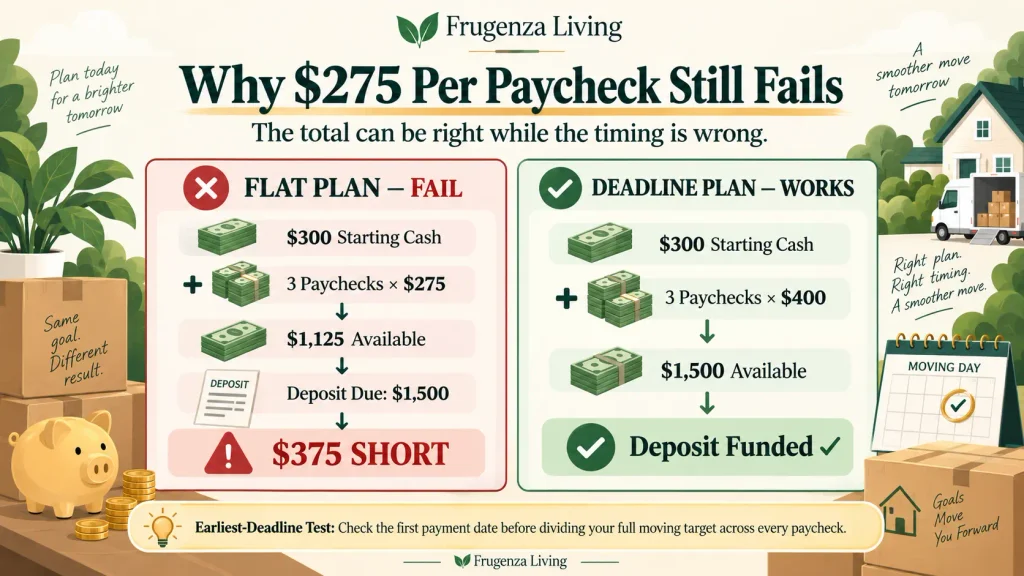
The $275 Plan That Misses a $1,500 Deposit
Consider this illustrative example, not a typical moving price.
A renter has $300 already assigned to the move and twelve usable paydays before the final moving-stage payments.
The plan includes a $1,500 security deposit due after payday 3, $200 of packing supplies after payday 6, $1,600 of final-stage payments after payday 12, and a $300 contingency.
The total funding requirement is $3,600.
Using one final deadline gives:
($3,600 − $300) ÷ 12 = $275 per payday
After three paydays:
$300 + (3 × $275) = $1,125
The deposit is $1,500, so the plan is $375 short.
The failure is timing, not addition.
Fix the First Deadline First
To have $1,500 ready after three usable paydays:
($1,500 − $300) ÷ 3 = $400 per payday
Pay the deposit, and the moving-fund balance returns to $0.
The remaining target is $2,100: $200 supplies, $1,600 final-stage payments, and $300 contingency. Nine usable paydays remain:
$2,100 ÷ 9 = $233.33
Round up to $234 per payday.
After payday 6, three $234 contributions create $702. Pay $200 for supplies, leaving $502.
The final six contributions add $1,404:
$502 + $1,404 = $1,906
After $1,600 of final-stage payments, $306 remains.
So the working schedule is $400 for the first three usable paydays, then $234 for the next nine. It reaches each deadline instead of merely reaching the final total.
That does not mean the move permanently cost $3,606. The ending balance still contains $306, and the new deposit is cash tied up in the tenancy rather than automatically spent forever.
Build the Plan Backward From Each Payment Date
Use the balance left after one payment as the starting balance for the next. Do not add the same starting cash twice, and do not count a pending reimbursement, promised help, or expected deposit refund until the money is actually received and usable.
The point is to prevent future income from being assigned to an earlier obligation. A paycheck received after a deposit deadline cannot rescue that deposit on paper.
Moving Sinking Fund Deadline Calculator
Use this calculator for your first major moving payment. It shows the amount required per usable payday and whether the amount you can safely save would leave a shortfall.
For later checkpoints, repeat the test using only the balance remaining after earlier payments.
Moving Sinking Fund Deadline Calculator
Test the first major payment before you divide your entire moving target across every remaining paycheck. Your numbers stay in your browser.
Enter your numbers and check the deadline.
Planning tool only. For later payments, carry forward only the balance left after earlier payments.
What If the First Deadline Is Not Affordable?
A correct calculation can still produce an unaffordable answer.
Suppose the deposit requires $400 per usable payday, but after rent, food, transportation, debt minimums, and other required expenses, you can safely transfer only $250.
Across three paydays, the deposit will be $450 underfunded.
That number tells you what must change.
First, verify the amount and exact deadline. If a landlord, utility, mover, or other provider offers different timing or terms, count them only after they are confirmed.
Then separate fixed requirements from flexible choices. A required deposit may not move, while furniture, premium packing, storage upgrades, or nonessential setup purchases may be delayed. Compare moving quotes on the same service scope so a cheaper price is genuinely comparable.
Test the required transfer against your Paycheck Budget Template for Beginners. A moving fund should not be solved by quietly underfunding groceries, required bills, transportation, or minimum debt payments.
If the move is urgent because of safety, housing loss, or another serious situation, financial neatness is secondary. Use legitimate assistance that is actually available rather than delaying a necessary move only to preserve a perfect savings schedule.
Before the First Payment
A funded account can still miss a deadline if the money is not usable in time.
Check transfer timing, withdrawal limits, accepted payment methods, and any requirement for certified funds before the due date.
Keep one moving ledger even if cash sits across several accounts. Record available moving cash, contributions already received, payments made, confirmed incoming cash, and the next payment date.
Do not assign the same dollars to two different payments.
If the moving date is uncertain, build a provisional target and recalculate when a lease date, mover quote, utility requirement, or other confirmed number changes.
There is no useful universal moving-fund amount per paycheck without both a target and a timeline.
After the Move, Close the Fund
Pay remaining move-specific obligations and record refunds or reimbursements only when they actually arrive. Then decide where any unused cash should go.
If rent, utilities, commuting, or other recurring costs changed, move them into your normal monthly budget. They no longer belong to the completed moving fund.
Your Next Step
Write down the first unpaid moving payment, its deadline, the cash genuinely available for that payment, and the usable paydays that occur before it.
Run the Earliest-Deadline Test.
If that deadline works, carry the remaining balance forward and test the next one. If it does not, you have found the problem while there is still time to change the plan.
Solve that deadline before you solve moving day.

The ideas shared here come from real-life experience and practical habits that actually work.
→ Read more about Jeffi
- Vacation Sinking Fund: How Much to Save for Your Trip - September 12, 2026
- Moving Sinking Fund: How Much to Save Before Moving Day - September 12, 2026
- Appliance Replacement Sinking Fund: How Much Should You Save? - September 11, 2026