
You estimate a $4,000 vacation, start saving, and assume the plan is settled.
Then the flight you expected to cost $900 is booked for $760. A few weeks later, the hotel comes in $150 over budget. You add checked baggage. One activity gets dropped, another gets added.
Now the useful question is no longer simply, “Am I saving enough?”
It is:
Am I still saving toward the right number?
A vacation sinking fund is money you gradually set aside for a planned trip. Instead of expecting one paycheck—or a future credit card statement—to absorb airfare, lodging, meals, transportation, and activities, you build the money before you need it.
Quick answer: Estimate the total vacation cost, subtract money already reserved for the trip, and divide the gap across the months or paychecks available. Once you begin booking, replace old estimates with actual prices and recalculate what still needs to be funded.
This article is general budgeting education, not individualized financial advice.
Your Vacation Fund Is a Forecast, Not a Receipt
Most vacation budgets begin with estimates.
You may know your destination and dates without knowing the final airfare, exact hotel rate, transportation cost, restaurant spending, attraction prices, baggage fees, parking, or pet care.
That is normal.
What matters is updating the plan when better information arrives.
Think of a vacation sinking fund as a small rolling forecast:
Estimate → Save → Book → Replace the Estimate → Reforecast
Suppose your first plan looks like this:
| Vacation category | Initial estimate |
|---|---|
| Flights | $900 |
| Lodging | $1,200 |
| Food | $700 |
| Local transportation | $250 |
| Activities | $450 |
| Other trip costs | $200 |
| Vacation buffer | $300 |
| Initial target | $4,000 |
That $4,000 is useful today. It is not permanent.
When airfare is booked for $760, the $900 estimate should disappear from the forecast. If lodging later becomes $1,350 instead of $1,200, replace that number too.
Your savings plan should follow the vacation you are actually building.
What Belongs in a Vacation Sinking Fund?
Focus on expenses created by the trip itself.
Typical categories include transportation, accommodation, local transportation, food, activities, trip-specific fees, optional travel insurance, pet boarding, and a modest vacation-specific buffer.
Keep ordinary bills outside the fund. Rent, insurance premiums, car payments, subscriptions, and debt minimums remain part of your regular budget even while you travel.
If the broader concept is new, this guide to sinking funds for beginners explains how planned-expense funds work before you apply the idea specifically to travel.
Build the First Vacation Savings Target
Suppose your estimated trip costs $4,000 and you already have $600 reserved specifically for it.
Your first savings gap is:
$4,000 − $600 = $3,400
If the trip is 10 months away:
$3,400 ÷ 10 = $340 per month
If you prefer budgeting when income arrives and have 20 usable paychecks before the remaining money is needed:
$3,400 ÷ 20 = $170 per paycheck
That gives you a starting contribution.
Tracking the fund makes it easier to see whether your current contribution will reach the goal before deposits, flights, or accommodation payments are due.
When Should You Start a Vacation Sinking Fund?
There is no universal number of months.
Start once the trip is realistic enough to estimate and you know roughly when the first major payment will be needed.
A longer saving runway lowers the amount required from each paycheck, but do not automatically use departure day as the finish line. If airfare, a cruise balance, a hotel deposit, or another large booking must be paid earlier, that earlier payment date matters to the savings plan.
The first calculation answers:
Based on what I know today, what should I save?
Later, you need a different question:
Based on what I know now, what still needs to be funded?
Keep the Vacation Money Easy to Identify
Keep vacation money easy to distinguish from normal spending and emergency savings. A dedicated savings account or named bucket such as “Italy 2027” can make the goal easier to track.
Automate the monthly or per-paycheck contribution when that fits your cash flow, but update the recurring transfer when the forecast changes.
A planned vacation and an emergency fund have different jobs.
The Vacation Fund Reforecast Loop
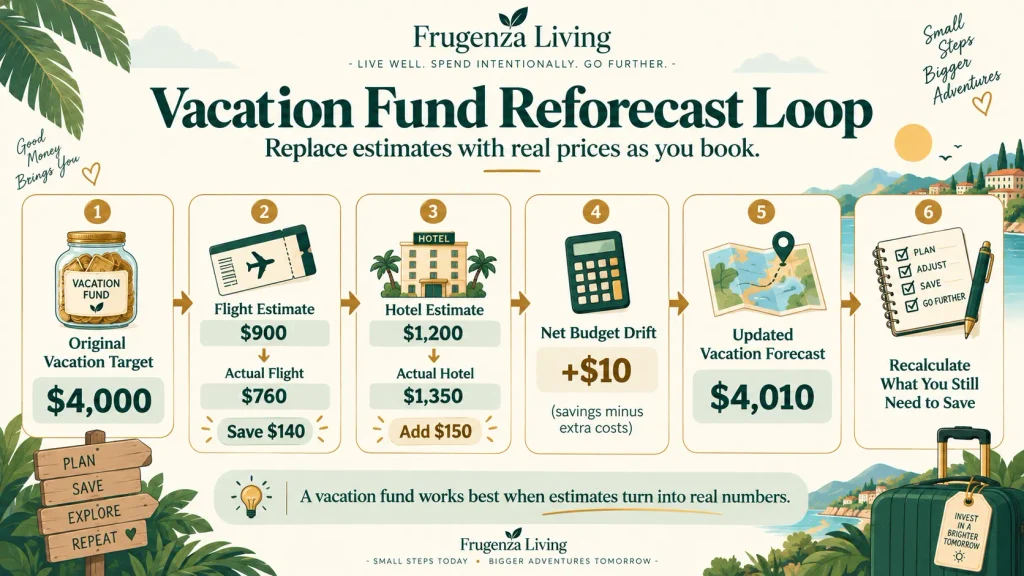
Two months into the example, your vacation fund contains:
- $600 starting balance
- $340 saved in month 1
- $340 saved in month 2
Total:
$1,280
Then you book airfare.
Estimated airfare: $900
Actual airfare: $760
You pay $760 from the fund.
Available vacation cash becomes:
$1,280 − $760 = $520
The old $900 flight estimate should now disappear from your remaining costs because the flight is paid.
Then lodging changes.
Estimated lodging: $1,200
Current booked lodging cost: $1,350
Airfare improved the original forecast by $140.
Lodging worsened it by $150.
Net change:
+$10
The original $4,000 vacation is now tracking around $4,010, assuming the other estimates stay unchanged.
Reforecast when a booking, itinerary decision, or price change is large enough to affect what you still need to save.
Estimated, Booked, and Paid Are Not the Same Thing
This distinction prevents a common planning error.
Estimated
The cost is expected but not finalized.
Example: you allow $450 for activities but have not chosen them.
Booked or Committed
The price is known or reasonably fixed, but some money may still be due later.
Example: the hotel is booked for $1,350. You paid a $300 deposit, and $1,050 remains due.
Paid
The money has already left the vacation fund.
Example: airfare is fully paid.
A booking can be committed without being paid, which is why your savings-account balance alone cannot tell you how much vacation money is truly unassigned.
If a $1,350 hotel requires a $300 deposit today, do not count $1,350 again as unpaid after recording the $300 payment.
The remaining hotel obligation is:
$1,350 − $300 = $1,050
That $1,050 belongs in your unpaid forecast.
Recalculate What Still Needs Funding
After paying the airfare, you have $520 left in the vacation fund.
Suppose the current unpaid forecast is:
- Unpaid lodging: $1,350
- Food: $700
- Local transportation: $250
- Activities: $450
- Other trip costs: $200
Unpaid costs:
$2,950
Add the separate $300 vacation buffer:
$2,950 + $300 = $3,250
Subtract your current available vacation fund:
$3,250 − $520 = $2,730
With eight monthly saving periods remaining:
$2,730 ÷ 8 = $341.25
Rounding up gives about:
$342 per month
Your original contribution was $340. Despite the price changes, the plan is still close to its starting trajectory.
Another trip could produce a much larger difference.
Vacation Sinking Fund Reforecast Calculator
Use this calculator after major bookings or price changes.
Enter only what remains unpaid. If part of a hotel, rental car, tour, or other booking has already been paid, include only the remaining balance in unpaid costs.
If points, airline miles, travel credits, gift cards, or vouchers cover part of a booking, enter only the cash amount that your vacation plan actually pays. This tool tracks your cash trip forecast, not the retail value of rewards.
Vacation Sinking Fund Reforecast Calculator
Replace old estimates with what you know now. See your updated cash trip forecast, remaining funding gap, surplus, and required contribution.
Enter your current numbers to update the plan.
Planning tool only. If part of a booking has already been paid, enter only its remaining unpaid balance under unpaid trip costs. Your entries stay in your browser.
What If the Updated Number No Longer Fits?
Reforecasting is valuable precisely because sometimes you will not like the answer.
Suppose the updated calculation raises your required contribution from $340 to $460 per month.
The solution is not automatically to find another $120.
First identify what caused the change.
A nonrefundable flight is different from an activity you have not booked. A hotel with free cancellation is different from a fully committed stay.
Protect genuine commitments first. Then examine what is still flexible: accommodation, trip length, dates, paid activities, rental car or local transportation, upgrades, and convenience purchases.
Small decisions add up: a $45 seat choice, $60 baggage change, $80 room upgrade, and $100 additional activity increase the trip by $285.
The fund should reveal that trade-off before the trip grows faster than the money behind it.
The 2026 Summer Travel Report from NerdWallet found that 45% of Americans surveyed planned a summer vacation involving flights and/or paid lodging, with those travelers estimating an average of $3,940 for airfare and lodging. Among 2025 summer travelers who used credit cards for travel expenses, 35% still had not paid those balances off when surveyed.
Using a credit card as a payment method is not the same as financing a vacation. If the money already exists in the vacation fund and the statement is paid in full, the card is simply how the purchase was made.
The problem begins when vacation spending continues growing while the money available to repay it does not.
Test the Contribution Against Your Normal Budget
A calculation can be mathematically correct and still be unaffordable.
If the reforecast says you now need $460 per month, check what that transfer does to housing, groceries, transportation, insurance, debt minimums, and other required expenses.
A realistic monthly budget example can help you test vacation savings against ordinary cash flow rather than treating the trip as financially separate from the rest of your life.
There is no universal percentage of income that everyone should spend on travel. A vacation plan should adapt to the household budget, not force the budget to adapt to the vacation.
Your vacation fund does not have to receive the same priority as every other sinking fund, especially when necessary expenses have earlier deadlines.
Remember the Other Planned Expenses
Vacation savings rarely exist alone.
The same budget may also need money for annual insurance, car maintenance, home repairs, gifts, school costs, or other predictable expenses.
A prioritized list of sinking fund categories can help you decide which goals are fixed, flexible, or able to wait.
A vacation often has more flexibility than an insurance premium or necessary repair. Use that flexibility deliberately rather than crowding the monthly budget with every goal at once.
After the Vacation, Close the Forecast
Do one short review after the trip.
Compare:
- the original vacation target;
- the final actual cash cost;
- the categories with the largest differences;
- costs you forgot to estimate;
- money left in the vacation fund.
The value is learning what your own trips actually cost. If local transportation ran high or you forgot airport parking and pet boarding, use that information to improve the next forecast.
If money remains, give it another job deliberately. You can leave it as the beginning of the next vacation fund or redirect it toward another priority.
Then close the old plan.
A vacation sinking fund works best when it evolves with the vacation itself:
Start with an estimate. Save against it. Replace guesses with real prices as you book. Recalculate the remaining gap. Then fund the trip you are actually taking—not the trip your first spreadsheet imagined.

The ideas shared here come from real-life experience and practical habits that actually work.
→ Read more about Jeffi
- Vacation Sinking Fund: How Much to Save for Your Trip - September 12, 2026
- Moving Sinking Fund: How Much to Save Before Moving Day - September 12, 2026
- Appliance Replacement Sinking Fund: How Much Should You Save? - September 11, 2026