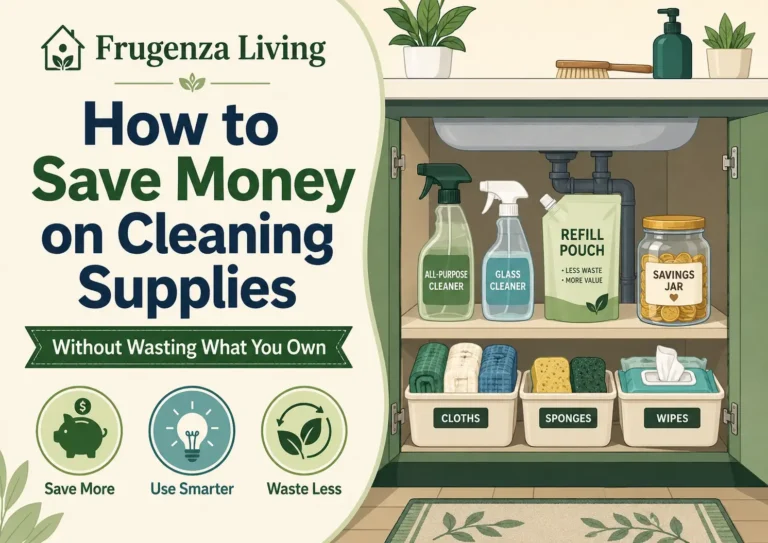
Open the cabinet under your sink and you may find duplicate sprays, half-used bottles, drying wipes, and a specialty cleaner bought for one problem. None may have felt expensive alone, but together they create clutter, forgotten inventory, overpouring, and unnecessary restocking.
Learning how to save money on cleaning supplies is not about replacing everything with homemade mixtures or buying the cheapest bottle. A better approach is to organize products by task, finish safe duplicates, compare the cost of a completed result, and buy again only when a product has a clear recurring role.
The Quickest Way to Lower Cleaning-Supply Costs
Start with six decisions:
- Check every open product before buying another.
- Group supplies by task rather than scent, brand, or marketing claim.
- Choose one primary option for each recurring job.
- Finish safe, effective duplicates before restocking.
- Follow the label’s dose, dilution, dwell time, and surface directions.
- Compare completed-task cost and use a restock gate before buying more.
The goal is to stop paying twice for the same job while keeping what you need to clean safely.
Once your cleaning costs are under control, look for other practical ways to lower household costs without making daily life uncomfortable.
Use a Task-First Cleaning-Supply Audit
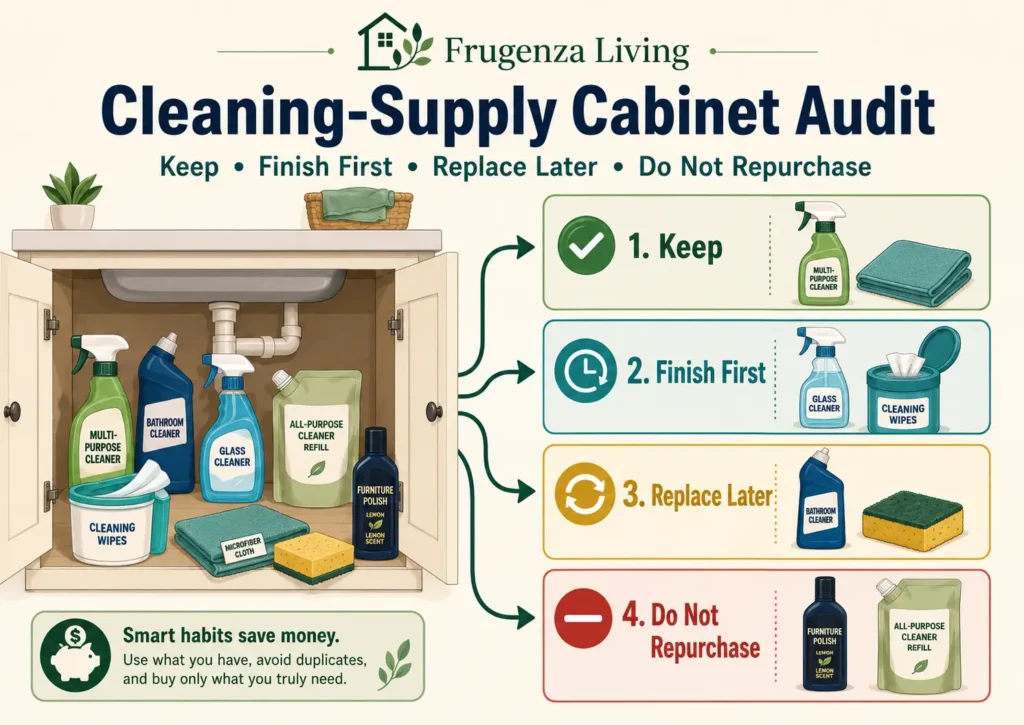
Take everything out of one cabinet, shelf, laundry area, or utility closet. Include surface cleaners, dish soap, laundry detergent, dishwasher products, wipes, brushes, cloths, sponges, mop heads, disinfectants, and specialty cleaners.
Group the items by task, then give each one a decision:
Keep: It is the primary product or tool for a recurring task.
Finish first: It safely duplicates another option and should be used before either product is replaced.
Replace later: The task is necessary, but the current option is difficult to dose, regularly needs repeat cleaning, or is poorly suited to the surface.
Do not repurchase: It has no recurring role or duplicates something that already works better.
What This Can Feel Like in a Real Home
The following is a composite household scenario.
A discounted bathroom spray joins two partly used bottles already under the sink. One was bought for hard-water marks, another because nobody remembered what was already open.
When the household finally pulls everything out, 11 products turn out to cover only six recurring jobs. Three items overlap, one pack of wipes is beginning to dry out, and a specialty polish has not been touched for months.
Nothing is thrown away just to make the cabinet look tidy. One bathroom cleaner becomes the primary choice, an acceptable duplicate is marked finish first, and the wipes are reserved for an upcoming task the household would already complete. The polish moves to do not repurchase unless the material genuinely requires it again.
The next shopping list becomes shorter, the cabinet is easier to understand, and several purchases can be delayed.
“Do not repurchase” never means pouring out usable cleaner, mixing leftovers, or transferring chemicals into an unlabeled container.
Household supplies are a good place to start when you want to reduce small recurring expenses without making a major lifestyle change.
Find the Cleaning-Supply Leaks That Cost the Most
Duplicate Products
Different scents and claims do not always represent different functions. Compare permitted surfaces and results, then finish an acceptable duplicate first.
Excess Product per Task
More liquid, powder, or foam does not automatically clean better. Overpouring can empty a package faster and leave residue.
Use the labeled dose or dilution rather than estimating by eye. Keep the correct cap, scoop, or measuring tool near concentrates.
Repeat Cleaning
A cheap cleaner becomes expensive when it needs a second application, several wipes, or another product to finish the job.
Before replacing it, check the tool, applicator condition, surface compatibility, and any dwell or contact time stated on the label. Count the task only when the intended result is complete.
Letting a Small Mess Become a Heavy-Cleaning Job
A fresh spill or light grease may require less product than hardened buildup. Handling a small mess promptly can reduce repeat applications later without encouraging unnecessary chemical use.
Compare Cost per Completed Clean
Shelf price does not show how many useful jobs a package will complete.
First, define a narrow, repeatable task. “Clean the bathroom” is too broad. Better units include one bathroom-sink cleaning, one countertop session, one floor-mopping session, one dishwasher load, or one laundry load.
For laundry and dishwasher products, count one successfully cleaned load rather than one pod, scoop, or machine cycle. A load that must be washed again was not completed on the first attempt.
Laundry products can become another recurring cleaning expense, so it helps to learn how to save money on laundry as well.
Use this formula:
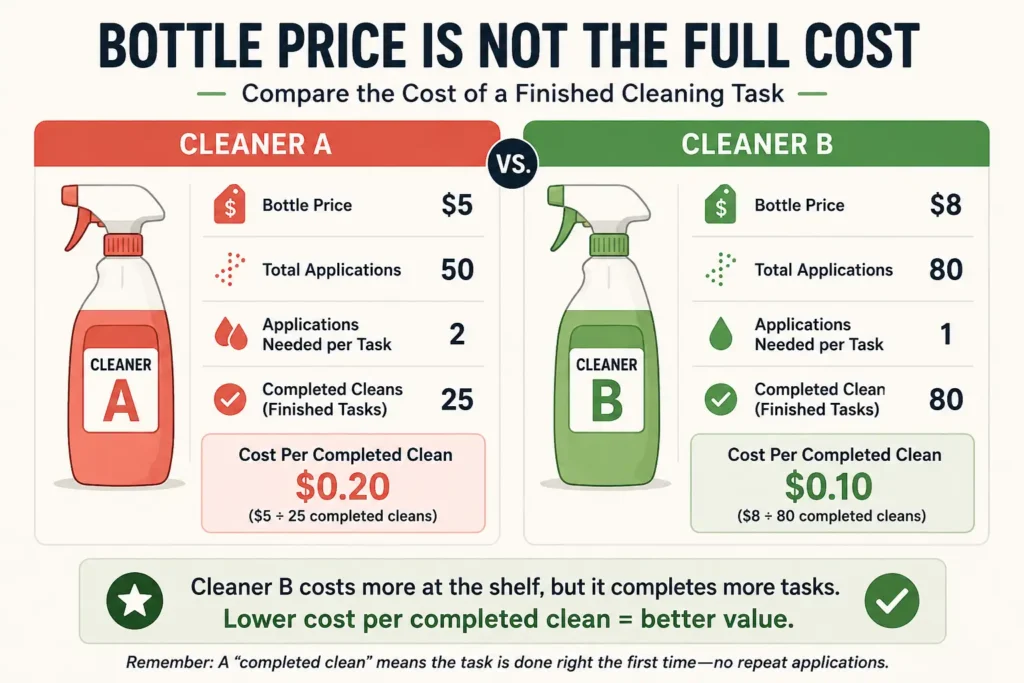
Product-only cost per completed clean = package price ÷ completed tasks
Suppose Cleaner A costs $5 and appears to provide 50 applications. If it usually takes two applications to finish the task, it completes about 25 cleans. Its cost is $0.20 per completed clean.
Cleaner B costs $8 and completes 80 comparable tasks in one application. Its cost is $0.10 per completed clean. The more expensive bottle is cheaper for the finished result.
These figures are illustrative. Include accessory or care costs only when they are significant and can be estimated consistently.
Track One Product Before Buying It Again
- Record its package price.
- Define one consistent task.
- Tally each completed job.
- Note repeat applications or disposable accessories.
- Continue until the package is empty.
- Divide the price by the completed tasks recorded.
Cleaning Supply Cost-per-Clean Calculator
Compare two products by the cost of a finished cleaning task—not bottle price alone.
Option A
Option B
Your comparison
Option A
Option B
Completed cleans = total applications ÷ applications needed per task\nTotal cost per completed clean = package price ÷ completed cleans + accessory cost per taskUse the same narrow task for both products, such as one bathroom-sink clean or one laundry load. Results are estimates and should be checked against product labels and real household use.
If you stop tracking early, treat the result as an estimate. This method improves on cost per application because it counts completed jobs after repeat use. The cabinet audit separately reveals money tied up in duplicate or unfinished products.
Shop by Usable Yield, Not Sale Price
A discount matters only after a product passes your restock test.
For a concentrate, compare the number of correctly diluted bottles, loads, or sessions the package should provide. For a refill, compare usable quantity and price with a new ready-to-use bottle, then check whether the original sprayer or pump still works.
Include delivery fees, minimum orders, and subscription costs when they materially change the total.
Test an alternative in the smallest practical quantity before buying several packages or moving to bulk.
The same habit of checking stock before shopping can help you save money on toiletries and other household essentials.
Compare Formats Without Assuming One Is Always Cheaper
Ready-to-use: Useful when consumption is low, but repeated packaging and duplicate bottles can raise costs.
Concentrate: May save when dilution is clear and measured correctly; pouring by eye can erase the advantage.
Refill: Works when the original container still functions. A cheap pouch is not useful if the sprayer fails.
Bulk size: Can lower unit cost for a tested, frequently used product, but unused stock ties up cash.
Store brand: May offer good value, but performance can differ. Test a small size first.
Disposable wipes: Useful for specific situations, but routine wiping may cost less with a suitable washable cloth.
Reusable tools: Save only when they fit the task, are easy to wash, and are used repeatedly.
Homemade options: May suit limited routine jobs, but are not universal replacements for disinfectants or specialty products.
Make Products and Tools Last Longer
- Store bottles upright according to label directions.
- Close wipe containers immediately.
- Remove residue from openings and nozzles.
- Keep older products visible in front of newer purchases.
- Add an opening date without covering safety information.
- Keep the correct measuring tool with concentrates.
- Wash and dry reusable tools as directed.
- Keep cleaners secured and out of reach of children and pets.
- Replace tools when they no longer work effectively.
Do not use an unsuitable cleaner merely to finish the bottle. Preventing damage to stone, sealed wood, flooring, appliance finishes, electronics, or upholstery is more valuable than avoiding one replacement purchase.
Know Where Not to Cut Costs
Cleaning and disinfecting are different tasks. The CDC explains that routine cleaning with soap or detergent removes dirt and most germs from household surfaces. Additional disinfecting may be more relevant when someone is sick or a household member has a higher risk of severe illness.
Follow the current product label when disinfecting, including contact time, ventilation, and approved surfaces.
Never mix household bleach or disinfectants with other cleaners or disinfectants. Mixing products can release vapors that may be dangerous to breathe. Review the CDC’s household bleach safety guidance before using bleach-based products.
Keep a specialty product when a general cleaner is not approved for the material or task. Damaging an expensive surface to save a small amount on cleaner is not frugal.
EPA’s Safer Choice program can help identify products that meet its ingredient and performance criteria, but the label does not automatically make a product the least expensive choice.
Use a Four-Question Restock Gate
Before buying a replacement, ask:
- Is the current product nearly empty?
- Is there another open product that can safely do the job?
- Does the replacement fit a recurring task and the intended surface or load?
- Is its usable cost reasonable for how often it will be used?
A discount should influence which suitable replacement you choose, not persuade you to buy something unnecessary.
This supports using what you already own before buying more without allowing an essential supply to run out. When your cleaning supplies are manageable, apply the same process to reduce other repeated household expenses.
Lower the Cost of Every Successful Clean
The best way to save money on cleaning supplies is not to chase the cheapest bottle. It is to stop buying duplicate coverage, measure products correctly, prevent waste, use effective tools, and compare the cost of a completed result.
Start with one cabinet, shelf, or laundry area. Group each item by task, choose one primary option for every recurring job, and identify the first acceptable duplicate you will finish before buying another.
That single audit can reduce clutter, shorten future shopping lists, and lower household spending without weakening your cleaning routine.
Follow current product labels, local disposal guidance, and surface-manufacturer instructions.

Read about Jeffi and Frugenza Living
- How to Budget a 10-Month Salary Over 12 Months - October 16, 2026
- Pet Adoption Budget Checklist: What You Still Need to Pay - October 16, 2026
- Proportional Bill Split Calculator for Two Incomes - October 15, 2026