
Most people do not lose control of money from one huge mistake.
It usually happens through small daily expenses: coffee, lunch upgrades, gas, delivery fees, snacks, small groceries, and online orders that feel harmless in the moment.
By the end of the week, your account looks lower than expected, but you cannot point to one big reason.
That is why learning how to control daily expenses effectively matters.
Daily expense control is not about removing every small joy. It is about noticing where money leaks happen, keeping what actually matters, and reducing repeated expenses that do not add much value.
How Do You Control Daily Expenses Effectively?
You control daily expenses effectively by tracking daily spending, separating needs from flexible spending, setting a realistic spending boundary, reducing repeated money leaks, replacing expensive defaults, and reviewing expenses once a week.
The goal is not to control every dollar perfectly.
The goal is to make everyday spending visible enough that you can adjust before the month gets messy.
If you want to manage daily expenses without feeling deprived, focus on the purchases that repeat most often. Those are usually easier to improve than trying to fix everything at once.
Why Daily Expenses Are Hard to Control
Daily expenses are tricky because they feel normal.
Coffee feels normal. Takeout after a long day feels normal. A quick delivery fee feels normal. A small online order feels normal.
None of these purchases are automatically bad.
The problem is that small spending often stays invisible.
A $7 purchase does not feel serious. But when small purchases repeat several times a week, they can quietly take over your flexible spending.
That is why it is hard to control everyday spending by memory alone.
The first step is to reduce daily expenses in small ways that do not feel overwhelming.
Daily expense control starts with awareness, not guilt. You are not trying to shame yourself for every purchase. You are trying to notice which expenses keep repeating and whether they are still worth it.
The Daily Expense Control Loop
Use this simple loop:
Notice → Limit → Replace → Review
This loop keeps the system simple. You notice the spending, set a boundary, replace the expensive default, and review what happened.
Track Daily Spending Without Making It Complicated
You do not need a perfect spreadsheet.
For seven days, record your daily spending in a notes app, budgeting app, paper notebook, or banking app.
Track:
- food and drinks
- groceries
- transport and gas
- online orders
- subscriptions or app charges
- convenience purchases
Grocery waste can quietly increase your daily costs, so learning how to keep groceries fresh longer can help.
If you are new to tracking money, start by recording your daily spending for one week before changing anything.
The goal is awareness, not judgment.
If most of your daily spending goes to lunch, snacks, delivery fees, or small online orders, you now know where to focus first.
Daily spending becomes easier to control when you track your expenses and notice where your money actually goes.
Separate Daily Spending Into Three Zones
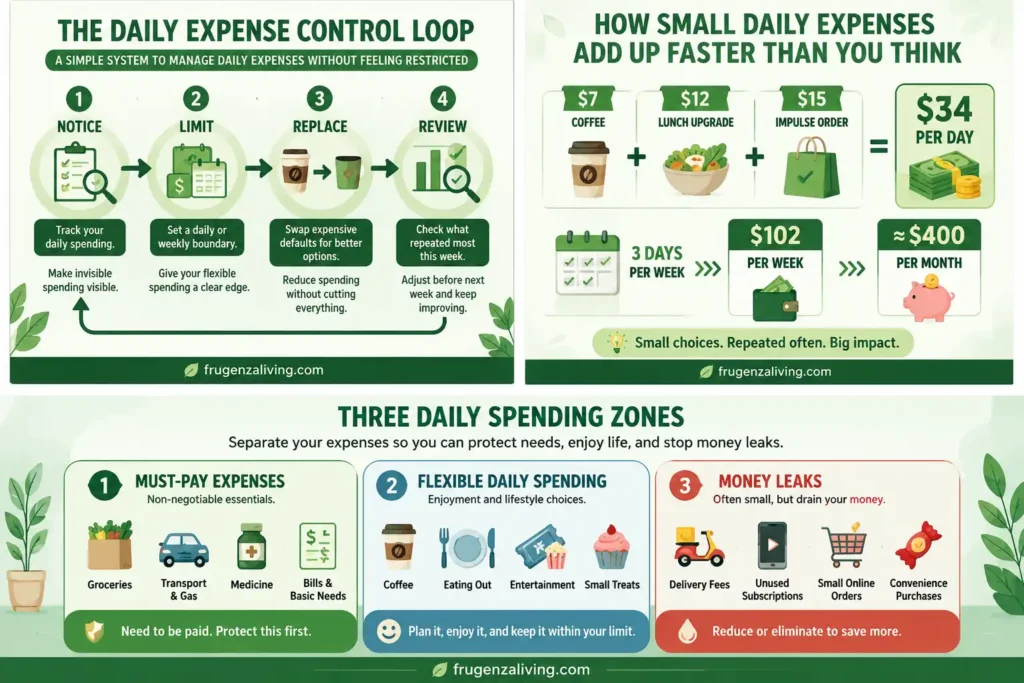
Not all daily expenses are the same.
Use three simple zones:
Must-pay expenses: transport, groceries, medicine, required bills, and basic household items.
Flexible daily spending: coffee, eating out, entertainment, small treats, and convenience purchases.
Money leaks: repeated expenses that do not add much value anymore.
This keeps the plan realistic. You protect real needs, allow some flexible spending, and reduce the expenses that quietly drain your budget.
A practical way to manage everyday costs is to reduce monthly electricity costs before they add up.
Set a Daily or Weekly Spending Boundary
A daily spending limit can help, but it can feel too tight.
A weekly flexible spending limit often works better.
For example, if you have $210 for flexible spending this week, that equals about $30 per day.
You do not have to spend exactly $30 each day. Some days may cost more, and some days may cost less.
The boundary simply tells you when to slow down.
If you spend $90 by Tuesday, the rest of the week needs to be lighter. If you only spend $40 in the first few days, you have more room later.
This creates a daily spending plan that gives your money direction without making every day feel restrictive.
Small daily changes become more powerful when they help you save money weekly without making your routine feel strict.
Find Your Small Money Leaks
Small money leaks are often easier to fix than big dramatic cuts.
Look for repeated expenses like:
- coffee you do not really enjoy
- lunch upgrades
- delivery fees
- unused subscriptions
- convenience store purchases
- small online orders
- snacks bought because nothing was prepared
Do not start with ten rules.
Start with one repeated leak.
If delivery fees are the problem, switch one delivery order to pickup. If coffee is the leak, make coffee at home three days a week and still buy it on the days you enjoy it most.
One repeated improvement is easier to maintain than a strict plan you quit after four days.
The Difference Between a Real Leak and a Spending Pattern That Just Looks Like One
Not every small expense that repeats is a money leak.
And not every expense that feels harmless is worth keeping.
The distinction matters because cutting the wrong things makes daily expense control feel more restrictive than it needs to be — and missing the real leaks means the effort does not add up to much.
Here is a practical way to tell the difference.
For each repeated daily expense, ask two questions:
First: Would this purchase feel like a loss if it were gone?
Not mild inconvenience — an actual loss. Something that would change how the day feels or functions in a way that matters to you.
Second: Did this purchase happen because you chose it, or because nothing else was available?
This second question is where most money leaks hide.
A $7 coffee you drink slowly and genuinely enjoy is not a leak — even if it repeats daily. A $7 coffee you buy because you left the house unprepared and needed something to hold is a different kind of purchase entirely. Same price, same frequency, completely different category.
The same logic applies to lunch upgrades, convenience snacks, and delivery fees. The question is never whether the amount is large or small. The question is whether you would choose it again if the cheaper alternative were just as easy to reach.
When the answer is “I bought it because there was no other option ready,” that is the leak — not the purchase itself, but the missing preparation that made the expensive option the only one.
This is why replacing defaults works better than cutting spending outright. You are not removing the purchase. You are removing the moment of no-alternative that kept producing it.
Go through your repeated daily expenses and mark each one with one of two labels:
Chosen — you would buy this even if the cheaper option were available
Default — you bought this because the cheaper option was not ready
The Default column is your actual leak list. The Chosen column is what you protect.
That separation takes about five minutes and makes the rest of the system considerably more accurate.
How Small Daily Expenses Add Up Faster Than You Think
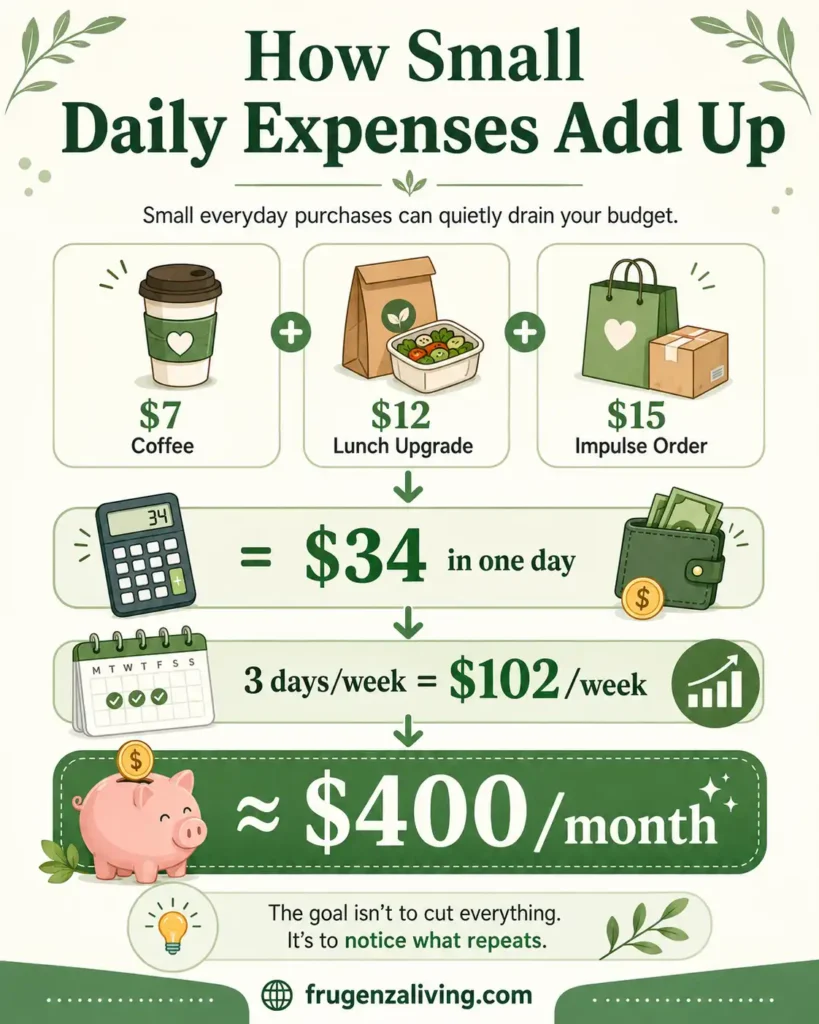
Small spending adds up because it rarely feels serious in the moment.
For example:
- $7 coffee
- $12 lunch upgrade
- $15 impulse order
That is $34 in one day.
If it happens three days per week, it becomes $102 per week, or around $400 per month.
The point is not that coffee is bad.
The point is that automatic daily extras can quietly take over your flexible spending.
If you love the coffee and it fits your plan, keep it. But if the purchase is just a habit, stress response, or convenience default, it may be worth changing.
Replace Expensive Defaults
Daily expense control becomes easier when cheaper options are already available.
You are not relying only on willpower. You are changing the default.
Try simple replacements:
- make coffee at home three days a week
- bring lunch twice a week
- use pickup instead of delivery
- plan one cheaper dinner
- keep snacks at home or work
- combine errands to reduce gas
- pause one small online order for 24 hours
A good replacement still solves the same problem.
If you buy takeout because you are tired, the replacement should be easy food, not a complicated recipe.
Make the cheaper choice easy enough to repeat.
Review Your Expenses Once a Week
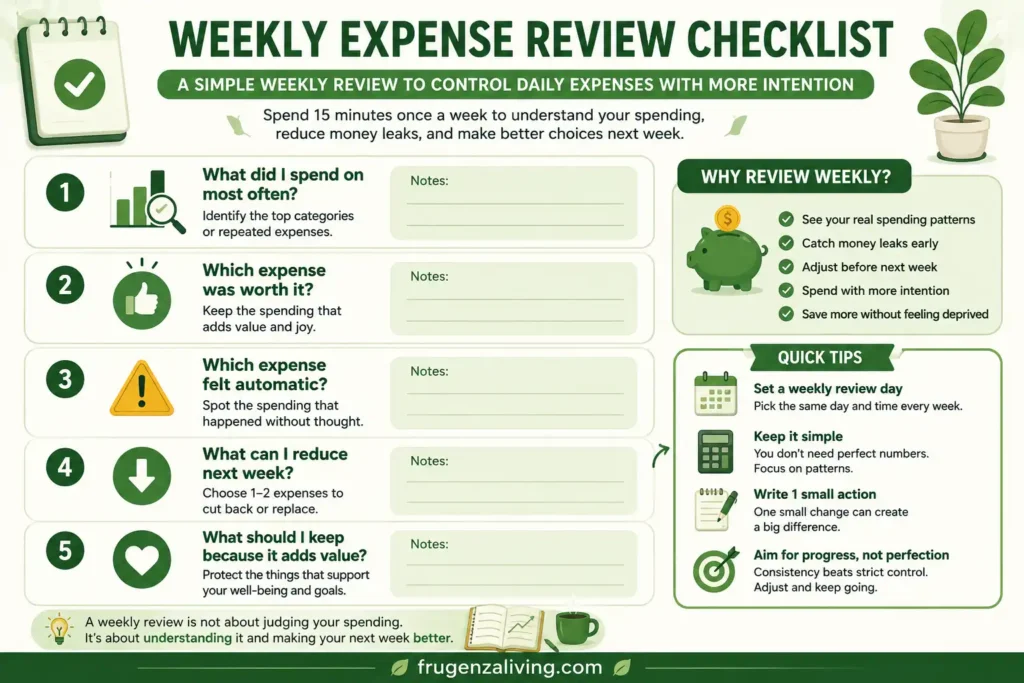
You do not need to feel guilty every day to control everyday spending.
A weekly expense review is enough.
Once a week, ask:
- What did I spend on most often?
- Which expense was worth it?
- Which expense felt automatic?
- What can I reduce next week?
- What should I keep because it adds value?
Maybe eating out with friends was worth it, but three random delivery fees were not.
The goal is not to remove all spending. The goal is to spend with more intention.
The Minimum Version for Busy Days
Some days are too busy for a full system.
When life gets messy, use the minimum version:
- check today’s spending
- avoid one unnecessary purchase
- choose one cheaper default tomorrow
That is enough.
Daily expense control should not feel like another job. If you keep one small part of the system alive, you are still building awareness.
What to Do If You Overspend Today
Overspending today does not mean the whole month is ruined.
Use this recovery loop:
Notice → Adjust tomorrow → Protect the week → Continue
If lunch was expensive today, make dinner simple.
If you ordered delivery twice, plan one pickup or home meal.
If you spent more than planned, reduce one flexible expense later in the week.
Do not punish yourself with extreme restriction. That often leads to rebound spending.
A better approach is to adjust calmly and continue.
My Simple Rule for Daily Expenses
I stopped trying to control every dollar perfectly.
Instead, I started watching the small daily leaks.
For me, it was not always the big bills that created the most frustration. It was the repeated little expenses I barely noticed: convenience food, small upgrades, quick purchases, and “just this once” spending that happened too often.
Things changed when I started reviewing those patterns weekly.
I did not cut every joy. I just replaced some expensive defaults and kept the spending that actually felt worth it.
Controlling daily expenses became one of the habits that helped me save over $15,000 in a year.
Your numbers may look different, but noticing small daily spending patterns can still make your money feel easier to control.
How This Fits Into Your Money-Saving System
Daily expense control works best when it supports a bigger money-saving system.
If tracking feels hard, learning how to track expenses easily can make daily expense control less stressful.
If your spending feels inconsistent, building a simple financial routine can help you check your money regularly.
If online shopping is one of your daily money leaks, learning how to avoid impulse buying online can help you slow down before checkout.
If you want a broader weekly system, learning how to save money weekly can help you protect cash before it disappears.
FAQ
How do I control daily expenses effectively?
You can control daily expenses effectively by tracking daily spending, separating needs from flexible spending, setting a realistic spending boundary, reducing repeated money leaks, replacing expensive defaults, and reviewing expenses weekly.
What is the easiest way to track daily expenses?
The easiest way to track daily expenses is to record purchases for seven days using a notes app, banking app, budgeting app, or notebook. Keep it simple and focus on patterns, not perfection.
How can I reduce daily expenses without feeling deprived?
Reduce daily expenses without feeling deprived by replacing expensive defaults instead of cutting everything. For example, make coffee at home a few days a week, bring lunch twice a week, or use pickup instead of delivery.
What daily expenses should I cut first?
Start with repeated expenses that do not add much value, such as unused subscriptions, delivery fees, lunch upgrades, convenience snacks, or small online orders. The best expense to cut first is the one that repeats often and feels least worth it.
Is a daily spending limit better than a weekly limit?
A daily spending limit can help some people, but a weekly limit often feels more flexible. For example, $210 per week gives you about $30 per day, but you can spend more on one day and less on another.
How often should I review my daily expenses?
Review your daily expenses once a week. A weekly expense review helps you see repeated patterns, decide what was worth it, and adjust before the next week starts.
What should I do if I overspend today?
If you overspend today, do not restart the whole month. Notice what happened, adjust tomorrow, protect the rest of the week, and continue. A small adjustment is better than giving up.
Final Thought: Control the Repeated Expenses First
You do not need to control every dollar perfectly.
Start by noticing what repeats.
Set a flexible boundary.
Replace expensive defaults.
Review once a week.
Daily expense control works best when it feels realistic enough to repeat.

Read about Jeffi and Frugenza Living
- Proportional Bill Split Calculator for Two Incomes - October 15, 2026
- How to Split Grocery Bills With Roommates - October 14, 2026
- First Apartment Kitchen Essentials on a Budget - October 13, 2026