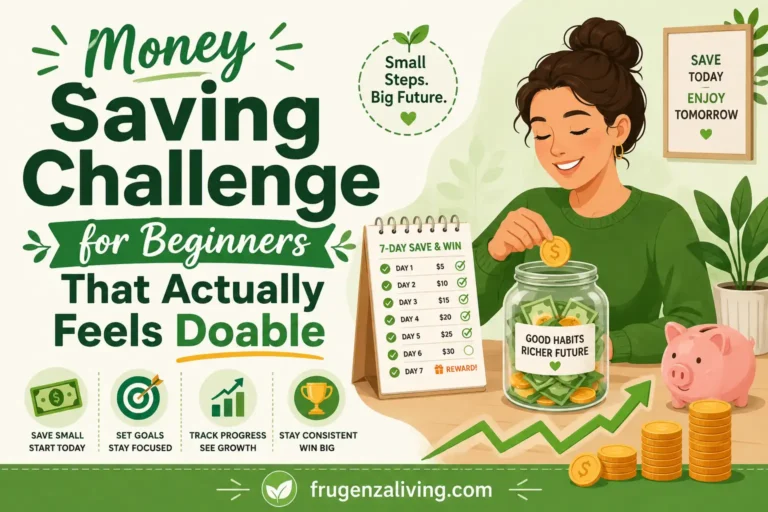
Saving money sounds simple until real life gets in the way.
The week gets busy. Bills hit. Groceries cost more than expected. A random expense shows up. Suddenly, the challenge you picked feels impossible, and saving money starts to feel like one more thing you are failing at.
That is why a money saving challenge for beginners should not be built around pressure.
The best challenge is not always the one with the biggest final number.
It is the one you can repeat without feeling punished.
A good beginner challenge should help you save small amounts, see progress, build confidence, and keep going even when the week is not perfect.
What Is a Money Saving Challenge for Beginners?
A money saving challenge for beginners is a simple savings plan with easy rules, small amounts, and a clear timeline.
It might last 7 days, 30 days, one month, or one year. The challenge may use a tracker, envelope, jar, savings account, spreadsheet, or notes app to help you see progress.
The goal is not perfection.
The goal is to build consistency.
If you are new to saving money, a beginner challenge should feel realistic enough to continue even when your income, bills, or spending changes a little.
That is what makes it useful.
Why Beginners Should Start Smaller Than They Think
Many savings challenges look exciting at first.
The 100-envelope challenge sounds fun. A strict no-spend month looks powerful. A high weekly savings target feels motivating for a few days.
But for beginners, aggressive challenges can backfire.
If the challenge is too intense, one missed deposit can make you feel like you failed. Then the whole plan gets abandoned.
Saving $5 consistently can teach you more than trying to save $500 too quickly and quitting.
A small savings challenge can still matter because it builds the habit of setting money aside before it disappears.
For beginners, confidence comes first.
The bigger numbers can come later. A money saving challenge feels easier when you turn it into a simple weekly saving plan instead of trying to save everything at once.
The Beginner Challenge Fit Test
Before choosing a savings challenge, ask four questions.
Can I do it on a bad week?
Choose a challenge that still works when bills, groceries, or unexpected expenses show up.
Can I restart without guilt?
A beginner challenge should let you continue even if you miss a day, a week, or a deposit.
Does it protect essentials?
Do not choose a challenge that makes rent, food, bills, medicine, or debt payments harder to cover.
Does it build confidence?
The right challenge should make you feel more capable with money, not more behind.
This test matters because a savings challenge should fit your real life.
If it only works when everything goes perfectly, it is probably too strict for a beginner.
5 Beginner-Friendly Money Saving Challenges
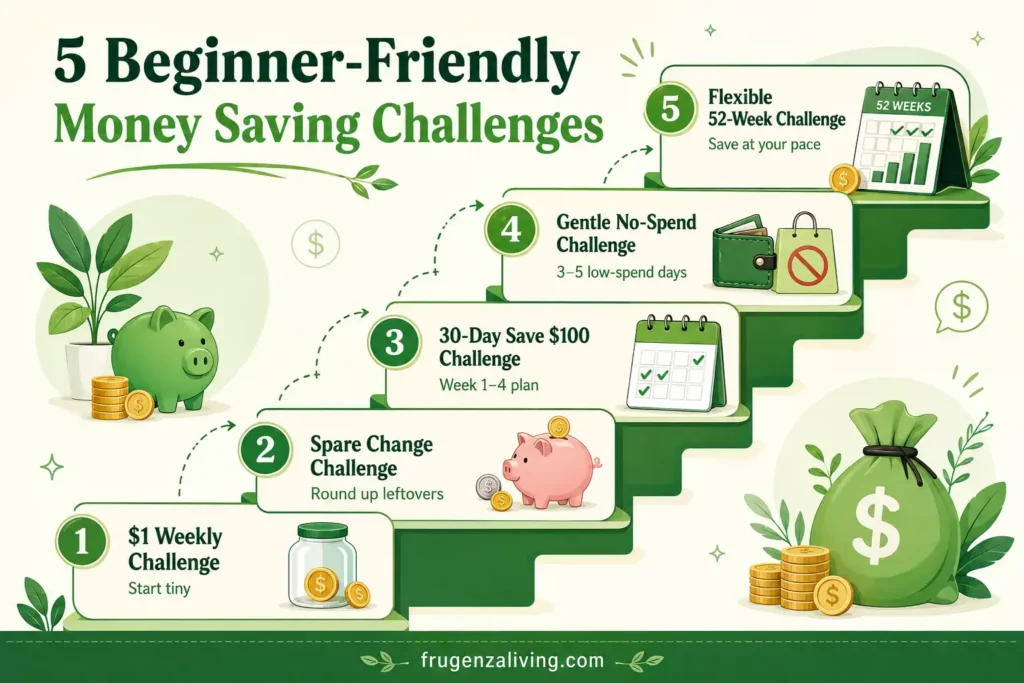
Here is the simple ladder:
- Level 1: $1 weekly challenge
- Level 2: spare change challenge
- Level 3: 30-day save $100 challenge
- Level 4: gentle no-spend challenge
- Level 5: flexible 52-week challenge
Start with the easiest level that still feels realistic. You can always move up later.
Level 1: $1 Weekly Challenge
This is the simplest beginner money saving challenge.
Save $1 every week.
If that feels too easy later, increase it to $2, $3, or $5. But in the beginning, the point is not the amount. The point is proving to yourself that you can save consistently.
This is a good option if you are starting from zero or living on a tight income.
Level 2: Spare Change Challenge
With the spare change challenge, you save small leftover amounts.
That could mean coins, cash left in your wallet, or rounded-up amounts from purchases.
For example, if you spend $4.40, you can move $0.60 into savings. If tracking every purchase feels annoying, make it easier and transfer a small fixed amount once a week.
This challenge works because the amounts feel less intimidating.
If you do not use cash, you can make it a digital savings challenge with a small automatic transfer.
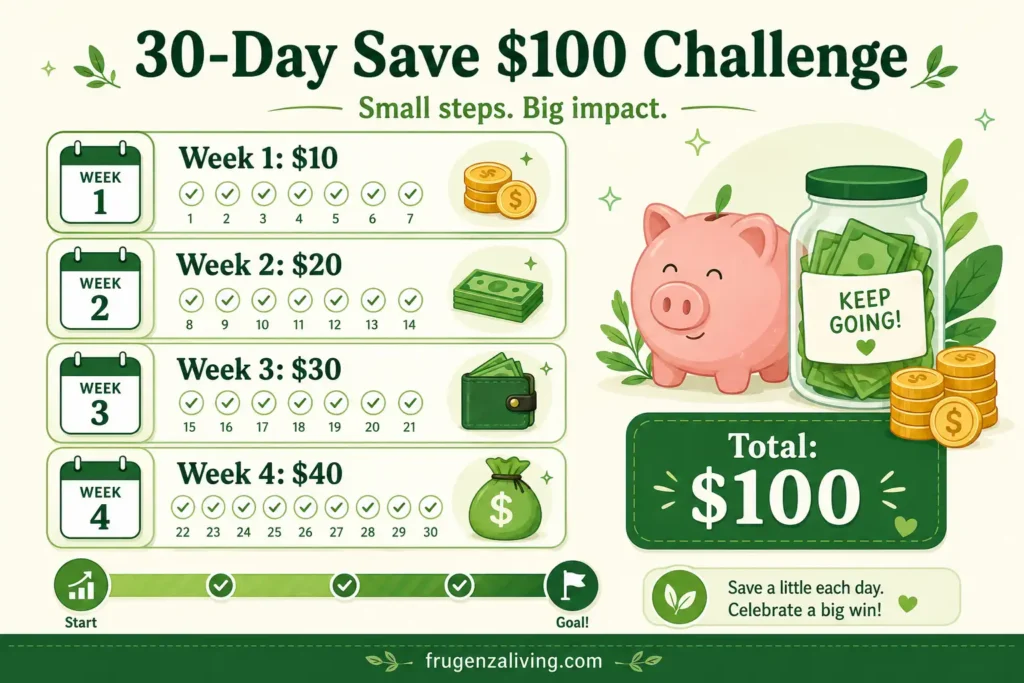
Level 3: 30-Day Save $100 Challenge
A 30-day money saving challenge can feel more motivating because the timeline is short.
Try this beginner version:
- Week 1: $10
- Week 2: $20
- Week 3: $30
- Week 4: $40
Total: $100
This is simple, clear, and not too long.
It is a good challenge if you want to build a small starter fund without committing to a full year.
A beginner challenge works best when it supports realistic ways to save money every month.
Level 4: Gentle No-Spend Challenge
A no-spend challenge for beginners should not feel extreme.
Instead of doing a harsh no-spend month, choose 3–5 no-spend days in a month.
On those days, you only pay for essentials:
- bills
- groceries you already planned
- transportation
- medicine
- necessary expenses
The goal is not to stop living.
The goal is to notice how often small purchases happen automatically.
Level 5: Flexible 52-Week Challenge
The classic 52-week money challenge starts with $1 in week 1, $2 in week 2, $3 in week 3, and continues until $52 in week 52.
If completed, it saves $1,378 in a year.
That can be powerful, but beginners do not have to follow it perfectly.
You can make it flexible by:
- starting with smaller amounts
- repeating easy weeks
- pausing during expensive weeks
- reversing the challenge
- choosing a random amount you can afford each week
A flexible savings challenge is usually easier to finish than a strict one.
A beginner challenge can also lead into a year-long money saving challenge if you want a longer plan.
The Best Challenge If You Are Starting From Zero
If you are starting from zero, choose the $1 weekly challenge or the 30-day save $100 challenge.
If you are unsure, start with the $1 weekly challenge for two weeks first. It is the lowest-pressure way to prove that you can keep a saving habit.
Do not start with the challenge that looks most impressive.
Start with the one that helps you create trust with yourself.
Saving small amounts consistently is better than quitting a challenge that sounds exciting but does not fit your real budget.
A beginner savings plan should make you feel capable.
That feeling matters.
When saving feels possible, you are more likely to continue.
A good challenge should help you save money without cutting everything you enjoy.
A Mini Envelope Challenge for Beginners
The full 100-envelope challenge is popular, but it can be too aggressive for beginners.
The standard version uses envelopes numbered 1–100. You save the amount written on the envelope. If completed, it totals $5,050.
That is exciting, but it may not be realistic for someone just starting.
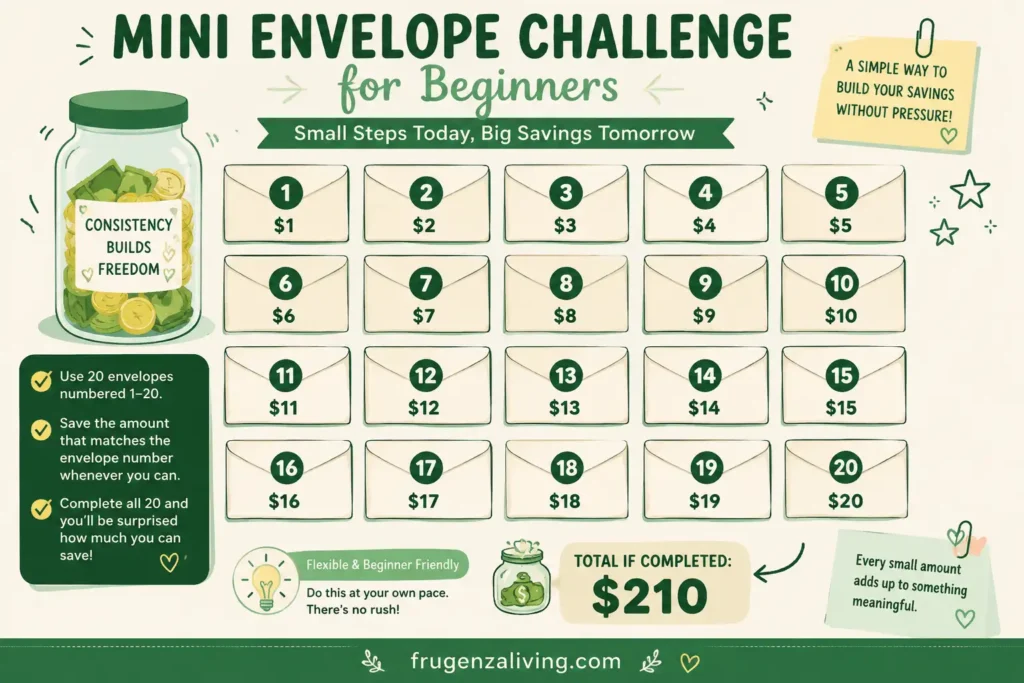
Try a mini version instead.
Use 20 envelopes and label them 1–20.
Fill one envelope when you can.
If you complete all 20 envelopes, you save $210.
This keeps the fun visual part of the envelope challenge without the pressure of a huge final number.
You can also use digital envelopes in a banking app, spreadsheet, or notes app.
If you want a more focused challenge, you can try a no spend week challenge before moving to bigger goals.
Use a Savings Tracker to Make Progress Visible
A savings tracker helps because progress feels more real when you can see it.
You do not need anything fancy.
Use whatever you will actually check:
- printable savings tracker
- notes app
- spreadsheet
- calendar
- jar or envelope
- separate savings account
You can also treat the challenge like a small sinking fund if you are saving for a specific goal, such as a bill, holiday, car repair, or emergency buffer.
The best tracker is the one you will use.
Seeing small progress can keep you motivated, especially when the amount feels small at first.
A tracker also helps you avoid the feeling that “nothing is happening.”
Something is happening.
You are building the habit.
What to Do If You Miss a Day or Week
Missing a deposit does not mean failure.
This is where many beginners quit, but you do not have to.
Try one of these options:
- restart the next day
- lower the amount
- skip catch-up pressure
- continue from where you left off
- switch to a smaller challenge
Do not punish yourself by doubling the next deposit if that makes your budget harder.
The goal is to keep the habit alive.
A flexible savings challenge should make room for real life.
If you missed a day, keep going.
That is still progress.
The Point Where Most Challenges Quietly Fall Apart (And How to See It Coming)
Missing a deposit is not random.
For most people, the hardest point in a savings challenge is not week one, when motivation is high and the amount is small. It is not the final stretch, when the end is visible and momentum carries the habit forward.
It is usually somewhere in the middle — around week three of a monthly challenge, or month two of a longer one.
This is predictable enough that it has a name in behavioral research: the novelty cliff.
When you start a savings challenge, the act of tracking, watching the number grow, and having a new financial goal provides its own motivation. The behavior feels rewarding independent of the savings amount. That extra motivation is real, but it is also temporary.
By week three or month two, the tracker no longer feels new. The amount has not changed. The goal is not yet close enough to feel urgent. And the behavior that used to feel like a small win now just feels like a task.
This is the moment most people interpret as a sign that the challenge is not working, or that they are not cut out for it.
Neither is true.
It is just the point where the initial novelty stops doing half the motivational work for you — and something else needs to take over.
There is one shift that tends to work at this exact stage.
Change something visible, not something structural.
Do not lower the amount. Do not switch to a different challenge. Do not restart from zero.
Instead, change the format of how you track it.
If you have been using a notes app, switch to a physical jar or envelope for two weeks. If you have been using a jar, move the money to a separate savings account and watch the balance. If you have a tracker on your phone, print a simple visual version and put it somewhere you see daily.
The savings behavior stays exactly the same. Only the way you see it changes.
This works because the novelty cliff is a visibility problem, not a motivation problem. The habit is still there. The progress is real. What disappeared is the visual feedback that made the behavior feel worth doing.
Restoring that feedback — even in a small way — is usually enough to carry the challenge through its hardest stretch.
Turn the Challenge Into a Small Emergency Fund
A money challenge becomes more meaningful when it gives your money a purpose.
For beginners, one of the best goals is a small emergency fund.
Start with:
- $100 first
- then $250
- then $500
You do not need to build a huge emergency fund immediately.
A small buffer can help you handle surprise expenses without reaching for debt or giving up completely.
This is where a beginner money saving challenge can become more than a game.
It can become your first layer of financial breathing room.
My Simple Rule for Money Saving Challenges
I stopped choosing challenges based on the biggest savings total.
I started choosing ones I could repeat.
That changed the way I saved.
A small challenge that I could actually finish helped me more than a big challenge I abandoned after two weeks.
For me, small savings challenges, weekly check-ins, and reducing money leaks became some of the habits that helped me save over $15,000 in a year.
Your numbers may look different, but a beginner-friendly challenge can still help you build confidence with money.
The amount matters, but the habit matters more at the beginning.
How This Fits Into Your Saving Money System
A money saving challenge works best when it supports your bigger money system.
If you want a steady routine, how to save money weekly can help you turn saving into a repeatable habit.
If your money feels disorganized, a simple money management plan for beginners can help you understand where your income is going.
If daily spending keeps draining your progress, how to control daily expenses effectively can help you find small money leaks.
If you struggle to stay consistent, how to build a simple financial routine can help you check your money without overthinking it.
FAQ
What is the easiest money saving challenge for beginners?
The easiest money saving challenge for beginners is the $1 weekly challenge. Save $1 each week, then increase the amount slowly if your budget allows. The goal is to build consistency before chasing a bigger savings total.
How much should a beginner save in a challenge?
A beginner should save an amount that feels realistic enough to repeat. That might be $1 per week, $5 per week, or a small monthly goal like $50 or $100. The best amount is one that does not make essentials harder to cover.
Is the 52-week money challenge good for beginners?
The 52-week money challenge can be good for beginners if you use a flexible version. The classic version saves $1,378 in a year, but beginners can start smaller, pause when needed, reverse the challenge, or repeat easier weeks.
What is a good 30-day money saving challenge?
A good 30-day money saving challenge for beginners is the save $100 challenge: save $10 in week 1, $20 in week 2, $30 in week 3, and $40 in week 4. It is short, simple, and easy to track.
What happens if I miss a day in a savings challenge?
If you miss a day, continue from where you left off. You can restart the next day, lower the amount, skip catch-up pressure, or switch to a smaller challenge. Missing one deposit does not mean the challenge is ruined.
Can I do a money saving challenge on low income?
Yes, you can do a money saving challenge on low income by choosing small amounts and protecting essentials first. A $1 weekly challenge, spare change challenge, or mini envelope challenge can be more realistic than aggressive savings targets.
Where should I keep the money from a savings challenge?
Keep the money somewhere separate from everyday spending, such as a savings account, cash envelope, jar, or separate digital account. The goal is to make the money visible but not too easy to spend casually.
Final Thought: Choose a Challenge You Can Repeat
A money saving challenge for beginners should make saving feel possible.
Start small.
Protect your essentials.
Track your progress.
Keep going even if the challenge is imperfect.
The best challenge is not the one with the biggest final number.
It is the one that helps you trust yourself with money again.
This article is for educational purposes only and is not professional financial advice.

Read about Jeffi and Frugenza Living
- Proportional Bill Split Calculator for Two Incomes - October 15, 2026
- How to Split Grocery Bills With Roommates - October 14, 2026
- First Apartment Kitchen Essentials on a Budget - October 13, 2026