
Money can disappear fast during a normal week.
You start with good intentions, but then lunch costs more than expected, weekend plans get expensive, or one small online purchase turns into three. By the end of the week, you wonder where the money went.
That is why learning how to save money weekly can feel more manageable than waiting until the end of the month.
A monthly goal can feel far away. A weekly saving plan feels closer, easier to adjust, and less intimidating.
This is not a full weekly budget plan. It is a simple weekly savings system for people who want money left over every week, even if the amount is small.
How Can You Save Money Weekly?
You can save money weekly by setting a small weekly savings target, saving it early, reducing one weekly expense, protecting your money before the weekend, and reviewing what worked at the end of the week. The goal is consistency, not saving a perfect amount every time.
What Weekly Saving Should Help You Do
A simple weekly saving system should help you:
- save something before spending takes over
- notice weekly money leaks
- build consistency with small wins
- recover quickly after a bad week
The goal is not to create a perfect money week.
The goal is to save something, learn from the week, and repeat.
The hardest part is not starting, but learning how to stick with your budget week after week.
Weekly Saving Works Because the Feedback Is Faster
Saving monthly can feel slow.
You might set a goal at the beginning of the month, but by week three, real life has already changed the plan. Maybe groceries cost more. Maybe a bill appeared. Maybe weekend spending quietly got out of control.
Weekly saving gives faster feedback.
You can see what worked within 7 days.
If one week goes badly, you do not have to feel like the whole month is ruined. You can reset next week with a smaller target, a different expense cut, or a better weekend plan.
That is why weekly saving can feel easier for beginners.
Small weekly wins build confidence faster than waiting for one big monthly result.
Saving money weekly works best when you protect a small amount early, reduce one expense, and reset before the next week starts.
Some of the easiest weekly wins come from simple ways to save money at home.
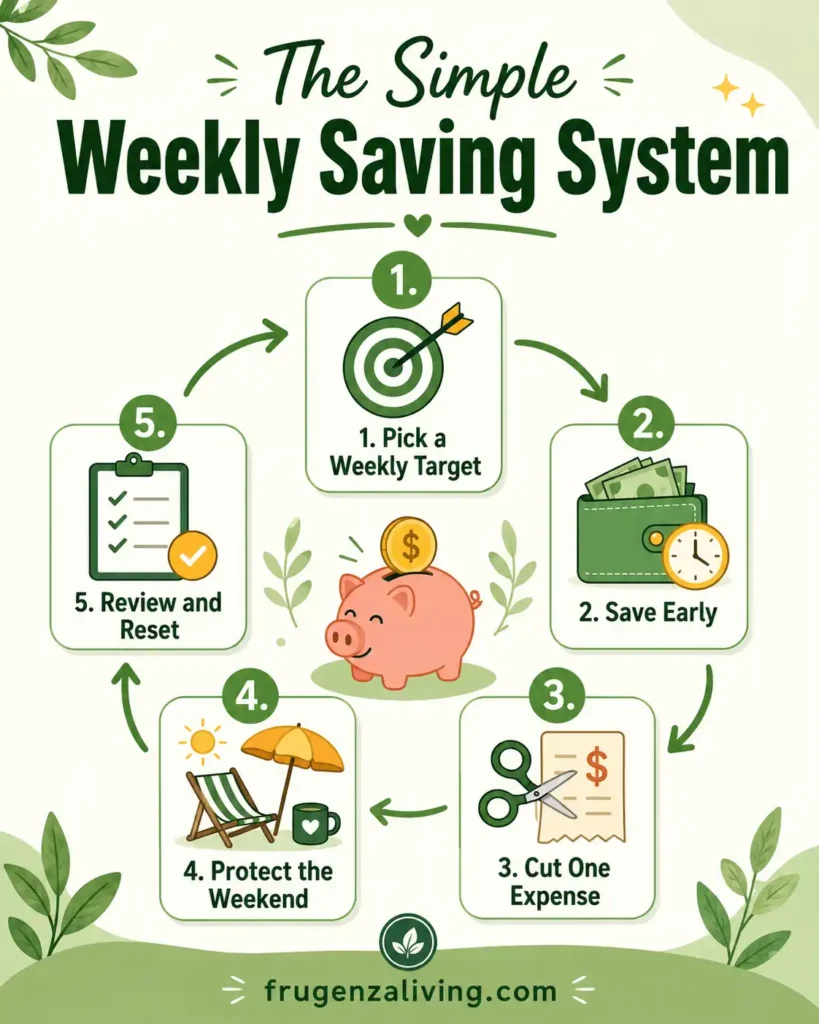
The Simple Weekly Saving System
Here is a simple system you can repeat each week:
| Step | What to Do | Why It Helps |
|---|---|---|
| Pick a weekly target | Choose a realistic amount | Makes saving clear and specific |
| Save early | Move money before the week gets busy | Prevents saving only leftovers |
| Cut one expense | Choose one area to reduce | Keeps the plan simple |
| Protect the weekend | Save before Friday and set a spending limit | Stops weekend spending from draining progress |
| Review and reset | Check what worked and adjust | Makes the next week easier |
This system works because it is not complicated.
You are not trying to fix your whole financial life in one week.
You are building one repeatable weekly saving habit.
If you are looking for weekly money saving tips, start with this simple weekly saving method instead of trying to cut everything at once.
Step 1: Pick a Weekly Savings Target You Can Repeat
Start with a weekly savings target that feels realistic.
Not impressive.
Realistic.
For some people, that might be $10 per week. For others, it might be $25, $40, $50, or more.
The amount matters less than whether you can repeat it.
A target that looks good but makes the week stressful will not last. A smaller target that you can repeat builds more confidence.
For example:
$25 per week = about $100 per month
$50 per week = $2,600 per year
Those numbers show why weekly saving can be powerful. Small amounts become meaningful when they happen consistently.
Start with an amount you can protect without making the rest of the week feel impossible.
Weekly saving feels easier when you focus on weekly saving without stress instead of cutting everything.
How to Find Your Real Weekly Savings Number
The examples above are starting points, not recommendations.
The right weekly savings amount for you depends on one thing most guides skip: the difference between your fixed weekly costs and your actual variable spending.
Here is a simple way to find your number without building a full budget.
Look at the last two weeks of your bank or card statements. Ignore fixed bills — rent, insurance, subscriptions — because those do not change week to week. Focus only on the variable spending: food, transport, shopping, entertainment, anything that could have been different.
Add those variable costs up for each week. You now have two numbers.
Take the lower of the two.
That lower week is your baseline — what your week actually costs when you are not overspending.
Now subtract your income for the week from that lower number.
Whatever remains is your realistic weekly savings capacity: the amount you can move to savings without making the week feel impossible.
For example:
- Weekly take-home income: $750
- Lower variable spending week: $680
- Realistic weekly savings capacity: $70
That $70 is your ceiling, not your target.
Start at roughly half of it — in this case, around $35 — and protect that amount first before spending starts. The rest gives you enough room so the week does not feel squeezed from day one.
This is why two people with the same income can have very different weekly savings amounts that work for them. Someone with high fixed costs and unpredictable variable spending may find their realistic ceiling is $20. Someone with lower fixed costs and consistent spending patterns may find it is $120. Neither is wrong. The difference is structure, not discipline.
The weekly savings target that works is the one that fits your actual structure — not the one that sounds most impressive.
Step 2: Save Early in the Week
Do not wait until the end of the week to save.
That is the common mistake.
If you wait for leftovers, there may be nothing left.
Instead, transfer your savings early. You can do it on payday, Monday morning, or whenever your week usually starts.
If possible, move the money to a separate savings account so it does not sit beside your spending money.
You can also automate it.
Even a small automatic transfer helps because it removes the decision. You do not have to feel motivated every week. The system does part of the work for you.
The key is to keep the amount realistic.
Saving early should protect your goal, not make your week feel too tight.
Saving money each week becomes easier when you follow a simple weekly budget that fits your routine.
Step 3: Choose One Weekly Expense to Reduce
You do not need to cut everything.
Choose one expense to reduce this week.
That could be:
- one takeout meal
- one grocery extra
- one coffee run
- one delivery fee
- one random online purchase
- one paid activity you do not care about much
This works better than vague restriction.
“Spend less this week” is too broad.
“Skip one $18 takeout meal” is clear.
For example:
Skip one $18 takeout meal this week = $18 saved
Repeat it for 4 weeks = about $72 per month
That is real money from one specific change.
If you want more repeatable expense cuts, frugal habits that actually save money can help you choose habits that keep working week after week.
Step 4: Use the Save-Before-Weekend Rule
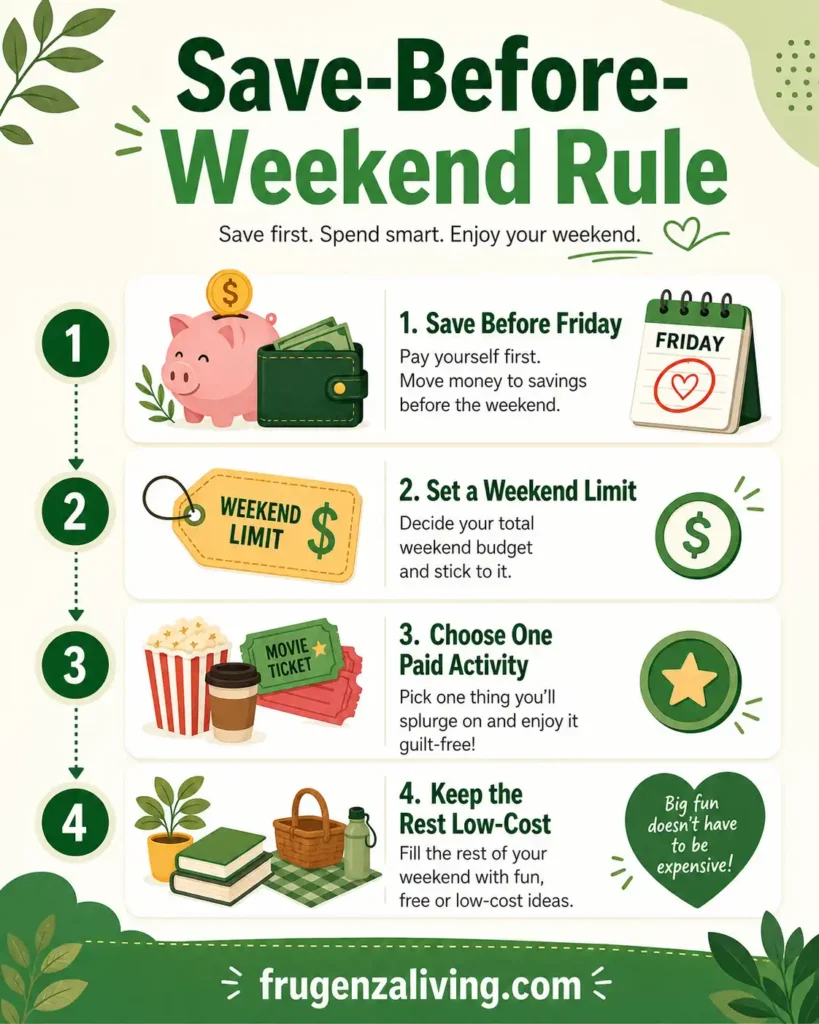
Weekends can quietly drain savings.
You may do well Monday through Thursday, then spend more on Friday, Saturday, and Sunday because the week feels almost over.
That is why the save-before-weekend rule helps.
Before Friday, do three things:
- move your weekly savings target
- decide your weekend spending limit
- choose one paid thing instead of several
For example, instead of dinner, movie, shopping, and delivery in one weekend, you might choose one paid activity and keep the rest low-cost.
This does not mean you cannot enjoy weekends.
It means your savings should be protected before fun spending begins.
If impulse spending is what usually breaks your weekend plan, how to control spending habits can help you build better pauses before buying.
Step 5: Review Your Week Without Guilt
A weekly savings reset should not feel like a punishment.
It should feel like checking the map.
At the end of the week, ask:
- Did I save my target?
- What helped me save?
- What leaked money?
- Did weekend spending surprise me?
- What should I adjust next week?
Keep it short.
The goal is not to judge yourself. The goal is to learn quickly.
One bad week does not mean the system failed.
It only means the next week needs a better target, a clearer expense cut, or a stronger weekend plan.
Weekly progress becomes more powerful when it supports realistic ways to save money every month.
A Realistic Weekly Saving Example
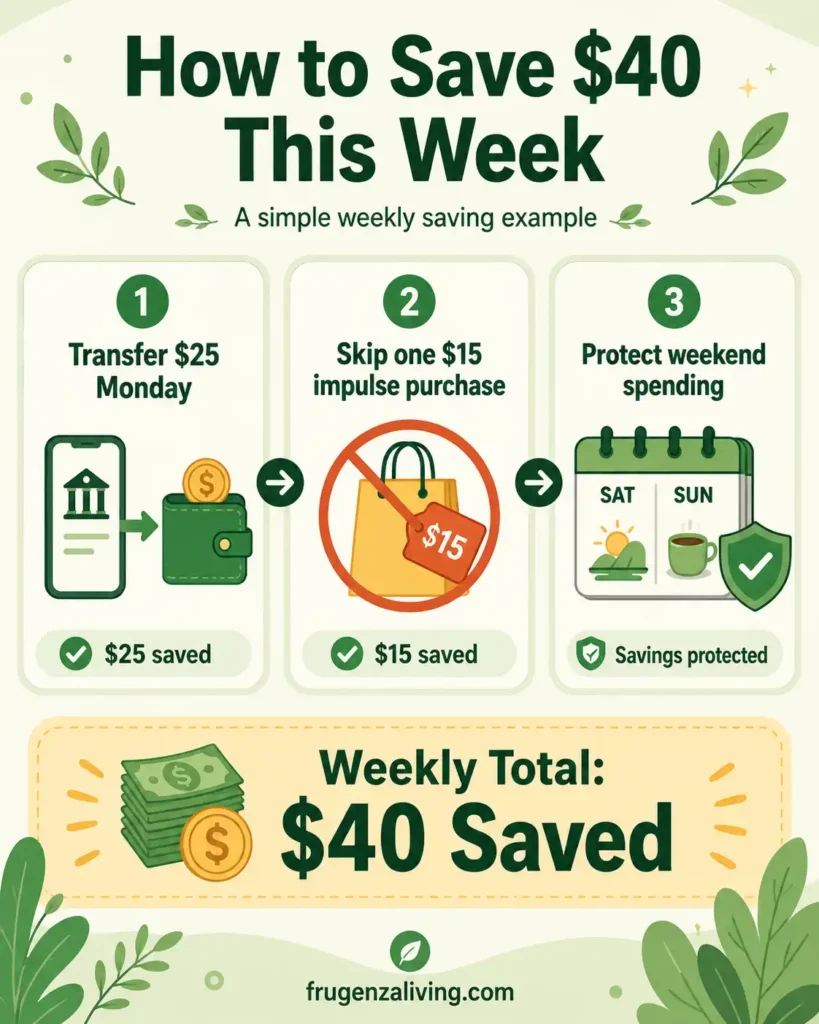
Here is a simple example for someone who wants to save $40 per week.
| Weekly Action | Example | Savings Result |
|---|---|---|
| Save early | Transfer $25 on Monday | $25 saved |
| Reduce one expense | Skip one $15 impulse purchase | $15 saved |
| Use weekend rule | Choose one paid activity | Savings protected |
| Weekly total | $25 + $15 | $40 saved |
This is not a full budget.
It is a weekly saving plan.
The purpose is simple: save early, reduce one expense, and protect the result.
Weekly Savings Challenges: Helpful or Too Much?
Weekly savings challenges can be helpful if they motivate you.
A common example is the 52-week savings challenge. You save $1 in week one, $2 in week two, $3 in week three, and continue increasing the amount each week.
It can feel fun at first because the early weeks are easy.
But it can become harder near the end when the weekly amount gets much larger.
That does not mean the challenge is bad.
It means you should customize it.
You can try:
- a flat weekly amount, like $10, $25, or $50
- a reverse challenge, starting higher and getting lower
- a flexible challenge, saving more on good weeks and less on tight weeks
- an automatic weekly transfer
For beginners, a flat weekly amount is often easier because it is predictable.
Do not force a viral challenge if it makes your week stressful.
The best weekly savings challenge is the one you can actually finish.
What I Noticed After Saving Weekly
Saving weekly felt less intimidating than waiting for the end of the month.
I could see progress sooner.
I also noticed money leaks faster. If takeout, weekend spending, or random shopping got out of control, I did not have to wait a whole month to adjust.
The biggest shift was that I stopped saving only what was left over.
I protected a small amount first, then adjusted the week around it.
Over time, weekly saving became one of the small systems that helped me save over $15,000 in a year.
The biggest change was not saving a huge amount every week.
It was protecting small amounts before they disappeared.
It was not one huge deposit.
It was the repeatable pattern that made the difference.
Common Weekly Saving Mistakes
Setting the Target Too High
A big savings target can feel exciting, but it may not be realistic.
Start smaller if needed.
Consistency matters more than ambition.
Waiting Until Sunday Night to Save
If you wait until the end of the week, spending may already have taken over.
Save early.
Even a small transfer is better than hoping money remains.
Ignoring Weekend Spending
Weekend spending is one of the biggest weekly money leaks.
Use the save-before-weekend rule to protect your progress before Friday.
Trying to Cut Every Expense at Once
Do not try to fix groceries, takeout, coffee, shopping, and entertainment all in one week.
Choose one expense.
Make the change clear.
Quitting After One Bad Week
A bad week does not erase the habit.
Lower the target. Pick a different expense. Reset and try again.
How to Start Saving Money This Week
Use this simple loop:
Choose → Save → Cut → Review
Choose one weekly amount.
Save it early.
Cut one expense.
Review before the next week starts.
That is enough to begin.
You do not need a perfect budget or a complicated challenge. You only need one weekly saving action you can repeat.
How This Fits Into Your Saving and Budgeting System
This article focuses on saving money weekly.
If you need a full weekly spending structure, use a weekly budget plan for beginners.
If you want a bigger goal, realistic ways to save money every month can help you connect weekly progress to monthly savings.
If money is very tight, how to save money with low income can help you start with smaller amounts.
If you want repeatable expense cuts, frugal habits that actually save money can help.
If impulse purchases keep blocking your progress, how to control spending habits can help you reduce spending triggers.
Weekly saving is the action layer.
Budgeting and habits help support it.
FAQ
How can I save money weekly?
You can save money weekly by choosing a realistic weekly target, saving it early, cutting one weekly expense, protecting your money before the weekend, and reviewing the week without guilt. Start small so the habit feels repeatable.
How much money should I save each week?
How much you should save each week depends on your income, bills, and goals. A good beginner target might be $10, $25, $40, or $50 per week. Choose an amount you can repeat without making the week stressful.
Is saving weekly better than monthly?
Saving weekly can be easier than monthly because the feedback is faster. You can see what worked within 7 days and reset quickly after a bad week. Monthly saving is useful for bigger goals, but weekly saving helps build consistency.
What is the easiest weekly savings challenge?
The easiest weekly savings challenge is usually a flat amount challenge. Instead of increasing the amount every week, save the same amount, such as $10, $25, or $50 weekly. It is predictable and easier to maintain.
How do I save money weekly when money is tight?
When money is tight, start with a very small weekly target, even $5 or $10. Save it early, then reduce one small expense. The goal is to keep the saving habit alive, not to force an amount that makes the week harder.
Conclusion
Weekly saving does not need to be big.
It needs to be repeatable.
Save early. Cut one expense. Protect the weekend. Review and reset.
Some weeks will be easier than others. That is normal.
You do not need a perfect money week.
You need a weekly system you can repeat.

The ideas shared here come from real-life experience and practical habits that actually work.
→ Read more about Jeffi
- No Spend Month Challenge for Beginners: A 30-Day Plan - September 24, 2026
- Low Buy Month Challenge: Realistic Rules for 30 Days - September 23, 2026
- How to Stop Buying Groceries You Already Have - September 20, 2026