
If you reach the end of the month and think, “I should have saved something,” you’re not alone.
A lot of people earn money, pay bills, buy groceries, cover small expenses, and somehow end the month with almost nothing left. It doesn’t always happen because of one big mistake. Most of the time, it happens because your monthly money pattern quietly repeats itself.
That used to frustrate me too.
I wasn’t spending wildly. I wasn’t buying expensive things every week. But every month felt the same: money came in, money went out, and savings stayed small.
That’s when I realized something important.
Saving money monthly is not about changing your entire life. It’s about making a few realistic adjustments that you can repeat every month without feeling stressed.
If you want realistic ways to save money every month, the goal is not perfection. The goal is stability.
What Are Realistic Ways to Save Money Every Month?
Realistic ways to save money every month include lowering recurring bills, reducing unused subscriptions, planning grocery spending, cutting small money leaks, and setting aside a manageable amount consistently. The best monthly saving approach is simple, repeatable, and easy to maintain without extreme lifestyle changes.
Key Takeaways
- Realistic saving works better than aggressive saving
- Monthly consistency matters more than one big effort
- Small savings compound into meaningful yearly results
- Awareness helps you control where your money goes
Saving Money Monthly Is About Stability, Not Perfection
Most people fail to save money because they aim too high at the beginning.
They decide they’re going to save a huge amount immediately. For a few days or weeks, they try hard. They cut too much. They restrict everything. Then life happens, unexpected spending appears, and the plan falls apart.
That’s why realistic monthly saving works better.
It doesn’t depend on perfect discipline.
It depends on repeatability.
If you can save $50 every month without feeling miserable, that is better than trying to save $500 once and quitting. Stable habits beat aggressive saving because they fit into real life.
The best realistic monthly saving plan is one you can repeat even when the month is busy, imperfect, or unpredictable.
The key is to stay consistent with a budget instead of relying on motivation alone.
Why Most People Fail to Save Money Every Month
Saving money every month sounds simple until the month actually starts happening.
One common problem is unrealistic goals. If your target is too high, saving feels like punishment. Instead of building confidence, it creates pressure.
Another issue is inconsistent behavior. You may save money one week, then overspend the next. Without a monthly rhythm, your savings depend on mood and motivation.
Irregular spending also makes saving harder. Some months include birthdays, repairs, school costs, medical expenses, or unexpected bills. If your plan doesn’t allow flexibility, it breaks quickly.
The last problem is ignoring monthly cycles. Many people only look at daily spending, but monthly bills, subscriptions, groceries, utilities, and repeated small costs are where a lot of money quietly disappears.
That’s why learning how to save money every month realistically means looking at your full money flow, not just one or two purchases.
Where Your Money Actually Goes Each Month
Before you can save more, it helps to know where money usually leaks.
| Category | Typical Leak | Monthly Impact | Fix |
|---|---|---|---|
| Subscriptions | Paying for apps or services you rarely use | $10–$50/month | Cancel or rotate subscriptions |
| Groceries | Buying without a simple plan | $30–$100/month | Plan basic meals before shopping |
| Utilities | Leaving devices, lights, or AC running | $10–$40/month | Use a simple energy routine |
| Food delivery | Ordering because you feel tired | $40–$150/month | Keep easy meals ready |
| Shopping | Small impulse purchases | $20–$100/month | Add a 24-hour pause |
| Bank fees | Late fees or avoidable charges | $5–$30/month | Set reminders or autopay |
| Household items | Duplicate purchases | $10–$50/month | Check what you already have |
The goal is not to remove every expense.
The goal is to find the easiest leaks to fix first.
How Small Monthly Changes Create Real Savings
Small savings do not look exciting at first.
But they become powerful when repeated.
For example:
- $50/month becomes $600/year
- $100/month becomes $1,200/year
- $200/month becomes $2,400/year
This is why simple monthly saving tips that work are usually boring but effective.
You don’t need a dramatic change to improve your financial life. You need a repeatable amount that stays consistent.
Even saving $25 or $50 each month matters because it builds the habit of keeping money instead of letting every dollar disappear.
If you’re wondering how to save a little money every month, start with the smallest amount you can repeat instead of chasing a perfect number.
The Minimum Save Rule That Makes Monthly Saving Easier
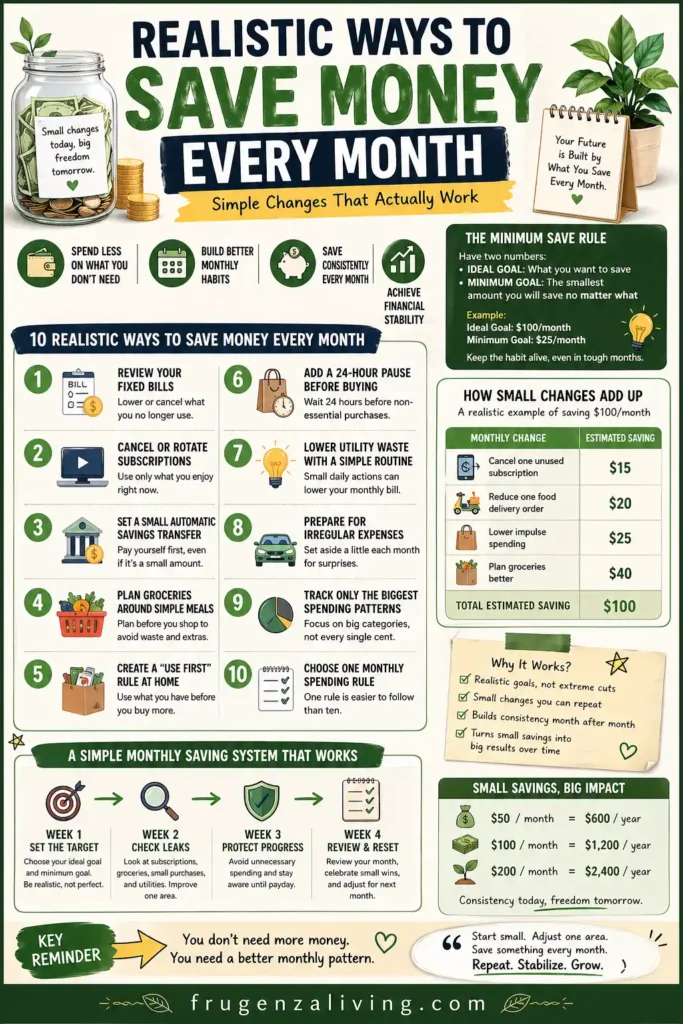
One simple way to make monthly saving more realistic is to use two numbers:
- your ideal saving goal
- your minimum saving goal
Your ideal goal is what you want to save in a normal month.
Your minimum goal is the smallest amount you will save no matter what.
For example:
- Ideal goal: $100/month
- Minimum goal: $25/month
If the month goes well, you save $100.
If the month is tight, you still save $25.
That matters because the habit stays alive.
Most people quit because one difficult month makes them feel like they failed. But with a minimum save rule, you don’t need a perfect month to keep going.
This also works if you’re trying to save money every month on a tight budget, because the minimum goal keeps the habit realistic.
You simply keep the rhythm.
And for realistic monthly saving, rhythm is more important than intensity.
A Realistic $100 Monthly Saving Example
You don’t always need one big cut to save $100 a month.
Sometimes, it comes from a few small adjustments that feel manageable.
| Monthly Change | Estimated Saving |
|---|---|
| Cancel one unused subscription | $15/month |
| Reduce one food delivery order | $20/month |
| Lower impulse spending | $25/month |
| Plan groceries better | $40/month |
| Total Estimated Saving | $100/month |
This is what makes the approach realistic.
You’re not cutting your lifestyle in half.
You’re trimming money leaks that already happen quietly.
A few small monthly changes can create a saving habit that feels stable instead of stressful.
10 Realistic Ways to Save Money Every Month
1. Review Your Fixed Bills Once a Month
Fixed bills are easy to ignore because they repeat automatically.
Look at rent, phone plans, internet, insurance, subscriptions, and other monthly charges.
Ask one simple question: “Am I still getting value from this?”
If not, cancel, downgrade, or look for a cheaper option.
A $15 reduction may not feel exciting today, but repeated for 12 months, it becomes $180 saved without needing extra effort every week.
2. Cancel or Rotate Subscriptions
You probably don’t need every subscription active at the same time.
Streaming services, apps, cloud storage, premium memberships, and software tools can quietly drain money each month.
Instead of paying for everything, rotate them.
Use one or two at a time, then switch when needed.
By rotating them, you still get to enjoy your favorite shows, apps, or tools without paying for things you barely use.
3. Set a Small Automatic Savings Transfer
You don’t need to automate a huge amount.
Start with something realistic, like $20, $50, or $100 per month.
Set it to move shortly after payday.
That way, saving happens before the money gets absorbed into regular spending. You also remove the monthly decision of “Should I save now or later?”
A small automatic transfer builds consistency without making your month feel tight.
These ideas only work if you manage your money effectively in your daily routine.
4. Plan Groceries Around Simple Meals
You don’t need a strict meal plan. Just choose a few simple meals before shopping.
Groceries can become expensive when you shop without direction.
One of the most effective ways to save each month is to reduce grocery spending with a simple plan.
For example:
- rice or pasta meals
- eggs and toast
- soup
- chicken and vegetables
- leftovers
A loose plan helps you buy food you will actually use. It also reduces waste, random purchases, and those “there’s nothing to eat” moments that lead to delivery.
5. Create a “Use First” Rule at Home
Before buying more food, cleaning supplies, or household items, check what you already have.
Many people spend extra money because they forget what’s in the pantry, fridge, freezer, or storage cabinet.
The rule is simple:
Use what you already have first.
This turns forgotten items into savings and helps you reduce daily expenses at home without feeling like you’re cutting anything important.
Many of these habits start with simple ways to do easy home saving habits.
6. Add a 24-Hour Pause Before Non-Essential Purchases
Impulse buying can destroy monthly savings.
The easiest fix is a pause.
Before buying something non-essential, wait 24 hours.
If you still need it later, you can buy it. But many times, the urge fades.
This 24-hour pause breaks the impulse loop without forcing you to rely on strict “never buy” rules. You’re not banning purchases; you’re just slowing down the decision.
7. Lower Utility Waste With a Simple Routine
Utilities are easy to ignore because the bill comes later.
Create a simple home routine:
- turn off lights when leaving a room
- unplug unused chargers
- avoid running appliances unnecessarily
- manage heating or cooling more intentionally
You may not cut your bill in half, and that’s fine. The goal is to reduce waste that repeats every day and shows up quietly on the monthly bill.
These strategies are especially useful if you want to save money fast on a low income.
8. Prepare for Irregular Expenses
One reason people fail to save monthly is that “unexpected” expenses keep appearing.
But many irregular expenses are not truly unexpected.
Things like car maintenance, gifts, school costs, clothes, repairs, and annual fees happen repeatedly.
Set aside a small amount each month for them.
When these costs appear, they no longer destroy your savings. They become part of your monthly money rhythm instead of a surprise that throws everything off.
9. Track Only the Biggest Spending Patterns
You don’t need to track every cent if that feels overwhelming.
Start with the biggest categories:
- food
- bills
- transport
- shopping
- subscriptions
If you want a simple method, learning how to track expenses easily can help you spot patterns without turning your life into a spreadsheet.
Once you know where money usually goes, it becomes much easier to make realistic monthly changes.
10. Choose One Monthly Spending Rule
Too many rules are hard to follow.
Choose one simple rule per month.
Examples:
- no new subscriptions this month
- limit takeout to twice a week
- use what’s already at home first
- wait 24 hours before online purchases
- save $50 immediately after payday
One rule is easier to remember than ten. It keeps the month focused and makes saving feel realistic instead of overwhelming.
A Simple Monthly Saving System That Works
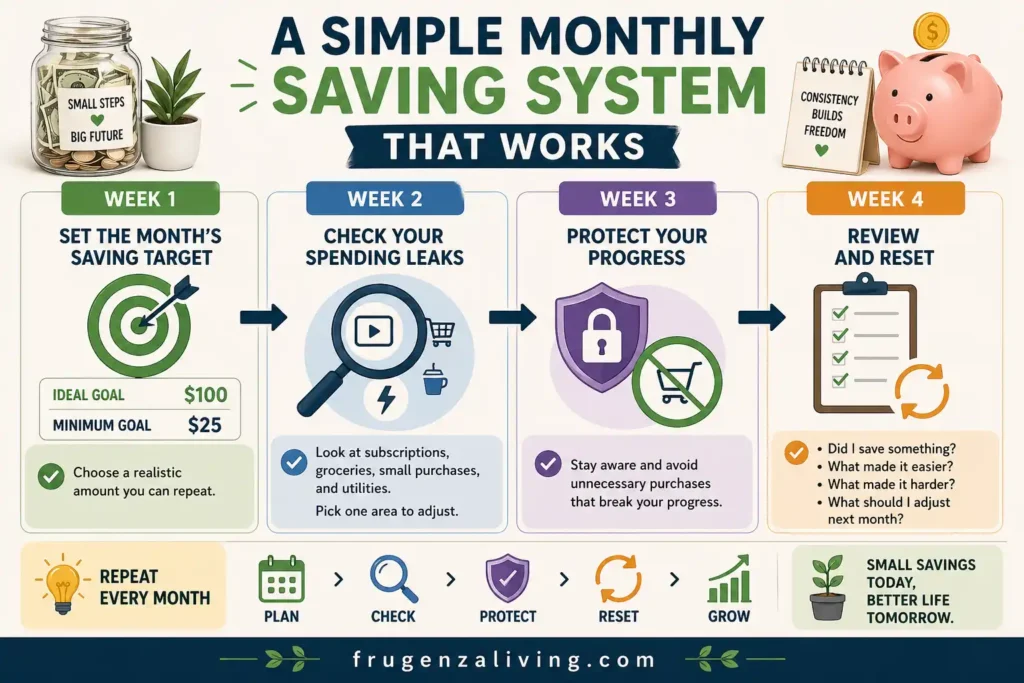
You don’t need a strict budget to save every month.
A simple four-week system is enough.
Week 1: Set the Month’s Saving Target
Choose a realistic amount.
Not the biggest amount possible.
The amount you can repeat.
For example, if $200 feels stressful, start with $50 or $100. A smaller amount saved consistently is better than an ambitious number you can’t maintain.
This is also a good time to set your minimum save amount. If the month becomes difficult, you still have a small target that keeps the habit alive.
Week 2: Check Your Spending Leaks
Look at subscriptions, groceries, small purchases, and utility habits.
Pick one area to adjust.
Don’t try to fix everything at once.
Week 3: Protect Your Progress
This is where many people slip.
Mid-month spending often feels harmless because payday still feels recent. Stay aware and avoid unnecessary purchases that break your progress.
If impulse purchases are the problem, learning how to control spending habits can help you protect the savings you’ve already made.
Week 4: Review and Reset
At the end of the month, ask:
- Did I save something?
- What made it easier?
- What made it harder?
- What should I adjust next month?
This simple review helps you improve without guilt.
What I Noticed After Saving Money Monthly
When I first tried to save money monthly, I made the mistake of aiming too high.
I wanted fast progress.
But the more aggressive the goal felt, the harder it was to maintain.
Things improved when I made the target smaller and more realistic. Instead of trying to change my entire lifestyle, I focused on repeatable choices.
What helped most was not saving a perfect amount. It was saving something every month, even when the amount was small.
After a few months, the biggest improvement wasn’t a huge dramatic number. It was consistency. Saving $50 to $100 every month felt much more realistic than trying to save a large amount once and failing.
I also noticed that the months I saved something, even a small amount, felt easier to recover from than the months I saved nothing at all.
I started feeling less stressed because saving no longer felt like a punishment. It became part of the month.
The biggest change was emotional.
I stopped seeing saving as something I had to force. I started seeing it as something I could stabilize.
That shift made the habit easier to continue.
What the First Month of Saving Actually Looks Like (And Why It Feels Off)
The first month is almost never the clean success story people expect.
Most guides describe saving as something that clicks immediately once you start. In reality, the first month often feels messy. You set a target, something unexpected comes up — a small repair, a medical copay, a friend’s birthday — and the original plan no longer fits.
That does not mean the month failed.
It means you learned something the second month will benefit from.
Here is what the first month of realistic monthly saving often looks like in practice:
- Week 1 feels motivating. You canceled a subscription, wrote down your goal, and moved money to savings.
- Week 2 starts smoothly, then a small unplanned expense appears.
- Week 3 is where most people quietly give up. The progress feels uncertain, and the month is not over yet.
- Week 4 arrives and the amount saved is lower than expected.
That pattern is not failure. That is what month one actually looks like for most people.
The value of the first month is not the amount you save. It is the information you collect about your real spending patterns. Where did the plan hold? Where did it break? What expense appeared that you did not expect?
A 2023 survey by Bankrate found that 57% of Americans could not cover a $1,000 emergency from savings alone. That is not a discipline problem. That is a pattern problem — one that a realistic monthly saving system is specifically designed to address over time, not instantly.
Month two becomes easier because you already know where your plan broke. Month three gets better because you adjust again.
The first month is not a test you pass or fail. It is the first draft of a habit you are still writing.
The Most Underrated Monthly Saving Habits
Some monthly saving habits don’t look impressive, but they work extremely well.
The first is reviewing subscriptions. It takes only a few minutes, but it can stop silent money leaks.
The second is planning easy meals. Food is one of the most flexible spending categories, and small improvements can make a big difference.
The third is checking your home before buying more. This prevents duplicate purchases.
The fourth is setting a low automatic savings transfer. Even if the amount is small, it builds consistency.
These habits are underrated because they are simple.
But simple is exactly why they work.
Common Mistakes That Stop Monthly Saving
The biggest mistake is being too strict.
If your plan feels miserable, you won’t stick with it.
Another mistake is being too ambitious. Saving money is good, but unrealistic targets create frustration.
Inconsistency is also a problem. Saving only when you “feel motivated” makes progress unpredictable.
And finally, many people ignore small expenses because they don’t seem important. But small expenses repeat. That repetition is what makes them powerful.
Saving money every month is not about doing everything perfectly.
It’s about improving the pattern.
How to Stay Consistent Every Month
Use this simple loop:
Adjust → Repeat → Stabilize
Adjust one spending area.
Repeat the change for a month.
Stabilize it before adding another change.
For example, start by reducing unused subscriptions. Once that feels normal, work on grocery planning. After that, improve impulse spending.
This keeps saving realistic.
You’re not rebuilding your whole financial life in one month.
You’re improving one layer at a time.
How This Fits Into Your Bigger Money Plan
Saving money every month becomes easier when it connects to a simple money system.
First, you reduce daily expenses at home so fewer small costs leak out.
Then, you learn how to control spending habits so impulse purchases don’t ruin your progress.
After that, you track expenses easily to see where your money actually goes.
And when you’re ready, better budgeting system can help you organize everything without making it stressful.
The order matters.
Habits first.
Awareness second.
Budgeting becomes easier after that.
FAQ
What are realistic ways to save money every month?
Realistic ways to save money every month include reducing unused subscriptions, planning groceries, lowering utility waste, setting small automatic transfers, and reviewing spending patterns. The key is choosing actions you can repeat every month without feeling restricted.
How much should I save every month?
How much you should save every month depends on your income, expenses, and situation. A realistic starting point could be $25, $50, or $100 per month. The amount matters less than building consistency first.
How can I save money consistently each month?
You can save money consistently each month by setting a realistic goal, automating a small transfer, reducing recurring money leaks, and reviewing your spending at the end of each month. Consistency improves when the system feels easy to repeat.
Why can’t I save money every month?
You may struggle to save money every month because your goal is too high, your spending patterns are unclear, or irregular expenses keep surprising you. Start smaller, review your monthly leaks, and create a flexible plan you can maintain.
What is the easiest way to save money regularly?
The easiest way to save money regularly is to automate a small amount after payday and reduce one recurring expense. This creates savings without requiring constant discipline or complicated budgeting.
Conclusion
Saving money every month does not have to feel extreme.
You don’t need to change your whole life.
You don’t need to cut every enjoyable thing.
You need a realistic pattern you can repeat.
Start small.
Adjust one area.
Save something every month.
If you repeat this for the next six months, even small amounts can start to feel meaningful.
Because real progress is not built from one perfect month.
It’s built from a simple habit you can keep repeating.

Read about Jeffi and Frugenza Living
- Proportional Bill Split Calculator for Two Incomes - October 15, 2026
- How to Split Grocery Bills With Roommates - October 14, 2026
- First Apartment Kitchen Essentials on a Budget - October 13, 2026