If you need to save money quickly—whether it’s for bills, an emergency, or just to get some breathing room—you probably already know one thing:
It feels almost impossible on a low income.
I’ve been there.
When most of your income is already used for essentials, saving doesn’t feel like a choice. It feels like something only people with extra money can do.
But here’s what changed everything for me.
Saving money fast on a low income is not about fixing everything.
It’s about making a few changes that create immediate impact.
Quick Answer: How to Save Money Fast on a Low Income
To save money fast on a low income, focus on cutting high-impact expenses, pausing non-essential spending, and making short-term adjustments that free up cash quickly. Instead of optimizing everything, target the biggest spending areas and make simple changes that can produce results within days.
Key Takeaways
- Fast saving comes from high-impact changes, not small details
- You don’t need a perfect system—just quick, practical actions
- The goal is to create results in 7–14 days, not months
Why Saving Money Feels Impossible on a Low Income
When your income is low, most of your money is already committed.
Rent, food, transport, utilities—these are not optional. That’s why advice like “just save more” doesn’t work.
There’s no margin.
On top of that, financial stress makes decision-making harder. When you’re tired, it’s easier to choose convenience over savings.
That’s why saving money quickly feels out of reach.
But the problem is not always your income.
It’s where your money is leaking.
The Fastest Way to Save Money Is to Stop the Biggest Leak
Most people try to save money by fixing small things first.
Skipping coffee. Cutting small subscriptions. Tracking every dollar.
That feels productive—but it’s slow.
If you want fast results, you need to stop the biggest leak in your budget.
One big change can save more money in a week than ten small ones combined.
High Impact vs Low Impact Spending (What Actually Saves Money Fast)
| Type | Example | Weekly Impact |
|---|---|---|
| High Impact | Food delivery, groceries, shopping | $50–$150+ |
| Low Impact | Coffee, small apps, minor fees | $5–$20 |
This is why focusing on the right expenses matters more than doing everything.
If your income is limited, learning how to manage money with a low income is the first step to gaining control.
Build a Fast-Savings Gap Plan
Fast Savings Gap Planner
Calculate how much you still need, your daily target, and whether your short-term savings plan closes the gap.
Set your target
Do not include money already reserved for rent, food, utilities, medication, or required payments.
Your fast-savings result
Remaining gap after your plan
$0
This is the amount your current plan has not covered yet.
Before cutting expenses, define the exact amount you need and the date you need it. “Save as much as possible” creates urgency but gives you no clear finish line.
Use this simple calculation:
Savings target − money already safely available = savings gap
Then divide the gap by the number of days remaining:
Savings gap ÷ days remaining = average amount to find each day
For example, imagine you need $300 in 10 days and already have $40 that is not reserved for rent, utilities, basic food, medication, transportation, or required payments.
Your savings gap is:
$300 − $40 = $260
Your average target is:
$260 ÷ 10 days = $26 per day
You do not need to find exactly $26 every day. The daily number simply shows whether the goal is realistic and how much progress is still required.
Next, divide the gap into three sources:
- Money saved: expenses you avoid, such as takeout, shopping, or optional transportation.
- Money delayed: non-essential purchases or subscriptions moved beyond the deadline.
- Cash raised: one-time money from selling unused items or completing temporary work.
Keep these amounts separate. Selling an item creates cash, but it does not permanently lower your expenses. Canceling an unused recurring charge may save less immediately, but it can continue helping after the deadline.
A $260 gap might be covered like this:
- $70 from a seven-day pause on optional spending;
- $60 from replacing several takeout meals;
- $30 from pausing a non-essential charge;
- $100 from selling unused items.
If the numbers still do not work, do not take money from essential expenses just to reach the target. Reconsider the deadline, reduce the amount if possible, or contact the company or person expecting payment to ask about a payment arrangement.
Saving money fast becomes more useful when the goal is measurable. Instead of cutting randomly, you know the size of the gap, the time available, and which actions are actually moving you closer.
Real Data: Why Food Spending Is the Fastest Lever
According to recent consumer data in the US, eating out can cost 2–3× more than cooking at home.
- Average takeout meal: $12–$18 per meal
- Simple home-cooked meal: $3–$6 per meal
👉 That means switching just one meal per day can save:
$60–$200 per week
This is why food is often the fastest way to save money on a low income.
10 Realistic Ways to Save Money Fast on a Low Income
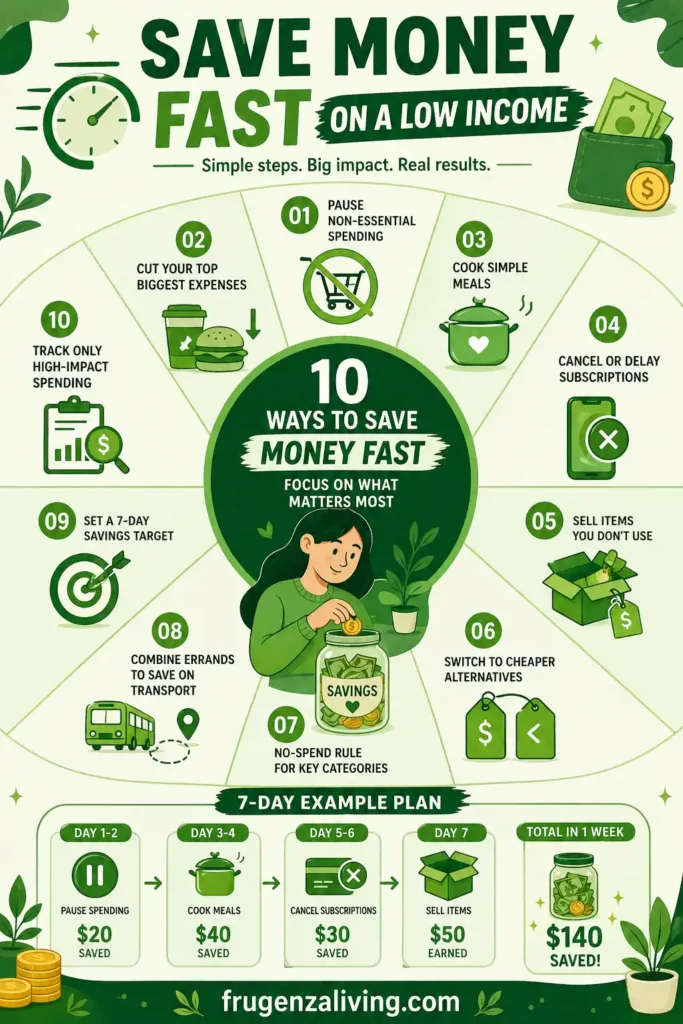
1. Pause All Non-Essential Spending for 7 Days
This is the fastest reset you can do.
Instead of trying to fix everything, pause anything non-essential for one week. This removes decision fatigue and gives you instant control.
Example:
$10/day × 7 days = $70 saved immediately
It’s not just about ideas—you need to handle your finances better in everyday situations.
2. Cut Your Top 1–2 Biggest Flexible Expenses
Small cuts feel safe, but big cuts create results.
Focus on:
- food delivery
- shopping
- convenience spending
This works because large expenses create immediate financial impact without needing detailed tracking.
3. Simplify Your Meals (Temporarily)
Food is your biggest opportunity for fast savings.
You don’t need perfect nutrition plans—just simple, low-cost meals for a short period.
Some of the fastest results come from saving money at home with small, practical changes.
This works because it reduces both cost and decision-making.
4. Delay Subscriptions and Recurring Payments
Recurring costs often go unnoticed.
Even $10–$30 matters when saving fast. Cancel or pause what you don’t need right now.
5. Sell Items You’re Not Using
This is one of the fastest ways to generate cash.
You don’t need perfect listings. Speed matters more than price.
Example:
2–3 items → $50–$200 within days
6. Switch to Lower-Cost Alternatives Immediately
Instead of cutting everything, downgrade temporarily.
This works because it reduces resistance while still creating savings.
7. Use a “No-Spend Rule” for Specific Categories
Choose 1–2 categories only.
This works because it creates a clear boundary without overwhelming you.
The real challenge is learning how to maintain your budget over time even when things feel tight.
8. Combine Errands to Reduce Transport Costs
Transport adds up quickly.
Planning smarter reduces unnecessary spending immediately.
9. Set a 7-Day Savings Target
Short-term goals feel achievable.
This works because it creates urgency and visible progress.
Fast results matter, but long-term progress comes from realistic ways to save money every month.
10. Track Only High-Impact Spending
Tracking everything slows you down.
Focus only on what matters.
If you want a simple system, learning how to track expenses easily can help without overcomplicating things.
A Simple 7-Day Example to Save Money Fast
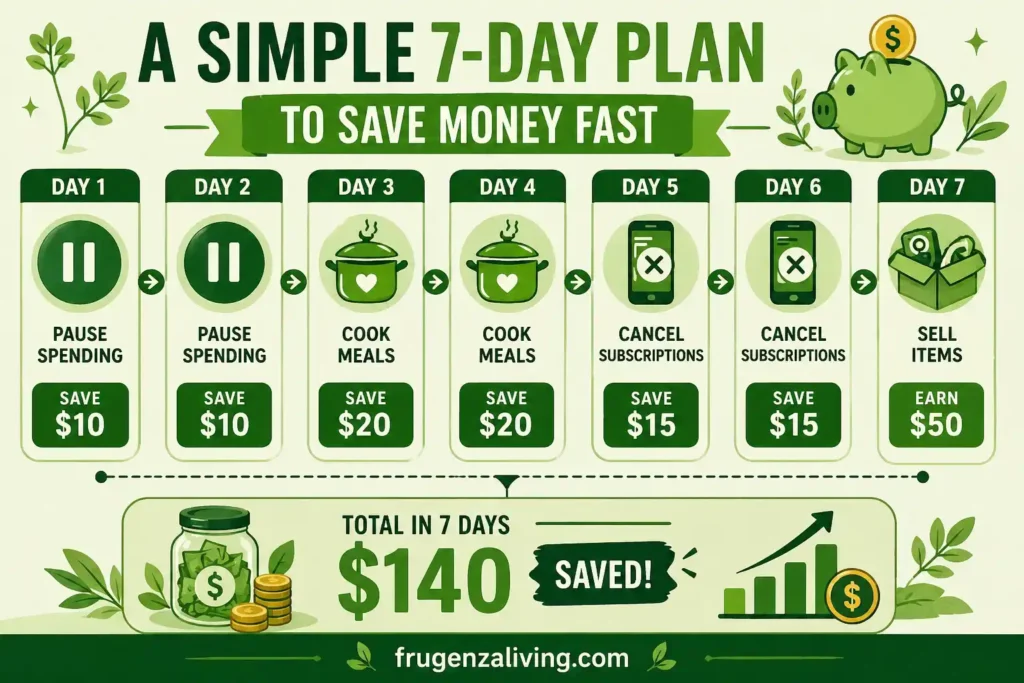
Day 1–2:
Pause spending → Save $20
Day 3–4:
Cook meals → Save $40
Day 5–6:
Cancel subscriptions → Save $30
Day 7:
Sell items → Earn $50
Total: $140 saved in one week
One of the fastest ways to cut expenses is to follow a grocery budget for one person that fits your routine.
What I Noticed After Trying This
At first, I thought I needed a perfect system.
But when I focused only on high-impact changes, something shifted.
I wasn’t earning more during that time. The change came purely from how I handled the money I already had.
Within a few days, saving didn’t feel impossible anymore.
It felt manageable.
And that made it easier to continue.
What NOT to Do When Trying to Save Fast
Don’t try to cut everything
→ leads to burnout
Don’t track every detail
→ slows you down
Don’t set unrealistic goals
→ causes frustration
How to Stay Consistent While Saving Quickly
Fast saving works best when it’s simple.
- check your spending
- notice patterns
- adjust quickly
If consistency is your issue, learning how to stay consistent with a budget can help you keep the progress going.
How This Connects to Your Overall Money System
Fast saving is not the end.
It’s the starting point.
After that, you can:
- build structure
- improve habits
- create stability
You can combine this with simple budgeting for beginners or how to manage money on a low income.
FAQ: How to Save Money Fast on a Low Income
Is it really possible to save money fast on a low income?
Yes. By focusing on high-impact expenses, you can free up money within days, even with limited income.
What is the fastest way to save money when broke?
Pause non-essential spending, reduce food costs, and sell unused items.
How much can I save in a week?
Most people can save $50–$150 depending on spending habits.
Should I budget or save first?
Save first if urgent, then budget later.
What if I fail after a few days?
Continue the next day. Don’t wait for next month.
Ending
Saving money fast on a low income is not about doing everything.
It’s about doing what matters first.
Stop the biggest leak.
Make a few smart changes.
And start building from there

The ideas shared here come from real-life experience and practical habits that actually work.
→ Read more about Jeffi
- No Spend Month Challenge for Beginners: A 30-Day Plan - September 24, 2026
- Low Buy Month Challenge: Realistic Rules for 30 Days - September 23, 2026
- How to Stop Buying Groceries You Already Have - September 20, 2026