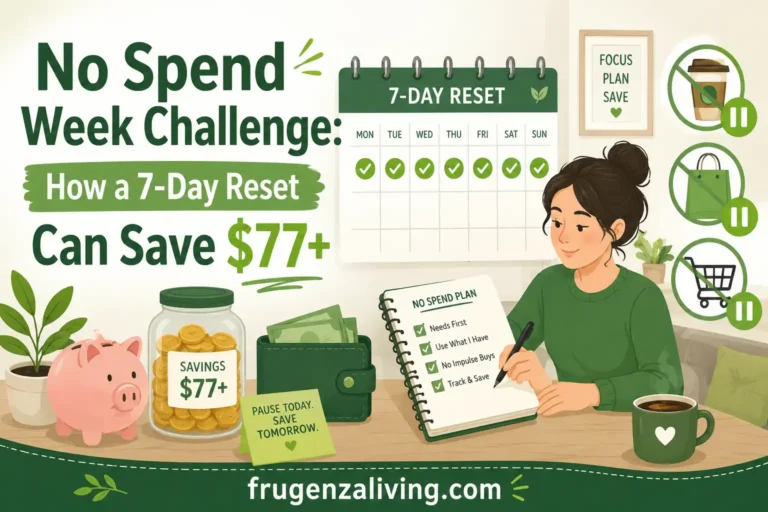
A no spend week challenge sounds simple until real life shows up.
Coffee on a busy morning. Takeout after a long day. An online cart during boredom. A “small” purchase that somehow turns into three more.
That is why a no spend week should not feel like punishment.
It is not about spending zero money for seven days. It is about pausing nonessential spending so you can see where your money quietly disappears, reset your habits, and decide what is actually worth bringing back.
This matters because small spending habits can add up fast. U.S. household spending on food away from home, including restaurant, delivery, and takeout meals, averaged $3,945 per year in 2024, according to Bureau of Labor Statistics data.
What Is a No Spend Week Challenge?
A no spend week challenge is a 7-day spending reset where you still pay for essentials but pause nonessential purchases.
You still cover real needs like rent, utilities, groceries, transportation, medicine, healthcare, required bills, and debt minimums. But for one week, you pause spending on extras like takeout, impulse shopping, unnecessary online orders, paid entertainment, coffee runs, and convenience purchases.
Fidelity explains that a no-spend challenge means buying only essentials for a set period, not eliminating all spending completely.
That distinction matters because a realistic challenge should reduce money leaks, not create unpaid bills or stress.
The goal is not perfection.
The goal is awareness.
Why a No Spend Week Can Work
A week is short enough to feel doable, but long enough to reveal patterns.
You may notice that you do not miss some purchases as much as you expected. You may also notice that certain spending habits appear at predictable times: after work, late at night, during stress, or when your fridge feels empty.
Impulse spending is common. Capital One Shopping Research estimated that the average consumer spent $282 per month on impulse buys in 2024.
A no spend week gives you a short pause before those habits become automatic again.
Author Note: Why I Use No-Spend Weeks
I used to think saving money meant making huge changes.
But small spending pauses taught me more about my habits than any complicated budget ever did.
A no spend week helped me notice how often I spent money because I was tired, bored, stressed, or trying to make the day feel easier. It was not always about the dollar amount. It was about the pattern.
No-spend weeks, weekly check-ins, and reducing money leaks became some of the habits that helped me save over $15,000 in a year.
Your numbers may look different, but a no spend week can still show you where your money quietly disappears.
This challenge works best when it becomes part of a weekly saving habit you can repeat.
What You Can Still Spend Money On
A no spend challenge should never block essentials.
You can still spend money on:
- rent or mortgage
- utilities
- basic groceries
- transportation
- medicine
- healthcare
- required bills
- debt minimums
This matters because some people hear “no spend” and think they are supposed to avoid all spending.
That is not realistic or healthy.
Essentials still count as responsible spending.
A no-spend week becomes easier when you already understand how a simple saving challenge works.
What to Pause During a No Spend Week
During the challenge, pause nonessential spending.
That usually includes:
- takeout
- coffee runs
- online shopping
- new clothes
- beauty extras
- paid entertainment
- unnecessary delivery orders
- impulse purchases
The goal is not to feel deprived forever.
The goal is to pause automatic spending long enough to notice it.
If you usually buy coffee because you are tired, order food because cooking feels hard, or browse online stores when you are bored, this week can show you where those patterns appear.
When a No Spend Week May Not Be the Right Move
A no spend week may not be the right move if it would make you delay medicine, basic groceries, bills, transportation, or necessary repairs.
In that case, focus on stability first.
You can still track spending for seven days without forcing yourself to pause essential purchases.
That still gives you useful information.
The point is not to prove toughness. The point is to understand your money habits without making your life harder.
The goal is not to punish yourself, but to save money without cutting everything you enjoy.
No Spend Week Rules: What to Keep, Pause, and Protect
Use this simple rule before you start:
Pause nonessential spending for seven days, protect real needs, and track what you avoided buying.
No Spend Week Challenge Rules
What to Keep, Pause, and Track
Use this quick guide to pause money leaks without blocking real-life essentials.
Simple rule:
Pause nonessential spending for seven days, protect real needs, and track what you avoided buying.
This keeps the challenge clear: essentials stay, money leaks pause, free swaps replace habits, and avoided spending becomes visible.
After finishing one no-spend week, you can try a 52-week saving challenge to build longer-term momentum.
A Simple 7-Day No Spend Week Plan
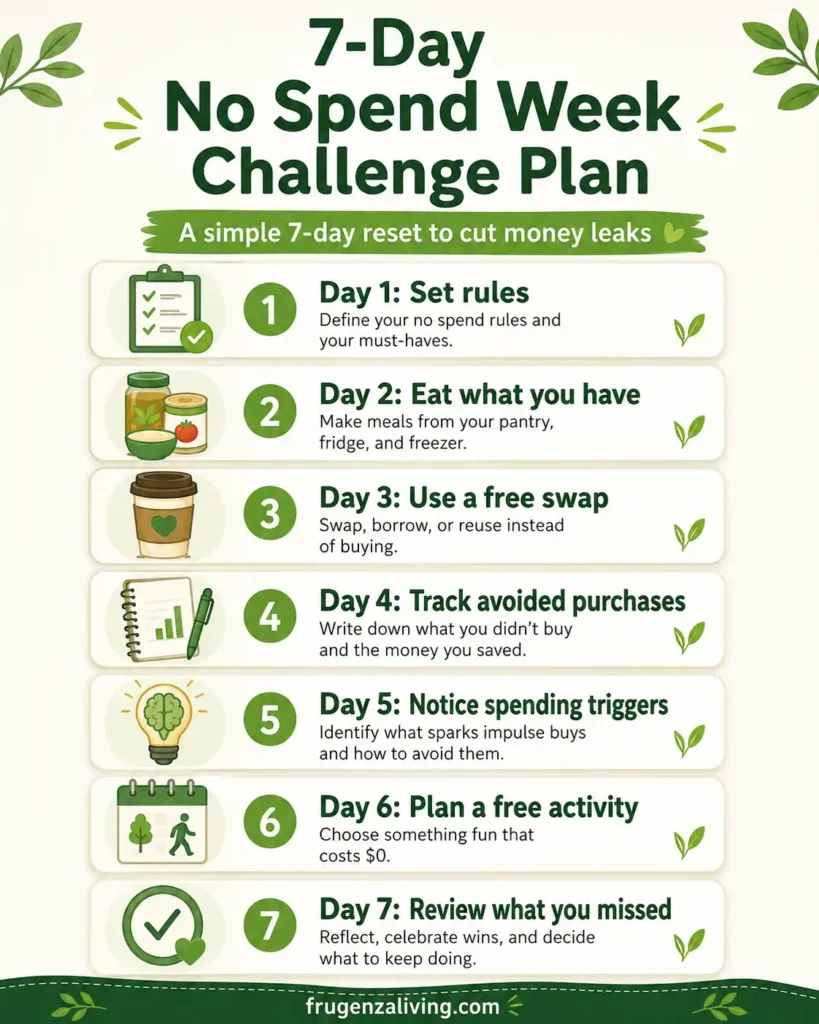
Use this as a realistic no spend week checklist.
Day 1: Set rules and remove easy temptations
Start by writing your rules before the week begins.
Do not leave the rules vague. “Spend less” is too easy to bend when you are tired. Instead, decide what counts as essential and what is paused.
For example, groceries are allowed, but takeout is paused. Gas for work is allowed, but a random store run is paused. Medicine is allowed, but browsing sale items online is paused.
Then remove easy temptations. Delete shopping apps from your home screen, clear saved carts, unsubscribe from promo emails for the week, and make food delivery harder to access.
The goal is not to rely on willpower all week.
The goal is to make the easier choice cheaper.
Day 2: Eat from what you already have
Check your fridge, freezer, and pantry before buying anything.
Most people have at least one simple meal hiding somewhere: rice and beans, eggs and toast, pasta and sauce, frozen vegetables, soup, oats, or leftovers.
This day is not about making a perfect meal.
It is about proving that you can delay convenience spending by using what you already own.
A useful question is:
“What can I make before I spend?”
That one question can stop a takeout order before it starts.
Day 3: Replace one spending habit with a free option
A no spend week works better when you replace spending, not just remove it.
If you usually buy coffee, make it at home. If you usually browse online stores when you are bored, take a walk, read, clean one drawer, or call someone instead.
This matters because spending often fills a feeling.
Sometimes it is stress. Sometimes it is boredom. Sometimes it is the need for a small reward after a hard day.
You do not have to judge that.
Just notice it.
Then test a free replacement.
Day 4: Track avoided purchases
Write down every purchase you almost made.
Do not only track what you bought. Track what you avoided.
For example:
- “Almost ordered takeout: $18”
- “Skipped coffee run: $6”
- “Did not buy sale item: $35”
This makes no spend week savings feel real.
A no spend challenge can feel invisible if you do not track avoided spending. But when you write it down, you can see the pattern clearly.
Day 5: Notice emotional spending triggers
Day 5 is where the challenge becomes more useful.
By now, you may notice certain triggers.
Maybe you want to shop when you are bored. Maybe you want takeout when you feel overwhelmed. Maybe you scroll shopping apps at night because your brain wants a small hit of excitement.
Use this day to ask:
“What was I feeling right before I wanted to spend?”
That question can teach you more than simply saying, “I need more discipline.”
Day 6: Plan a free weekend activity
Weekends can be harder because spending often feels social.
Plan one free activity before the urge to spend appears.
That could be a walk, library visit, home movie night, free local event, pantry clean-out meal, or calling a friend.
If you wait until you are bored, spending becomes easier.
If you plan ahead, the free option has a chance.
Day 7: Review what you actually missed
At the end of the week, review what you paused.
Which purchases did you truly miss?
Which ones were automatic?
Which ones felt urgent at the time but unimportant later?
This is the difference between restriction and reflection.
You are not trying to prove that you never need to spend money again.
You are learning what deserves a place in your life and what was quietly draining your budget.
Free Alternatives During a No Spend Week
Try:
- library books
- free walk
- home movie night
- leftover meal
- call a friend
- free local events
- clean out pantry
- use what you already own
If you only remove spending, the week can feel restrictive.
If you replace spending, it becomes a reset.
Track the Money You Did Not Spend
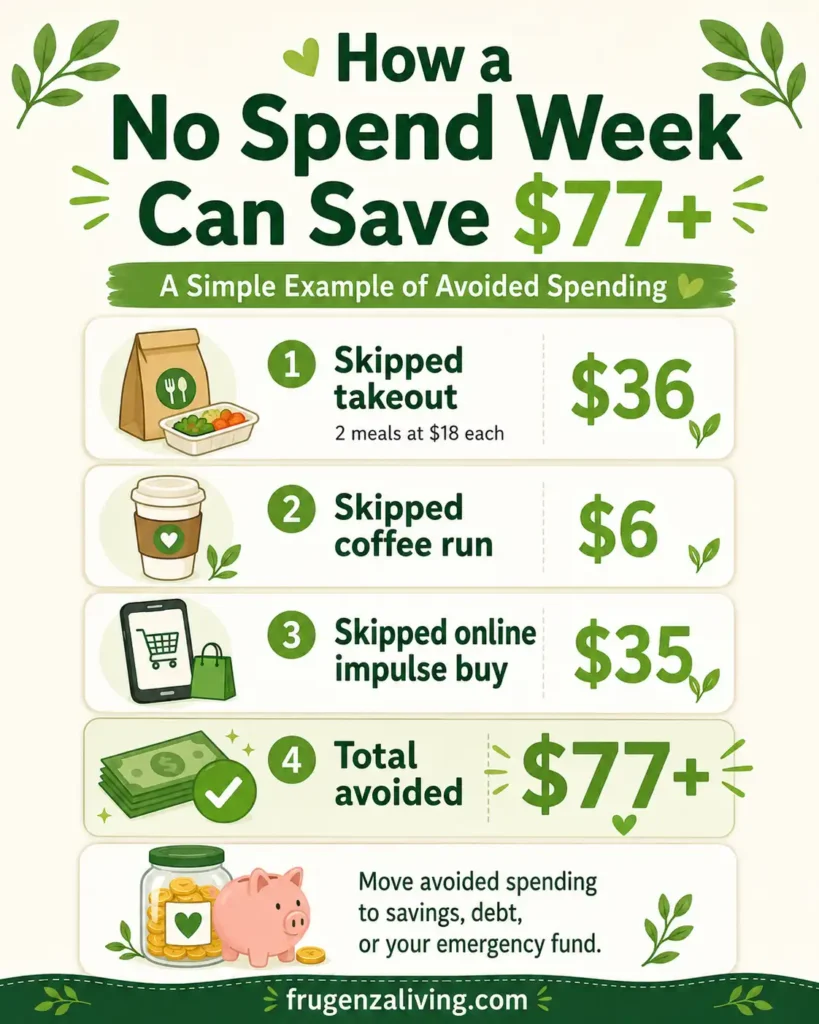
Tracking avoided spending is one of the most useful parts of the challenge.
For example:
- two takeout meals at $18 each = $36
- one coffee run = $6
- one online impulse buy = $35
That is about $77 avoided in one week.
You do not have to save all of it if your budget is tight. But if possible, move some of that money to savings, debt repayment, or a small emergency fund.
This connects the challenge to a real result.
Decide Where the Money Goes Before the Week Starts
The $77 avoided in the example above does not automatically become savings.
Without a destination decided in advance, avoided spending tends to dissolve back into the regular budget within a few days — not through one deliberate purchase, but through dozens of smaller ones that feel reasonable because last week was strict.
This is the most common reason a no-spend week produces no lasting financial change: the money existed briefly as avoided spending, then quietly returned to normal patterns before a decision could be made about it.
There is a straightforward way to prevent this.
Before the week starts, decide on one destination for the avoided spending. Not after the week ends, when you can see the number — before, when the decision is made without the pressure of a specific amount in hand.
The destination does not need to be complicated. It only needs to be specific:
- Move a fixed amount to a separate savings account on Day 7, regardless of how much was actually avoided
- Apply the avoided spending toward the next step of a savings challenge already in progress
- Use it to cover one specific upcoming bill or irregular expense that would otherwise feel unplanned
- Set it aside as the start of a small emergency buffer if that does not yet exist
The reason pre-assignment works better than post-challenge deciding is simple.
When you decide after the week, you are making a financial decision while the relief of “it’s over” and the accumulated desire for normal spending are both present. The mental calculus tends to favor a small reward.
When you decide before the week, the money already has a job. The question is no longer “what should I do with this?” It is only “did enough get avoided to fill the job I already set?”
That shift removes one decision from a moment when it is easy to make the wrong one.
Write the destination down on Day 1, next to your spending rules.
That note makes the end of the week an outcome, not another decision.
Free 7-Day No Spend Week Tracker
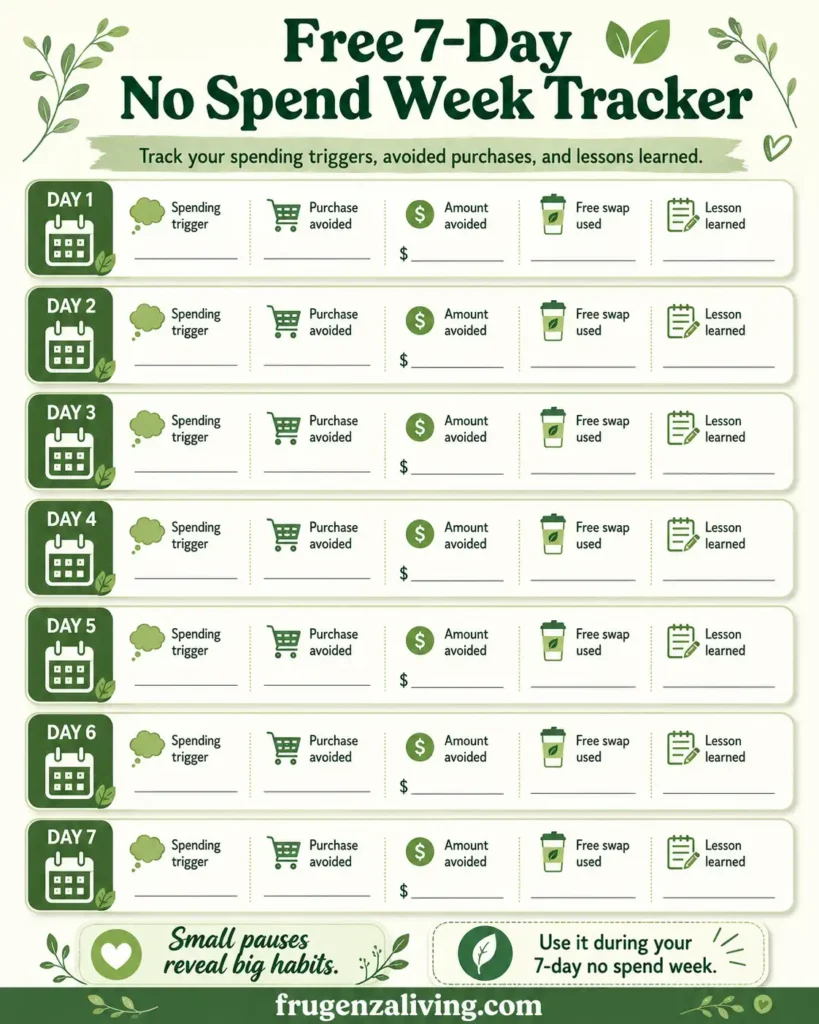
Use this simple tracker while you do the challenge.
Day 1
- Spending trigger:
- Purchase avoided:
- Amount avoided:
- Free swap used:
- Lesson learned:
Day 2
- Spending trigger:
- Purchase avoided:
- Amount avoided:
- Free swap used:
- Lesson learned:
Day 3
- Spending trigger:
- Purchase avoided:
- Amount avoided:
- Free swap used:
- Lesson learned:
Day 4
- Spending trigger:
- Purchase avoided:
- Amount avoided:
- Free swap used:
- Lesson learned:
Day 5
- Spending trigger:
- Purchase avoided:
- Amount avoided:
- Free swap used:
- Lesson learned:
Day 6
- Spending trigger:
- Purchase avoided:
- Amount avoided:
- Free swap used:
- Lesson learned:
Day 7
- Spending trigger:
- Purchase avoided:
- Amount avoided:
- Free swap used:
- Lesson learned:
This gives you a reason to return to the article during the week instead of reading it once and forgetting it.
Watch for These Money Leaks
Common money leaks include:
- food delivery
- convenience snacks
- coffee runs
- sale items
- app purchases
- subscriptions
- small online carts
These purchases may not look huge by themselves.
But repeated often, they can quietly drain your money.
The challenge is not useful because it makes you perfect.
It is useful because it makes invisible habits visible.
How to Avoid Rebound Spending After the Challenge
Rebound spending can happen when people feel restricted and then overspend afterward.
Try this:
- wait 48 hours before buying anything saved in a cart
- move avoided spending to savings
- buy only what still matters after the challenge
- keep one no-spend day each week
- bring back spending intentionally, not automatically
The goal is not to never spend again.
The goal is to decide what is actually worth bringing back.
FAQ
What is a no spend week challenge?
A no spend week challenge is a 7-day spending reset where you pause nonessential purchases while still paying for essentials like rent, utilities, groceries, transportation, medicine, required bills, and debt minimums.
What can I buy during a no spend week?
You can buy essentials during a no spend week. This includes basic groceries, medicine, healthcare, transportation, utilities, rent or mortgage, required bills, and debt minimums.
What should I avoid during a no spend week?
Avoid nonessential spending such as takeout, coffee runs, online shopping, new clothes, paid entertainment, beauty extras, unnecessary delivery orders, and impulse purchases.
How much money can a no spend week save?
The amount depends on your habits. For example, skipping two $18 takeout meals, one $6 coffee run, and one $35 online impulse buy can avoid about $77 in spending.
What if I accidentally spend money during the challenge?
If you accidentally spend money, continue the challenge. Do not quit because of one purchase. Write down what happened, adjust your rules if needed, and keep going.
Is a no spend week better than a no spend month?
A no spend week is often better for beginners because it is shorter, easier to finish, and less overwhelming. A no-spend month can work, but it may feel too strict if you are new to spending resets.
How do I avoid overspending after a no spend week?
Wait 48 hours before buying anything saved in a cart, move avoided spending to savings if possible, buy only what still matters, and keep one no-spend day each week to maintain the habit.
Final Thought: Make the Week a Reset, Not a Punishment
A no spend week challenge is not about proving you can live without spending forever.
It is about noticing what happens when nonessential spending pauses for seven days.
Keep essentials covered.
Replace spending with free options.
Track what you avoided.
Then use the week to learn what you want to bring back intentionally.
This article is for educational purposes only and is not professional financial advice.

Read about Jeffi and Frugenza Living
- Proportional Bill Split Calculator for Two Incomes - October 15, 2026
- How to Split Grocery Bills With Roommates - October 14, 2026
- First Apartment Kitchen Essentials on a Budget - October 13, 2026