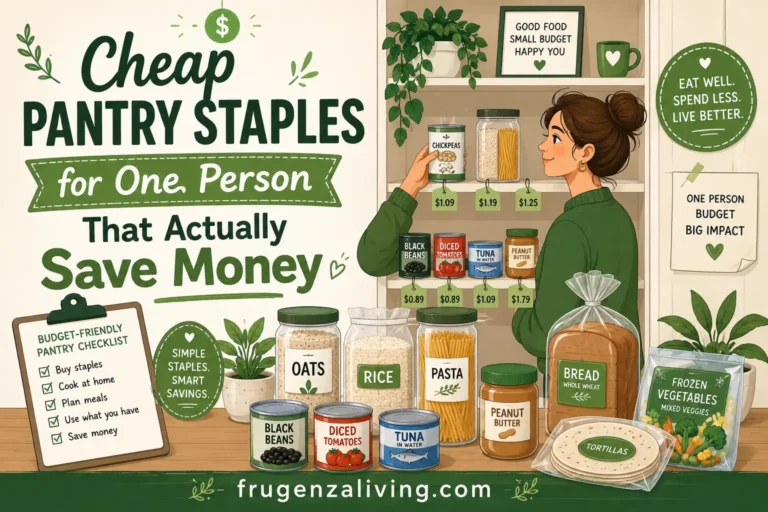
Cheap pantry staples for one person are useful when you can turn them into meals you already eat, afford the full packages, and store the remaining food correctly. Start with a few connected ingredients rather than trying to buy every low-cost food at once.
This guide shows how to choose a small core, price an illustrative shopping basket, allocate ingredients to portions, and decide what to restock. It includes refrigerator and freezer companions, clearly separated from foods that belong on a pantry shelf.
Choose Meal Combinations Before Buying Staples
Write down two simple combinations you are willing and able to prepare. One might be oats with peanut butter; another might be pasta with cooked beans, tomatoes, and vegetables. Check what you already own before buying any missing components.
Use four roles to narrow the list:
- Base: choose oats, pasta, rice, or another base you use regularly.
- Protein ingredient: choose an option that fits the meal, such as cooked canned beans, canned fish, or peanut butter.
- Flavor: choose a compatible ingredient, such as canned tomatoes, a sauce, or seasoning already at home.
- Backup: reserve enough ingredients for one meal you can prepare when the original plan changes. A backup can use the same staples; it does not require another shopping category.
This is a shopping filter, not a nutritional formula. Add produce and other foods to meet your needs. You do not have to buy several grains, proteins, or sauces in the same trip.
Separate Shelf, Refrigerator, and Freezer Stock
| Storage area | Examples | What changes after use |
|---|---|---|
| Pantry shelf | Dry oats, dry pasta, dry rice, commercially canned beans or tomatoes labeled for room-temperature storage | Keep dry foods protected and follow the label. Opened canned food and cooked portions need a different storage plan. |
| Product-dependent | Peanut butter, sauces, some packaged broths | Read the label before and after opening. Some products need refrigeration; shelf-stable packaging does not make the opened food shelf-stable. |
| Refrigerator | Refrigerated eggs, chilled tofu, opened canned food, and cooked leftovers | Keep cold, label opened or prepared food, and plan its next use. |
| Freezer | Frozen vegetables, frozen bread, and suitable prepared portions | Keep frozen until needed and follow cooking or thawing instructions. |
Eggs and frozen vegetables can support an inexpensive kitchen, but they are not dry pantry items. If you lack a refrigerator or freezer, choose products that can safely remain at room temperature until use and plan to finish opened perishables promptly.
An Illustrative Starter Basket With Package Sizes
These USD prices are hypothetical calculation inputs. They are not verified store quotes, national averages, or the author’s personal spending results. Replace each package size and price with the product available to you before shopping. The basket is an example, not a claim that everyone can stock a pantry for $9.
The example allocates ingredients to two oatmeal breakfasts and two pasta-and-bean meals. It is not a full day’s or week’s food plan. The serving quantities are starting examples, not calorie or nutrition targets; increase quantities and costs if you need more food.
| Item and package | Checkout cost | Planned use | Remaining stock | Allocated cost |
|---|---|---|---|---|
| Rolled oats, 500 g | $2.00 | 120 g dry | 380 g dry | $0.48 |
| Peanut butter, 340 g | $2.00 | 40 g | 300 g | $0.24 |
| Dry pasta, 500 g | $1.50 | 160 g dry | 340 g dry | $0.48 |
| Cooked canned beans, 400 g net; assumed 240 g drained | $1.00 | All 240 g drained beans | No beans; canning liquid discarded | $1.00 |
| Canned tomatoes, 400 g | $1.00 | All 400 g, including juice | None | $1.00 |
| Frozen mixed vegetables, 500 g | $1.50 | 300 g weighed frozen | 200 g frozen | $0.90 |
| Total | $9.00 | Two breakfasts and two pasta meals, plus stock remaining | $4.10 | |
Check drained weight on the beans or weigh them after draining. A 400 g can includes liquid and may yield a different usable amount. This example assigns the entire $1 purchase price to the drained beans, not to food that will be discarded.
The illustrative checkout excludes applicable taxes, delivery, and travel charges. Ingredient costs exclude cooking energy, equipment, containers, and optional additions. Water is used to cook the oats and pasta; no milk, oil, or seasoning purchase is assumed. Add relevant costs to your own comparison.
How the Portions Use the Basket
Two oatmeal breakfasts
For each breakfast, use 60 g dry oats and 20 g peanut butter. Cook the oats with water according to the package, then stir in the peanut butter. That uses 120 g oats and 40 g peanut butter across both breakfasts. Any fruit, milk, or extra topping is additional.
The combined allocated cost is $0.48 for oats plus $0.24 for peanut butter: $0.72 for two breakfasts, or about $0.36 each.
Two pasta-and-bean meals
Use 160 g dry pasta, the full 240 g drained cooked beans, all 400 g tomatoes with juice, and 300 g frozen vegetables. Cook the pasta and vegetables according to their package directions. Heat the tomatoes and beans, combine with the cooked vegetables and pasta, and divide equally.
Each portion receives the cooked equivalent of 80 g dry pasta, 120 g drained beans, 200 g tomatoes, and 150 g frozen vegetables. Pasta absorbs water, so divide the cooked batch equally rather than treating its cooked weight as its dry weight.
The allocated cost is $0.48 + $1.00 + $1.00 + $0.90 = $3.38 for two meals, or $1.69 each. Eat one and refrigerate the other promptly for the next day, following the handling guidance below. Freeze promptly if plans change.
For a more detailed preparation and backup-food workflow, use the small-batch meal prep guide for one person. Here, the purpose of the portions is to show which packages get used and what remains.
Reconcile Food Value With Cash Spent
For a partially used package, calculate:
Allocated ingredient cost = package price × amount used ÷ usable package quantity.
For example, pasta costs $1.50 × 160 ÷ 500 = $0.48 for the planned meals. Peanut butter costs $2 × 40 ÷ 340, rounded to $0.24. This table rounds each allocated row to cents before adding; remaining stock value is the package cost minus that rounded allocation.
- Cash needed to buy all packages: $9.00.
- Ingredients allocated to the four eating occasions: $4.10.
- Remaining stock value: $1.52 oats + $1.76 peanut butter + $1.02 pasta + $0.60 vegetables = $4.90.
$4.10 + $4.90 = $9.00. The remaining $4.90 is food you own, not money returned to your account. If you discard some of it, record waste rather than treating all of it as food successfully used.
Existing stock changes checkout. If you already have enough oats and peanut butter, buying the other four packages costs $5.00 at these example prices. The oats and peanut butter you use still have value. For dated comparisons of your actual packages and prices, use the grocery price book.
Restock What the Next Meals Need
After these meals, write the remaining quantities on your shopping list: 380 g oats, 300 g peanut butter, 340 g dry pasta, and 200 g frozen vegetables. Beans and tomatoes have been used up.
If your next intended meal repeats one pasta portion, you already have enough pasta and frozen vegetables for it, but need beans and tomatoes. Price any replacement cans in full and plan their remaining contents. Owning part of a recipe does not mean the whole next meal is funded.
Before restocking, ask what you expect to use before the next shop and whether a deliberate backup is already covered. An unopened can held for occasional use does not become a poor choice simply because it has not moved in two or three weeks.
Investigate repeated waste, missing ingredients that prevent meals, or purchases that no longer match your needs. Takeout frequency alone cannot establish whether the pantry works: you may still choose restaurant meals for convenience or social plans.
Choose Package Size After Checking Cash and Expected Use
A larger pack can have a lower unit price while requiring more cash today. Choose it only if you can afford the whole purchase alongside other food needs, store it properly, and realistically use the quantity.
Count usable carryover that you genuinely expect to eat, even if it lasts beyond this week. Do not count food you repeatedly discard. Use the bulk-buying break-even check for a price-and-expected-use comparison rather than assuming the largest package wins.
Keep Opened Food and Cooked Portions Safe
Follow the product label for storage before and after opening. Keep dry foods protected from moisture and pests. Give opened perishables and cooked portions a next use rather than leaving them on the shelf with unopened cans.
FoodSafety.gov’s food safety steps specify these handling basics:
- Keep the refrigerator at 40°F (4°C) or below and the freezer at 0°F (−18°C) or below.
- Refrigerate perishables within two hours, or within one hour when exposed to temperatures above 90°F (32°C).
- Use shallow containers to cool leftovers promptly; do not wait for a large pot to become completely cold on the counter.
- Keep refrigerated eggs in their carton in the refrigerator. Frozen vegetables belong in the freezer and need the cooking directed on their package.
For the saved pasta portion, reheat to 165°F (74°C), checked with a food thermometer, as listed in FoodSafety.gov’s minimum-temperature chart for leftovers. Follow microwave stirring and standing instructions where applicable. Discard food left out beyond the safe time limits; reheating does not undo unsafe storage.
Frequently Asked Questions
What cheap pantry staples should one person buy first?
Choose ingredients for meals you already eat: one or two dry bases, a compatible protein ingredient, and a flavor component. Check existing stock and storage before adding extras. The example basket is one option, not a required list.
How much does a starter pantry cost?
It depends on local prices, package sizes, dietary needs, and what you own. The $9 basket here uses hypothetical prices to explain checkout cost, ingredient allocations, and remaining stock; it is not a current price quote.
Are eggs and frozen vegetables shelf-stable pantry foods?
No. They can complement pantry staples, but refrigerated eggs need refrigerator storage and frozen vegetables need freezer storage. Follow the product’s handling instructions.
Do pantry staples guarantee lower spending?
No. The food must be used, fit your needs, and replace spending you would otherwise make after extra costs are considered. Buying ingredients or holding leftover stock is not itself a realized saving.
Should I replace stock that I have not used for several weeks?
Not automatically. Check whether it is a deliberate backup, whether you still expect to use it, and whether its condition and storage remain suitable. Repeated waste or no realistic use is a better reason to change future purchases than a fixed weekly turnover rule.

Read about Jeffi and Frugenza Living
- Return Deadline Tracker Template: Track Returns and Refunds - November 12, 2026
- Recipe Cost Calculator for Home Cooking - November 10, 2026
- How to Save for a Car Insurance Deductible - November 9, 2026