Your pantry can look full and still somehow feel like there is nothing to eat.
There is half a bag of pasta, three jars of sauce, rice hiding behind newer groceries, something forgotten in the freezer, and an ingredient bought for a recipe that never happened. Then the grocery app opens anyway.
A shop your pantry challenge is a short experiment where you build meals around food already in your pantry, fridge, and freezer before automatically buying more.
The goal is not to empty every shelf. It is to turn food you already paid for into useful meals, reduce duplicate purchases, and learn what actually deserves to be restocked.
A full pantry is not savings until the food actually gets used.
When your pantry finally needs restocking, grocery shop on a budget by replacing only the foods you actually use rather than automatically refilling every empty space.
Shop Your Pantry Challenge Rules
Keep the rules practical:
- use existing food first;
- buy essentials or a small bridge ingredient when genuinely needed;
- compare spending over equal-length grocery periods;
- never sacrifice nutrition or food safety just to avoid shopping;
- stop when your inventory can no longer support reasonable meals.
This is an inventory reset, not a deprivation test.
The Food Is Already Paid For
A pantry challenge does not create free groceries.
You already spent money on the rice, canned beans, frozen vegetables, yogurt, pasta, cereal, and leftovers sitting in your kitchen. The opportunity is to capture the value of those purchases before the food is forgotten, duplicated, or wasted.
The U.S. Environmental Protection Agency estimates the cost of edible food waste at about $728 per U.S. consumer per year. That includes food purchased both for eating at home and away from home.
It does not mean a pantry challenge will save you $728.
It shows why food that gets purchased but never eaten represents a real financial loss.
Pick a Challenge Length That Matches Your Inventory
There is no reason everyone needs a 30-day pantry challenge.
Three or four days can work when you have only a few scattered ingredients.
Seven days is a practical first attempt because it covers a normal grocery cycle without requiring a long restriction.
Two weeks or longer can work when your household genuinely has enough usable food.
Do not extend the challenge simply to say you completed it.
When the remaining inventory no longer supports reasonable meals, buy groceries. And never eat food showing signs of spoilage or questionable safety just to finish the challenge.
Make a Use-First Map
Do not inventory every spice jar.
Look through the pantry, fridge, and freezer and divide what matters into three groups.
| Group | Look for | Action |
|---|---|---|
| Use First | Leftovers, opened packages, aging fresh food, forgotten freezer items | Plan around these first |
| Meal Anchors | Foods that can carry a meal: pasta, rice, beans, eggs, proteins, bread | Connect rescue foods to these |
| Backup | Unopened staples and non-urgent food | Leave alone unless needed |
If spoilage keeps happening even outside pantry challenges, better grocery storage and visibility habits deserve their own fix.
For this challenge, ask one simpler question:
What is most likely to be lost if I do not use it soon?
Turn Rescue Items Into Meals
Start with the ingredient most likely to be forgotten or wasted, then work outward.
1. Rescue Item
What needs attention?
Maybe it is spinach, cooked chicken, half a jar of sauce, opened tortillas, or frozen vegetables buried at the back.
2. Meal Anchor
What food you already own can turn that rescue item into an actual meal?
Spinach might connect with pasta already in the pantry.
Cooked chicken might connect with rice.
A half jar of sauce might finally give beans and tortillas a clear direction.
3. Optional Bridge Buy
Is one inexpensive missing ingredient all that prevents several existing foods from becoming meals?
If yes, consider buying it.
This keeps the challenge focused on using inventory rather than creating another shopping list.
Use the Bridge-Buy Rule
Suppose you already have rice, black beans, frozen corn, salsa, and cheese.
You are missing tortillas.
Buying one package of tortillas may unlock several lunches or dinners.
That is a bridge buy.
A bridge buy should unlock food you already own, not restart normal grocery shopping.
Fresh produce, milk, eggs, or another true household need may also be reasonable.
But there is a difference between buying tortillas and buying tortillas plus snacks, drinks, three sale items, and replacement pantry stock you do not need yet.
A useful question is:
Would I still be buying this if I were not doing the challenge?
If the answer is “probably, because it looked good or was on sale,” it may not be a bridge buy.
The Pantry Savings Reality Check
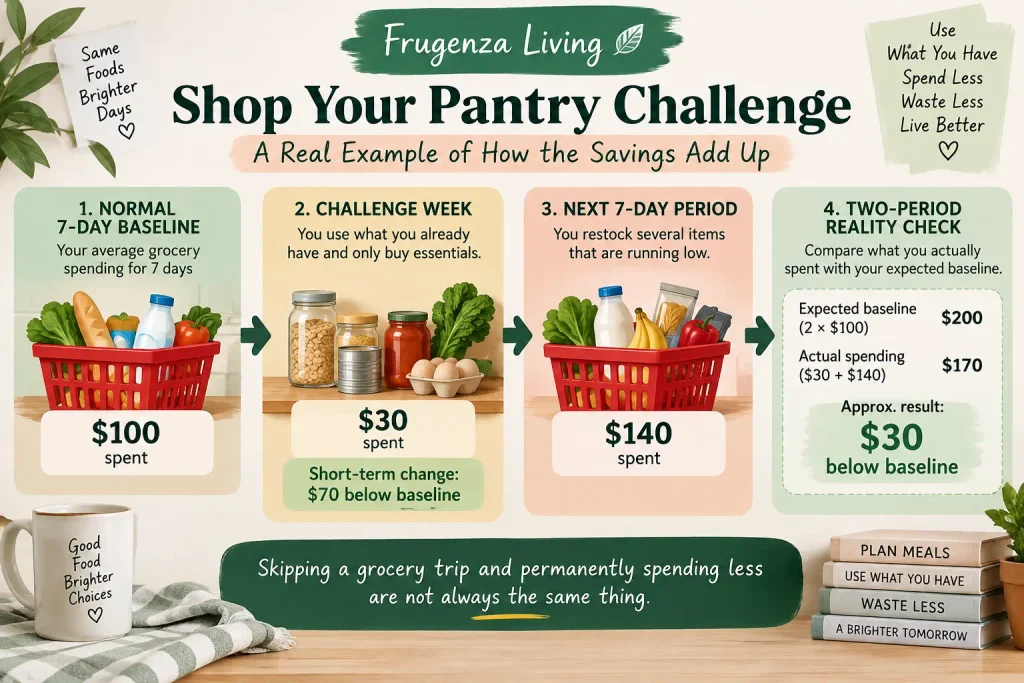
This is where pantry challenges often look more profitable than they really are.
Suppose your average grocery spending for a comparable seven-day period is $100.
During a seven-day challenge, you spend $30.
Your short-term spending change is:
$100 − $30 = $70 below baseline
Now look at the next comparable seven-day period.
Suppose you spend $140 because several items need replenishing.
Across two normal seven-day periods, your expected baseline would have been:
$100 × 2 = $200
Actual spending across the challenge and the next seven days was:
$30 + $140 = $170
So the adjusted two-period result is:
$200 − $170 = $30 below baseline
That is more useful than declaring that you “saved $70” as soon as the challenge ended.
The same method works when the result goes the other way.
Suppose you spend $120 during the challenge and then $140 in the following comparable period.
Actual spending:
$120 + $140 = $260
Two-period baseline:
$200
Result:
$60 above baseline
The challenge may still have helped you use old inventory, but it did not reduce grocery spending over those two periods.
A skipped grocery trip can produce three different outcomes.
Spending truly avoided. Food that might otherwise have gone unused became meals without creating an equivalent replacement purchase immediately afterward.
Spending deferred. You skipped buying something during the challenge but bought it shortly afterward.
Existing inventory consumed. You received value from food you had already paid for, which is useful but should not automatically be counted again as new cash savings.
For a fair comparison, estimate your baseline from the last 3–4 comparable grocery periods when possible, excluding unusual holiday, travel, or major stock-up periods.
Most importantly, compare the same length of time.
A 7-day challenge should use a 7-day baseline and a 7-day post-challenge period.
A 14-day challenge should use 14-day periods.
That keeps a low-spend challenge week from looking like permanent savings simply because the restocking happened later.
Shop Your Pantry Challenge Tracker
Use this tracker after both your challenge and the next equal-length grocery period are complete.
It compares what you actually spent against what two normal periods would have cost.
Shop Your Pantry Challenge Tracker
Compare equal-length grocery periods so delayed restocking does not get mistaken for permanent savings.
Enter your challenge results to see what changed.
This is a practical household spending comparison, not an exact valuation of the food you consumed. Your entries stay in your browser.
Avoid the Rebound Restock
A challenge can look successful on Sunday and disappear financially on Monday.
Do not rebuild every shelf simply because it looks emptier.
Instead, separate what you learned into two lists.
| Restock | Do Not Rebuy Yet |
|---|---|
| Foods you actually used | Ingredients you repeatedly avoided |
| Reliable meal anchors | Duplicate sauces and condiments |
| Useful freezer or pantry backups | One-recipe specialty ingredients |
| Foods that helped prevent takeout | Bulk amounts that lasted far too long |
When you do rebuild, focus on flexible low-cost pantry staples you already know how to turn into real meals.
The permanent value of the challenge may come less from what you used this week and more from what you stop buying next month.
What a Good Pantry Challenge Leaves Behind
Maybe you discover three jars of the same sauce because nobody checked the back of the shelf.
Maybe frozen food kept disappearing behind newer purchases.
Maybe an aspirational ingredient sounded healthy or useful at the store but never became something you actually wanted to eat.
Those discoveries matter.
Once you see how much food was already hiding in your kitchen, it becomes easier to recognize grocery shopping mistakes such as buying duplicates or purchasing more than you can realistically use.
You do not need to finish with bare shelves.
A better result is:
- less forgotten food;
- fewer duplicate purchases;
- a clearer idea of what becomes real meals;
- a smaller restock list;
- and a more honest understanding of whether grocery spending actually fell.
The challenge is successful when the kitchen becomes easier to shop after the challenge ends, not merely when you manage to avoid the grocery store for seven days.

The ideas shared here come from real-life experience and practical habits that actually work.
→ Read more about Jeffi
- Shop Your Pantry Challenge: Use What You Have and Spend Less - September 16, 2026
- Car Insurance Sinking Fund: Save for Every Renewal - September 14, 2026
- Vacation Sinking Fund: How Much to Save for Your Trip - September 12, 2026