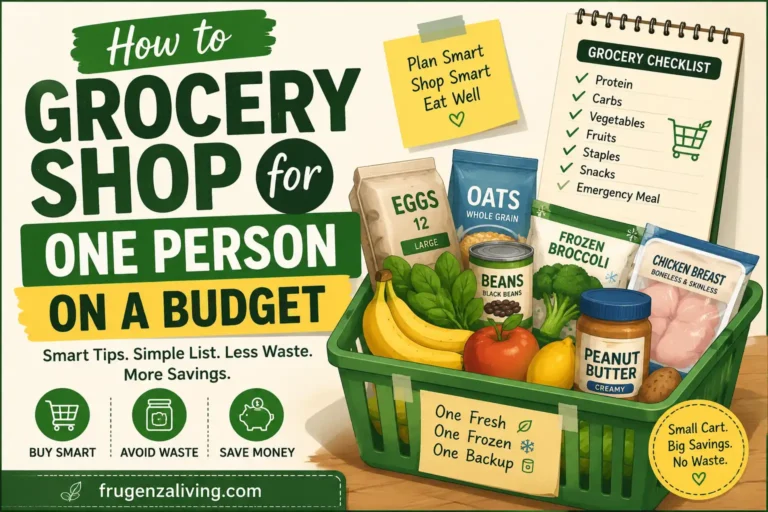
To grocery shop for one person on a budget, count the meals you will eat at home, subtract ingredients you already have, and write down the quantities you still need. At the store, compare both the package price and the unit price, then check whether you can use or store the whole package.
The six steps below take you from checking your kitchen to putting groceries away. The worked example shows why the amount you need for a meal and the amount you pay for at checkout can be different.
1. Set a Budget for This Grocery Trip
Choose your next shopping date first. Buying for four days between trips requires a different list from buying for ten days. Then decide how much of your remaining food budget is available for this trip.
If you need a starting point, use this guide to setting a grocery budget for one person. Adjust it for your location, dietary needs, and meals eaten elsewhere.
Keep any planned top-up money separate from today’s limit. For example, a hypothetical $50 food allowance might be divided into:
- $42 for the main grocery trip.
- $5 for a planned fresh-food top-up.
- $3 left unallocated for price changes or a missed ingredient.
This is a budgeting example, not a recommended weekly allowance. If you do not need a second trip, you can allocate the money differently. Account for applicable tax and shopping fees within the money available, too.
Track toiletries and cleaning supplies separately from food, but include them when checking whether you can afford the full checkout total.
2. Count Your Meals and Check Your Kitchen
Write down breakfasts, lunches, and dinners until your next trip. Mark meals provided at work, meals out, and evenings when you need something ready quickly. Include snacks and drinks you normally use.
For example, seven evenings minus two dinners away leaves five dinners at home. If one is already covered by a freezer meal, you need ingredients for four dinners. Two recipes that each make two portions would cover those four meals.
Check the fridge, freezer, and pantry before choosing those recipes. Record usable quantities: “2 ounces of dry pasta” tells you more than “some pasta.” Identify food that needs using soon, and plan meals around it while it is still safe to eat.
A pantry inventory checklist for one person can help if you regularly buy duplicates or forget opened packages.
Plan one genuinely easy meal for your busiest evening. A frozen dinner, canned soup with bread, or another ready-to-eat option can fit a budget if you will use it. Check that every part of the meal is available; a bag of uncooked rice alone is not a ready dinner.
Need help turning ingredients into a schedule? This weekly meal plan for one on a budget includes a menu, quantities, and a leftover plan.
3. Turn Meals Into a Grocery List With Quantities
For each ingredient, write the amount required, subtract usable stock, and choose a package that covers the difference. Check how many portions each recipe makes before multiplying its ingredients.
Amount to buy = amount needed for planned meals minus usable amount already at home. If you already have enough, buy none. Then account for the package sizes the store actually sells.
A Worked Shopping Example for Two Dinners
Suppose a two-serving bean-and-tomato pasta recipe requires 6 ounces of dry pasta, one 15-ounce can of beans, one 14.5-ounce can of tomatoes, and 8 ounces of frozen vegetables, plus oil and seasonings.
You already have 2 ounces of dry pasta, the can of beans, oil, and seasonings. You have no tomatoes or frozen vegetables. Your shopping decisions would be:
Dry pasta
Need: 6 ounces. Have: 2 ounces. Still needed: 4 ounces.
Buy: one 16-ounce package at an illustrative $1.50.
After making both portions: 12 ounces remain.
Canned tomatoes
Need: one 14.5-ounce can. Have: none.
Buy: one can at an illustrative $1.00.
After making both portions: none remain.
Frozen vegetables
Need: 8 ounces. Have: none.
Buy: one 12-ounce bag at an illustrative $1.25.
After making both portions: 4 ounces remain frozen.
Beans, oil, and seasonings
Already available in sufficient quantities. Buy none for this recipe.
Checkout spending for these three new packages: $1.50 + $1.00 + $1.25 = $3.75, before any applicable tax or fees.
These are assumed US-dollar prices for explaining the calculation, not current store quotes. The $3.75 is additional shopping spending, not the full ingredient cost of the two dinners: it excludes previously purchased food and includes pasta and vegetables left for future meals.
This example covers only two dinners. Add quantities for the other meals, snacks, and drinks in your own plan. For a broader starting list, use this one-week grocery list for one person, then subtract your stock.
4. Compare Package Prices, Unit Prices, and Usable Amounts
The package price is what you pay at checkout. The unit price shows the cost per ounce, pound, or another unit, helping you compare sizes and brands. Compare like products using the same unit; NIST explains how unit pricing works.
Consider these hypothetical prices for the same perishable food:
- 8-ounce pack for $2: $0.25 per ounce.
- 16-ounce pack for $3: $0.1875 per ounce, or about $0.19.
If you need only 8 ounces and cannot use or preserve the rest before it spoils, the smaller pack costs $1 less for the food you need. If you can use all 16 ounces, the larger pack saves $1 compared with buying two smaller packs.
A larger pack can also make sense when you can freeze portions and have both freezer space and enough money for today’s purchase. Give the surplus a specific future use before buying it.
Check store brands, sale conditions, and smaller packs without assuming any one option always wins. Buy-one-get-one offers and quantity discounts still have to fit your meals, storage, and checkout budget.
Use a grocery price book template to record dated unit prices for comparable items across stores, so you have a reference when deciding whether the next offer is worth buying.
5. Keep a Running Total Before You Pay
Use your phone calculator or shopping app to add the price of each whole package as it goes into the cart. For produce sold by weight, estimate the total from the weight you are buying. Keep room for applicable tax or fees.
If the cart exceeds your limit, adjust it in this order:
- Remove duplicates and unplanned extras. Check your stock notes before removing ingredients needed for meals.
- Compare a suitable lower-cost version. Consider a store brand, a smaller package, or frozen or canned food when it suits the meal and your dietary needs.
- Change an expensive meal. Recheck all its ingredients so the revised cart still makes the meals you counted.
For example, removing eggs may lower the total but leave three planned breakfasts without their main ingredient. Replace those breakfasts or choose a suitable alternative before checking out.
For an online order, check substitutions, taxes, fees, and any tip before paying. If both services are available, compare pickup and delivery costs for the same groceries and include the cost of collecting your order. A discount that makes you buy unwanted extras can raise the total.
6. Put Groceries Away With Their Next Meal in Mind
Unpack chilled and frozen foods promptly. Keep your refrigerator at 40°F (4°C) or below. Refrigerate perishable food within two hours, or within one hour when temperatures exceed 90°F (32°C), following FoodSafety.gov’s food safety guidance.
- Use first: put suitable ready-to-eat foods and produce that need using soon where you can see them. Keep raw meat contained separately to prevent leaks onto other food.
- Save for later: portion and freeze suitable foods you will not use in time, labeling the contents and date. Do not assume every fresh purchase will last until your next trip.
- Make meals easy to find: note which ingredients go together and when you intend to use them. Keep your quick dinner accessible.
Before the next shop, compare your receipt with what you used. If you discarded half a bag of greens, reduce the quantity or change how you buy them. If you unexpectedly ate at home more often, update your meal count. Change the purchase that caused the problem.
Your Before-Shopping Checklist
Use these six checks before your next trip. The check marks are temporary; copy the list into your notes if you want to keep a record.
Frequently Asked Questions
How often should one person grocery shop?
Choose a schedule that fits your storage, transport costs, and food use. A weekly trip may suit you; a smaller top-up can help when fresh food runs out. Use a specific list for that top-up and count its cost within your budget. There is no need to make a second trip simply to follow a rule.
How can I shop cheaply without a freezer?
Buy smaller amounts of perishables and use shelf-stable foods to cover later meals. Look for package sizes you can finish after opening, and follow storage instructions: shelf-stable before opening does not necessarily mean shelf-stable afterward. Avoid bulk purchases whose savings depend on freezing the surplus.
What if I am stocking an empty kitchen?
Your first trip may cost more because you are buying whole packages of basics such as oil, rice, or seasonings. Start with those required for a few meals you actually plan to make. Expand the pantry over later trips, and record these purchases so you do not treat every first-trip expense as a recurring weekly cost.
Start With Your Next Shopping Trip
Choose your next shopping date, count your meals, and check your stock. Build a quantity-based list, estimate the full checkout cost, and decide where any surplus will go. After using the groceries, adjust the next list based on what ran out or went unused.

Read about Jeffi and Frugenza Living
- How to Budget a 10-Month Salary Over 12 Months - October 16, 2026
- Pet Adoption Budget Checklist: What You Still Need to Pay - October 16, 2026
- Proportional Bill Split Calculator for Two Incomes - October 15, 2026