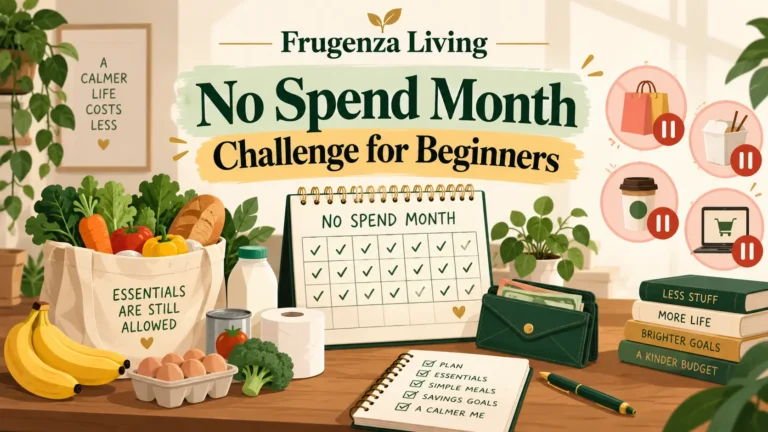
Day 1 is usually the easy part.
Then the calendar starts arguing with the plan: Friday takeout, payday, a birthday invitation, a draining workday, a weekend when browsing usually fills time, and perhaps something essential that breaks without warning.
That is why a no spend month challenge for beginners should not mean “spend nothing for 30 days.” The useful version is a temporary freeze on new discretionary spending while bills, necessary groceries, healthcare, transportation, and genuine obligations continue.
The beginner goal is not a perfect streak. It is knowing, before a difficult day arrives, which spending was always allowed, which spending was already committed, and which purchases you deliberately froze.
A no-spend month is easier to finish when the rules are written for the difficult days, not just the motivated first day.
Start With Three Lists and One Rescue Rule
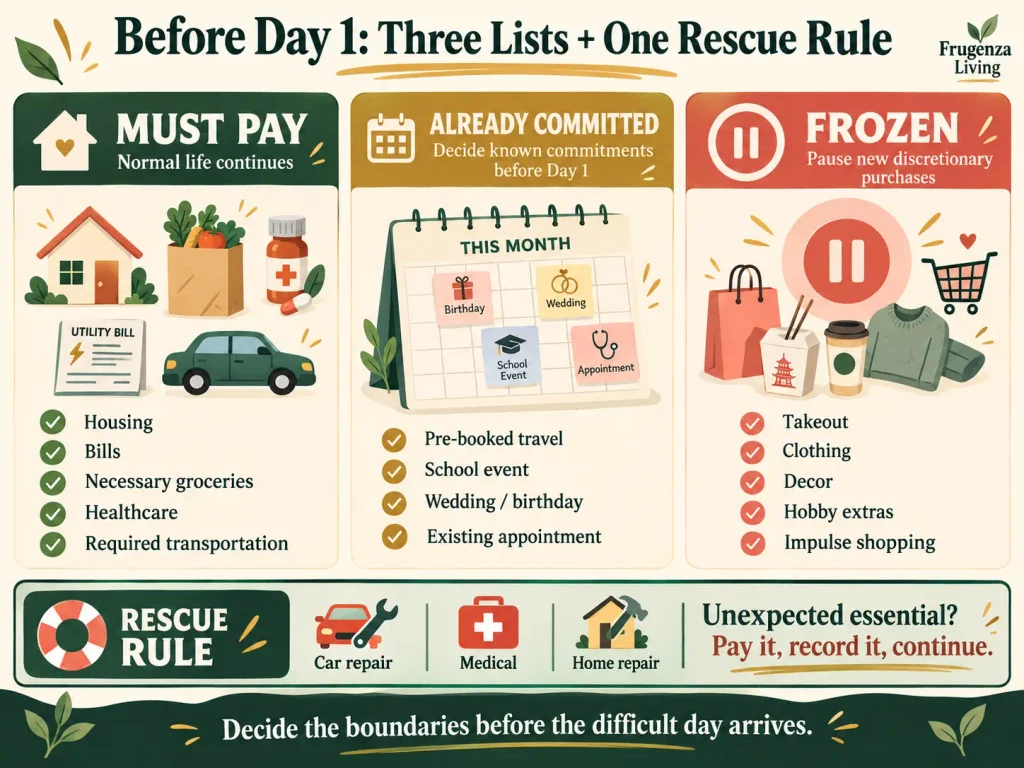
Before Day 1, write three short lists. You do not need to turn the challenge into a detailed monthly budget.
Must Pay contains normal necessities and obligations: housing, utilities, insurance, minimum debt payments, medicine, necessary groceries, required transportation, childcare, school requirements, and similar costs.
Already Committed contains known expenses that existed before the challenge: a close friend’s wedding, pre-booked travel, a child’s school activity, a required work meal, or an appointment already scheduled.
Writing these down beforehand matters. A genuine commitment decided before Day 1 is different from inventing a new “exception” when something tempting appears on Day 12.
Frozen contains new discretionary purchases you are pausing. Your list might include takeout, coffee out, clothing, decor, gadgets, hobby extras, paid entertainment, marketplace purchases, or beauty extras.
Freeze the categories that actually create optional spending in your life rather than copying somebody else’s list.
Then write one Rescue Rule:
If an unexpected expense is necessary for health, safety, work, essential transportation, housing, or another genuine obligation, I will pay it, record it, and continue the challenge.
That sentence prevents a necessary repair or medical expense from turning into “I failed, so the month is over.”
If 30 days feels too large for your first attempt, a no-spend week challenge can be a shorter diagnostic run before committing to a full month.
What Still Counts as Normal Life?
A beginner challenge should make boundaries clearer, not turn every transaction into a moral test.
| Situation | During a No-Spend Month |
|---|---|
| Rent, utilities, insurance | Pay normally |
| Necessary groceries | Buy within your normal plan |
| Medicine or healthcare | Do not delay |
| Existing bill or debt payment | Pay normally |
| Prewritten wedding or school commitment | Follow the rule decided before Day 1 |
| New clothing because it is on sale | Frozen |
| Takeout for convenience | Frozen unless your written rules genuinely allow it |
| Essential repair | Use the Rescue Rule |
A no-spend month is not a zero-expense month. In 2024, housing, transportation, food, healthcare, and personal insurance and pensions together represented 83.7% of average annual U.S. consumer-unit expenditures, according to U.S. Bureau of Labor Statistics — Consumer Expenditures in 2024.
That number is not a personal spending target and does not mean every dollar in those categories is essential. It simply illustrates why large parts of normal household spending continue during a no-spend challenge.
Map the Days Most Likely to Break the Plan
Thirty days are not thirty identical days.
Before starting, scan your calendar for pressure points:
- payday;
- Friday night;
- weekends;
- grocery day;
- birthdays;
- social plans;
- travel;
- recurring renewals;
- unusually demanding workdays.
For each pressure point, ask:
What do I normally buy here?
Is it Must Pay, Already Committed, or Frozen?
If it is Frozen, what practical replacement prevents inconvenience?
This matters because “do not order takeout” is an easy rule to write on Sunday afternoon and a much harder rule at 8 p.m. after an exhausting Wednesday.
If your calendar genuinely requires recurring discretionary spending—such as planned meals out, hobby spending, or other flexible allowances—you may be designing a low buy month challenge rather than a true no-spend month. That is not worse; it is simply a different experiment.
Remove the Purchase, Not the Function
Optional spending often performs a useful function even when the purchase itself is unnecessary.
Takeout may solve exhaustion. Coffee out may provide a break or social routine. Shopping may fill boredom. Paid entertainment may provide novelty or connection.
If you remove the purchase but leave the function empty, the challenge becomes harder than necessary.
Prepare a few substitutes before the pressure point arrives:
- takeout temptation → an easy freezer or pantry meal;
- coffee-shop routine → coffee from home plus a walk or conversation;
- browsing for entertainment → save the item to a Later List without checkout;
- paid entertainment → something already owned, the library, or a free activity.
You do not need fifty free activities. You need replacements for the situations that repeatedly lead you to spend.
If the same off-plan purchases keep appearing after stress, boredom, loneliness, or a need for reward, the spending rule may not be the whole issue.
Before replacing something, check whether you already have another product at home that can do the job.
Do Not “Win” the Month by Spending Early
One beginner mistake happens before Day 1.
You buy extra snacks, toiletries, clothing, entertainment, or restaurant gift cards because next month will be “no spend.”
That is the Preloading Trap.
Ordinary preparation is fine. Artificially pulling discretionary purchases into the previous month makes the challenge easier on paper without necessarily changing your behavior.
Before a pre-challenge purchase, ask:
Would I buy this today if the no-spend month were not starting tomorrow?
If not, moving the transaction backward on the calendar does not make it disappear.
Gift cards and rewards need a rule too.
If your goal is reducing new cash outflow, using an already-owned gift card may create no new cash expense that month.
If your goal is a behavior reset, using store credit to keep browsing and ordering exactly as before may defeat the experiment.
Choose the rule before Day 1, not while looking at something you want.
Already-paid services are simpler. Using a streaming subscription, prepaid gym membership, or annual app plan that has already been charged does not create a new purchase today. An upcoming discretionary renewal, however, deserves review before it charges.
No-Spend Month Check-In Calendar
Use the calendar to observe the month without turning it into a streak contest. Choose 28–31 days, tap one day, and record only information relevant to the challenge.
No-Spend Month Check-In Calendar
Check in without chasing a perfect streak. Essential spending and planned exceptions are recorded separately from off-plan discretionary spending.
Day 1 Check-In
Recorded Discretionary Outflow includes only amounts entered on Planned Exception or Off Plan days. Unplanned Essential spending is never included. This number is not your total monthly spending and is not a savings calculation. Data stays in this browser unless you clear it or start a new challenge.
If You Spend Off Plan, Do Not Restart the Month
A full month gives you more opportunities to make an imperfect decision than a seven-day experiment. That does not make the remaining days worthless.
Use:
CLASSIFY → RECORD → CONTINUE
Classify: Was the expense Must Pay, Already Committed, covered by the Rescue Rule, or genuinely Off Plan?
Record: Note what happened, any relevant discretionary amount, the trigger, and what might help next time.
Continue: Return to the rules at the next decision.
Do not skip food, medicine, or another necessity to “make up” for a purchase. Do not add harsher restrictions as punishment.
The calendar deliberately has no streak counter. If Day 17 includes an off-plan coffee, Days 18–30 still exist.
Measure the Month Without Inventing Savings
At the end of the challenge, a skipped purchase can have several different outcomes.
Purchase avoided: You no longer want or need it. That is spending that genuinely did not happen.
Purchase deferred: You still intend to buy it after the challenge. The spending changed timing rather than disappearing.
Cost substituted: You avoided one cost but created another. Skipping $35 of takeout while buying $12 of extra convenience groceries is not automatically $35 saved.
Spending shifted in time: You bought something just before Day 1 or plan to buy it immediately after Day 30.
This distinction matters because a dramatic “money saved” total can hide what the challenge actually taught you.
A no-spend month is still useful if its clearest result is discovering that weekend browsing, exhausting workdays, payday, or convenience—not a lack of budgeting knowledge—drives much of your optional spending.
Day 31 Is Part of the Experiment
During the month, put tempting nonessential purchases onto a Later List instead of buying them.
Do not treat that list as a shopping order when the month ends.
On Day 31, run each postponed item through a Re-entry Gate:
Still Needed — there is a real use case and the need survived the month.
Still Wanted — you still value it, but it remains discretionary. Reintroduce it deliberately into normal spending decisions.
No Longer Care — the urgency disappeared. Remove it.
Was Only a Trigger — boredom, stress, convenience, or sale pressure created the desire more than a lasting need did.
This protects the month from an easy reversal: checking out every saved cart as a reward for “being good.”
The list of things you stop wanting may teach you more than the list of things you successfully resisted.
Keep the Lesson, Not the Restriction
A beginner no spend month does not need to become your permanent lifestyle.
Perhaps you learn that keeping one freezer meal available prevents expensive exhausted-evening takeout. Maybe removing shopping apps from your home screen reduces browsing. Perhaps Friday spending is more predictable than you thought.
Those are useful results because they can outlive the challenge.
If one lesson remains easy and useful after Day 31, turn it into one of your regular frugal habits that actually save money.
A successful no spend month is not a perfect 30-day streak. It is a month in which discretionary spending has clearer boundaries, necessary life continues normally, one mistake does not erase the experiment, and Day 31 does not become a catch-up shopping day.

The ideas shared here come from real-life experience and practical habits that actually work.
→ Read more about Jeffi
- No Spend Month Challenge for Beginners: A 30-Day Plan - September 24, 2026
- Low Buy Month Challenge: Realistic Rules for 30 Days - September 23, 2026
- How to Stop Buying Groceries You Already Have - September 20, 2026