
You decide, “I’m buying less this month.”
On day three, you skip a shirt. On day six, two home-decor purchases seem harmless because clothing was the category you meant to cut. A stressful evening later in the week ends with delivery.
You may be buying less in one place, but you never decided what low buy meant everywhere else.
A low buy month challenge works better when it is built around rules rather than vague restraint. For 30 days, necessary spending continues, selected discretionary spending remains possible, and the categories that cause trouble get clearer boundaries before temptation appears.
Low-buy works best when the rules remove decisions you keep regretting without removing the spending you genuinely value.
Low-Buy Is Not the Same as No-Buy
A no-buy or no-spend challenge makes the default answer to targeted discretionary purchases “no.” A low-buy month leaves some decisions open, but narrows the conditions for saying yes.
You might allow two restaurant meals, replace shampoo only when another bottle is genuinely needed, cap hobby spending at $50, and pause home decor completely. That is different from trying to spend nothing.
If you want a short experiment where most discretionary purchases stop altogether, a no-spend week challenge is cleaner. A low-buy month is more useful when you want selective limits without treating every enjoyable purchase as a mistake.
Build the Month Around Four Spending Lanes
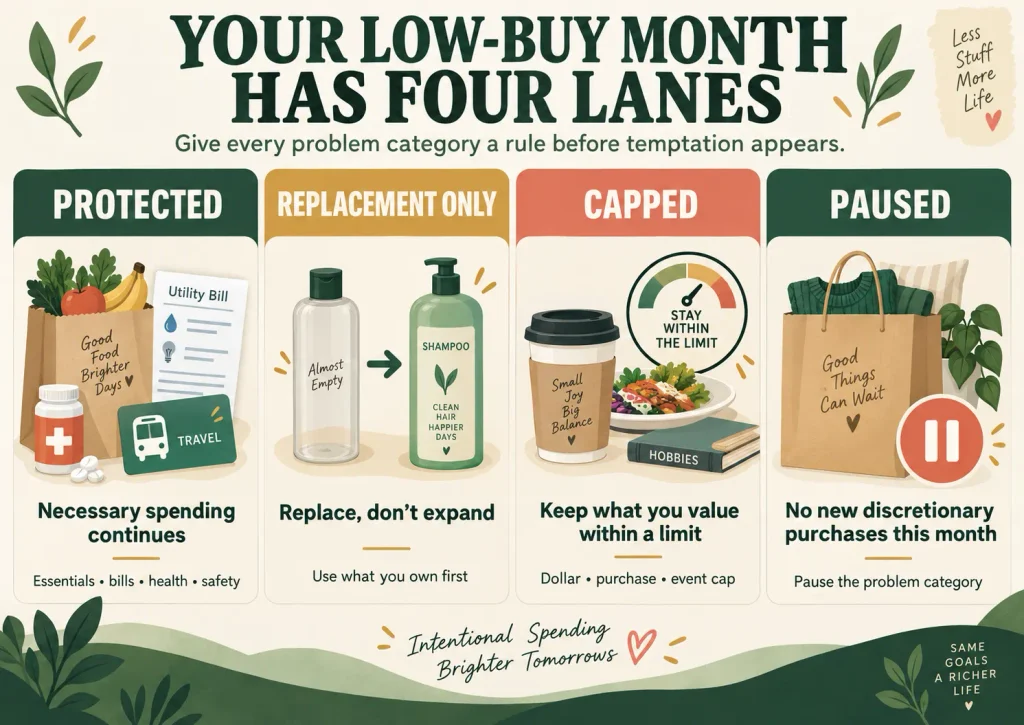
“Essential” versus “nonessential” is often too blunt. Put only the categories that need attention into one of four lanes.
| Lane | Main rule | Best for |
|---|---|---|
| Protected | Spend when genuinely required | Essentials, obligations, health, safety |
| Replacement Only | Replace; do not expand inventory | Consumables and basics |
| Capped | Stay within a preset limit | Valued discretionary categories |
| Paused | No new discretionary purchases this month | Problem categories |
Protected covers rent, utilities, necessary groceries, medicine, required transportation, bills, and genuine repairs. Protected does not mean careless spending; it means the challenge does not label normal life as failure.
Replacement Only works when the problem is accumulating more than you use. Toiletries, cleaning supplies, skincare basics, makeup basics, or household consumables may fit here. The rule is simple: replacement is allowed; inventory expansion is paused. If the deeper problem is a backlog of half-used products, the Use It Up Challenge handles that more directly.
Capped categories are things you value but want to contain. A cap can be dollars, purchase count, or event count. “Dining out — two planned meals this month” may work better than banning restaurants if meals with friends are something you genuinely value.
Paused removes a problem category from the decision loop for one month. Clothing, home decor, gadgets, hobby supplies, beauty extras, or marketplace browsing might belong here. The category itself is not universally bad; it is simply where you want no new discretionary purchases this month.
Once you are comfortable buying less, a full no-spend month can be the next step if you want a more structured spending reset.
The useful question is not “Is this purchase morally necessary?” It is:
What rule should control this category this month?
Match the Rule to the Way You Overspend
“Buy less clothing” is hard to enforce because almost every purchase still requires another decision.
If frequent small purchases are the problem, use a count cap:
Maximum two clothing items this month.
If purchase size is the problem, use a dollar cap:
Hobbies get $50 this month.
If duplicate inventory is the problem, use Replacement Only.
If browsing creates purchases you did not plan, combine Paused with a waiting rule.
A strong low-buy rule targets how the overspending happens, not merely the category name.
Also choose one Intentional Yes if that makes the month more sustainable. Perhaps one dinner with friends consistently feels worth the cost while random delivery does not. The lesson is not “restaurants are bad.” It is to protect spending you value and restrict spending that happens automatically.
Choose Waiting Rules That Match the Trigger
There is no magic waiting period that works for every purchase.
Use one where urgency is artificial: an online browsing purchase can wait until tomorrow, a grocery-day extra until the next planned shop, and a larger discretionary purchase for several days.
The waiting period should be long enough to interrupt the trigger behind the purchase, but simple enough that you will actually use it.
Low-Buy Month Rule Board
Track only categories that need a rule. The board saves in this browser, flags activity that needs review, lets you resolve that review, and downloads your month as a CSV.
Low-Buy Month Rule Board
Set rules only for categories that need attention this month. Fields change automatically to match the lane you choose. Your board saves in this browser.
Unused Cap Room is neither a spending target nor automatic savings. If a purchase-count cap has already been reached, that category contributes $0 to remaining cap room even when part of its dollar cap remains. Resolved exceptions and confirmed replacements no longer stay in Categories Needing Review. Clearing browser storage may remove this board, so download the CSV if you want a backup.
Mid-Month: Check Whether Spending Simply Moved
A low-buy month can look successful while the buying urge changes categories.
Imagine clothing is Paused. By day 15, you have bought no clothes—but home decor, delivery, and hobby spending all increased. The clothing rule worked mechanically, yet your discretionary behavior may not have changed much.
This is category migration. Ask:
Did my spending become more intentional, or did it simply move somewhere with weaker rules?
Then look for rule leaks: purchases that technically fit the wording but defeat its purpose.
“Replacement-only beauty” becomes meaningless if every new item is called a replacement while usable alternatives remain. A $50 hobby cap is not really $50 if gift-card purchases or buy-now-pay-later charges are mentally excluded.
A useful test is:
Would I still consider this purchase consistent with my rule if there were no discount, points, gift card, or clever label involved?
If the same category repeatedly breaks through after stress, boredom, or reward-seeking, the rule may not be the whole problem. The guide to stopping spending money to feel better deals with the emotional trigger rather than the monthly limit.
Unexpected Spending Is Not Automatically Failure
Real life does not obey challenge rules.
The Federal Reserve reported that 59% of U.S. adults experienced at least one type of major unexpected expense during the prior 12 months in its Economic Well-Being of U.S. Households in 2025.
A necessary car repair, medicine, required travel, or replacement for essential broken equipment is not the same as quietly turning a Paused category into a loophole.
Separate a rule exception—spending that genuinely needed to happen—from a rule leak, which is discretionary spending relabeled to escape a restriction you chose.
Do not restart the month because life happened. If you deliberately break a discretionary rule, record what happened, identify the trigger, and continue. One purchase is information; abandoning the rest of the month would turn that one purchase into the entire result.
At Month-End, Separate Avoided, Deferred, and Shifted Spending
A lower spending total can mean several different things.
Spending avoided means the purchase stopped mattering and disappeared.
Spending deferred means you still intend to buy it later.
Spending shifted means one category fell while another rose.
Those outcomes should not all be labeled “savings.”
The same caution applies to caps. If your entertainment limit was $100 and you spent $40, the remaining $60 is unused cap room. It becomes meaningful savings only in the context of what actually happened to your overall money.
Use the Carryover Test Instead of Repeating Challenges Forever
At day 30, review each rule individually.
KEEP — it reduced automatic spending, clutter, or regret and was easy enough to live with.
ADJUST — the idea worked, but the cap, wording, or waiting period needs improvement.
DROP — it created more friction than useful benefit.
Then ask one final question:
Did this rule change the spending itself, or merely move it somewhere else?
The best result is not turning every future month into another challenge. If replacement-only skincare, a next-day waiting rule, or two planned restaurant meals still feels useful after the month ends, it can become one of your regular frugal habits that actually save money.
A low buy month challenge should leave you with fewer automatic spending decisions, not a longer list of restrictions.
Keep the rules that make your spending clearer. Let the rest expire with the month.

The ideas shared here come from real-life experience and practical habits that actually work.
→ Read more about Jeffi
- No Spend Month Challenge for Beginners: A 30-Day Plan - September 24, 2026
- Low Buy Month Challenge: Realistic Rules for 30 Days - September 23, 2026
- How to Stop Buying Groceries You Already Have - September 20, 2026