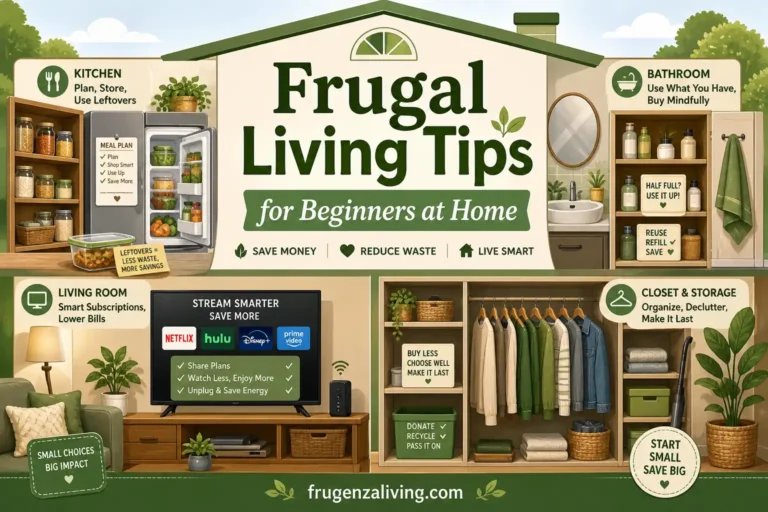
Before adding household supplies to your shopping list, check the places where you keep them. A spare bottle, a usable container, or a garment that already fits the occasion can change what you need to buy.
These frugal living tips for beginners at home turn a room-by-room check into a short replacement list. The task is concrete: identify what you can use, what needs replacing before your next shopping trip, and what you still need to verify.
If you first need to decide what your income must cover, start with the frugal living guide for beginners. Use this home check when you are ready to review actual items.
Start With One Shelf and Your Next Shopping Date
Choose a cupboard, drawer, shelf, or clothing rail connected to an upcoming purchase. Write down your next planned shopping date. You are checking whether the items already there can meet your needs until then.
Do not empty the whole room unless you have time to put it back. Take a note or photo of the items you need to remember, keeping labels readable. In a shared home, confirm who owns a spare before treating it as available.
Give each possible purchase one decision:
- Use what is here: a suitable item is available and can meet the need until the next check.
- Buy by a stated date: usable supplies will run out, or an essential item cannot do its job.
- Verify first: quantity, condition, compatibility, ownership, or the real need is unclear.
A note such as “toothpaste: buy before Friday” is actionable. “Bathroom needs organizing” leaves the purchase unresolved. Put the item, amount needed, and deadline on the list.
A Room-by-Room Check That Produces a Decision
| Area | What to inspect | What to record |
|---|---|---|
| Kitchen | Food available for the meals you expect to eat at home | A meal you can make and its missing ingredients |
| Bathroom | Usable products, unopened spares, and likely runout dates | The next replacement and when it is needed |
| Laundry area | Detergent remaining and the instructions for your loads | Whether another pack is needed before shopping again |
| Living room | A device or service you are considering replacing or renewing | The fault, missing feature, or renewal detail to verify |
| Closet | Clothes suitable for a particular upcoming activity | A usable outfit or a specific gap |
| Storage | Supplies or containers relevant to your shopping list | A compatible item already owned or the exact size needed |
Kitchen: Attach Available Food to a Meal
Check your fridge, freezer, and pantry before making the food portion of the list. Choose a meal you expect to eat at home and identify the ingredients available for it. Write down only the missing quantities.
The U.S. Environmental Protection Agency’s guidance on preventing wasted food at home recommends checking food stocks before shopping, planning around food that needs using, and listing quantities for the meals you expect to prepare.
For example, finding pasta is only the first step. Check whether you have enough for the planned meal and what else it requires. A meal needing several new ingredients may change the shopping cost. Follow food-storage guidance; a plan to use something does not establish that it is safe.
For a more detailed stock record, use the pantry inventory checklist for one person. Here, one meal and its missing ingredients are enough to finish the kitchen check.
Bathroom: Set a Replacement Date
Look at one product category, such as toothpaste or shampoo. Check the current container and any spares you are entitled to use. A bottle that is unsuitable for you does not remove the need for a suitable replacement.
Estimate whether the usable amount covers the time until your next shopping opportunity. If you are unsure, put the item under “verify first” and check again before you shop. You do not need to wait until an essential product is completely empty.
Leave products in their labeled packaging and follow their use and storage instructions. The decision is about purchasing a replacement, rather than combining leftovers or changing how a product should be used.
Laundry Area: Check Instructions Before Buying More
Check how much detergent remains against the loads you expect to wash. Use the product and machine instructions for the relevant load; an advertised pack size alone does not establish how many of your loads it will cover.
Record a restock point you can check, such as “review before the next two planned loads.” Use your own experience to refine it. Do not assign a money-saving percentage to a smaller dose without checking whether that dose is appropriate.
Living Room: Define the Problem Before Replacing Something
If a lamp, remote, or other household item is on your list, state what it must do. Check whether an existing suitable item can do that job. A working alternative in another room only helps if moving it does not leave a different need unmet.
For a streaming service, use the account’s renewal information rather than the apps visible on the television. Check the charge date, cancellation terms, and whether anyone else in the household relies on it. The subscription budgeting guide covers the recurring-payment review.
Keep unverified utility savings off this list. Seeing a device plugged in does not tell you its consumption, your tariff, or the effect of changing its use.
Closet: Check One Upcoming Occasion
Choose an activity you actually have planned: work, an appointment, or a social event. Check the fit, condition, suitability, and availability of the clothes you would wear.
Write down the specific gap if there is one. “Need suitable footwear for Friday” leads to a different decision from buying an entire outfit. Include any necessary cleaning or repair cost when comparing your options.
If you want to plan several outfits, continue with the shop your closet challenge. This check only needs to establish what the next occasion requires.
Storage: Match the Item to the Job
Check the relevant drawer or cupboard for the item you planned to buy. A spare bulb must fit the fixture; a container must fit the space and its intended contents. Finding something similar is a reason to check compatibility.
Try an existing suitable container before buying an organizer. If it works, note where the contents now belong. If it does not, measure the space and record the requirement before shopping. Buying storage is a separate purchase decision, with its own cost.
Worked Example: What Changed on the Shopping List?
This is a hypothetical US-dollar example for a 14-day period. It illustrates a stock check, not the author’s spending or a typical household result. All listed purchase prices include applicable tax. Assume the normal shopping trip requires no additional travel or delivery charge.
The draft list contains four purchases. After checking the relevant areas, the person finds enough suitable toilet paper and laundry detergent for the entire period. An existing box also meets the storage need. Dish soap needs replacing now.
| Item | Draft purchase | After checking | Cash paid during 14 days |
|---|---|---|---|
| Dish soap | $4 | Buy the needed replacement | $4 |
| Toilet paper | $8 | Use available stock; review at the end | $0 |
| Laundry detergent | $10 | Use available stock; review at the end | $0 |
| Storage basket | $12 | Use an existing suitable box | $0 |
| Total | $34 | One purchase remains | $4 |
The checkout total is $30 lower than the draft list: $34 − $4 = $30. That difference has two parts:
- $18 of restocking is deferred: $8 of toilet paper plus $10 of detergent. Existing stock is being used and will eventually need replenishing.
- The $12 basket purchase is removed: the existing box meets the stated need without extra cost. This assumes the person would otherwise have bought the basket.
Stock bought earlier was not free. This table measures new cash payments during the period, rather than the cost of everything consumed. It does not value the stock used or establish a lasting reduction in supply costs.
If both refills are later bought for the same combined $18, and nothing else changes, cash paid across the longer period becomes $4 + $18 = $22. The difference from the original $34 list is then $12. Do not turn the initial $30 checkout difference into a monthly saving.
For your own review, keep the draft list and receipts. Check whether removed purchases stay removed, whether replacements happen later, and whether using an existing item creates another cost. A crossed-out price alone does not prove an expense was avoided.
Copy This Home Check Into Your Notes
Use one entry per item. These prompts are a manual note-taking exercise:
- Item and location: what were you considering buying, and where did you check?
- Need and deadline: what must it do, and when is it needed?
- Available now: what suitable quantity or alternative do you already own?
- Decision: use what is here, buy by a date, or verify first?
- Shopping detail: what quantity, size, or compatibility requirement belongs on the list?
- Follow-up: when will you check again, and was the purchase later made?
Review the note at your next planned shopping trip. If an item ran out sooner than expected, adjust its replacement date. If you repeatedly cannot find supplies, choose a consistent accessible location before buying more containers.
Frequently Asked Questions
Which room should a beginner start with?
Start with the area connected to a purchase you are about to make. If toothpaste is on your list, check the bathroom. If dinner ingredients are the question, check the kitchen. You can complete one decision without inspecting the whole home.
Should I finish every product before buying a replacement?
Set the replacement date around usable stock and your next shopping opportunity. Keeping enough of an essential item can be necessary. A product that does not suit you or cannot be used as directed should not be counted as an adequate spare.
Do I need new storage supplies to begin?
First check whether an existing suitable container or shelf meets the need. If a purchase is necessary, establish the required size, use, and cost before buying it. Organization does not require a matching set of new containers.
How much will this save?
The result depends on your stock, actual purchases, replacement costs, and needs. Using supplies already owned can delay a payment without reducing long-term consumption. The dollar figures above are constructed illustrations, not personal results or a promised saving.

Read about Jeffi and Frugenza Living
- How to Save for a Car Insurance Deductible - November 9, 2026
- How to Rebuild an Emergency Fund After Using It - November 4, 2026
- How to Budget a 10-Month Salary Over 12 Months - October 16, 2026