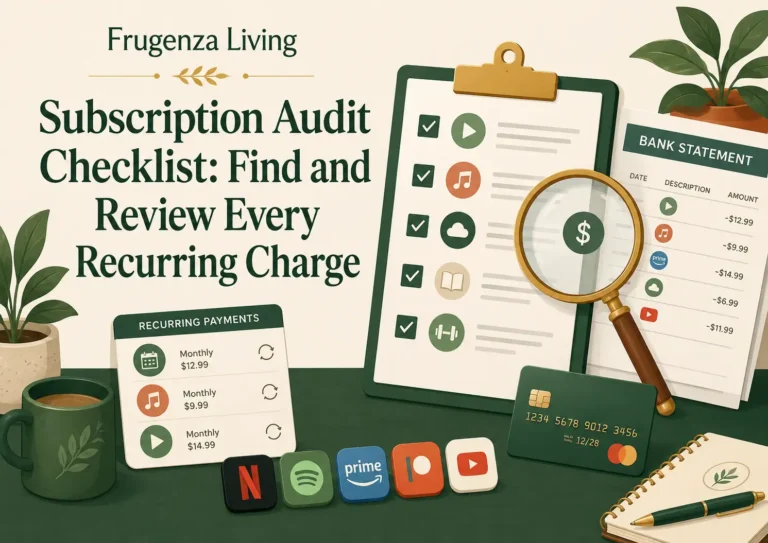
A recurring-looking charge appears on your credit card statement, but the merchant name does not look familiar. Then you open an app-store subscription page and find another service that does not appear under the same name on your statement.
A useful subscription audit checklist should do more than tell you to cancel whatever you have not used lately. It should help you find recurring charges, verify what each one belongs to, decide what should happen next, and close the action so unfinished items do not disappear into a spreadsheet.
This checklist is designed for personal and household subscriptions, not company SaaS contracts, employee software seats, utilities, loans, insurance premiums, or other recurring bills that do not represent ongoing subscription access.
The desired result is simple: every recurring charge you find should have an identity or verification status, an owner, a decision, and a next action.
What a Subscription Audit Should Actually Produce
A subscription audit is not complete merely because you have a list of merchant names.
By the end, you should have:
- A master list of confirmed subscriptions.
- A separate queue for recurring-looking charges that still need verification.
- A decision for every confirmed service.
- A record of changes or cancellations you actually completed.
- A short list of audit gaps that still require follow-up.
An unfamiliar descriptor could belong to a legitimate service, a household member, an app-store billing relationship, or a transaction that needs separate investigation.
The purpose of the audit is clarity. Savings may follow, but maximum dollars canceled is not the success metric. An audit can be successful even when every subscription is kept, as long as every charge has a deliberate status.
Start With Coverage, Not Memory
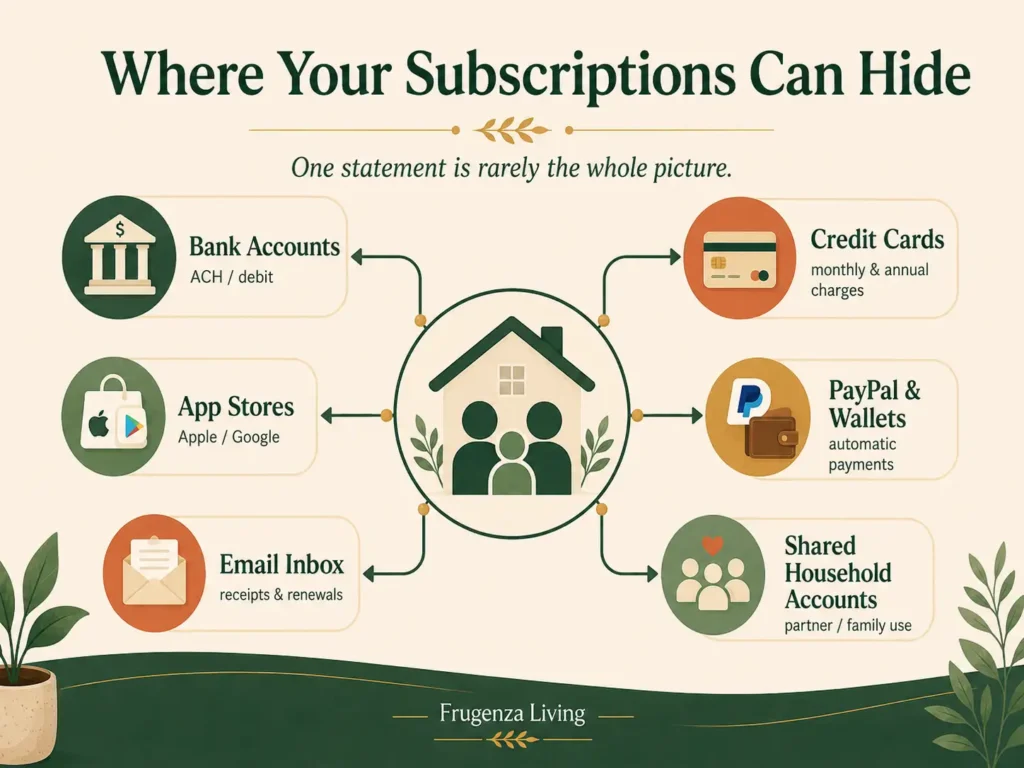
Memory is a weak starting point because subscriptions can be distributed across several payment channels.
Review about 12–13 months of transaction history when that much history is available. This makes an annual renewal more likely to appear, but transaction history alone cannot guarantee completeness. Supplement it with subscription settings, payment-platform records, and email searches.
Check the sources that apply to your household:
- Main checking account and other active bank accounts.
- Every active credit card, including less-used cards that may still carry autopay.
- Apple or Google app-store subscription settings.
- PayPal automatic payments and relevant digital wallets.
- Membership portals and provider accounts you recognize.
- Email receipts, renewal notices, trial messages, and price-change notices.
- Shared household accounts.
- Personally paid services that may later be reimbursed.
If you need a broader system for reviewing transactions, learn how to track expenses easily without turning this subscription audit into a full spending-tracking project.
Do not put full card numbers, passwords, security codes, or other sensitive credentials in your audit notes.
If an annual service passes your audit and you decide to keep it, an annual subscription sinking fund can help you prepare for the next renewal without absorbing the full cost at once.
Build the Master Subscription Record
Each recurring-looking charge should get its own record. Keep the statement descriptor separate from the actual service name because the two may not match.
Record:
- Statement descriptor.
- Service name, if confirmed.
- Last verified charge.
- Billing cycle.
- Next known charge date.
- Payment source.
- Owner or user.
- Audit confidence.
- Decision status.
- Follow-up action, if needed.
Use three confidence levels:
Confirmed: The service is matched to evidence such as a statement plus a receipt, provider account, app-store record, or renewal notice.
Likely: The merchant, amount, timing, and household context strongly match a known service, but one important detail still needs confirmation.
Needs Verification: The merchant identity, ownership, or purpose remains uncertain.
The worksheet below gives you a browser-based record to complete one service at a time, plus a compact audit log for keeping several results visible. Transfer finished records to permanent notes or a spreadsheet before refreshing or leaving the page.
Subscription Audit Evidence Checklist
Find coverage gaps, document subscription evidence, and close unfinished actions.
1. Coverage Check
2. Master Subscription Record
3. Decision Status
4. Compact Audit Log
Use these rows as a quick printable summary after completing individual records.
| Service | Charge | Owner | Confidence | Decision |
|---|---|---|---|---|
5. Close the Audit
Important: Entries and checked boxes are not saved. Complete one record at a time, then print the checklist or transfer the result to your own notes or spreadsheet before refreshing or leaving the page.
Put Unknown Charges in a Verification Queue
An unfamiliar recurring-looking transaction is a question to resolve, not a subscription to cancel blindly.
Place it in a temporary Needs Verification queue. Record the descriptor exactly as it appears, then work through the strongest available evidence:
- Look for a matching receipt or renewal email.
- Check app-store or payment-platform purchase history.
- Review provider account history you already recognize.
- Compare earlier transactions with the same amount or descriptor.
- Ask household members who may own or use the service.
For example, a statement may show ABC*DIGITALSERV while an email receipt identifies the service as “Example Media Membership.” Once confirmed, retain both names in your record so the next audit is faster.
If evidence suggests the transaction was not authorized, use the official fraud or dispute process provided by the bank or card issuer. An unidentified charge alone is not proof of fraud.
Decide Whether the Service Still Has a Job
Do not use a rigid rule such as “cancel anything unused for 30 days.”
Recent use is evidence, but value also depends on function and context. A service may be seasonal, shared by another household member, used for occasional professional work, or provide storage or backup without frequent logins.
Ask:
- What job does this subscription perform?
- Who actually uses it?
- Is another paid service performing the same job?
- What would replace it if it disappeared tomorrow?
- Would I intentionally subscribe again at the current known price?
- Is a different tier, pause option, or other change available under current terms?
Label the function as well as the brand. Categories such as video entertainment, cloud storage, learning, fitness, or professional tools can reveal overlap that service names hide.
Then assign Keep, Change, Cancel, or Needs Verification.
A successful audit can keep every subscription. What matters is that every charge has an intentional status.
Close the Action, Not Just the Decision
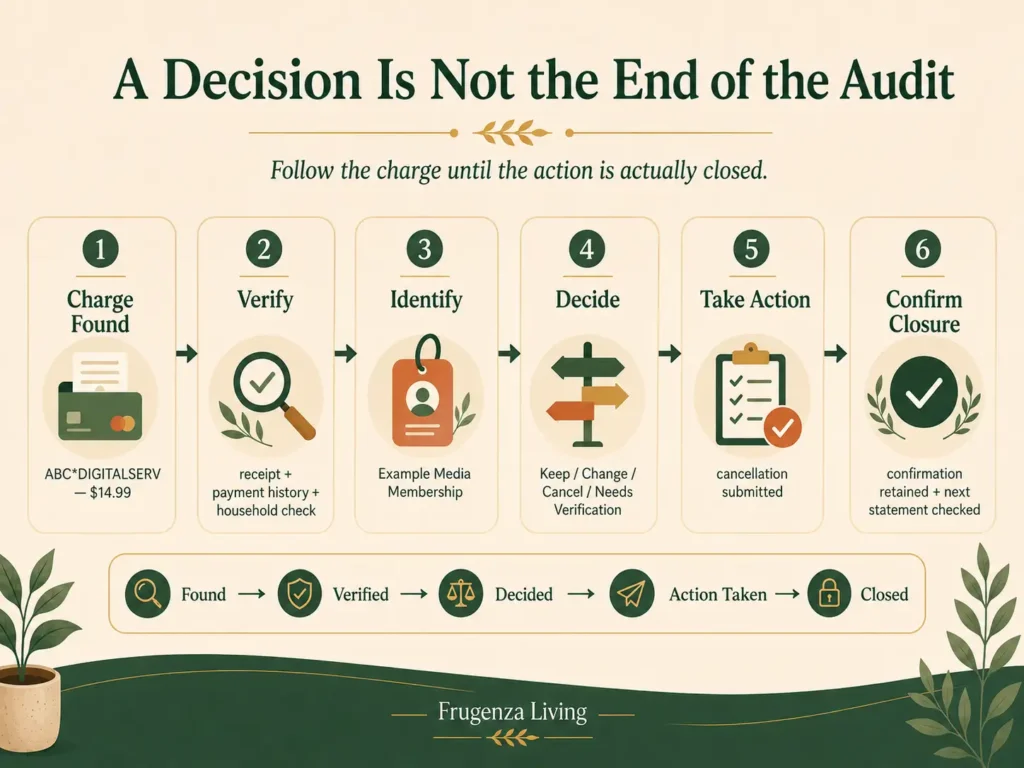
Writing “cancel” in a spreadsheet does not mean the recurring charge is resolved.
For a service you change or cancel, record:
- Date the action was taken.
- What action was requested.
- Confirmation received, when available.
- Expected final charge, if known.
- Expected access-end date, if confirmed.
- Whether another charge appears after the expected change.
Keep a non-sensitive provider confirmation until the expected billing cycle has passed. Do not assume every provider sends the same confirmation, allows the same changes, or ends access immediately after cancellation.
This distinction between a decision and a closed action prevents the same unresolved item from reappearing in the next audit.
What to Do With the Subscriptions You Keep
A clean audit record should contain the current charge, billing cycle, next known charge date, payment source, and owner for every retained service.
That is where auditing ends and budgeting begins.
Use the confirmed list to budget the subscriptions you keep rather than calculating affordability inside this audit. That separate step helps you compare ongoing subscription costs with the cash needed for upcoming renewals without turning this audit into a second budgeting worksheet.
If you are not sure whether you have found every subscription, review your monthly bills checklist and look for recurring charges that may have blended into your regular expenses.
The audit tells you what is real. Your budget decides how retained services fit with everything else.
When Is the Audit Actually Finished?
The audit still needs follow-up when:
- A relevant payment account or active card has not been checked.
- Available annual history is incomplete and other sources have not been searched.
- A merchant descriptor remains unidentified.
- Ownership of a shared charge is unclear.
- Trial or promotional status has not been verified.
- A cancellation or plan change has not been confirmed.
- Current price or renewal terms remain uncertain.
Do not force a universal monthly or quarterly audit schedule.
Repeat the audit when there is a useful trigger: an unexpected recurring charge, several new trials, price increases, a card change, household changes, a renewal-heavy period, or a broader monthly budget reset routine.
This checklist organizes evidence and decisions. Actual subscription status, renewal terms, cancellation processes, and access periods should be confirmed with the provider or payment platform involved.
The Bottom Line
A useful subscription audit checklist does not end with a list of services. It creates a trail from recurring charge to verified identity, deliberate decision, completed action, and documented gap.
Start with the payment account you use most. List every recurring-looking charge you find, then assign a verification status before deciding what should happen next.
Clarity comes before cancellation.
Frequently Asked Questions
What is a subscription audit checklist?
A subscription audit checklist is a structured review of personal or household recurring service charges across bank accounts, cards, app stores, payment platforms, email records, and shared accounts. A complete audit finds subscriptions, verifies identity and ownership, records a decision, follows through on changes, and keeps unresolved items visible.
How far back should I check for subscriptions?
Review about 12–13 months of transactions when that history is available because it can expose annual renewals that a short statement review misses. History alone cannot guarantee completeness, so supplement it with app-store subscriptions, payment-platform settings, renewal emails, receipts, and other relevant sources.
How do I identify an unknown recurring charge?
Record the statement descriptor exactly, then compare it with email receipts, app-store or payment-platform history, provider accounts, earlier transactions, and household members’ subscriptions. Keep the item marked Needs Verification until evidence identifies it. If evidence suggests an unauthorized transaction, follow your bank or card issuer’s official process.
Should I cancel a subscription if I have not used it recently?
Not automatically. Consider its function, household use, replacement cost, seasonal use, duplicate services, current price, and available provider options. Low usage is useful evidence, but it does not prove that a subscription has no value or should be canceled.
How often should I audit my subscriptions?
There is no single schedule that fits every household. Useful triggers include unexpected recurring charges, several new trials, price increases, a payment-card change, household membership changes, a broader budget reset, or a period with major renewals approaching.

The ideas shared here come from real-life experience and practical habits that actually work.
→ Read more about Jeffi
- No Spend Month Challenge for Beginners: A 30-Day Plan - September 24, 2026
- Low Buy Month Challenge: Realistic Rules for 30 Days - September 23, 2026
- How to Stop Buying Groceries You Already Have - September 20, 2026