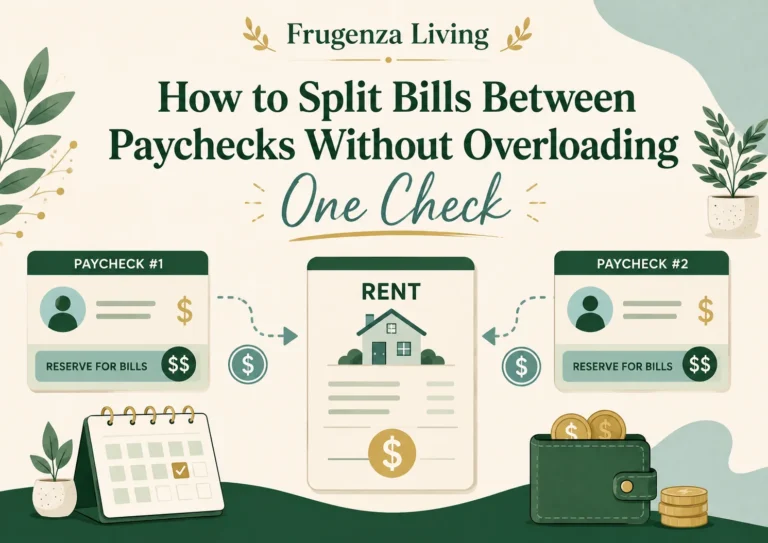
A $1,100 rent payment is due on September 1, but the August 28 paycheck cannot comfortably carry the whole amount after groceries, transportation, and other required commitments.
If you are trying to learn how to split bills between paychecks, start by assigning the bill to the last paycheck that arrives before the money must be fully available. If that paycheck can fund the bill comfortably, do not split it. If it cannot, reserve only the shortfall from the previous paycheck.
In this guide, “split bills” means funding your own household bill from more than one paycheck. It does not mean dividing expenses between partners, roommates, or different people. You are splitting the funding, not necessarily making multiple payments to the provider.
Start With the Paycheck That Naturally Owns the Bill
Before deciding how much each paycheck should contribute, identify the paycheck that naturally has to support the bill.
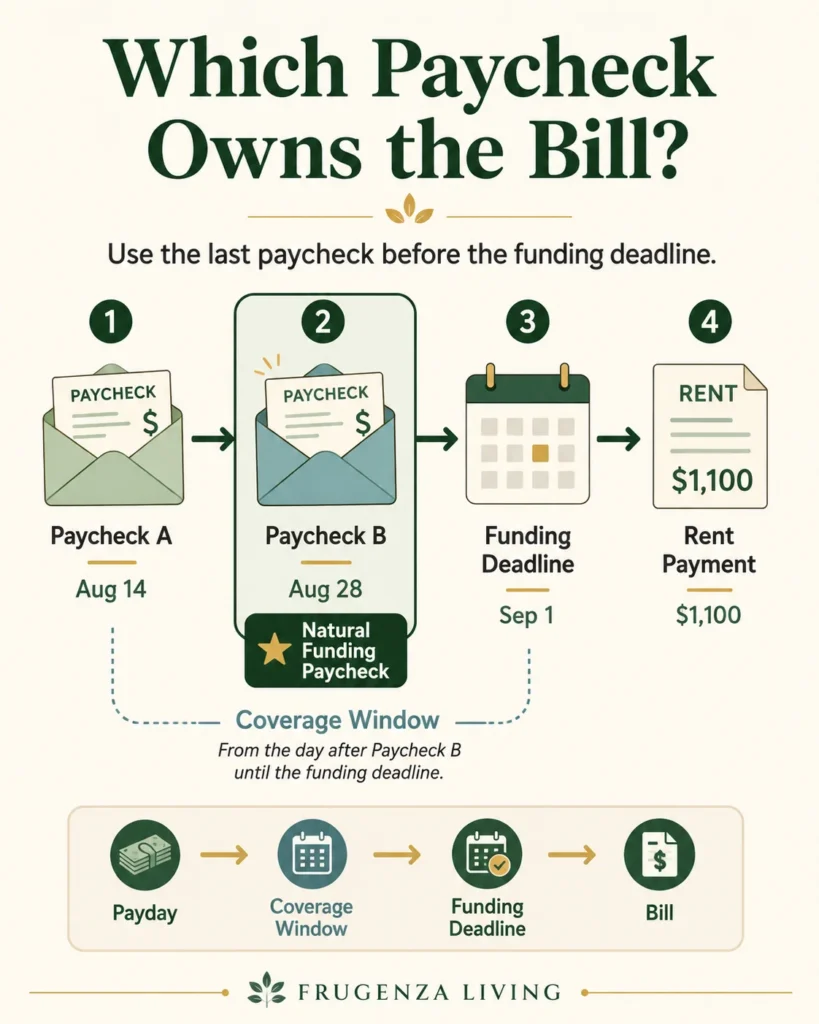
Think in terms of a paycheck coverage window: from the day a paycheck becomes available through the day before the next confirmed paycheck. A paycheck dated August 14 may cover August 14–27 if the next paycheck arrives August 28.
Then identify three useful dates:
- Provider due date: when payment must be received under the provider’s current terms.
- Planned payment date: when you intend to initiate the payment.
- Expected debit date: when you expect the money to leave your account.
For paycheck planning, use one additional concept: the funding deadline.
The funding deadline is the earliest point when the bill money must already be available and should no longer be treated as spendable. For a manual payment, that may be when you initiate it. For autopay, it may be the expected debit date. Processing can vary, so use the timing shown by your actual biller and financial institution.
If your dates are not organized yet, build a bill calendar first. The calendar answers when money moves; this method answers how much each paycheck should fund.
The last confirmed paycheck before the funding deadline is the bill’s natural funding paycheck.
Do Not Split Every Bill in Half
The half-payment method can be convenient, but 50/50 is not a universal rule.
A small $80 bill may fit easily in its natural paycheck and need no split at all. A $1,100 rent payment might need $450 from the earlier paycheck and $650 from the natural paycheck—not $550 each.
For the same $1,100 bill:
- Automatic 50/50: $550 from the earlier paycheck + $550 from the natural paycheck.
- Capacity-based split: $450 from the earlier paycheck + $650 from the natural paycheck.
Both methods fully fund $1,100. The difference is that the capacity-based version asks the earlier paycheck to reserve only what the later paycheck cannot comfortably carry.
The better question is:
How much does the natural paycheck fall short after the spending and commitments that must be protected until the next payday?
Also remember that setting money aside is different from sending a partial payment. Unless a provider explicitly permits partial payments and you understand the terms, keep the reserved money available and make the provider payment normally.
Calculate How Much the Earlier Paycheck Needs to Cover
Start with:
Remaining bill amount = bill amount − money already reserved
Then estimate the natural paycheck’s available bill capacity:
Available bill capacity = take-home pay − protected between-payday needs − other committed amounts
Protected needs may include groceries, transportation, medications, and essential household spending assigned to that pay period.
Important: “Other committed amounts” should not include the bill you are currently testing, or you will count the same bill twice.
For example:
- Take-home pay: $1,700
- Protected between-payday needs: $700
- Other already-assigned commitments: $350
- Available bill capacity: $650
So:
$1,700 − $700 − $350 = $650
Then calculate:
Pre-fund amount = max(0, remaining bill amount − natural paycheck available bill capacity)
If the earlier paycheck has enough capacity, reserve that amount there. If it does not, leave the remaining amount visible as an uncovered gap instead of treating the timing problem as solved.
Bill Split Funding Check
Calculate how much an earlier paycheck needs to reserve for one bill.
Bill Details
Available Bill Capacity
Capacity means money available after protected between-payday needs and other already-assigned commitments. Do not subtract the bill you are testing twice.
Enter the bill and paycheck capacities, then calculate.
—
—
—
—
Results show whether the available paycheck capacities can fund the remaining bill.
How do I estimate bill capacity?
Example: $1,700 take-home − $700 protected needs − $350 other commitments = $650 available bill capacity. Exclude the bill you are currently testing from those other commitments.
Example: $1,100 rent
Already reserved: $0. Natural paycheck capacity: $650. Earlier paycheck capacity: $950. The earlier paycheck needs to reserve $450, the natural paycheck funds $650, and the uncovered gap is $0.
This tool splits bill funding, not provider payments. Keep reserved money available until the bill is paid or drafted.
This calculator itself does not save your entries. Values are used on the page to calculate the result and may disappear when you refresh or leave the page. Estimates are planning aids, not guarantees of provider payment timing.
Example: Split a $1,100 Rent Payment Across Two Paychecks
Consider this illustrative timeline.
August 14 paycheck: $1,950 take-home. After protected spending and other commitments through August 27, $950 remains available for bill funding.
August 28 paycheck: $1,700 take-home. After required commitments, $650 remains available.
Rent: $1,100 must be fully funded before the September 1 payment.
The August 28 paycheck naturally owns the rent because it is the final paycheck before the funding deadline. But its bill capacity is only $650.
So:
$1,100 − $650 = $450 to pre-fund
Reserve $450 from August 14 and $650 from August 28.
You are not necessarily paying the landlord $450 on August 14. The earlier paycheck is holding part of the future payment so the later paycheck does not have to carry the entire bill.
If you need to plan groceries, savings, debt, and flexible spending around these bill assignments, use a paycheck budget template for the rest of the paycheck.
What If the Bill Is Due Before the Next Paycheck?
Do not let calendar labels decide which income “belongs” to a bill.
A September 1 rent payment can legitimately be funded with August paychecks because the money must be ready before September begins. Waiting for “September income” would not work if the next paycheck arrives September 11.
Look beyond month-end boundaries. If no new paycheck arrives before the funding deadline, the previous paycheck—or money reserved even earlier—must prepare for the bill.
This is not permission to pay late. It is a method for making money ready sooner.
If your paychecks arrive on two fixed dates each month, such as the 1st and 15th, a semimonthly paycheck budget can make splitting your bills much easier.
Adjust the Method for Unequal or Variable Paychecks
Paychecks do not need to be equal.
Suppose Paycheck A is $2,200 and Paycheck B is $1,600. The larger paycheck does not automatically have more bill capacity if it also carries more essential spending or other commitments.
Use the capacity left after the obligations attached to each pay period, not paycheck size alone.
The same logic works with different pay schedules.
Biweekly pay usually arrives every 14 days, so payday dates move through the calendar. If this is your schedule, the broader guide on how to budget biweekly paychecks handles the full 14-day planning cycle.
Semimonthly pay usually arrives on two set dates each month. The split method still uses actual upcoming pay dates and the funding deadline rather than assuming every “first check” or “second check” should carry the same bills.
For variable bills such as electricity or water, use the current statement when available. Before that, use a clearly labeled estimate based on your own recent bills, then replace the estimate when the actual amount arrives.
Splitting bills between paychecks creates the plan; tracking which bills each paycheck has funded helps you make sure the plan is actually working.
When Splitting a Bill Is the Wrong Fix
Splitting solves a timing problem only when the combined available capacity is enough.
Suppose a $1,100 bill has nothing reserved. The natural paycheck can contribute $500 and the earlier paycheck can contribute only $300.
That leaves:
$1,100 − $500 − $300 = $300 uncovered
The problem is no longer only timing.
Do not keep borrowing from future paychecks that already need to protect essentials. Reassess discretionary allocations, check whether the provider currently offers a different due date, use an existing buffer if appropriate, or contact the provider early if payment difficulty is expected. Availability and terms vary.
Repeated uncovered gaps are a signal that the larger budget deserves attention. A bill split should clarify cash timing, not hide a continuing shortfall.
Make the Split Repeatable Without Building a Complicated System
Before using a paycheck:
- Confirm the next paycheck date.
- Identify bills whose funding deadlines arrive before or shortly after it.
- Check whether a later bill needs partial pre-funding now.
- Keep the reserved amount separate from spendable money.
- Replace estimates when actual bill amounts change.
Once the bill portion is protected, continue with the rest of your normal paycheck plan. This guide explains how to budget after payday without turning this bill-funding decision into an entire new system.
The rule stays simple:
Assign the bill first, then split only the funding gap.
Methodology note: This is a cash-flow planning framework, not a provider payment rule. Use your actual paycheck dates, take-home amounts, planned payment timing, expected debits, and current bill amounts. Provider terms determine when payment is actually due.
The Bottom Line
The practical answer to how to split bills between paychecks is not “divide every bill in half.”
Identify the paycheck that naturally owns the bill, determine its available bill capacity, and reserve only the shortfall from an earlier paycheck. Use the funding deadline—not the calendar month label—to decide when the money must be protected.
Start with the largest bill currently overloading one paycheck and calculate only what the earlier paycheck needs to reserve.
Frequently Asked Questions
What does it mean to split bills between paychecks?
Usually, it means reserving portions of one bill from more than one paycheck so the full amount is available by the funding deadline. It does not necessarily mean sending multiple partial payments to the provider. You can split the funding internally and still make the actual payment normally.
Should I split every monthly bill 50/50?
No. A 50/50 split can be convenient when two paychecks have similar capacity, but it is not required. First assign the bill to the natural funding paycheck. If that paycheck can cover it after protected needs, keep it there. Pre-fund only the amount that would otherwise overload it.
How do I split rent between two paychecks?
Identify the last paycheck before rent’s funding deadline. Calculate how much that paycheck can fund after protecting required between-payday needs, then reserve the remaining shortfall from the previous paycheck. Keep both amounts available until rent is paid or drafted under your actual payment arrangement.
What if a bill is due before my next paycheck?
The current or previous paycheck may need to reserve the money before the calendar month of the bill begins. Base the plan on actual payday dates and the funding deadline. If combined paycheck capacity remains insufficient, splitting does not solve the underlying shortfall.
Does this work if I am paid biweekly or twice a month?
Yes. The method uses actual upcoming pay dates, so it can work with biweekly or semimonthly pay. Biweekly dates move through the calendar, while semimonthly dates are usually more fixed. In either case, identify the natural funding paycheck first and pre-fund only when needed.

The ideas shared here come from real-life experience and practical habits that actually work.
→ Read more about Jeffi
- No Spend Month Challenge for Beginners: A 30-Day Plan - September 24, 2026
- Low Buy Month Challenge: Realistic Rules for 30 Days - September 23, 2026
- How to Stop Buying Groceries You Already Have - September 20, 2026