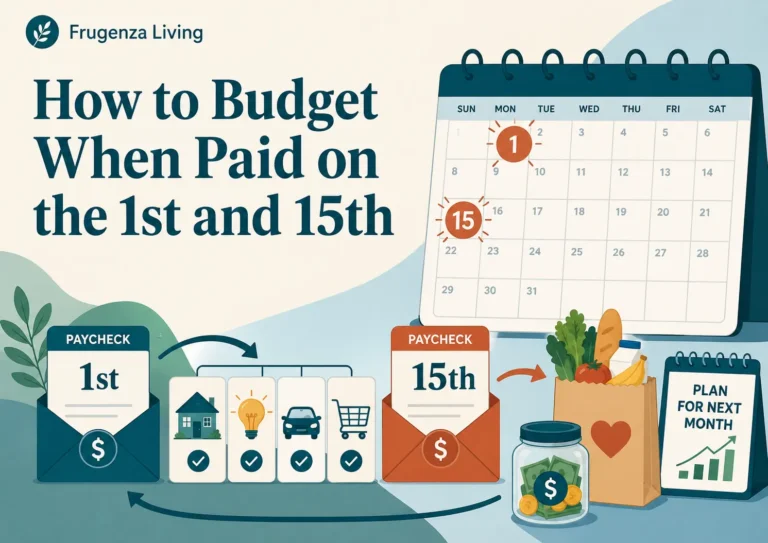
Getting paid on the 1st and 15th sounds simple: two paychecks, two halves of the month. But that neat calendar can hide a cash-flow problem.
The paycheck on the 1st may disappear quickly into rent and early-month bills. The paycheck on the 15th can look more flexible, even though it may need to last longer and prepare for bills due at the start of the next month.
If you are paid on the 1st and 15th, build your budget around two funding windows instead of dividing every expense in half. Map bills to the paycheck that must have the money ready before the due date, let the 15th paycheck look across the month boundary when necessary, and adjust flexible spending for the actual number of days each check needs to cover.
First, Make Sure You Are Actually Paid Semi-Monthly
A schedule built around the 1st and 15th is normally semi-monthly: two paychecks per month, or typically 24 paychecks per year.
That is different from being paid every two weeks.
A biweekly paycheck arrives every 14 days, so the calendar dates move and a typical year contains 26 paychecks. A semi-monthly schedule stays tied to two points in each month and does not normally create “three-paycheck months.”
That distinction changes the budget. If your employer actually pays you every 14 days, use a method designed for budgeting a true every-two-weeks paycheck instead.
For a 1st-and-15th schedule, the useful question is not:
“Can I stretch this check for exactly 14 days?”
It is:
“What must this paycheck have funded before the next paycheck is safely available?”
Stop Thinking “Paycheck #1” and “Paycheck #2”
Think in two funding windows.
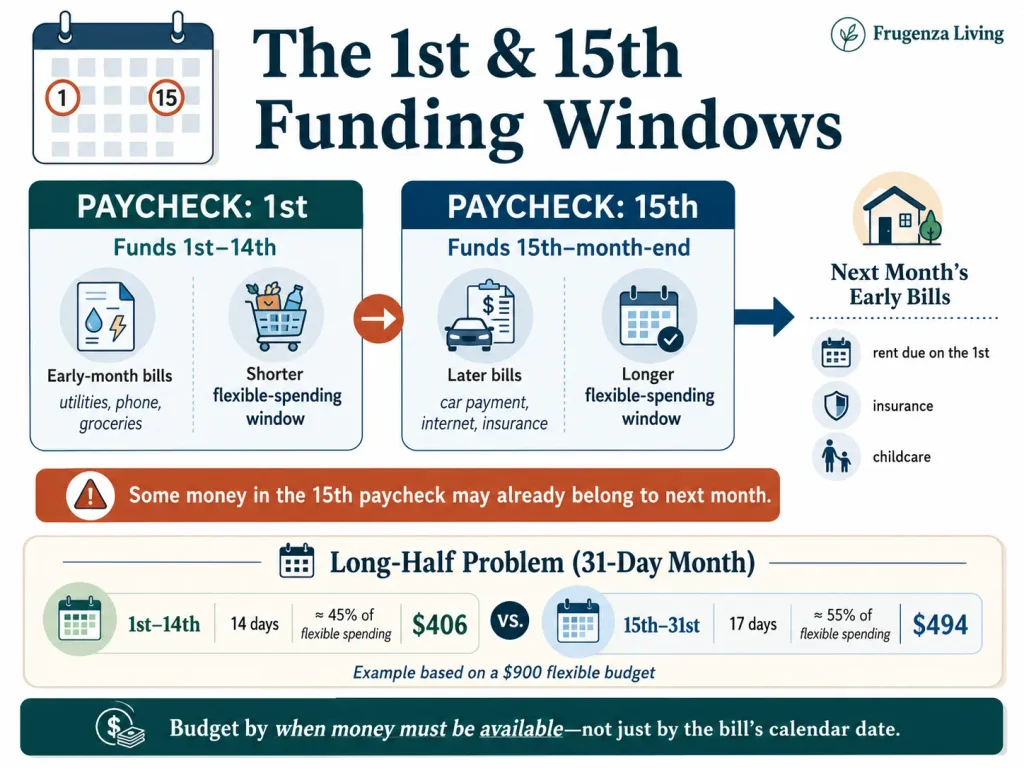
The 1st paycheck window generally handles expenses that need funding after the 1st and before the 15th.
The 15th paycheck window generally handles expenses after the 15th and before the next 1st.
The difference is subtle but important. You are not assigning bills based only on which half of the calendar they appear in. You are deciding when the money must already be protected.
The Consumer Financial Protection Bureau notes that people can run short even when their monthly numbers appear workable because the timing of income and expenses may not line up. Its bill calendar guidance recommends mapping what each bill is, how much is owed, and when it is due.
That is exactly the problem a semi-monthly budget needs to solve.
The 15th Paycheck Has to Look Into Next Month
This is the part many twice-monthly budgets miss.
Suppose rent is due October 1. It is tempting to write:
October 1 paycheck → October rent
But what if the automatic debit happens early that morning and your payroll deposit is not yet available? What if the nominal payday shifts because of payroll processing, a weekend, or a bank holiday?
A bill sharing a date with payday is not automatically funded by that paycheck.
If money needs to be available before or very early on the 1st, some or all of it may need to be reserved from the previous month’s 15th paycheck.
That means the September 15 paycheck may have two jobs:
- cover late-September expenses; and
- protect money for early-October obligations.
This is why the 15th paycheck can feel deceptively “free.” Some of that balance may already belong to next month.
If one large bill is too heavy for a single funding window, do not automatically divide every bill in half. First decide whether the large bill actually needs funding from both paychecks and pre-fund only what is necessary.
Do Not Automatically Split Flexible Spending 50/50
There is another quirk in a 1st-and-15th budget: the two spending windows are not always the same length.
Call this the Long-Half Problem.
In a 31-day month, the first practical window may be roughly 14 days—from the 1st through the 14th—while the second covers 17 days, from the 15th through the 31st.
If groceries, gas, household basics, and everyday personal spending total $900 for the month, splitting $450/$450 may repeatedly leave the second window tight.
A useful starting estimate is:
Monthly flexible spending × days in the funding window ÷ days in the month
For a 31-day month:
- First window: $900 × 14 ÷ 31 ≈ $406
- Second window: $900 × 17 ÷ 31 ≈ $494
That is not a required spending target. Grocery trips, commuting, childcare, and household needs are rarely perfectly even.
But if the second half of every month feels harder despite equal paychecks, day-weighting can show why.
If a due date lands just before one of your semimonthly paydays, learn how to budget for bills due before payday rather than risking a late payment.
1st & 15th Spending Window Calculator
1st & 15th Spending Window Calculator
Estimate how much flexible spending each semi-monthly window may need, then add any early-next-month money the 15th paycheck should protect.
This calculator uses the nominal 1st-and-15th schedule: 14 calendar days in the first window and the remaining days in the second. If your actual deposit date shifts, adjust the result to when your money is really available. The calculation is a planning starting point, not a required spending target.
A Realistic 1st-and-15th Budget Example
Assume take-home pay is $4,000 per month, delivered as two $2,000 checks.
The monthly plan includes:
- Rent: $1,300 due on the 1st
- Utilities: $180 due on the 8th
- Phone: $70 due on the 12th
- Car payment: $350 due on the 20th
- Internet: $70 due on the 22nd
- Insurance: $140 due on the 26th
- Debt minimum: $120
- Flexible spending: $900
- Savings/sinking funds: $250
Total recurring monthly allocations are $3,380, leaving $620 for other real-life categories, additional goals, or buffer.
Now assume the budget has reached a rolling rhythm in which $650 of this month’s $1,300 rent was already reserved from the previous 15th paycheck.
There is one important timing assumption: this example assumes the new $2,000 paycheck is available before the remaining $650 rent payment must be funded. If your rent is debited before that deposit is safely available, the full rent amount would need to be reserved earlier instead.
The new 1st paycheck could look like this:
| 1st paycheck | Amount |
|---|---|
| Finish current rent funding | $650 |
| Utilities | $180 |
| Phone | $70 |
| Flexible spending — 14-day estimate | $406 |
| Debt minimum | $120 |
| Savings/sinking funds | $125 |
| Unassigned margin | $449 |
| Total | $2,000 |
Then the 15th paycheck looks forward:
| 15th paycheck | Amount |
|---|---|
| Reserve toward next month’s rent | $650 |
| Car payment | $350 |
| Internet | $70 |
| Insurance | $140 |
| Flexible spending — 17-day estimate | $494 |
| Savings/sinking funds | $125 |
| Unassigned margin | $171 |
| Total | $2,000 |
The two checks still allocate the full $900 flexible budget and $250 savings amount.
Rent also stays on a $1,300 monthly rhythm: $650 completes the current rent requirement while another $650 begins funding the next one.
The combined $620 margin is not automatically “free money.” In a real household, it may need to cover medical costs, childcare, subscriptions, clothing, irregular bills, extra debt payments, or a larger cash buffer.
The example leaves that amount visible instead of pretending every household has identical expenses.
Once bills are assigned, use a paycheck bill tracker to check whether the money has actually been reserved. An assignment on paper does not protect cash if the money remains mixed with your spendable balance.
Which Paycheck Should See the Bill First?
The calendar date is useful, but the funding deadline matters more.
Which Paycheck Should See the Bill First?
Start with the date the money needs to be available, not just the calendar label on the bill.
A bill due on the 10th will usually belong naturally to the 1st paycheck window. A bill due on the 24th will usually belong to the 15th window.
Bills due exactly on payday need more care because actual deposit availability and payment processing may not line up perfectly.
If a provider offers due-date changes, asking whether a date that better matches your cash flow is available can simplify the system. Availability and terms vary, so treat that as an option rather than an assumption.
What to Do With Savings, Sinking Funds, and Unequal Checks
Savings do not have to be divided exactly in half either.
You can fund a monthly savings goal from one paycheck, split it across both, or use whatever pattern leaves required bills and between-payday needs protected. The same applies to sinking funds and extra debt payments.
If your two semi-monthly checks are not equal because of hours, commissions, or other variable pay, build fixed commitments around realistic take-home amounts rather than an ideal month. A conservative baseline is safer than promising uncertain income to a fixed bill.
For readers who want a broader worksheet for bills, savings, debt, and spending after the two windows are mapped, put those categories into a reusable paycheck budget template.
Common Mistakes With a 1st-and-15th Budget
Treating semi-monthly as biweekly. A fixed 1st-and-15th schedule does not normally create the 26-paycheck pattern or three-paycheck months used in biweekly budgeting.
Assigning a bill to a paycheck just because they share a date. Verify when the deposit is actually available and when the payment needs funding.
Splitting flexible spending exactly 50/50. The second funding window can be longer.
Spending the 15th paycheck only on the current month. Some of it may already belong to next month’s rent or another early obligation.
Treating reserved money as available cash. Once a bill amount is protected, it is no longer part of your spendable balance.
Quick Answers
Is being paid on the 1st and 15th biweekly or semi-monthly?
It is generally semi-monthly because you receive two checks at fixed points in each month. Biweekly pay means every 14 days and usually produces 26 checks per year.
How should I split bills when paid on the 1st and 15th?
Assign bills to the funding window in which the money must be ready. Use the 1st paycheck for expenses due before the 15th when timing allows, and the 15th paycheck for later expenses plus early-next-month bills that must be funded before the next check is safely available.
Which paycheck should cover rent due on the 1st?
Do not assume the paycheck arriving on the 1st should fund the whole payment. Check actual deposit and payment timing. If rent needs to be funded earlier, reserve some or all of it from the previous 15th paycheck.
Should spending money be split equally between both checks?
Not necessarily. In a 30- or 31-day month, the second window is longer. A day-weighted split can be a useful starting point, then adjust it to your real grocery, transportation, childcare, and household patterns.
The Calendar Is Not the Budget
The cleanest way to budget when paid on the 1st and 15th is to stop treating the two checks as identical halves.
Give each paycheck a funding window. Make the 15th paycheck look across the month boundary. Protect bills by the date the money must actually be available, and let flexible spending reflect the number of days the check needs to carry.
Once that rhythm is established, a semi-monthly schedule can become predictable—not because every month is divided perfectly in half, but because each dollar has a job before the next payday arrives.
Editor’s note: This article provides general budgeting education, not individualized financial, legal, tax, or debt advice. Adjust the examples to your actual pay dates, take-home income, bill terms, household needs, and account timing.

Read about Jeffi and Frugenza Living
- How to Budget a 10-Month Salary Over 12 Months - October 16, 2026
- Pet Adoption Budget Checklist: What You Still Need to Pay - October 16, 2026
- Proportional Bill Split Calculator for Two Incomes - October 15, 2026