Payday can feel less like new money and more like a handoff. The deposit arrives, bills immediately claim it, and the next paycheck is already waiting to repeat the same job.
Getting one paycheck ahead changes that sequence.
There is no single standardized definition of “one paycheck ahead” across budgeting systems. In this guide, being one paycheck ahead on bills means one future pay window’s recurring bills are already reserved before the paycheck that would normally fund them arrives.
The new paycheck is not extra money. Its job moves forward.
That distinction matters because you do not necessarily need to save the full dollar amount of one paycheck. If a $2,100 paycheck normally needs to cover $1,340 of recurring bills, your initial bills-ahead target may be $1,340—not $2,100.
The practical path is to calculate that future bill window, subtract what is already reserved, choose a contribution the current budget can genuinely support, and keep shifting the funding timeline forward.
What “One Paycheck Ahead” Actually Means
Use this simple Ahead Definition Test, an editorial planning concept for this guide:
Before today’s paycheck arrives, are the recurring bills it would normally fund already reserved using income you received earlier?
If yes, that future bill window is one paycheck ahead.
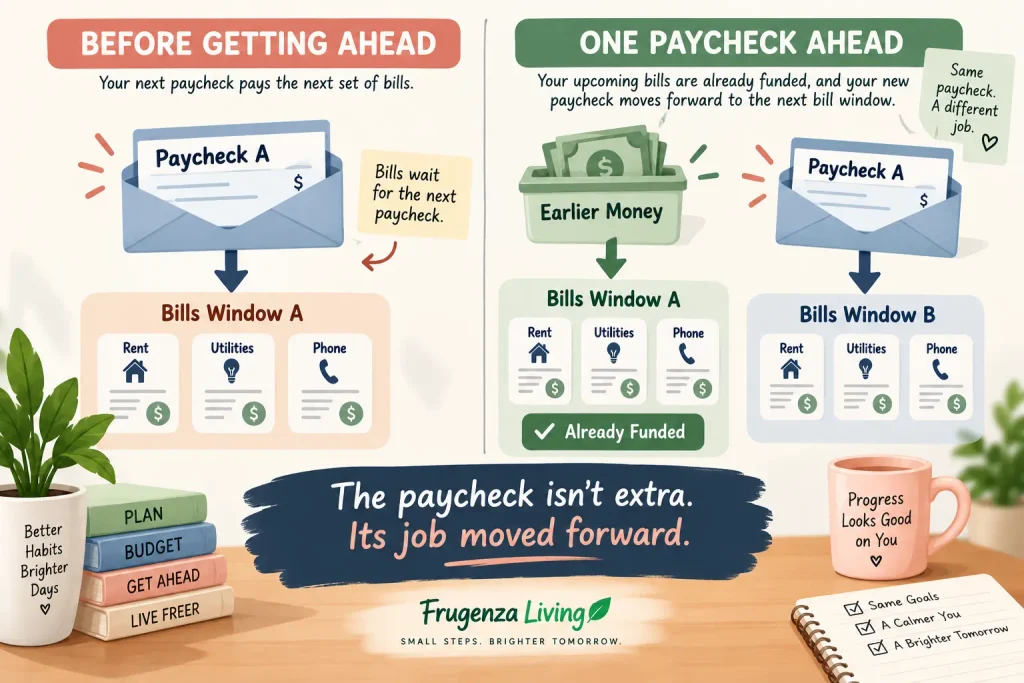
Before getting ahead:
September 18 paycheck → funds bills in the upcoming window
After getting ahead:
Earlier income → upcoming bills are already funded
September 18 paycheck → begins funding the following bill window
Getting ahead changes which paycheck funds the bills. It does not create another paycheck.
You also do not need to physically send every payment one pay cycle early. The money can remain reserved until the normal payment or autopay date.
Think fund early, not necessarily pay early.
If the current cycle is still short on bills or essentials, however, do not force an ahead transfer. First fix a bill gap that exists before the next paycheck arrives. You cannot get ahead by leaving today underfunded.
How Much Money Do You Actually Need?
“Save one whole paycheck” sounds simple, but it can be the wrong target.
For this article, the Bills-Ahead Target means:
Bills-Ahead Target = recurring bills that normally need funding during one future paycheck window
Suppose take-home pay is $2,100 and the next future bill window contains:
| Future bill | Amount |
|---|---|
| Rent allocation | $650 |
| Utilities | $160 |
| Car payment | $320 |
| Phone | $70 |
| Insurance | $140 |
| Bills-Ahead Target | $1,340 |
The initial target is $1,340, not automatically the full $2,100 paycheck.
That is the key difference between “saving a paycheck” and actually getting one paycheck ahead on bills.
A stronger milestone would be one full pay cycle ahead, where the same future window’s recurring bills plus essential variable spending—such as groceries and transportation—are already funded too.
That is useful, but it is a separate, larger target.
What if one pay window is more expensive?
Do not force every paycheck window to use the same target.
One normal window might need $950 while another needs $1,340 because rent, insurance, or another large bill falls there.
Being ahead means having the next actual funding window covered—not making every pay period artificially identical.
If you prefer a more conservative steady target, you could use the higher normal recurring bill window. But do not build the entire system around a one-time medical bill, unusual utility spike, annual expense already covered elsewhere, or another abnormal month.
Once your bills are assigned to specific paychecks, you can see where small amounts can gradually be redirected toward next month’s expenses.
Find the Gap Between Today and One Paycheck Ahead
Now suppose:
Bills-Ahead Target: $1,340
You have already received and reserved:
$240
Then:
Remaining Ahead Gap = $1,340 − $240 = $1,100
Only count money that:
- has already been received;
- genuinely exists;
- belongs to the future pay window you are funding.
Do not count expected pay, unused credit, overdraft limits, projected side income, a tax refund that has not arrived, or money reserved for a completely different goal.
If some cash is locked to another specific purpose, do not include it merely because it sits in the same account.
For the calculator below, Already Reserved is applied to the bills-ahead target first, then to optional future-window essentials. If money is already locked to groceries, a sinking fund, emergency savings, or another unrelated purpose, do not count it as general ahead reserve.
One Paycheck Ahead Builder
One Paycheck Ahead Builder
Calculate your bills-ahead target, remaining gap, and an estimated build timeline based on the contribution you enter.
This calculator does not determine whether your contribution is affordable. It assumes you have already confirmed that the current pay window’s bills and essential spending are funded. Money entered as Already Reserved is applied to the bills-ahead target first, then to optional future-window essentials. Do not count money locked to another purpose, a future paycheck, unused credit, overdraft capacity, or expected income.
Bills-Ahead Goal
Optional Full Pay-Cycle Goal
The Awkward Middle: Today and Tomorrow Overlap
The build phase often feels harder than the finished system.
You are still funding today’s bills while moving part of your available capacity toward a future bill window.
That can feel like paying bills twice.
You are not.
You are funding two timelines:
current obligations
and
future obligations
The build phase feels expensive because two timelines briefly overlap.
That is why a large transfer is not automatically better.
Moving $500 toward next month may look like fast progress until you discover that the current pay period still needs groceries, gas, or another required bill.
The goal is not to finish as quickly as possible.
The goal is to finish without breaking the budget you are using to get there.
Choose a Sustainable Contribution, Not an Impressive One
This guide calls the amount you can intentionally move forward a Safe Ahead Contribution, another editorial planning term.
The calculator does not determine whether that number is actually safe. You must establish that first.
A contribution qualifies only after the current pay window’s bills and essential spending are protected.
There is no universal percentage.
Suppose:
Remaining Ahead Gap = $1,100
After planning the current paycheck, you determine that:
$220 is genuinely available
Then:
$1,100 ÷ $220 = 5 paydays
If the target and contribution remain similar, it may take about five paydays to reach the bills-ahead target.
If next payday only has $90 genuinely available, use $90.
If nothing is available, use $0.
Do not force progress by moving money forward and then pulling it back three days later.
If you still need to determine what the current paycheck must handle first, give that paycheck its jobs before moving money forward.
What Happens When You Reach the Target?
This is where “getting ahead” becomes useful rather than simply looking like a savings balance.
Suppose your $1,340 future bill target is fully reserved before the next $2,100 paycheck arrives.
Those upcoming bills no longer depend on that paycheck.
The paycheck starts funding the following bill window.
This guide calls that transition the Rolling Funding Shift.
Before:
Paycheck A → Bill Window A
After:
Earlier money → Bill Window A
Paycheck A → Bill Window B
When Window A eventually arrives and its $1,340 gets used to pay the bills, your ahead reserve will decrease.
That does not automatically mean you lost progress.
The money did exactly what it was reserved to do.
Meanwhile, Paycheck A has already started funding Window B.
The goal is not to accumulate a pile of unused bill money forever. The goal is to move the funding timeline forward.
If the bills-ahead target is $1,340 and you have $1,500 reserved, do not automatically treat the extra $160 as spending money.
First determine whether it belongs to essential spending in the same future window, another upcoming bill window, or another planned savings goal.
One Paycheck Ahead Is Not an Emergency Fund
A paycheck-ahead reserve and an emergency fund may both involve cash sitting untouched, but their jobs are different.
Paycheck-ahead money is reserved for known future obligations.
The Consumer Financial Protection Bureau describes an emergency fund as a cash reserve for unplanned expenses or financial emergencies. CFPB also describes cash flow as the timing of money coming in and going out. Its guide to building an emergency fund explains these concepts further.
That means upcoming rent does not become an emergency just because you funded it early.
And being one paycheck ahead does not replace emergency savings.
It is also different from being one month ahead.
A weekly or biweekly worker can have several pay windows within one month. Someone paid monthly may find that the two milestones are much closer.
This article focuses on the smaller operational milestone:
one future paycheck window’s recurring bills already funded.
Extra Money Can Speed Up the Build—but It Is Not the System
A tax refund, bonus, cash gift, or genuinely uncommitted extra-paycheck money can accelerate progress.
Suppose:
Remaining gap = $1,100
and you receive $400 of one-time money that is genuinely available for this goal.
The gap becomes:
$700
Useful? Absolutely.
But the windfall did not create the underlying budgeting system.
The same is true for “third paychecks.” They occur only under certain pay schedules and calendar patterns.
Extra income can shorten the build phase; it should not be mistaken for the system itself.
A stable ahead system still depends on future paychecks continuing the rolling funding shift.
What If You Cannot Find Any Safe Contribution?
Do not force the goal.
If current required bills and essential spending are not funded, transferring money to a future bill window does not make you financially ahead.
It simply makes the shortage less visible.
Borrowing is not a shortcut either.
Using an overdraft, cash advance, or new credit balance to create an “ahead” balance replaces a funding goal with a debt obligation.
If reliable income consistently cannot cover required bills and essential living costs, rearranging the timing cannot manufacture the missing money.
If the current budget is stable but has no uncommitted room right now, the build may simply take longer until expenses, income, or genuinely available cash changes.
Slow progress is still real progress.
A contribution that creates another shortage is not.
Keep the Funding Shift Alive
Getting ahead once is only the transition.
Staying ahead means making sure future bill money remains identifiable and continues moving forward.
The reserve can stay in checking if that works for you. The important part is knowing which dollars already belong to future bills.
You might track that through:
- a budgeting category;
- spreadsheet;
- bank bucket;
- sub-account;
- another clearly labeled reserve system.
You do not need a separate bank account simply to satisfy this method.
Once money has been assigned, verify that future bill money has actually been reserved instead of assuming a line in the budget equals cash that is truly protected.
When recurring bills change, update the future-window target.
And when the ahead reserve gets used for the bills it was designed to pay, do not automatically treat the lower reserve balance as failure.
Ask the more important question:
Did the newest paycheck continue funding the next window?
If yes, the timeline is still ahead.
Common Mistakes That Make the Progress Disappear
Setting the target equal to a whole paycheck without checking the future bill window. Your true bills-ahead target may be smaller—or occasionally larger.
Counting expected income as money already reserved. Future income is not saved money.
Building ahead while today is underfunded. That merely moves a current shortage into another category.
Treating ahead money as emergency savings or extra spending cash. Planned bills and unplanned financial shocks have different jobs.
Reaching the target once but stopping the rolling shift. The long-term advantage comes from each new paycheck continuing to look forward.
Quick Answers
How much money do I need to get one paycheck ahead on bills?
Total the recurring bills that normally need funding during one future paycheck window. That amount—not automatically the full value of your paycheck—is the initial bills-ahead target.
How long does it take to get one paycheck ahead?
Subtract money already reserved from the bills-ahead target. Divide the remaining gap by the amount you can safely contribute per payday and round up to the next whole payday. The estimate changes whenever the target or contribution changes.
Is being one paycheck ahead the same as having an emergency fund?
No. Paycheck-ahead money is reserved for known future bills. An emergency fund is intended for unexpected expenses or financial emergencies.
Is one paycheck ahead the same as one month ahead?
Not necessarily. One paycheck ahead covers one future pay window. One month ahead is a broader budgeting structure and may involve multiple paycheck windows depending on how often you are paid.
The Finish Line Is a Funding Shift
Getting one paycheck ahead on bills is not about reaching an arbitrary savings number.
Ask one question:
Before today’s paycheck arrives, are the recurring bills it would normally fund already reserved from money received earlier?
If the answer is no, calculate the future bill target, subtract what is already reserved, and choose a contribution the current budget can actually carry.
If the answer is yes, that paycheck is not suddenly extra.
Its job has moved forward.
That change—from waiting for the next paycheck to fund the next set of bills, to having those bills funded before the paycheck arrives—is the real value of getting one paycheck ahead.
Editor’s note: This article provides general budgeting education, not individualized financial, legal, tax, credit, or debt advice. Use your actual take-home income, bill amounts, pay schedule, account balances, provider terms, and household needs.

Read about Jeffi and Frugenza Living
- How to Budget a 10-Month Salary Over 12 Months - October 16, 2026
- Pet Adoption Budget Checklist: What You Still Need to Pay - October 16, 2026
- Proportional Bill Split Calculator for Two Incomes - October 15, 2026