To budget biweekly paychecks, match your actual pay dates to the money you need before the next deposit. Include bills, groceries, transportation, and money reserved for larger bills that arrive later.
This guide uses a hypothetical $1,650 paycheck to show two dated budgets, how next month’s rent is funded, and a template you can copy. All amounts are in U.S. dollars and are examples, not spending targets.
Quick Answer: How to Budget Biweekly Paychecks
Write down your next pay date and each bill’s payment date. Use your take-home pay plus any unassigned carryover to cover essential costs, required payments, and future bill set-asides. Then assign affordable amounts to savings, a buffer, and optional spending.
Money already reserved for rent is unavailable for other spending, even if it remains in your checking account. A third paycheck also needs a budget; only the amount left after its obligations is available for extra goals.
Biweekly Pay Is Different From Twice-Monthly Pay
Biweekly means every 14 days, usually 26 paychecks a year. Twice-monthly, or semimonthly, means two scheduled paydays each month, usually 24 a year. Some biweekly calendars have 27 paydays; check your employer’s actual schedule.
Biweekly dates move through the month. A paycheck arriving on the 22nd may need to cover rent due on the 1st of the following month. Assign bills to specific dates rather than assuming the first paycheck covers the first half of every month.
1. Check Your Take-Home Pay and Upcoming Pay Dates
Use the net deposit after payroll deductions. Do not budget gross wages or subtract taxes and benefits again after using net pay. List at least your next three paydays, including any confirmed holiday changes.
At $1,650 per paycheck, a two-paycheck month brings in $3,300. With 26 equal paychecks, annual take-home pay is $42,900 and the monthly average is $3,575. That average describes the year; it does not put $3,575 in your account every month.
For this method, use two paychecks as a conservative monthly baseline and forecast the third separately. If you need the annual calculation, see how to calculate monthly income from a biweekly paycheck.
2. Match Each Bill to a Funded Payment Date
List each bill’s amount, due date, and the date money must be available for payment. For autopay, note the scheduled withdrawal; for manual payments, allow the provider’s processing time. If pay and a withdrawal fall on the same date, fund the payment earlier unless deposit availability is confirmed. Record minimum debt payments here once.
Also note how much is already reserved and how much new money the bill still needs. A $1,200 rent payment with $600 already set aside needs another $600, not a fresh $1,200 allocation.
Use a monthly bills checklist to find missing payments. Forecast beyond the next payday when a large bill needs several contributions. The CFPB’s cash flow budget worksheet can help you carry balances forward and identify weeks when money runs short.
3. Worked Example: Two $1,650 Biweekly Paychecks
Assume paydays are January 8 and January 22, 2027, followed by February 5. January’s rent has already been paid from earlier income, and the reserve for February’s $1,200 rent starts at $0. There is no unassigned carryover in this example.
These are allocations of new pay, not a bank transaction log. Each paycheck totals $1,650. Adjust every amount and date to your own situation.
January 8 Paycheck: January 8–21
- February rent set-aside: $600
- Phone, payment date January 12: $60
- Utilities, payment date January 18: $180
- Minimum debt payment, January 20: $150
- Groceries and transportation for 14 days: $300
- Sinking fund contribution: $60
- Emergency savings contribution: $100
- Buffer: $100
- Optional spending: $100
Total assigned: $1,650. Unassigned: $0.
January 22 Paycheck: January 22–February 4
- February rent set-aside: $600
- Internet, payment date January 26: $70
- Insurance, payment date January 28: $140
- Groceries and transportation for 14 days: $300
- Sinking fund contribution: $60
- Emergency savings contribution: $100
- Buffer: $100
- Optional spending: $280
Total assigned: $1,650. Unassigned: $0.
Follow the Rent Reserve Through the Payment
- Before January 8: February rent reserve is $0.
- January 8: add $600. Rent reserve becomes $600.
- January 22: add $600. Rent reserve becomes $1,200.
- February 1: pay $1,200 from the reserve. Rent reserve returns to $0.
The February 1 payment uses the two $600 allocations. Do not allocate another $1,200 from the January 22 paycheck for the same rent. Starting February 5, plan contributions toward March’s rent using the actual upcoming dates.
A reserve is still earmarked cash, not money already spent. Keep it separate in your records until the payment occurs. Unused buffers also carry forward; they do not become new income on payday.
4. Calculate Optional Spending After Protecting Essentials
Use this formula for money you can spend on optional purchases:
Unassigned carryover + net paycheck − bills needing new money − future bill set-asides − essential living costs − planned savings − buffer = optional spending.
For January 8, the calculation is $1,650 − $390 in current bills − $600 for future rent − $300 for groceries and transportation − $160 for savings − $100 buffer = $100.
Dividing $100 by 14 gives about $7.14 per day for optional purchases. This is a pacing guide, not a requirement to spend daily. Groceries and transportation already have their own $300 allocation; the $100 is additional room.
If the result is negative, the plan needs adjustment before optional spending begins. Reducing discretionary purchases or optional savings may help, but those changes cannot fix every income shortfall.
5. Handle Bills Due Before Your Next Payday
A timing buffer covers the gap between a payment date and incoming pay. Size it from your actual forecast rather than choosing an arbitrary $100 or $300 target.
If rent of $1,200 is due on February 1, payday is February 5, and only $200 is available for rent, the rent shortfall is $1,000. Add other essential costs due before February 5 to find the full gap.
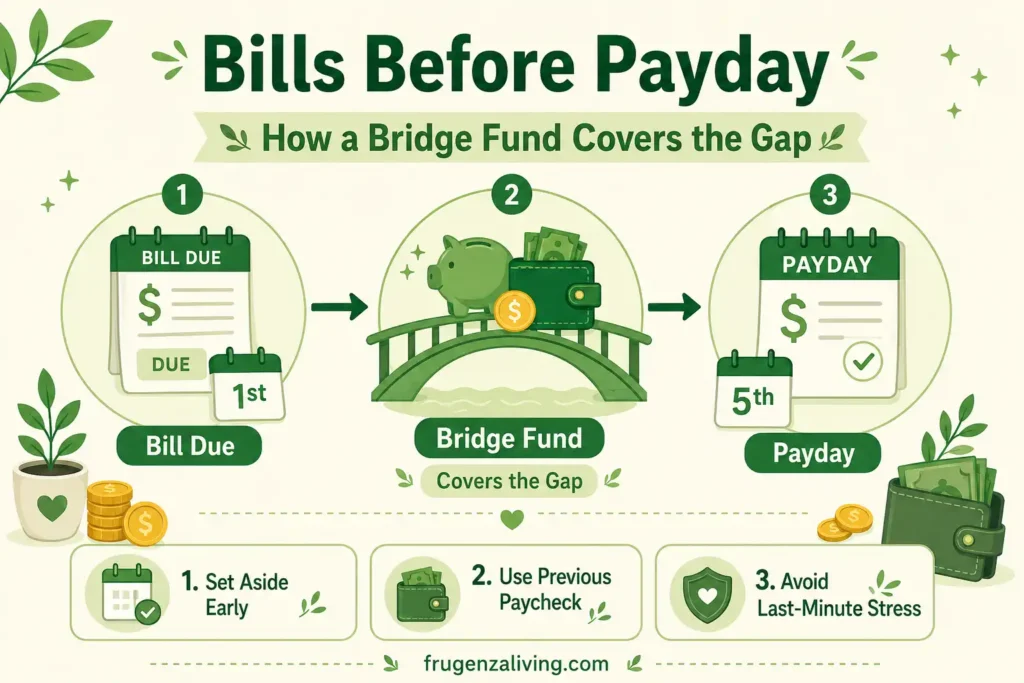
Starting the system with an empty reserve does not create that missing money. Reduce adjustable costs, use genuinely available funds, or contact the provider before the deadline about a payment arrangement or due-date change. Confirm any agreement; do not assume a new date applies immediately.
When you cannot cover everything, consider consequences for housing, food, health, utilities, and getting to work. An earlier due date alone does not determine which unpaid bill creates the greatest risk.
6. Budget a Third Paycheck Before Calling It Extra
On a typical 26-paycheck calendar, two months have three paychecks. Identify them from your actual payroll dates. The third deposit still has to support the next 14 days and any bills or reserves that remain unfunded.
Suppose a third paycheck is $1,650 and all required bills and future bill reserves are already funded. If groceries and transportation need $300, sinking funds $60, emergency savings $100, and the buffer $100, you have $1,090 left for additional goals: $1,650 − $560.
If another $600 rent contribution is needed, the remaining amount falls to $490. Check the calendar before choosing extra debt payments, more savings, or optional purchases.
If your budget already divides annual expenses across all 26 paychecks, keep those contributions in the third-paycheck plan. That money is part of the annual budget, even when monthly cash flow looks comfortable.
7. Calculate Sinking Funds From the Deadline
For an expense you can anticipate, use:
(Target amount − money already saved) ÷ paychecks available before the deadline = contribution per paycheck.
A $600 bill with $150 saved and five paychecks remaining needs $90 from each paycheck: ($600 − $150) ÷ 5. Dividing by 26 would underfund a bill arriving sooner.
Annual cost divided by 26 works when all 26 contributions are available before payment. For a $520 target with nothing saved and 26 deposits remaining, that is $20 per paycheck.
Keep predictable expenses separate from money for unexpected problems. See the difference between a sinking fund and an emergency fund. Moving cash into either fund is an allocation, not a second purchase expense.
8. Adjust the Plan When Pay Changes
If overtime, tips, or hours vary, start with a cautious estimate based on recent ordinary paychecks. Exclude unconfirmed bonuses and overtime. Your lowest recent paycheck is a planning reference, not a guarantee of future income.
When the deposit arrives, rebuild the allocation using the actual amount. Protect essential costs and required payments, then review optional spending and savings contributions. If income cannot cover necessities, identify the shortfall and contact affected providers early.
Assign a larger-than-expected deposit only after checking the next bill dates. First cover unfunded obligations; then decide how much can go toward reserves, savings, debt, or other priorities.
Biweekly Paycheck Budget Template You Can Copy
Copy this into your notes or a spreadsheet and complete it for each deposit. The fields are a manual planning template, not an automatic calculator.
PAY PERIOD
Pay date: ______
Next pay date: ______

MONEY AVAILABLE TO ASSIGN
Posted cash balance before this deposit: $______
Less unpaid amounts already reserved: $______
Less unreserved pending payments: $______
Unassigned carryover: $______
Net paycheck: $______
Total available to assign: $______

BILLS AND FUTURE RESERVES
Bill name: ______
Payment/funding date: ______
Amount needed by that date: $______
Already reserved: $______
New money to assign now: $______
(Repeat for each bill and future set-aside.)

OTHER ALLOCATIONS
Essential living costs until next pay: $______
Sinking fund contributions: $______
Emergency savings: $______
Other savings or extra debt payments: $______
Buffer: $______
Optional spending: $______

CHECK THE PLAN
Total new allocations: $______
Available to assign minus allocations: $______
Lowest projected cash balance before next payday: $______

RESERVE RECORD — REPEAT FOR EACH FUND
Opening reserve + new contributions − payments from reserve = closing reserve
$______ + $______ − $______ = $______
Start with the posted balance, before pending payments are deducted. Subtract a pending payment once: within an existing reserve, or as an unreserved pending payment. Do not also allocate new money to a payment deducted here. If your bank displays a balance already reduced by pending transactions, reconcile it to the posted balance first.
Existing reserves remain assigned and do not join your new spending allowance. Check each scheduled withdrawal against projected cash, not just the final total.
If money remains unassigned, give it a purpose or label it as carryover. If allocations exceed available funds, revise the plan. A balanced allocation also needs enough cash on every payment date.
Check Actual Spending Before the Next Paycheck
Compare purchases with your grocery, transportation, and optional spending allocations. Update changed bill amounts and confirm payments cleared. Use a simple expense-tracking system to record actual amounts rather than relying on memory.
If a category repeatedly needs the buffer, revise that category’s estimate. Before the next deposit, record remaining cash and reserve balances so you can tell genuinely unassigned money from funds already promised to a bill.
Biweekly Budgeting FAQ
Should I save half the rent or divide its annual cost by 26?
Both approaches need a date check. For $1,200 monthly rent, $600 from two selected paychecks each month funds the bill. Saving $1,200 × 12 ÷ 26 gives about $553.85 from every paycheck, including third paychecks, and requires a carryover reserve to handle timing. Adjust the final contribution for rounding. Two $553.85 deposits alone do not fund $1,200 rent. Choose one method, forecast the starting reserve, and avoid combining both for the same bill.
Do I need a separate bank account for bill money?
No. You can track reserved amounts in a spreadsheet or notebook while keeping the cash in one account. A separate account may make the distinction easier, but check fees, transfer timing, and where autopay draws funds. Either way, reserved money stays unavailable for other purchases.
Start With the Next Three Paydays
List those dates, map your bills, and complete the next paycheck’s allocation. Check whether larger bills need money from more than one deposit. Carry reserve balances forward and review actual spending before repeating the plan.
The useful result is a clear answer to two questions: what is this paycheck responsible for, and how much remains available after those responsibilities?
This guide provides general educational information. The example does not account for every household expense or individual financial circumstance.

Read about Jeffi and Frugenza Living
- How to Budget a 10-Month Salary Over 12 Months - October 16, 2026
- Pet Adoption Budget Checklist: What You Still Need to Pay - October 16, 2026
- Proportional Bill Split Calculator for Two Incomes - October 15, 2026