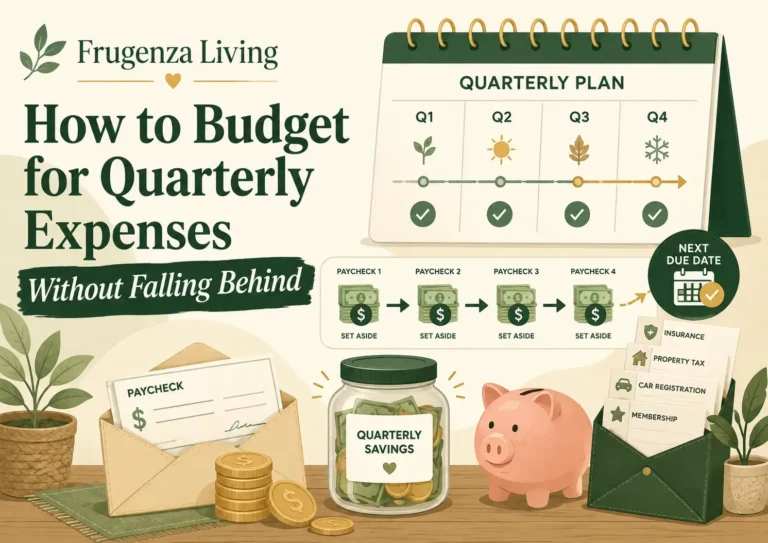
Your monthly budget can look stable until a bill due every three months lands beside another large payment. The expense was predictable, but its timing still creates a cash-flow problem.
Learning how to budget for quarterly expenses requires two calculations. First, determine what the next payment requires based on the amount already reserved and the deposits still available. After that bill is paid, calculate the smaller contribution for the next full cycle.
This guide focuses on personal or household bills that repeat approximately every three months. It is not a business quarterly budget or a guide to calculating estimated taxes.
Start With the Next Bill, Not an Ideal Quarter
Dividing a quarterly bill by three works only when the previous bill has just been paid and you have a complete three-month runway.
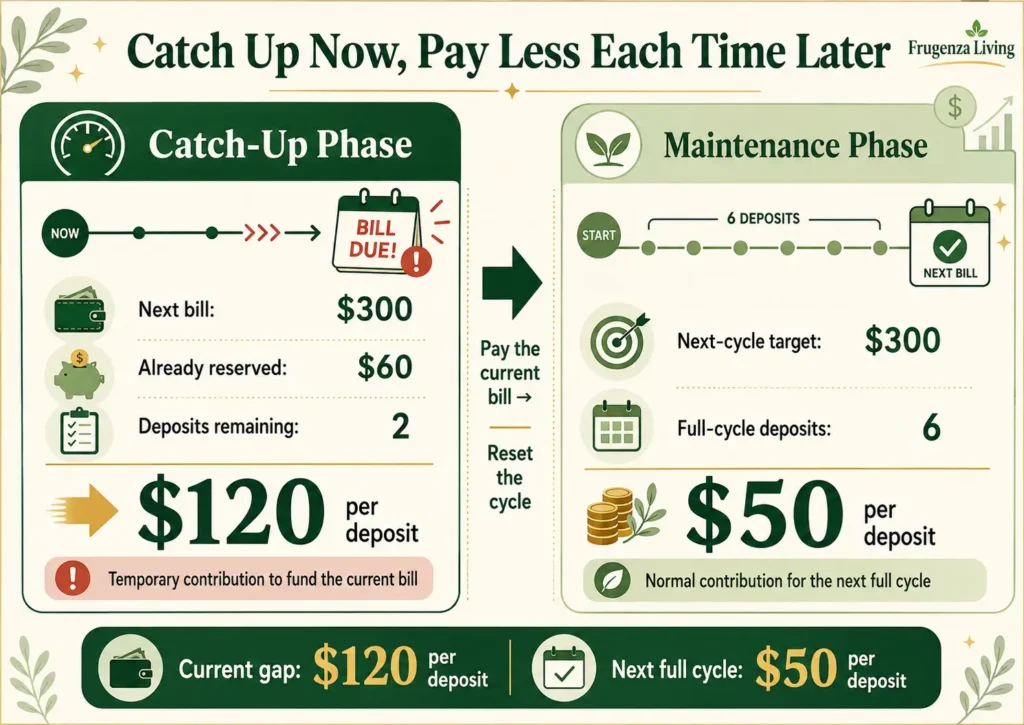
Suppose the next bill is $300. You have $60 reserved and only two paychecks available before the withdrawal date. Saving the normal $100 per month would leave you $40 short.
Use a temporary catch-up calculation:
Catch-up contribution = (expected next bill + justified buffer − amount already reserved) ÷ funding opportunities remaining
For this example:
($300 − $60) ÷ 2 = $120 from each remaining paycheck
After the $300 bill is paid, switch to maintenance:
Maintenance contribution = (expected next bill + justified buffer) ÷ funding opportunities in the next full cycle
If three monthly transfers will arrive before the following bill:
$300 ÷ 3 = $100 per month
In plain language, subtract what you already have from the amount you expect to pay, then divide only the remaining gap by the deposits available before payment. After the bill clears, divide the next target across the entire new cycle.
If you are still identifying all your non-monthly obligations, use an annual expenses checklist for the broader inventory. This page is specifically for calculating and managing one bill that returns about every three months.
Calculate the Runway Before the Due Date
Collect these details for one quarterly bill:
- The next payment or expected withdrawal date.
- The best available estimate of the bill.
- The amount already assigned to that bill.
- A buffer supported by a known increase or relevant history.
- The number of deposits available before payment.
- The contribution frequency you will use.
- The number of funding opportunities in the next full cycle.
Count only money available before the bill is withdrawn. A paycheck arriving the following day does not belong in the current runway.
The reserved balance can remain in checking, savings, or a labeled budget category. The location matters less than keeping its purpose visible. For the broader account and category setup, see sinking funds for beginners.
Quarterly Expense Runway Calculator
TWO-CYCLE METHODCalculate the catch-up contribution for the upcoming bill and the normal contribution for the next full cycle.
Use zero unless a known increase, seasonal history, or recent bill range supports a buffer.
Count only deposits available before the expected withdrawal date.
The maintenance result assumes the same expected bill and buffer unless you recalculate later.
Your Funding Result
Quarterly expense
Payment date: —
—
—
—
—
—
—
Enter your figures
Next action: Select Calculate Both Contributions.
max(0, expected bill + buffer − amount already reserved) ÷ current funding opportunities
Maintenance contribution:
(expected bill + buffer) ÷ funding opportunities in the next full cycle
Illustrative example: A $300 bill with $60 reserved and two deposits remaining requires $120 from each current deposit. Across six deposits in the following full cycle, the normal contribution would be $50 per deposit.
This calculator runs only in your browser and does not save or send your entries. It is a general planning tool, not tax, legal, or individualized financial advice.
Use the Date That Actually Affects Cash Flow
A statement can show an issue date, due date, autopay withdrawal date, and the date a bank transfer must begin. Build the runway around the earliest date when the money must be available.
For example, a bill may be officially due on October 15 but scheduled for autopay on October 12. A paycheck arriving October 14 cannot fund that withdrawal. A manual transfer may also need to begin before the provider’s due date.
Check the statement and payment method rather than assuming the printed due date is the only deadline. The calculator intentionally asks you to count funding opportunities manually because it cannot know your exact payday, bank-processing time, holidays, or money already committed elsewhere.
Follow One Bill Through Two Cycles
Assume an insurance installment of $360 is due on September 18. You have $120 reserved and four weekly deposits available before the withdrawal. With no extra buffer:
($360 − $120) ÷ 4 = $60 per weekly deposit
After the payment clears, confirm the next due date instead of assuming exactly 90 days. If twelve weekly deposits will arrive before the next installment:
$360 ÷ 12 = $30 per weekly deposit
That second amount is the maintenance contribution. It is easier because the full runway is available. It is not permanent: recalculate if the provider changes the amount, schedule, or withdrawal date.
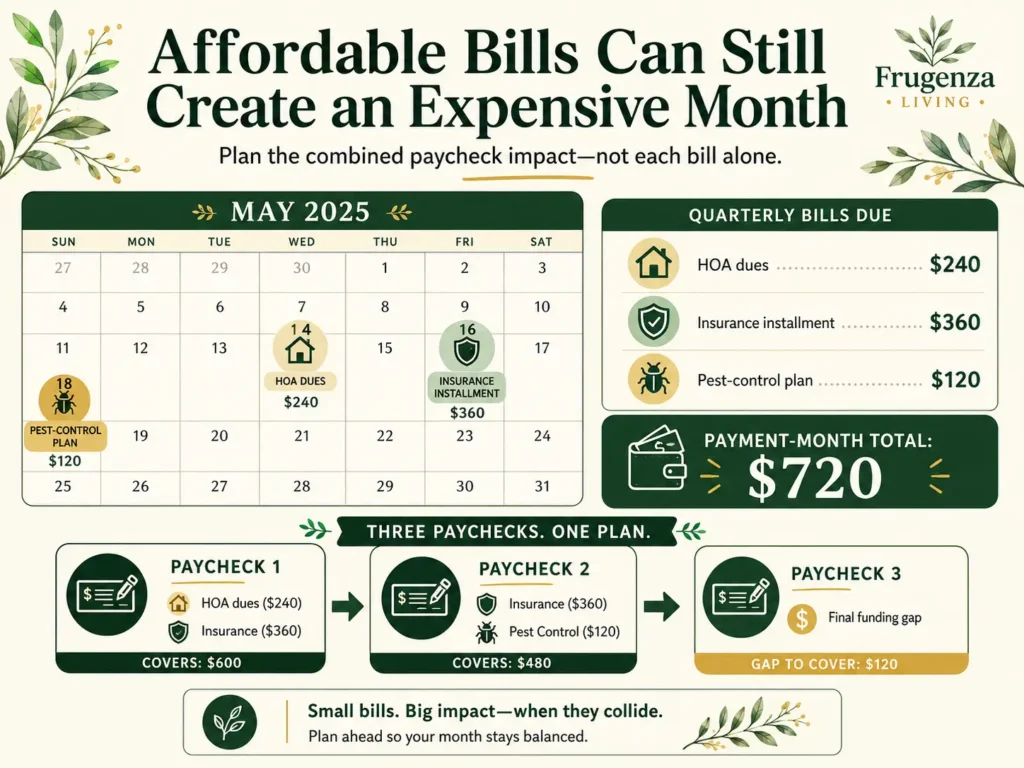
If several bills share a payment window, total the contribution each one requires from the same upcoming deposits. This reveals whether several individually affordable bills create an unaffordable combined claim on one paycheck.
Estimate a Changing Quarterly Bill Without False Precision
Use the strongest evidence available:
- Use a current statement or renewal notice when the amount is confirmed.
- For a seasonal bill, compare with the same quarter last year.
- For a variable bill, use a defensible recent range and update the target when the statement arrives.
Do not add a generic buffer simply because the amount is uncertain. Base it on a documented rate increase, repeated seasonal difference, or relevant recent high end.
The examples here use simplified household numbers to demonstrate the budgeting method. Your actual contribution depends on the confirmed amount, reserved balance, payment date, deposit schedule, and provider terms.
Treat these recurring subscription expenses like other non-monthly bills and save a small amount for them each month.
Fit the Contribution to Your Pay Schedule
Quarterly does not mean the contribution must be monthly. A $300 target could be funded with three $100 monthly transfers, six $50 biweekly contributions, or twelve $25 weekly contributions.
Use only deposits available before the payment date. When income varies, recalculate after every contribution instead of promising the same amount from every deposit. Stronger income deposits can carry more of the remaining target, while weaker deposits protect essential current bills first. The broader income system belongs in a guide on how to budget irregular income.
Do Not Count the Same Money Twice
Moving $100 from checking into a labeled savings account does not consume another $100. It changes where assigned money sits.
In your household spending report, make sure the transfer and the provider payment do not cause the same dollars to be counted as spending twice. The exact setup depends on the app or spreadsheet.
A useful distinction is:
- Contribution: assignment or movement of money.
- Category balance: committed money carried forward.
- Provider payment: final use of the money.
Suppose you assign $100 monthly to a quarterly category. The balance reaches $300, and you pay the provider $300. A report that treats the three transfers as $300 of spending and the provider payment as another $300 makes the quarter look like it cost $600. The household used $300; the transfers protected those dollars from other uses.
Money reserved for a quarterly bill is not free cash simply because it remains in your account.
Once quarterly expenses are under control, use the same advance-planning approach for annual, semiannual, and other irregular payments.
When the First Cycle Is Underfunded
A required catch-up contribution may be larger than the next paycheck can support. Treat that result as a prioritization signal, not permission to ignore the bill.
Protect required or contractually important obligations first, based on the real consequences and due date. For an optional service, review cancellation, downgrade, and renewal terms. A flexible future goal may need a temporary pause.
Other responses may include reducing discretionary spending, using genuinely unassigned savings, or contacting the provider before the deadline to ask whether another schedule is available. Do not assume every provider will change the arrangement, and do not treat credit as the automatic solution.
An emergency fund should not become the routine source for a predictable bill. If it must be used to avoid a more serious consequence, rebuild both the emergency balance and quarterly category afterward.
Reset the Category as Soon as Payment Clears
Do not wait until the next quarter feels close. Once the payment posts:
- Record the actual amount.
- Compare it with the estimate.
- Confirm the next payment date.
- Preserve or intentionally reassign any surplus.
- Count the next cycle’s eligible deposits.
- Start the maintenance contribution with the next deposit.
A broader monthly budget reset routine can help you review other categories, but this quarterly reset should happen immediately after payment while the information is current.
The Bottom Line
The reliable way to learn how to budget for quarterly expenses is to calculate what the next bill needs now and what the following full cycle will require later.
Subtract the amount already reserved, divide the remaining target across deposits available before payment, and use that catch-up contribution until the bill is funded. After payment, switch to the smaller maintenance contribution for the next complete cycle.
Start with one bill today: confirm the payment date, count the deposits available before it, and calculate both contribution amounts.
Frequently Asked Questions
How much should I save each month for a quarterly bill?
Divide the expected bill by three only when three monthly transfers will arrive before payment. If the bill is closer, subtract what is already reserved and divide the remaining target by the monthly transfers or other deposits available before the actual payment date.
What if my quarterly bill is due before I have three months to save?
Use the catch-up calculation. Prioritize the bill based on its deadline and consequences, reduce flexible spending temporarily, and contact the provider early if the required amount does not fit. Begin the normal maintenance contribution immediately after the current payment.
Should quarterly expenses go in a sinking fund or my monthly budget?
Both can be parts of the same system. The contribution belongs in the monthly or paycheck budget, while the accumulating balance can remain in a labeled sinking fund, savings bucket, or rollover category until payment.
How do I budget for a quarterly bill that changes?
Use a current statement first. Otherwise, check a known rate change, the same quarter from the previous year, or a relevant recent range. Add a buffer only when evidence supports it, then update the target when the provider confirms the amount.
What if several quarterly bills are due in the same month?
Calculate each bill separately, then combine the amounts required from every remaining deposit. If the total does not fit, protect higher-consequence and nearer obligations first, review optional services, and adjust lower-priority goals before the payment window arrives.

The ideas shared here come from real-life experience and practical habits that actually work.
→ Read more about Jeffi
- No Spend Month Challenge for Beginners: A 30-Day Plan - September 24, 2026
- Low Buy Month Challenge: Realistic Rules for 30 Days - September 23, 2026
- How to Stop Buying Groceries You Already Have - September 20, 2026