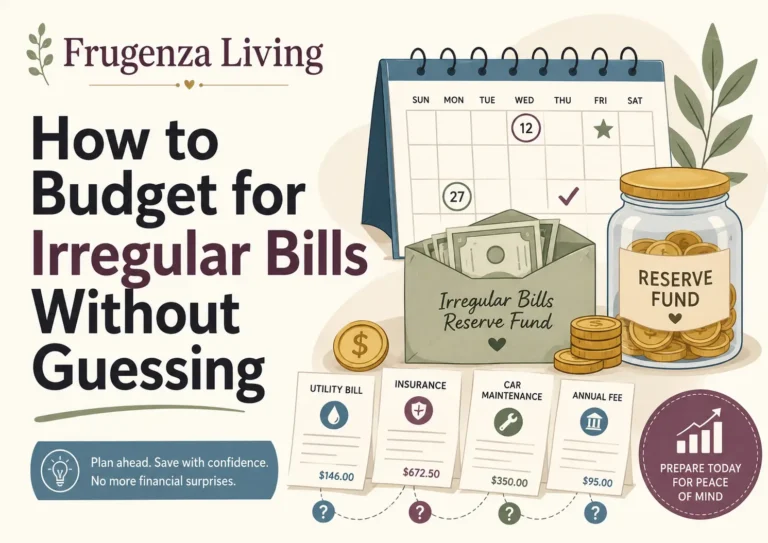
A fixed monthly bill is easy to place in a budget. An insurance renewal that changes, vehicle registration once a year, or maintenance with no exact date is different.
If you are learning how to budget for irregular bills, start by identifying what is actually irregular: the timing, the amount, or both. Then use the best information available today, reserve toward a working target, and update only the remaining gap when better information arrives.
Irregular bills are not the same as irregular income; here, the problem is the expense side of the budget.
If both the date and amount are known, the math can be straightforward. The real challenge starts when one of those inputs is still uncertain.
First Ask What Is Actually Irregular
Not every irregular bill needs the same treatment.
Some bills have a known date and a predictable amount. Others arrive on schedule but change in price. Some have no exact date. The hardest group has uncertainty in both timing and amount.
Before choosing a funding rule, ask:
- Do I know when this bill is likely to happen?
- Do I know roughly how much it will cost?
Use the decision map below as a starting point.
Match the Rule to the Uncertainty
Start with what you know about the bill today, not what you wish you could predict.
Known Timing + Predictable Amount
Best starting point: Use the confirmed amount and reserve the remaining gap before the due date.
Example: Vehicle registration.
Known Timing + Variable Amount
Best starting point: Use a current planning amount or range, then true-up when the final bill arrives.
Example: Insurance renewal or a variable utility bill.
Uncertain Timing + Predictable Amount
Best starting point: Maintain a ready balance rather than inventing a fake due date.
Example: A recurring service with variable scheduling.
Uncertain Timing + Variable Amount
Best starting point: Keep a minimum readiness reserve and review it using recent actual costs.
Example: Routine maintenance.
If you are still identifying which non-monthly costs belong in your plan, first map your annual and non-monthly expenses. This article starts after you know the obligation exists.
When the Date and Amount Are Both Known
This is the simplest irregular-bill case.
Suppose vehicle registration is confirmed at $180 and due in November. You already have $60 reserved, and four monthly funding opportunities remain.
Start with:
Remaining reserve gap = confirmed amount − amount already reserved
So:
$180 − $60 = $120 remaining
Then divide only what is still missing by the opportunities that remain:
Contribution per funding opportunity = remaining reserve gap ÷ remaining funding opportunities
In this example:
$120 ÷ 4 = $30 per month
This reflects what is true now: how much is already saved and how much time remains.
If the obligation genuinely repeats every three months, use the more specific guide to plan a true quarterly expense rather than forcing it into a generic irregular-bill method.
Budget a Variable Bill With a Working Number, Not a Guess
A harder case is a bill with a known timing window but a changing amount.
This includes annual or semiannual bills such as insurance renewals, but it can also include monthly bills such as electricity or water when the due cycle is predictable but the amount changes.
Use the best evidence available in this order:
- A confirmed bill, renewal notice, provider quote, or current estimate.
- A provider range or recent comparable seasonal bill.
- Your most recent comparable actual amount, clearly labeled provisional.
For example, suppose the last insurance premium was $720 and the provider now estimates the renewal at $740–$780. Using $780 as the current planning target is grounded in information you actually have. It is not a promise that the final bill will equal $780.
If no new estimate exists, use the previous $720 only as a clearly provisional baseline rather than adding an arbitrary percentage.
When the confirmed bill arrives, replace the working number and recalculate only the gap that remains.
If the expense is planned and recurring, you can build a sinking fund for planned costs, but not every irregular bill needs its own separate fund.
What to Do When You Do Not Know the Exact Due Date
Some expenses are expected but do not arrive on a clean schedule.
Do not create a fake provider due date such as October 1 simply because you expect the expense “sometime in October.”
Instead, distinguish:
Provider due date: the actual deadline established by the biller or provider.
Planning date: an internal date you intentionally choose to have money ready earlier.
A planning date changes your preparation schedule, not the provider’s terms.
If the provider date is still unknown, record an expected window such as “October” and maintain a ready balance.
A ready balance is money intentionally kept available for an expected obligation before its exact payment date is confirmed.
Choose the target from evidence you already have: a current service estimate, a recent comparable actual cost, or a documented range from your own recent history.
For example, if three recent routine service visits were $160, $210, and $185, keeping roughly $185–$210 ready is more grounded than inventing a $300 target with no evidence. It still does not guarantee the next service will fall in that range.
Once the actual date is confirmed, you can place the confirmed obligation on your bill calendar.
Example: Three Irregular Bills, Three Different Rules
Consider an illustrative household with three irregular costs.
Vehicle registration: $180 confirmed, due in November. Use the confirmed amount and fund the remaining gap across the opportunities left before the due date.
Semiannual insurance: renewal expected in October. Last premium was $720, and the current provider estimate is $740–$780. Use a supported working target, then true-up when the final premium arrives.
Routine car maintenance: no exact date and no guaranteed amount. Use recent routine-maintenance history to choose a reasonable readiness range and review it periodically.
Registration needs arithmetic, insurance needs a working number, and maintenance needs a readiness rule rather than a fake due date.
Car maintenance is a good example of an irregular expense, so it helps to build a specific plan to budget for car maintenance instead of waiting for the next service bill.
Update the Gap When the Real Bill Arrives
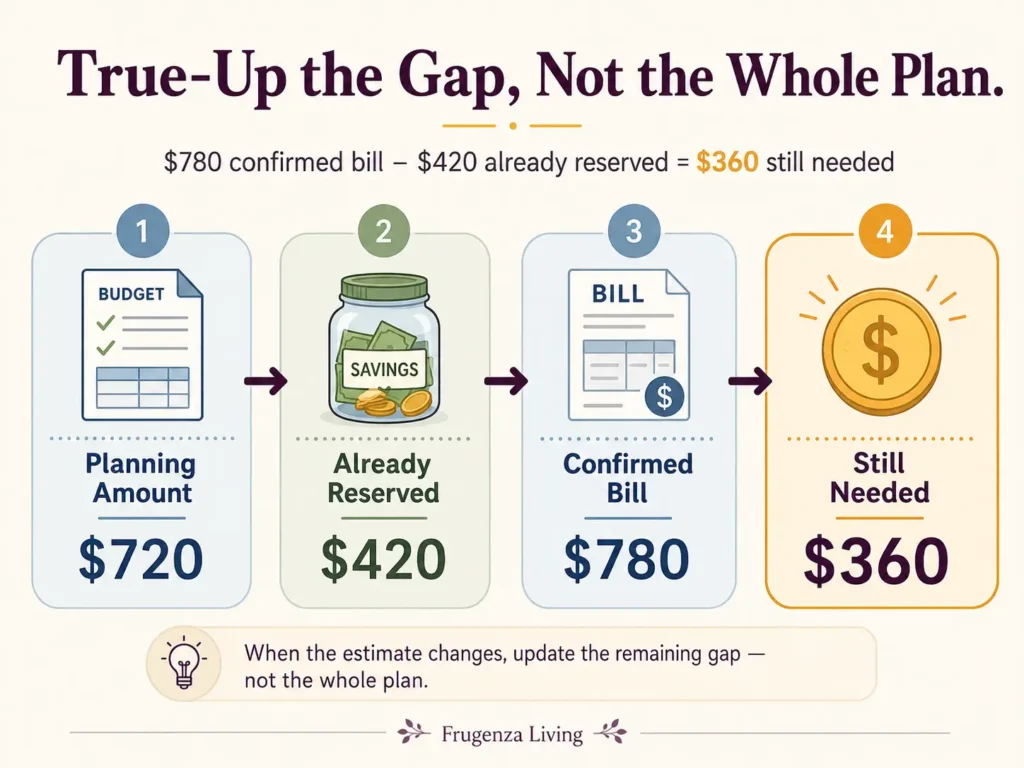
One of the most useful habits when you budget for irregular bills is to true-up the remaining gap instead of restarting the plan.
Suppose:
- Original planning amount: $720
- Already reserved: $420
- Confirmed bill: $780
The updated gap is:
$780 − $420 = $360
A changed estimate changes the remaining gap—not the fact that the $420 already reserved still exists.
The same rule works when the bill comes in lower.
Suppose the target was $780, the actual bill is $730, and you reserved $760. You now have $30 above the final bill.
Do not automatically spend it. Decide intentionally whether another related expected cost justifies leaving it in the same reserve or whether you want to reallocate it elsewhere.
Avoid Two Tracking Mistakes
1. Silently Rolling an Unfunded Gap Forward
If an irregular bill is still $90 short when the month ends, do not quietly move the $90 into next month and mark the current plan complete.
Keep the gap visible until responsibility is intentionally reassigned.
2. Double-Counting Reserve Transfers and Bill Payments
For household spending analysis, moving $100 from checking into your own reserve transfers money between accounts. If you later pay a $600 insurance bill from it, the $600 bill is the underlying household expense.
Track reserve contributions when you want to measure funding progress, and track actual bill payments when you want to understand spending history. Do not add both together as if they were separate new expenses.
Irregular Bill or Emergency?
An irregular bill is not automatically an emergency.
A planned irregular expense is something you reasonably expect to happen again even though its date or amount may not be perfectly predictable. Registration, annual professional fees, insurance renewals, and routine maintenance can fit here.
An emergency is a genuinely unplanned financial shock or urgent unexpected cost.
The same category can contain both: routine brake service may be planned, while collision damage may be an emergency.
Classify the event based on what was reasonably foreseeable, not simply on whether the amount feels inconvenient.
The Bottom Line
Learning how to budget for irregular bills does not require predicting every future expense to the exact dollar or exact date.
First identify whether the uncertainty is in the timing, the amount, or both. Then use confirmed figures when available, working targets when necessary, ready balances when dates are uncertain, and true-ups when better information arrives.
For known bills, divide the remaining gap by the funding opportunities still available.
Start with the next irregular bill that has disrupted your budget and ask:
What is actually uncertain here—the date, the amount, or both?
Methodology note: This is a household cash-flow planning framework. Estimates are planning inputs, not guarantees; replace them with confirmed bill amounts and provider dates when those become available.
Frequently Asked Questions
What are irregular bills?
Irregular bills are expenses that do not behave like predictable fixed monthly payments. They may occur only a few times a year, change in amount, arrive on uncertain dates, or combine those traits. Registration, insurance renewals, annual fees, variable utility bills, and some routine maintenance costs can all fit the category.
How do I budget for a bill when I do not know the exact amount?
Use the best evidence available today. Start with a current provider estimate or range, then recent comparable seasonal bills, or your most recent comparable actual amount as a clearly provisional baseline. Reserve toward that working target and replace it with the confirmed amount when the real bill arrives.
How do I budget for bills that do not have a fixed due date?
Do not invent a provider due date. Record an expected time window and maintain a ready balance based on current estimates or recent comparable costs. You may choose an earlier internal planning date for preparation, but that date does not change the provider’s actual terms or deadline.
Should irregular bills go in a sinking fund?
Often, planned irregular costs can work well with a sinking fund, especially when reserving money separately helps prevent it from being used elsewhere. But not every bill needs a separate fund. The more important question is whether you have a clear funding target, reserve rule, and update process.
Are irregular bills the same as emergency expenses?
No. Irregular bills are often reasonably foreseeable even when their exact dates or amounts are uncertain. Emergency expenses are genuinely unplanned financial shocks. The same category can contain both—for example, routine vehicle maintenance may be planned, while a sudden major failure may be an emergency.

Read about Jeffi and Frugenza Living
- Proportional Bill Split Calculator for Two Incomes - October 15, 2026
- How to Split Grocery Bills With Roommates - October 14, 2026
- First Apartment Kitchen Essentials on a Budget - October 13, 2026