Car maintenance is difficult to budget for because your vehicle does not operate on a neat monthly billing cycle. Service can be triggered by time, mileage, wear, or a repair that has no predictable date.
If you are learning how to budget for car maintenance, start with your vehicle’s actual maintenance guidance, current odometer, expected driving, recent invoices, known wear items, and money already reserved. Fund documented near-term needs first, then maintain a separate repair-readiness amount for costs whose exact timing cannot be predicted.
The goal is not to discover one perfect monthly number. It is to fund the workload your car currently puts in front of you.
Start With Your Car, Not a National Average
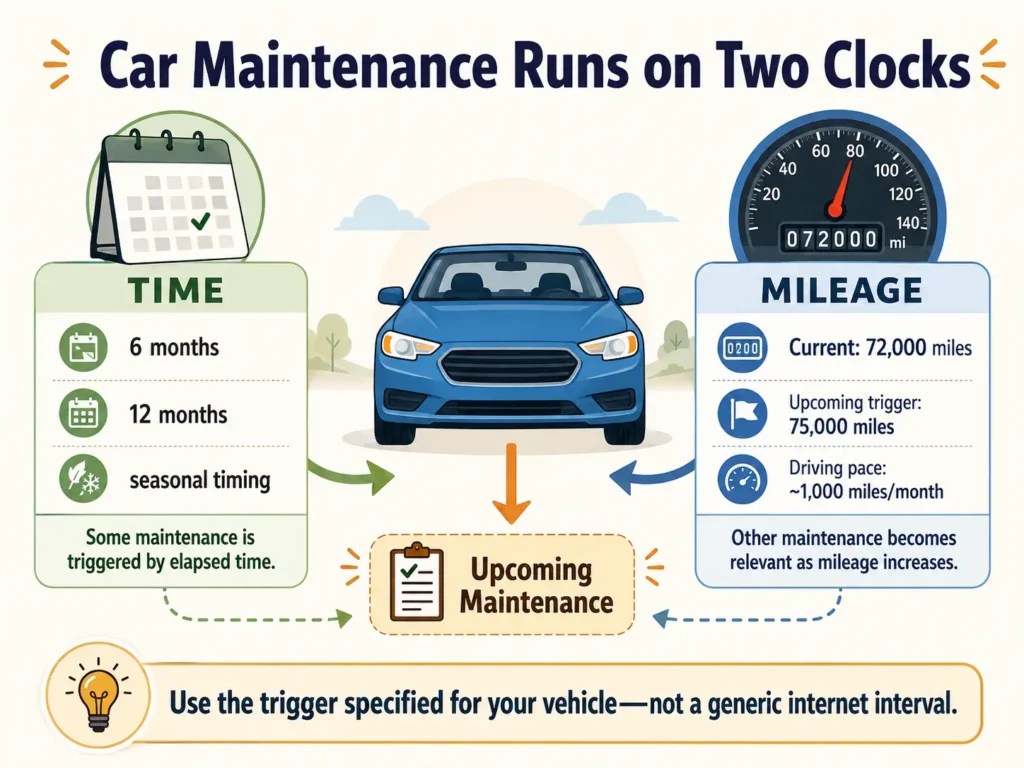
Car maintenance effectively runs on two clocks: time and mileage.
A service may become relevant because a calendar interval arrives, your odometer reaches a mileage trigger, or your vehicle’s maintenance documentation tells you to use another condition. Follow the guidance for your specific year, make, and model rather than applying a generic internet interval.
Before building your car maintenance budget, gather:
- Current odometer.
- Realistic monthly or annual mileage.
- Manufacturer maintenance documentation.
- Recent service records and invoices.
- Known wear items supported by current inspection or condition.
- Verified warranty, prepaid maintenance, or service-contract coverage.
- Amount already reserved.
National averages can still provide context.
AAA’s 2025 Your Driving Costs study reported 11.04 cents per mile for its Maintenance, Repair and Tires category. At 12,000 miles, that equals about $1,324.80 per year, or $110.40 per month as a simple monthly equivalent.
But that is not automatically your savings target. AAA’s methodology is a standardized ownership model and the category includes manufacturer-specified routine maintenance, wear-and-tear repairs, replacement tires, retail parts and labor, and a comprehensive extended warranty assumption.
Use the figure as a reasonableness check:
Does my vehicle-specific plan deserve another look?
Do not turn it into a universal transfer rule.
Separate Scheduled Service, Wear Items, and Repair Readiness
A useful maintenance budget has three different jobs.
Scheduled Service
This covers maintenance approaching according to your vehicle’s actual guidance.
The financial question is:
How much of that documented upcoming cost is still unfunded?
It is not:
What generic mileage interval should every car follow?
Wear Items
Tires and other normal wear items often have approximate preparation windows rather than exact replacement dates.
Use current inspection information, condition, credible quotes, and vehicle-specific guidance.
Repair Readiness
This is money intentionally available for ordinary ownership repairs whose exact timing cannot be predicted.
It does not mean you are predicting that a particular component will fail.
If separating these dollars helps prevent them from being spent elsewhere, you can use a dedicated sinking fund for planned maintenance.
The planner below calculates funding pace only. It does not determine when your vehicle mechanically requires service.
Car Maintenance Funding Planner
Replace the illustrative values with your own estimates, reserves, and preparation windows.
Scheduled Service
Use your vehicle-specific time or mileage guidance to estimate this preparation window. The planner does not determine when service is required.
Wear Item
Use current inspection information or a credible estimate. This is a funding window, not a prediction of exact replacement life.
Repair Readiness
Do not include scheduled service or wear-item costs already listed in the other cards when choosing this general repair-readiness target.
Update the example values with your own numbers, then calculate.
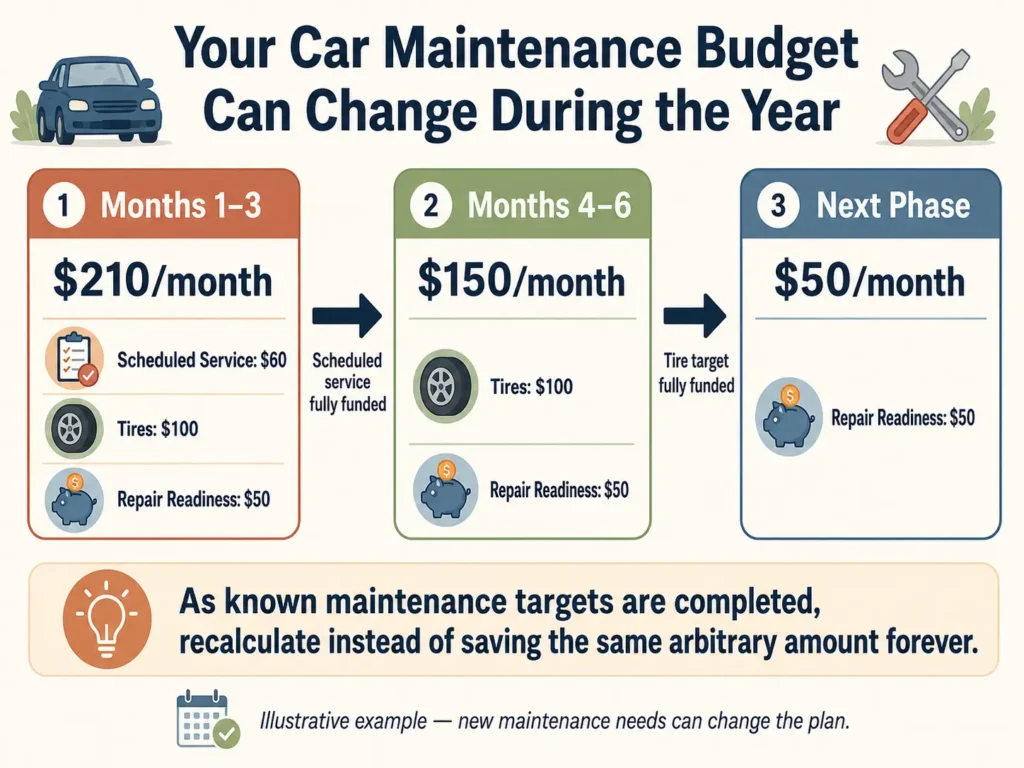
Your monthly target can change as known maintenance needs become fully funded.
This planner estimates funding pace, not mechanical service intervals. Use your vehicle’s manufacturer guidance, current condition, and qualified service recommendations to determine what work is needed and when.
The calculator itself does not save your entries. The CSV is created in your browser from the most recently calculated values.
With the illustrative values above:
$60 scheduled service + $100 tires + $50 repair readiness = $210 per month.
Once the scheduled-service target is funded, the same plan falls to $150 per month.
Once both the scheduled service and tire target are funded, only the current $50 repair-readiness contribution remains—assuming no new maintenance needs have been added and the repair target has not changed.
This is not a recommendation that you personally save $210 per month. It is the result of this illustrative vehicle’s current funding workload.
Fund Maintenance by the Next Real Trigger
For a known upcoming item:
Remaining funding gap = current estimate − amount already reserved
Then:
Funding pace = remaining funding gap ÷ funding opportunities before your preparation target
Consider an illustrative car with:
- Current odometer: 72,000 miles.
- Driving pace: about 1,000 miles per month.
- A vehicle-specific schedule showing upcoming service around 75,000 miles.
- Current estimate: $240.
- Already reserved: $60.
At that driving pace, the mileage trigger is roughly three months away.
$240 − $60 = $180 remaining
$180 ÷ 3 = $60 per month
This example does not recommend that every car needs service at 75,000 miles. The interval is illustrative. Use the maintenance schedule for your own vehicle.
Some schedules rely on elapsed time, some on mileage, and some provide particular instructions for applying those triggers. Follow the documentation for your vehicle rather than assuming a universal rule.
Instead of waiting for the next service bill, set aside money for car maintenance regularly so the cost is already partially funded when it arrives.
Budget for Tires and Wear Items Without Predicting the Exact Day
Wear items often need a preparation window rather than a fake replacement date.
Suppose a current tire inspection and quote suggest replacement may be needed within roughly six to nine months. The estimate is $800, and $200 is already reserved.
If you want the money ready by the earlier end of that window:
($800 − $200) ÷ 6 = $100 per month
The six-month point is an internal preparation target, not a prediction of exact tire life.
Use current condition, inspections, vehicle specifications, and qualified recommendations to decide when replacement is actually necessary. The budget prepares the money; it does not make the safety decision.
How Much Should You Keep for Car Repairs?
There is no universal repair-reserve number that fits every vehicle.
Consider:
- Recent non-routine repair invoices.
- Current mileage and vehicle age as context.
- Inspection findings.
- Confirmed warranty or service-contract coverage.
- Current local repair estimates.
- How much an ordinary repair your household could absorb from normal monthly cash flow.
Then choose a working repair-readiness target.
For example, imagine an illustrative household had recent non-routine repairs of $620 and $840, has no confirmed coverage for similar wear-related repairs, and would struggle to absorb another bill of that size directly from one month’s cash flow.
It might choose $900 as a working readiness target.
If $400 is already reserved and the household chooses to build the remaining $500 over ten months:
($900 − $400) ÷ 10 = $50 per month
That does not predict a $900 repair. It explains why the household chose $900 instead of selecting a round number without evidence.
Review the target after a major repair, warranty change, vehicle change, significant mileage change, or new inspection information.
Keep Known Costs and Repair Readiness From Overlapping
Avoid funding the same expected cost twice.
If $800 is already listed as a tire target, your general repair-readiness number should not also contain another $800 specifically for those same tires unless you intentionally designed it that way.
Known upcoming items and general repair readiness need separate jobs.
There is a similar distinction in spending records. Moving $100 from checking into your own maintenance reserve prepares money; the later repair or service invoice is the underlying vehicle-maintenance expense for household spending analysis.
Keep Maintenance Separate From Other Car Costs
This maintenance budget covers:
- Scheduled service.
- Wear items.
- Tires.
- Ordinary repair readiness.
It does not automatically include:
- Car payments.
- Fuel.
- Insurance.
- Registration.
- Parking.
- Tolls.
- Depreciation.
- Saving for the next vehicle.
Those are legitimate ownership costs, but they answer different budgeting questions.
Use the annual expense planning checklist for registration, insurance renewals, and other non-monthly vehicle obligations. If timing or amounts across household expenses are uncertain more broadly, the irregular-bills budgeting method handles that wider problem.
Before reducing a maintenance target because of warranty or prepaid coverage, verify the actual terms: covered service, time or mileage limits, exclusions, deductibles, and fees.
When a Car Repair Becomes an Emergency-Fund Question
Routine maintenance and known wear are part of normal ownership planning. Repair readiness also acknowledges that some repair spending is foreseeable as a category even if the next specific repair is unknown.
An emergency is different: it is an urgent financial shock that falls outside what the household reasonably prepared for.
The same vehicle can produce both types of costs.
If the distinction is unclear, use the guide that helps you separate planned savings from emergency reserves.
Do not postpone safety-related service because your maintenance fund is short. This article explains financial preparation; it does not determine whether a vehicle is mechanically safe to drive or when service is required.
The Bottom Line
The best answer to how to budget for car maintenance is not one permanent monthly number.
Start with the vehicle in front of you.
Check its maintenance guidance, odometer, actual driving pace, recent invoices, known wear items, confirmed coverage, and money already reserved.
For known needs:
Current estimate − already reserved = remaining funding gap
Then:
Remaining gap ÷ funding opportunities = current funding pace
Add a separate repair-readiness contribution supported by your own repair history, condition, coverage, and cash-flow capacity.
As targets are completed or new maintenance needs appear, recalculate.
Your monthly car-maintenance budget should change when your vehicle’s upcoming workload changes.
Methodology note: This is a financial planning framework, not a vehicle maintenance schedule. Use your vehicle’s actual manufacturer guidance, current condition, service records, and qualified professional recommendations to determine what work is needed and when.
Frequently Asked Questions
How much should I budget for car maintenance each month?
There is no single amount that fits every vehicle. Estimate your upcoming documented service and wear-item costs, subtract money already reserved, and divide each gap by its available funding window. Then add a repair-readiness contribution based on your vehicle history and household circumstances. National averages such as AAA’s are better used as benchmarks than personal prescriptions.
How do I calculate a car maintenance budget?
List documented upcoming maintenance and wear items, estimate their current costs, subtract what you have already reserved, and divide the remaining gaps by the months or paychecks available before your preparation target. Add your chosen repair-readiness contribution. Recalculate when a target is completed, estimates change, or new maintenance information becomes available.
Should I use a sinking fund for car maintenance?
A sinking fund can be useful because it separates maintenance money from everyday spending. It can hold money for scheduled service, wear items, and repair readiness. The important part is giving each target a clear job so you do not fund the same expected cost twice or confuse normal maintenance with emergency savings.
How should I budget for an older or high-mileage car?
Do not apply an arbitrary percentage solely because a vehicle is older or has higher mileage. Use its actual maintenance guidance, service history, current condition, mileage, inspection findings, repair estimates, and confirmed coverage. Those factors can justify adjusting your working reserve, but age alone does not produce a reliable monthly maintenance target.
Should unexpected car repairs come from my maintenance fund or emergency fund?
Use the maintenance or repair reserve when the cost fits the type of vehicle expense you intentionally prepared for. An emergency-fund decision arises when an urgent financial shock falls outside reasonable preparation. The boundary depends on what was foreseeable, the reserves you intentionally built, and the nature of the repair.

Read about Jeffi and Frugenza Living
- Proportional Bill Split Calculator for Two Incomes - October 15, 2026
- How to Split Grocery Bills With Roommates - October 14, 2026
- First Apartment Kitchen Essentials on a Budget - October 13, 2026