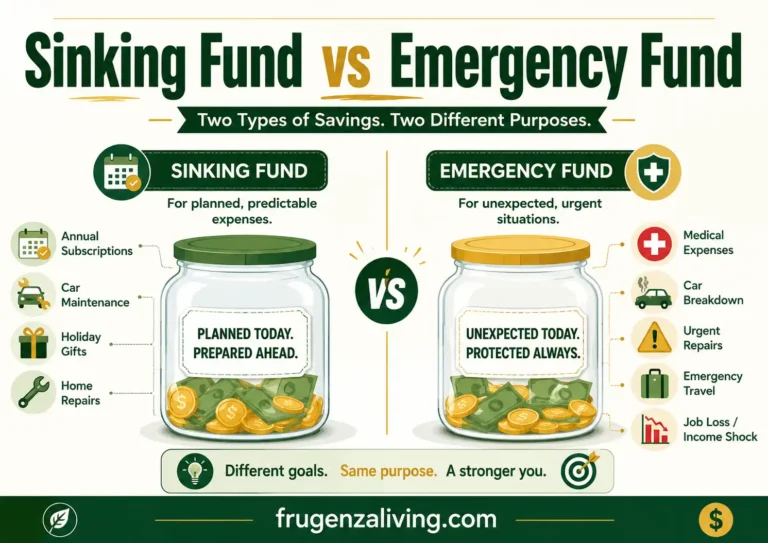
A sinking fund pays for an expense you can reasonably anticipate. An emergency fund covers an unplanned financial shock, including lost income. Annual insurance and routine maintenance belong in sinking funds; a sudden essential repair or job loss may require emergency savings.
The difficult cases are expenses that were predictable but arrive before you have saved enough. Separate two decisions: which fund should normally cover the cost, and how to pay for an urgent shortfall today. A bill does not become unpredictable just because its fund is empty, but protecting your health, housing, or ability to work may still require emergency money.
Sinking Fund vs Emergency Fund at a Glance
Sinking fund
- Purpose: a named future expense, including recurring costs with uncertain timing.
- Examples: annual insurance, replacement tires, planned dental work, holiday spending.
- Target: the estimated cost, less money already assigned to it.
- Contributions: based on the payment deadline or expected frequency.
- After spending: restart for a recurring cost, or close a completed one-time goal.
Emergency fund
- Purpose: an unplanned expense or interruption to income.
- Examples: job loss, urgent unexpected care, a sudden essential repair.
- Target: a reserve based on essential costs and financial risks.
- Contributions: an affordable amount toward the reserve, reviewed as circumstances change.
- After spending: rebuild the amount used while keeping essential bills funded.
What Does Each Fund Cover?
A sinking fund covers expected costs outside your ordinary monthly spending
Set aside money gradually for a bill or purchase instead of absorbing the full cost in one month. You can know that tires, pet checkups, or an appliance replacement will be needed without knowing the exact date. Use a reasonable estimate and revise it when better information becomes available.
Regular monthly rent and groceries normally belong in your current spending budget. Sinking funds are most useful for costs that occur less often or need advance saving. For the setup process, see how to start a sinking fund.
An emergency fund covers financial disruption
The Consumer Financial Protection Bureau’s emergency fund guide describes it as a reserve for unplanned expenses or financial emergencies, including loss of income. The amount needed depends on your circumstances.
During job loss, the groceries and rent themselves remain ordinary expenses. The unexpected event is losing the income that normally pays for them. Your emergency fund can cover that gap.
Which Fund Should Pay for an Expense?
- Identify the consequence of waiting. Does the expense affect health, safe housing, essential transport, or your ability to earn? A sale deadline alone does not make a purchase an emergency.
- Check whether the cost was reasonably foreseeable. Annual renewals, wear and tear, and scheduled treatment need sinking funds, even when the exact amount is uncertain.
- Use money already assigned to that purpose. Check the relevant sinking fund and confirm what you must pay after any verified insurance coverage or assistance. Do not count a reimbursement that has not arrived as cash available today.
- Resolve any urgent shortfall. If an essential expense cannot reasonably wait, emergency savings may cover the uncovered amount. If it can wait, postpone, reduce, or save for it instead.
Using emergency money for an underfunded essential bill can be a practical response. Record why it happened, then adjust the sinking fund so the same foreseeable cost does not repeatedly drain your reserve.
Car Repairs, Medical Bills, and Other Gray Areas
- Car costs: save for servicing, tires, and other expected upkeep. A sudden breakdown that stops essential travel may require emergency savings for the amount your car fund cannot cover.
- Medical costs: planned appointments and known treatment can have a sinking fund. An unexpected urgent bill may need emergency savings. Check the actual amount owed and any available payment arrangement without delaying necessary care.
- Home repairs: an aging appliance can have a replacement fund. A sudden leak or unsafe electrical fault may need emergency money if the repair cannot wait.
- Pet care: routine checkups and vaccinations are expected costs. An urgent unexpected vet visit may need emergency savings beyond the pet fund.
For other recurring costs, use these sinking fund categories to identify what your monthly budget leaves out.
Example: one repair paid from two funds
A hypothetical driver has $200 in a car sinking fund and receives a $600 repair bill. The car is needed for work, the repair cannot reasonably wait, and no other coverage applies.
$600 bill − $200 car fund = $400 emergency withdrawal.
Record the car fund falling by $200 and the emergency fund falling by $400. Then review whether the car contribution was adequate. The same bill can use both funds without counting the same savings twice.
Which Should You Build First on a Tight Budget?
First cover current essentials and required minimum debt payments. Then look at both your exposure to unexpected costs and the essential bills approaching their deadlines. There is no single savings order that fits every household.
If you have no emergency savings and no immediate funding deadline, begin a starter reserve based on a plausible expense you might face. $500 can be an example milestone, but it is not a universal rule or a complete safety net.
If an essential annual bill is coming soon, fund it alongside that reserve rather than waiting to finish the entire emergency target. Optional goals, such as a vacation, can usually wait. Compare the combined contributions with your affordable monthly savings amount.
Example: you can save $250 per month after current essentials and required payments. Insurance will cost $600, you already have $150 assigned to it, and two monthly deposits remain before payment. The insurance fund needs ($600 − $150) ÷ 2 = $225 per month, leaving $25 for emergency savings.
That split is an illustration, not a recommended ratio. If you could save only $100 per month, the same insurance deadline would leave a $250 total shortfall: $600 − $150 − (2 × $100). Changing the labels cannot close that gap; you would need to reduce another cost, find additional income, or check available payment options and their total cost.
How Much Should Go Into Each Fund?
Calculate sinking fund contributions from the remaining gap
Contribution per deposit = (estimated cost − amount already assigned) ÷ deposits remaining before payment.
If insurance costs $600, you have saved $150, and six monthly deposits remain, save $75 per deposit. If you instead have 26 weekly deposits before that same deadline, save about $17.31 per deposit, adjusting the last deposit to the actual remaining balance.
Count real deposit dates; do not assume each month contains four weeks. Allow time to transfer the money before the bill is due. If the fund already covers the estimated cost, no additional contribution is required for that bill. For an expense without a firm date, use an estimated planning period and review it regularly.
Set an emergency target from costs and risk
List essential monthly costs, including housing, utilities, food, necessary transport, insurance, and required minimum debt payments. Consider income stability, dependents, and expenses you might need to cover before support or a new income arrives.
For illustration, $1,500 of essential monthly costs × a chosen three-month cushion = $4,500. Three months is an example planning choice, not a requirement. A smaller starter reserve can be a first milestone; a household with less stable income may need more protection.
Do not include money committed to annual bills in both the sinking fund balance and the emergency reserve. Each dollar can cover only one allocation at a time.
How to Rebuild After Using Emergency Savings
Review each savings goal by necessity, deadline, current balance, and remaining contribution. Keep essential near-term bills funded. Pause or reduce optional goals where doing so does not create a more serious problem.
For an essential sinking fund you want to pause, recalculate its catch-up contribution before deciding. If $600 must still be saved over six deposits, skipping two means the remaining four need $150 each instead of $100. A bill more than three months away can still become difficult to fund.
Example: you used $900 from emergency savings. Your existing $75 monthly emergency contribution plus $125 redirected from a vacation fund gives $200 per month. Replacing $900 takes five monthly deposits: four of $200 and a final $100, assuming no new withdrawals and ignoring interest.
A longer rebuild does not, by itself, prove the original reserve target was too low. It may reflect the withdrawal size or limited saving capacity. Reassess the target against your risks, and reassess contributions against what your budget can support.
Where Should You Keep the Money?
Keep emergency savings safe and accessible. For money you may need soon, a suitable savings account can avoid exposure to market losses. Check fees, access rules, transfer times, and the deposit protection available in your country.
You can use separate accounts, savings buckets, or one account with a clear allocation record. A sinking fund is a purpose for money, not a special type of bank account. Start with a manageable number of categories; this guide to choosing how many sinking funds to use can help.
One-account example: a $3,000 savings balance includes $600 for insurance and $400 for car costs. If the entire remainder is assigned to emergencies, your emergency fund is $2,000, not $3,000. Update the allocations after every deposit and withdrawal.
Frequently Asked Questions
Can both funds pay for the same bill?
Yes. Use the relevant sinking fund first, then consider emergency savings for an urgent essential shortfall. Record the amount taken from each; the total paid must match the bill.
Should I stop all sinking funds when my emergency fund is empty?
Review them rather than stopping everything automatically. Optional goals may pause, while an essential bill due soon still needs funding. Work out the remaining gap and deadline before changing contributions.
Is a sinking fund the same as a savings account?
No. The fund is money assigned to a purpose. A savings account is one place to hold it. Several labeled funds can share an account if their balances remain separate in your records.
Choose Your Next Deposit
List your next essential irregular bill, its due date, and the amount already saved. Calculate the remaining contribution, then decide what your budget can also put toward emergency protection. When spending becomes urgent, pay attention to the consequence of waiting as well as whether you could have predicted the cost.
These examples use hypothetical U.S. dollar amounts for budgeting education. Adapt the costs, deadlines, and reserve target to your circumstances.

Read about Jeffi and Frugenza Living
- Shop Your Closet Challenge: A Week of Wearable Outfits - October 5, 2026
- 7 Cheap Things to Do Alone on a Weekend - October 4, 2026
- 8 Cheap Girls’ Night Ideas at Home Without a Big Shopping List - October 4, 2026