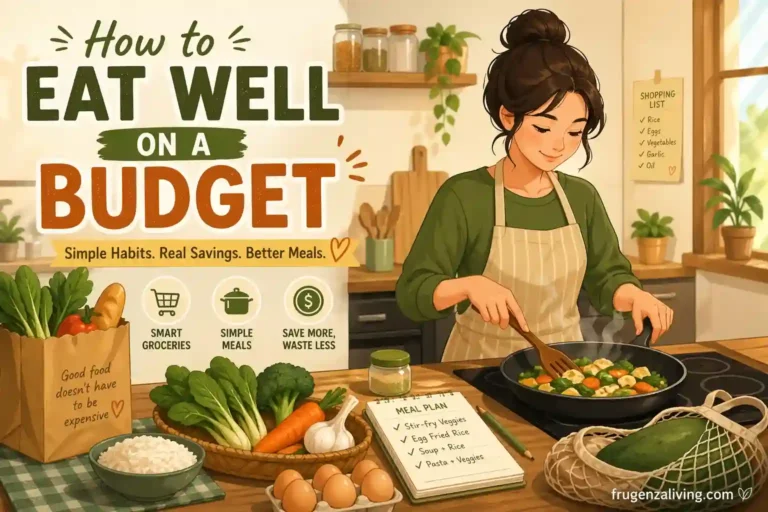
At some point, I started noticing how unpredictable food spending felt. Not in a dramatic way. Just small things adding up—extra groceries that didn’t get used, random takeout orders after long days, buying things that seemed like a good idea in the moment but didn’t really fit into anything.
It didn’t feel like overspending while it was happening. That’s probably the tricky part. You don’t really sit down and decide to spend more on food. It just… happens in pieces.
If you’re trying to figure out how to eat well on a budget, it’s easy to assume the problem is what you’re buying. Cheaper food, better meal planning, stricter control over groceries.
I used to think the same.
But over time, it became clear that it wasn’t really about finding the cheapest meals. It was more about understanding how everyday habits quietly shape your food budget—often without you realizing it.
Eating well on a budget works best when you stop treating food as a daily emergency.
Most overspending happens when meals are decided too late: when you are already tired, already hungry, or already standing in the store trying to make choices.
That is when takeout feels easier, random groceries look useful, and “just in case” items end up in the cart.
A better approach is to make food decisions earlier and simpler. You do not need a strict meal plan for every day of the week.
You need a few reliable meals, a small list of flexible ingredients, and backup options for low-energy days. That is what makes eating well on a budget feel realistic instead of restrictive.
What Eating Well on a Budget Really Means
Eating well on a budget doesn’t mean cutting everything or forcing yourself to eat the cheapest options available.
It’s more about balance.
You’re still eating proper meals. Still enjoying food. But you’re not spending money on things that never really turn into meals.
That might sound obvious, but it took me a while to notice how often I was buying groceries with good intentions… and then not using them.
And that’s where a lot of food spending disappears—somewhere between what you planned and what actually happens during the week.
If you’re just getting started, this complete frugal living guide shows how eating well on a budget fits into a bigger plan.
The Budget Plate Method
Budget Plate Builder
Eating well on a budget becomes easier when you stop building meals around expensive recipes and start building them around simple, flexible parts. Use this plate method to make meals that are filling, affordable, and easy to repeat.
Start With a Base
Choose a filling base like rice, oats, pasta, potatoes, tortillas, bread, or beans. This keeps meals affordable and satisfying.
Add a Protein
Use budget-friendly proteins like eggs, lentils, tuna, chicken, tofu, beans, yogurt, or canned fish to make meals more filling.
Add Color or Flavor
Add frozen vegetables, carrots, cabbage, spinach, salsa, spices, garlic, hot sauce, or simple dressing to make meals less boring.
Simple Budget Meal Combinations
One simple way to eat well on a budget is to build meals around a basic plate instead of a complicated recipe.
Think of each meal as three parts: a filling base, a protein, and something that adds color or flavor.
The base can be rice, pasta, oats, potatoes, bread, tortillas, or beans. The protein can be eggs, chicken, tuna, lentils, tofu, yogurt, or whatever fits your budget.
The color or flavor can come from frozen vegetables, cabbage, carrots, spinach, salsa, herbs, spices, sauce, or a small amount of cheese.
This method helps because it gives structure without becoming strict. You can use the same ingredients in different ways, which lowers waste and makes meals feel less repetitive.
A rice bowl, pasta dish, egg scramble, soup, wrap, or simple salad can all come from the same basic grocery list.
Eating well does not require buying expensive “health” foods. It often means building simple meals that are filling, flexible, and realistic enough to repeat.
Why It Feels Hard to Save Money on Food
Grocery prices are higher now. That part is real, and it’s hard to ignore.
But what makes it feel even harder is everything around it.
You go shopping with a plan, maybe even a rough idea of meals. Then you pick up a few extra things “just in case.” It feels harmless at the time.
Then the week gets busy.
You’re tired. Plans change. You don’t feel like cooking what you bought.
So you order something instead.
That’s usually how it starts.
And then it repeats—not every day, but often enough that your food budget slowly grows without you noticing.
The first step is learning how to save money on groceries without sacrificing quality.
Where Most Food Money Actually Goes
When you step back and look at it, food spending usually spreads across a few familiar places:
Groceries you intended to use
Takeout on low-energy days
Small extras like snacks or drinks
Food that ends up going bad
You can also rely on budget-friendly meal ideas that are simple, filling, and affordable.
I used to ignore it too, thinking it wasn’t a big deal. But over time, it became clear that reducing food waste was just as important as trying to save money on groceries.
Maybe even more.
Because wasting food is basically spending money without getting anything from it.
The Small Shifts That Actually Change Things
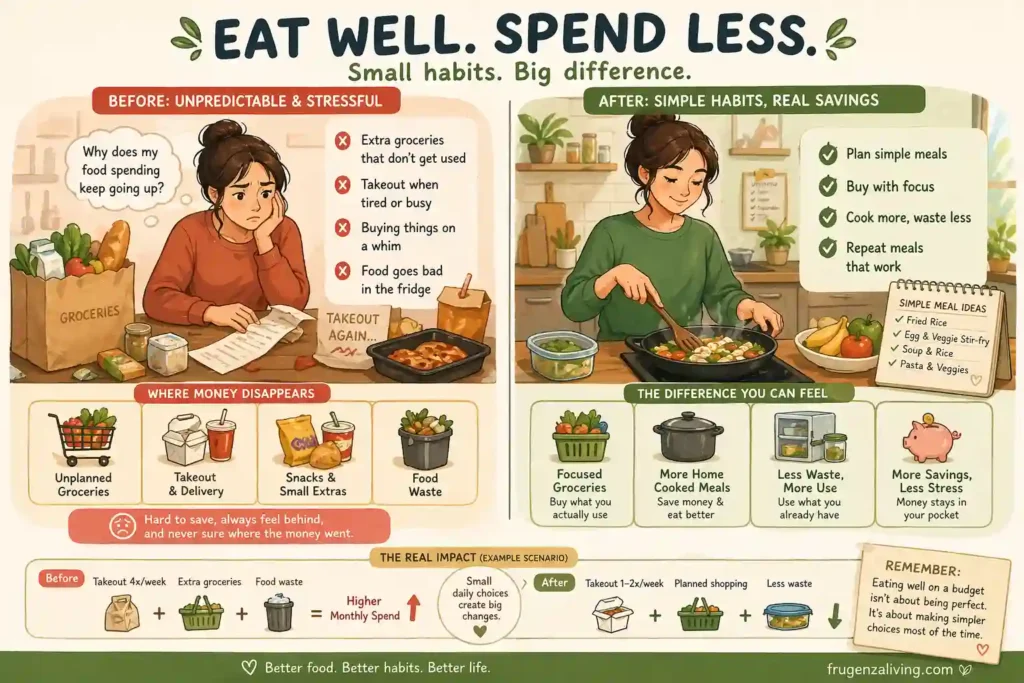
This is where things started to feel different—not because I followed a strict budget or system, but because a few habits shifted naturally.
Takeout didn’t disappear. It just happened less often.
Groceries became simpler. Not drastically cheaper, just more aligned with what I actually eat during the week.
I also stopped trying to cook something new every day.
That was a bigger change than I expected.
Repeating meals isn’t exciting, but it removes a lot of unnecessary decisions. And fewer decisions usually means fewer chances to overspend or waste food.
At some point, I also stopped thinking in terms of ingredients.
Instead of buying random items and hoping they’d turn into meals, I started thinking more like, “this will probably cover a couple of meals.”
It wasn’t structured or perfect. Just a small shift in how I approached grocery shopping.
But it made everything feel more intentional.
How to Eat Well on a Budget Without Making It Complicated
A lot of advice about eating on a budget focuses on strict meal plans or cutting everything unnecessary.
That sounds good in theory, but it doesn’t always hold up in real life.
What worked better was making things easier instead of stricter.
Having simple, repeatable meals made a bigger difference than trying to cook something new all the time. Not perfect meals—just something easy enough that I wouldn’t default to takeout after a long day.
That alone changed how often I spent money on food without thinking.
And then there’s awareness.
Not tracking every expense. Just noticing patterns.
Once you start seeing how often certain habits show up—ordering food when tired, buying extra groceries, forgetting what’s already in your fridge—it becomes easier to adjust without forcing yourself into a rigid system.
Cooking at home is one of the easiest ways to reduce your daily expenses.
The No-Strict-Meal-Plan Approach
A strict meal plan can work for some people, but it can also fail quickly when life changes. If your schedule is unpredictable, a flexible food plan may work better.
Instead of planning seven exact dinners, choose three meal types for the week. For example, one rice-based meal, one pasta-based meal, and one egg or bean-based meal.
Then choose ingredients that can move between those meals. This gives you direction without locking you into a plan you may not want to follow by Wednesday.
The goal is to reduce decision fatigue. When you already know your basic meal options, you are less likely to order takeout just because you cannot think of what to cook.
You are also less likely to buy random groceries because every ingredient has a place to go.
This is the middle ground between no plan and a strict meal plan. You still have structure, but you also have room for real life.
A More Realistic Way to Save Money on Food
A lot of examples online make saving money on food look easy, very clean and structured.
Real life isn’t like that.
It’s more subtle.
Spending a bit less on takeout this week
Using more of what you already have
Buying slightly fewer things you don’t really need
None of these feel like big changes on their own.
But over time, they start to shape your overall food spending.
Not in a perfectly calculated way—but in a way you can actually feel.
Quality Without Overspending
Eating well on a budget should not mean choosing the cheapest food at the cost of nutrition, energy, or satisfaction.
If your meals leave you hungry, bored, or tired, you may end up spending more later on snacks, takeout, or convenience food.
A better goal is to get more value from each meal. Choose foods that are affordable but still filling and useful: eggs, oats, rice, potatoes, beans, lentils, frozen vegetables, canned fish, yogurt, pasta, soup ingredients, and simple sauces.
These foods can stretch across several meals without requiring complicated cooking.
Taste also matters. A small amount of flavor can make budget meals easier to repeat. Spices, garlic, soy sauce, salsa, lemon, hot sauce, or a basic dressing can make simple meals feel less boring.
This matters because the meals you actually want to eat are the meals that help you avoid unnecessary takeout.
What Most People Don’t Realize About Food Spending
The biggest cost isn’t always what you expect.
It’s not just groceries or takeout.
It’s the combination of small decisions that don’t feel important at the time.
Buying something you might use
Ordering food because it’s easier
Letting food go unused
Individually, these don’t seem like much.
But together, they quietly define your entire food budget.
And once you start noticing that, things begin to shift naturally.
The Habits That Make Eating on a Budget Easier
Not habits that require discipline or strict rules.
Just habits that reduce effort.
Meals that are easy to repeat
Shopping that feels more focused
Having simple options for low-energy days
These don’t feel like “saving strategies.”
But they make daily decisions easier—and that’s usually where most food spending comes from.
When things feel easier, you’re less likely to fall back into expensive patterns.
The Backup Meal Rule
One of the most underrated ways to eat well on a budget is to keep backup meals at home. A backup meal is not your perfect dinner. It is the meal that saves you when you are tired, busy, or tempted to order food.
A good backup meal should be faster than delivery, cheaper than takeout, and easy enough to make with low energy.
Examples include eggs and toast, pasta with sauce, rice with frozen vegetables, soup, canned beans with tortillas, or a simple frozen meal you keep for emergencies.
This rule works because many food budget problems happen on low-energy days. You may have groceries in the fridge, but if they require too much effort, you still might not use them. Backup meals give you an easier option before spending extra money.
Eating well on a budget becomes more realistic when your plan includes tired days, not just ideal days.
What Not to Do When Eating on a Budget
Do not make your food budget so strict that it becomes hard to follow. If you remove all variety, flavor, or convenience, the plan may look cheap on paper but fail in real life.
Do not buy fresh ingredients without a clear use. Fresh food can be great, but it becomes expensive when it goes bad before you use it.
Start with flexible fresh items and support them with frozen, canned, or shelf-stable foods that last longer.
Do not build your grocery list around recipes you only might cook. Build it around meals you already know you will eat.
A simple meal you repeat is more useful than an exciting recipe that requires too many new ingredients.
Most importantly, do not confuse eating well with eating perfectly. The goal is not a flawless diet or a perfect grocery plan.
The goal is to spend less money while still eating meals that keep you full, satisfied, and able to continue the habit.
Final Thoughts
Eating well on a budget is not about following a perfect meal plan or forcing yourself to eat the cheapest food possible. It is about making food easier to manage before your week gets busy.
Start with a few meals you already like. Choose flexible ingredients. Keep backup meals at home.
Add enough flavor so simple food still feels satisfying. Use what you already have before buying more.
Small food habits matter because they repeat. When your meals are easier, your grocery spending becomes less random, your food waste goes down, and takeout becomes less automatic. That is how eating well on a budget becomes something you can actually maintain.

The ideas shared here come from real-life experience and practical habits that actually work.
→ Read more about Jeffi
- No Spend Month Challenge for Beginners: A 30-Day Plan - September 24, 2026
- Low Buy Month Challenge: Realistic Rules for 30 Days - September 23, 2026
- How to Stop Buying Groceries You Already Have - September 20, 2026