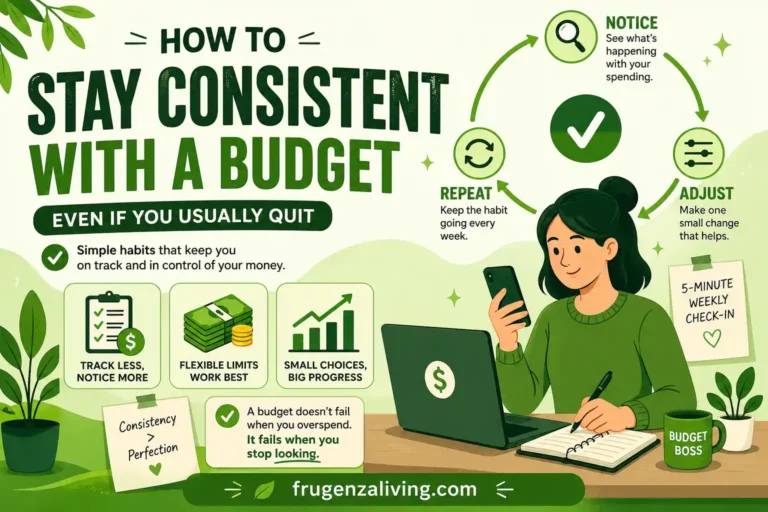
I used to think budgeting was about making the perfect plan.
If the numbers were right, everything would work. I would create categories, set spending limits, and promise myself that this time I would finally stick with it.
But after a few weeks, the same pattern kept happening. I stopped checking. I stopped tracking. Then I slowly went back to guessing where my money went.
That’s when I realized the real problem was not the budget itself. The real problem was consistency.
Staying consistent with a budget means following a simple money routine often enough that you stay aware of your spending, adjust when real life changes, and keep going even when your budget is not perfect.
For me, learning how to stay consistent with a budget changed more than the numbers. Building this exact consistency loop is what helped me save over $15,000 in a single year without feeling restricted. This was not from one huge cut or one perfect system. It came from small repeated changes: reviewing expenses weekly, reducing impulse food spending, and avoiding the “start over next month” mindset.
This is not a guaranteed result for everyone. The exact number will be different depending on income, expenses, and lifestyle. But the principle stayed the same: consistency made the savings visible.
Quick Answer: How Do You Stay Consistent With a Budget?
To stay consistent with a budget, keep your system simple, review your spending weekly, use flexible limits, and adjust based on real-life patterns. The goal is not to follow your budget perfectly every day, but to return to it consistently when things change.
Key Takeaways
- Consistency matters more than having a perfect budget
- A budget is easier to maintain when it fits your real life
- The real danger is not overspending once, but avoiding your budget afterward
Why It’s So Hard to Stay Consistent With a Budget
Budgeting often feels easy at the beginning because motivation is high. You feel organized, clear, and ready to build your money habits. The first few days usually go well.
Then real life gets in the way.
You get tired after work. A bill shows up earlier than expected. You spend more on food than planned. One small mistake turns into frustration, and suddenly the budget starts feeling like another thing you failed at.
This is where many people quit, not because they are bad with money, but because the system feels too difficult to maintain. A strict budget might look good on paper, but if it does not match your energy, routine, and actual spending behavior, it will be hard to follow long term.
Research on decision fatigue shows that repeated decision-making can reduce the quality of later decisions, which helps explain why budgets often break during normal daily moments rather than during planning.
Imagine this: it is the end of the day, you are tired, and you just want something easy. That is exactly when your budget gets tested.
Most budgets do not break during planning.
They break during ordinary decisions.
What Usually Breaks Budget Consistency After Week Two
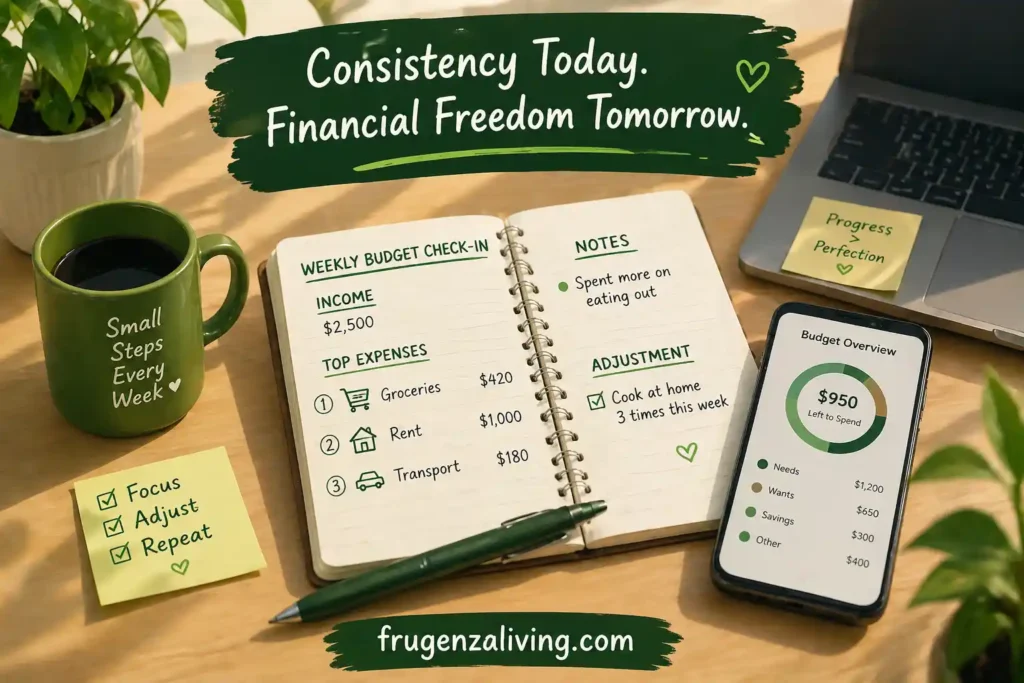
The first week of budgeting often feels exciting. The second week is where the real test begins.
One common reason consistency breaks is boredom. Checking numbers stops feeling new, and the routine becomes easy to skip. Another reason is unrealistic limits. If your budget leaves no room for small pleasures, one slip can make the whole plan feel ruined.
Unexpected expenses also create problems. A birthday gift, a small car issue, school cost, or subscription renewal can make you feel like the budget failed, even when the problem was simply that the budget did not leave room for real life.
The last issue is checking too rarely. If you only look at your budget when something goes wrong, it becomes stressful. But if you check it lightly and regularly, it becomes a normal habit instead of an emergency task.
What Budget Consistency Actually Means
Budget consistency does not mean following your plan perfectly every day.
It means staying connected to your money often enough that you can notice problems early and make small adjustments before things get out of control.
You do not need to track every dollar. You do not need to review your budget for an hour. You do not need to feel guilty when something goes wrong.
Consistency means you keep coming back.
That is the part most beginners miss. A budget can survive mistakes if you return to it quickly. It usually fails when you avoid it completely.
The Budget Doesn’t Fail When You Overspend. It Fails When You Stop Looking.
This is the biggest lesson I wish I understood earlier.
Overspending once does not destroy a budget. Avoiding the budget afterward does. The real danger is not one bad day—it is the silence that follows it.
When you stop checking, small problems become invisible. Food spending creeps up. Subscriptions keep renewing. Impulse purchases feel harmless because you are no longer looking at the pattern.
That is why consistency matters more than perfection. A budget is not meant to punish you for mistakes. It is meant to help you notice them early enough to adjust.
The Real Reason People Quit Budgeting
Most people quit budgeting because the system becomes too heavy.
It takes too long. It feels boring. It creates guilt. It requires too many decisions. Over time, the budget stops feeling helpful and starts feeling like a chore.
Here’s the part most people don’t realize: fixing your budget is not always about doing more. It is often about removing what makes it hard to follow.
If your budget takes 30 minutes to check, make it 5 minutes. If you have too many categories, reduce them. If daily tracking feels stressful, try a weekly check-in instead.
The goal is not to prove discipline. The goal is to create a routine you can actually repeat.
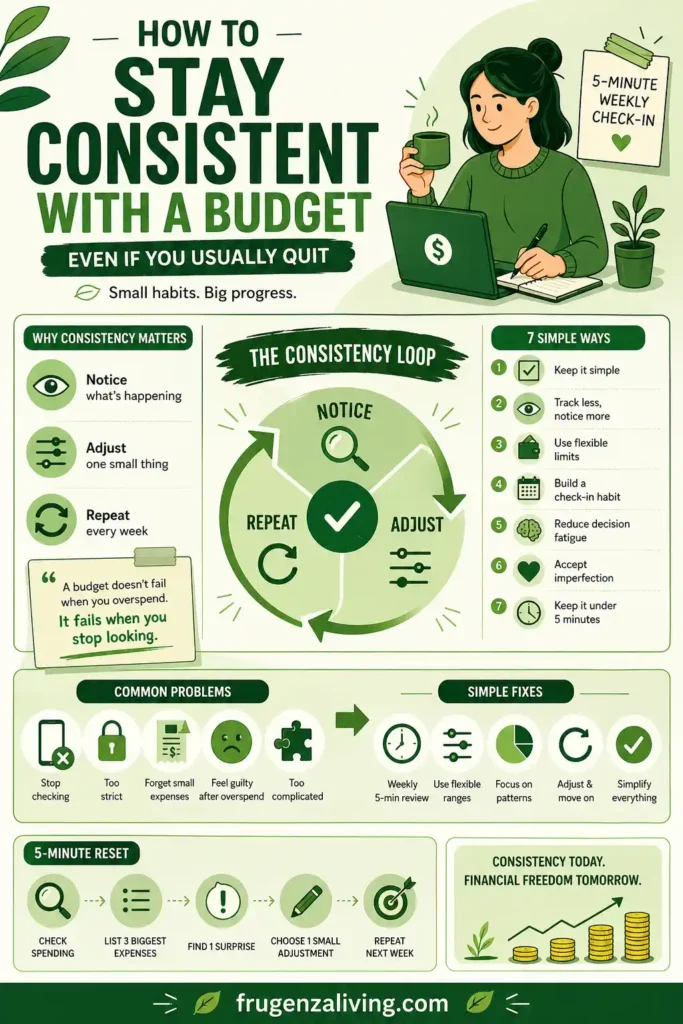
7 Simple Ways to Stay Consistent With a Budget
1. Make Your Budget Easier, Not Perfect
A complicated budget can feel impressive at first, but it rarely lasts.
If you have too many categories, too many rules, and too much detail, you will eventually start avoiding it. That was one of my biggest early mistakes. I tried to make my budget look perfect, but I did not make it easy to use.
A better approach is to simplify your structure. Use fewer categories. Focus on the expenses that matter most. Keep your budget clear enough that you can understand it quickly, even when you are tired.
A budget you can follow imperfectly is better than a perfect budget you abandon.
Many people lose consistency because of common budgeting mistakes they don’t notice early.
2. Track Less, Notice More
You do not need to track every detail to stay consistent with a budget.
What matters more is noticing patterns. Are you spending more on food during stressful weeks? Do small online purchases happen mostly at night? Are subscriptions quietly taking more money than you expected?
This is where learning how to monitor your budget regularly becomes helpful. Expense tracking is not about recording every single transaction perfectly. It is about giving yourself enough visibility to make better decisions.
When tracking feels light, you are more likely to keep doing it.
3. Set Flexible Limits
Strict limits often break quickly.
For example, setting a $0 eating-out budget might sound disciplined, but if you usually buy food outside once or twice a week, that plan may collapse fast. A flexible limit like $80 to $120 for eating out is more realistic because it gives you structure without pretending life will be perfect.
Flexible limits reduce guilt. They also make it easier to adjust without quitting completely.
The goal is not to eliminate every mistake. The goal is to keep the budget usable.
4. Build a Simple Check-In Habit
Consistency comes from repetition, not motivation.
Choose one regular time to check your budget. It could be Sunday evening, payday, after dinner, or before bed. The exact time does not matter as much as making it repeatable.
When I started doing short check-ins, my budget stopped feeling like a big event. It became a normal part of the week. I did not need to fix everything during each check-in. I only needed to see what was happening.
That small habit made it easier to stay engaged.
5. Reduce Decision Fatigue
A budget becomes harder to follow when every spending choice requires effort.
If you constantly ask yourself, “Can I afford this?” or “Is this okay?” you will eventually get tired. Decision fatigue often shows up after a long day when convenience feels more attractive than careful planning.
Reduce the number of decisions you need to make. Set a weekly spending limit. Plan a few simple meals. Decide ahead of time how much you can spend on flexible expenses.
Less thinking creates more consistency.
6. Accept Imperfection
Missing one check-in does not mean your budget failed.
Overspending once does not mean the whole month is ruined. This mindset is important because many people quit after one mistake. They think, “I already messed up, so what’s the point?”
The point is to continue.
A consistent budget is not one that never breaks. It is one you return to after it breaks. That difference matters.
7. Keep It Under 5 Minutes
If your budget takes too long to maintain, you probably will not stick with it.
A 5-minute review can be enough. Open your bank account. Look at your biggest spending areas. Notice what changed. Decide one small adjustment.
That’s it.
Keeping the routine short makes it easier to repeat, and repetition is where the real progress happens.
Budget Consistency Problems vs Simple Fixes
| Problem | Simple Fix |
|---|---|
| You stop checking after a few days | Use a weekly 5-minute review instead of daily tracking |
| Your budget feels too strict | Use flexible spending ranges instead of fixed limits |
| You forget small expenses | Focus on repeated patterns, not every single transaction |
| You feel guilty after overspending | Adjust the next week instead of quitting the budget |
| Your system feels too complicated | Reduce categories and use fewer tools |
A Simple Real-Life Example of Budget Consistency
Here is what consistency might look like during a normal week.
On Monday, you quickly check your spending and notice nothing unusual. On Wednesday, you realize food spending is higher than expected. On Friday, you choose a simple meal at home instead of ordering again. On Sunday, you review the week and adjust next week’s food budget slightly.
That is not dramatic. It is not perfect. But it works because you stayed in contact with your money.
A budget improves through small adjustments, not one big moment of discipline.
How to Get Back on Track After Breaking Your Budget
If you break your budget, do not restart from zero.
Look at what happened, name the trigger, and make one small correction. Maybe food spending went too high because you were tired after work. Maybe an irregular expense was not planned. Maybe you ignored your spending for too many days.
The goal is not to punish yourself. The goal is to return quickly.
This is where many people lose consistency. They wait until next month to try again. But you do not need a new month. You only need the next decision.
If you overspend on Tuesday, check your spending on Wednesday. If you miss a weekly review, do it the next day. The faster you return, the less damage one mistake can do.
Measure Your Budget Return Time
Budget Return Time Tracker
Select how long it usually takes you to return, then complete the four-step budget re-entry check.
How quickly did you return?
Your four-step budget re-entry
You do not need to rebuild the whole budget. Complete these four actions and continue from where you are.
Instead of measuring budgeting consistency by how long you can maintain a perfect streak, measure how quickly you return after something interrupts the plan.
Your budget return time is the gap between the moment you stop checking—or notice that spending has gone off track—and the moment you reconnect with your numbers.
For example:
- You overspend on Tuesday and review the budget on Wednesday: one-day return time.
- You miss Sunday’s check-in and complete it on Tuesday: two-day return time.
- You avoid the budget for three weeks and wait for the next month: three-week return time.
A shorter return time matters because fewer transactions and bills can accumulate while you are disconnected. You do not need to correct everything immediately. The first step is simply to look again.
Use this quick re-entry process:
- Check the current account balance.
- Identify bills due before the next income.
- Review the flexible amount still available.
- Choose one adjustment for the next few days.
Then continue with the existing budget. Do not rebuild every category unless the original numbers are no longer realistic.
You can review your return time at the end of each month. If you usually return within one or two days, your consistency is improving—even if the month was imperfect. If you regularly avoid the budget for a week or longer, make the re-entry step smaller. Check only the balance and upcoming bills first, then complete the full review later.
The goal is not an unbroken budgeting streak. The goal is to make returning so simple that one difficult week cannot turn into an abandoned month.
The Consistency Loop That Keeps Your Budget Working
Consistency Loop: Notice → Adjust → Repeat
- Notice what is happening with your spending
- Adjust one small thing based on what you see
- Repeat the process every week
This is the loop that changed everything for me. I stopped trying to control every dollar and started paying attention more consistently.
If you remember only one thing, remember this: consistency is not about doing everything right. It is about staying in the loop.
Start With This 5-Minute Consistency Reset
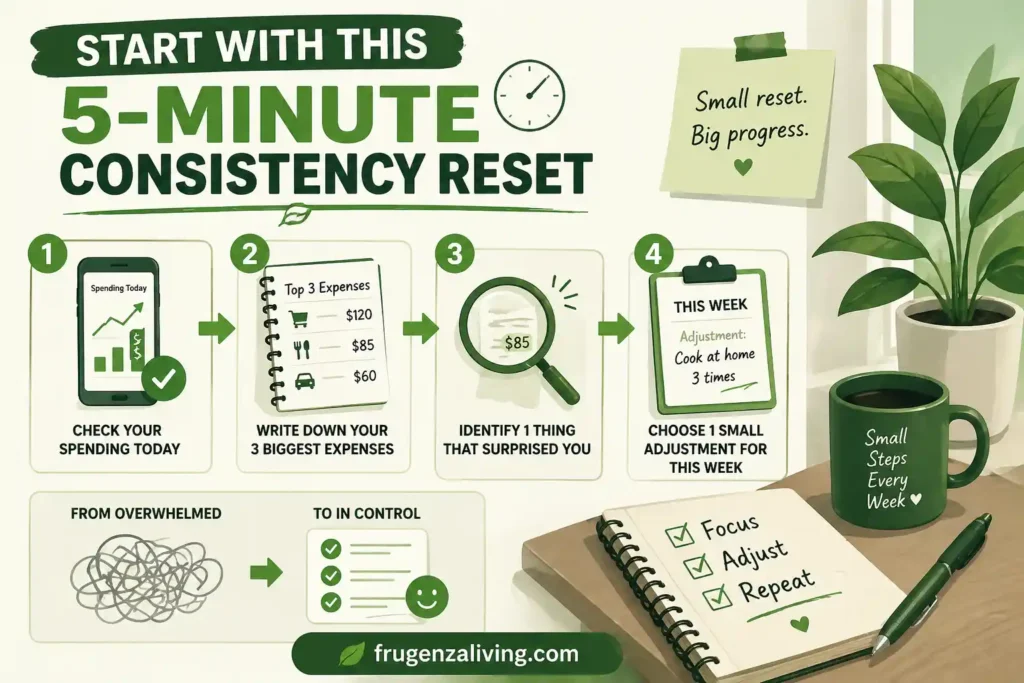
If your budget already feels messy, do not try to fix everything at once.
Start with this:
- Check your spending today
- Write down your 3 biggest expenses
- Identify 1 thing that surprised you
- Choose 1 small adjustment for this week
This reset is simple on purpose. It does not require a full budget rebuild. It only helps you reconnect with your money.
That is often enough to restart.
How Consistency Improves Your Budget Over Time
Consistency builds awareness.
Awareness helps you see patterns. Patterns help you make better decisions. Better decisions make your budget easier to follow.
At first, the progress may feel small. You might only notice one spending habit or avoid one unnecessary purchase. But over time, these small moments start to compound.
This is how budgeting becomes easier. You stop relying on motivation and start relying on routine.
That shift is what helped me save over $15,000 in a year. It was not about feeling restricted every day. It was about noticing, adjusting, and repeating until better decisions became normal.
How This Connects to Your Overall Budget
Expense tracking helps you see what is happening. Budget consistency helps you keep coming back to that information. Once both habits feel natural, a clear budgeting system becomes much easier to follow because you are no longer guessing or starting from zero every month.
That is why consistency fits naturally with basic budgeting tips for beginners and simple budgeting for beginners. Tracking gives you visibility. Consistency keeps you engaged. A budget gives that awareness structure.
If your income is limited, you can also adapt the same habit to how to manage money consistently so your system feels realistic instead of stressful.
The goal is not to create a perfect financial plan. The goal is to stay close enough to your money that you can make better choices.
FAQ: How to Stay Consistent With a Budget
Why is it so hard to stay consistent with a budget?
It is hard to stay consistent with a budget because many systems are too strict, detailed, or time-consuming. When a budget feels like extra work, people naturally avoid it. Consistency becomes easier when the system is simple, flexible, and realistic enough to repeat.
How can I stay consistent with my budget every month?
To stay consistent every month, create a small routine instead of relying on motivation. Review your spending weekly, use flexible limits, and make small adjustments when needed. A budget becomes easier to maintain when it fits your real life instead of demanding perfection.
What is the best way to stay on budget every month?
The best way to stay on budget every month is to keep your system simple, review spending weekly, and use flexible limits instead of strict rules. A budget becomes easier to maintain when it fits your real spending habits and allows small adjustments.
Should I check my budget daily or weekly?
Daily checks can build strong awareness, but weekly reviews are easier for many people to maintain. The best option is the one you can repeat consistently. If daily tracking feels stressful, start with a short weekly review and adjust from there.
How do I get back on track after breaking my budget?
Get back on track by reviewing what happened without judging yourself. Identify the expense or habit that caused the issue, then make one small adjustment for the next week. The goal is not to restart perfectly, but to return to the habit quickly.
What should I do if I break my budget?
If you break your budget, do not wait until next month to restart. Review what happened, identify the spending trigger, and make one small adjustment for the next few days. A budget becomes more useful when you return to it quickly instead of treating one mistake as failure.
Why do I keep failing at budgeting?
Many people keep failing at budgeting because their system is too strict, too detailed, or too disconnected from real life. Budgeting becomes easier when the process is simple enough to repeat and flexible enough to survive imperfect weeks.
How long does it take to build budgeting consistency?
Most people can start building budgeting consistency within a few weeks, but lasting change often takes a few months. The key is repetition. The more often you notice, adjust, and repeat, the more natural budgeting becomes over time.
Ending
Staying consistent with a budget is not about discipline alone.
It is about making things simple enough to repeat.
You do not need a perfect system. You need one that fits your life, your energy, and your real spending behavior.
I used to think budgeting was about control.
Now I know it is about consistency.
And building that consistency is exactly what helped me save over $15,000 in a year without feeling restricted.
Fix that, and everything else gets easier.

The ideas shared here come from real-life experience and practical habits that actually work.
→ Read more about Jeffi
- No Spend Month Challenge for Beginners: A 30-Day Plan - September 24, 2026
- Low Buy Month Challenge: Realistic Rules for 30 Days - September 23, 2026
- How to Stop Buying Groceries You Already Have - September 20, 2026