
The hardest part of frugal living is usually not the saving itself. It is figuring out where to actually start.
Search “frugal living” and you’ll find hundreds of tips at once — meal prep schedules, cash envelope systems, no-spend challenges, capsule wardrobes. Each one sounds reasonable on its own. Together, they feel like a full-time job.
If you’re here trying to figure out frugal living for beginners, you’re probably not lacking motivation. You’re lacking a starting point that doesn’t require changing your entire life at once.
So let’s pick just one. Not the perfect system — just a real first step you can actually take this week.
What Is Frugal Living for Beginners?
Frugal living for beginners means learning how to spend less on things that don’t matter much, so you can have more control over your money—without feeling restricted or stressed.
It’s not about being cheap.
It’s not about saying no to everything.
It’s about:
- Making smarter choices
- Keeping what you enjoy
- Letting go of what drains your money
Think of it like cleaning up your spending—not cutting it completely.
If you have a packed routine, these frugal living tips for busy people can help you stay consistent without feeling overwhelmed.
Why Frugal Living Feels Hard at First
Most beginners don’t struggle because frugal living is difficult. They struggle because they try to change everything at once — a perfect budget, full discipline, zero unnecessary spending — and that lasts about a week before normal life interrupts it.
The real issue is usually decision fatigue, not lack of willpower. When you’re tired or busy, your brain reaches for the easiest option, and the easiest option usually costs money. That’s not a character flaw. It’s how decision-making works under pressure.
This is why strict rules rarely last, but small, repeatable adjustments do.
What usually goes wrong:
- You try to be too strict
- You overthink every purchase
- You expect instant results
- You feel guilty when you “mess up”
Frugal living isn’t hard. Trying to do it perfectly is. A simple starting point is learning how to cut everyday costs without making drastic changes.
Where Most Beginners Lose Money Without Realizing
Most beginners assume groceries or bills are where their money disappears. Often, it’s not.
It’s the in-between spending: a quick online purchase, a “just this once” delivery order, an extra item added to the cart without thinking. Individually, none of these feel significant. Together, they usually outweigh the big expenses people try hardest to control.
That was the real shift — not cutting big expenses more aggressively, but noticing the small ones that had been invisible the whole time.
If you’re new to this, it helps to live frugally the easy way instead of trying to change everything at once.
If You’ve Tried Before and It Didn’t Stick, Read This First
If this is not your first attempt at frugal living, you are not starting from zero. You are starting with information.
A failed attempt usually falls into one of two categories, and knowing which one applies to you changes what to do next.
The first is an unbuilt habit — the approach was fine, it just had not been repeated long enough to feel automatic. If you can point to one specific week where something unusual happened — a busy stretch, a stressful event — and that is when things fell apart, this is probably you. The fix is to restart the same approach, just smaller.
The second is a mismatched system — the approach itself did not fit your actual life. A strict meal-prep schedule built for predictable hours will keep failing for someone whose work changes weekly. If the same type of problem keeps resurfacing every few weeks regardless of motivation, this is probably you. The fix is not more willpower. It’s changing the structure.
You don’t need to start completely over. You need to be honest about which of the two you’re actually dealing with.
Simple Frugal Living Tips for Beginners (That Actually Work)
At some point, I started thinking about spending in a simpler way.
Not categories. Not budgets.
Just two types:
- automatic spending
- intentional spending
Automatic spending happens without thinking—subscriptions, habits, routine purchases.
Intentional spending is when you actually pause and decide.
The goal isn’t to stop spending.
It’s just to slowly move more of your spending into that second category.
That shift alone made things feel more manageable.
Let’s keep this realistic. No extreme rules. No complicated systems.
Just small changes that actually fit into your life.
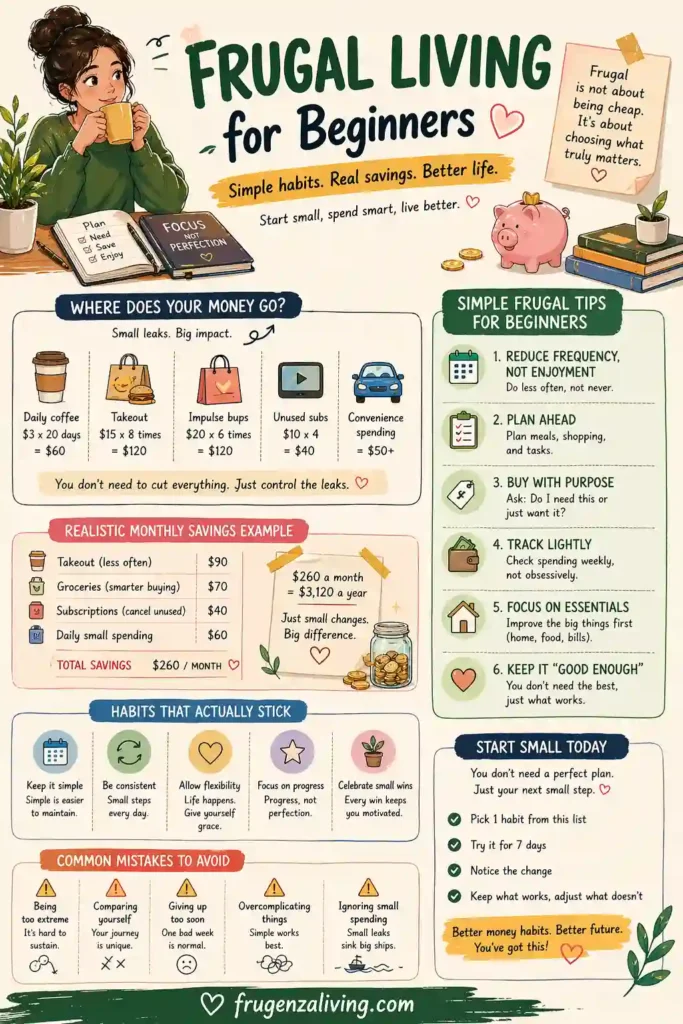
Here are six starting points. You don’t need all six this week — pick one.
1. Pick One Recurring Expense to Cut in Half (Not to Zero)
Don’t eliminate takeout, coffee, or shopping completely. Pick one and cut its frequency in half for two weeks.
Order takeout four times a week? Try two. Buy coffee daily? Try three times a week instead of seven.
Cutting to zero invites burnout within days. Cutting in half is something you can actually sustain long enough to see if it sticks.
2. Remove One Decision Per Day
Decision fatigue is the real cost driver, not any single purchase. Pick one daily decision and pre-make it: the same breakfast every weekday, the same two lunch options on rotation, one default answer to “should I order food tonight.”
One less decision a day is one less chance to spend on autopilot.
3. Check Spending Once a Week, for Ten Minutes Only
Not a full audit. Not a spreadsheet. Open your bank app once a week, scan the last seven days, and notice anything that surprises you.
Ten minutes is short enough that you’ll actually do it. A detailed tracking system you abandon after day four teaches you nothing.
4. Apply the 80/20 Rule to Your Three Biggest Bills
Look at your three largest fixed costs — usually rent, groceries, and one utility or subscription bundle. Ask only one question for each: “Is there a 20% reduction here that wouldn’t change my daily life?”
Skip every other category for now. Three targeted questions beat twenty vague ones.
5. Use a 24-Hour Hold on Anything Over a Set Amount
Pick a number that fits your budget — $20, $30, whatever feels meaningful to you. Anything above that number gets a 24-hour wait before you buy it.
This isn’t a ban. It’s a pause long enough for the urge to either fade or prove itself real.
6. Replace One “Default Yes” With a “Default No”
Most overspending comes from defaults, not decisions. If your default is “yes” to extra cart items, free trials, or upsells, pick one and flip it to “no” as your starting setting. You can still say yes — you just have to choose it on purpose.
If your income is tight enough that even small cuts feel risky, the order you make changes in matters more than the changes themselves — that’s the focus of how to save money with low income.
A Realistic Monthly Savings Example
What made this more real for me was looking at it on a smaller scale.
Spending an extra $5–$10 a day doesn’t feel like much.
But over a month, that’s easily $150–$300 without noticing.
And it usually doesn’t come from one big decision.
It’s:
- adding one extra item to your cart
- choosing convenience over planning
- saying “it’s fine” a few times a week
Nothing feels excessive in the moment.
But together, it builds into something you didn’t plan for.
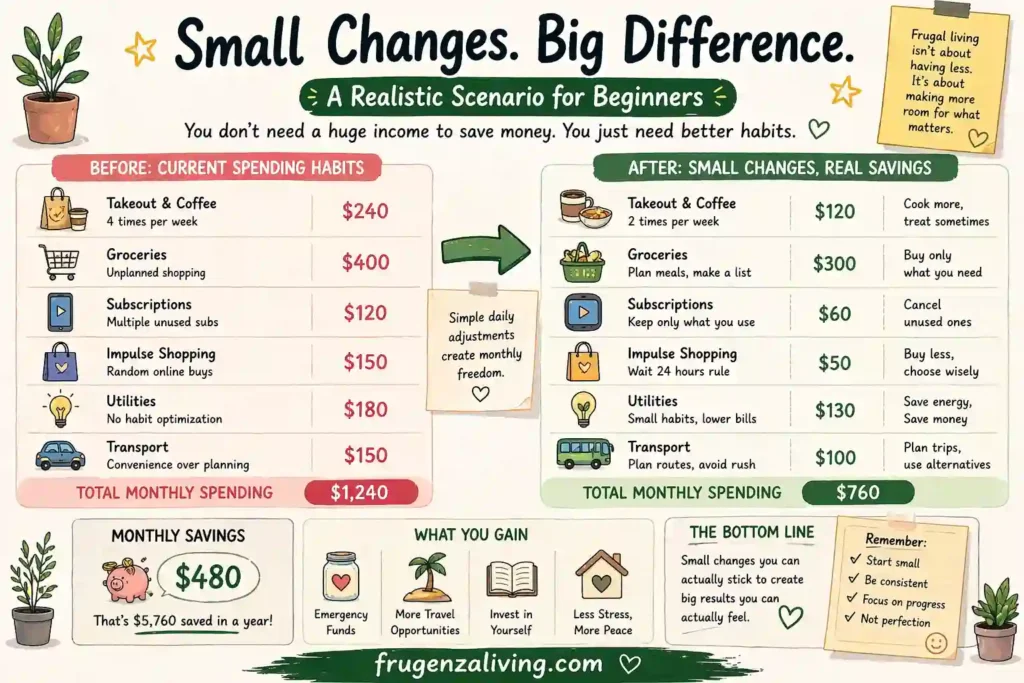
Let’s say you make a few small changes:
- Reduce takeout → save $90/month
- Adjust groceries → save $70/month
- Cancel unused subscriptions → save $40/month
- Cut small daily spending → save $60/month
👉 Total: ~$260/month
👉 In a year: over $3,000
That’s not from extreme budgeting.
That’s from simple adjustments.
For a more sustainable approach, focus on realistic frugal living tips that you can maintain long term.
Common Mistakes Beginners Should Avoid
You don’t need to learn everything the hard way.
1. Trying to Be Too Extreme
Cutting everything sounds good until you burn out. Counter: pick one category to reduce, not all of them.
2. Comparing Yourself to Others
Your situation is different. Your approach should be too. Counter: use your own numbers as the only benchmark that matters.
3. Giving Up After One Bad Week
Progress isn’t linear. Counter: one off week is data, not failure — see the section above on unbuilt habits vs mismatched systems.
4. Overcomplicating the Process
Simple works better. Counter: if a habit needs an app, a spreadsheet, and a notification system to function, it’s probably too complex to last.
5. Ignoring Small Spending
Those small purchases matter more than you think. Counter: the $5–10/day pattern from the savings example above is usually where the real leak is.
What actually sticks long-term is the opposite of these patterns: keeping it simple, repeating what already works instead of constantly switching methods, accepting imperfect weeks without quitting, and choosing consistency over intensity.
When you are just starting, it also helps to understand the frugal living mistakes beginners make so you do not become too extreme too fast.
What You Can Change This Week (Without Overthinking It)
If everything still feels like a lot, here’s the version with no extra thinking required.
This week, pick one:
- Skip one takeout meal (just one)
- Cancel one subscription you forgot you had
- Plan two simple dinners instead of deciding each night
- Apply the 24-hour hold to one purchase you’re tempted by
Then build a simple weekly rhythm around it:
- Once a week: check spending for ten minutes
- Before shopping: write a short list
- Mid-week: stick to your one chosen change
- End of week: notice what worked, adjust next week
No complicated system. Just one change, repeated until it’s no longer a decision.
A Simple Weekly Frugal Routine (Beginner-Friendly)
If you’re not sure where to start, try this:
- Once a week: check your spending (5–10 minutes)
- Before shopping: make a short list
- During the week: reduce takeout slightly
- End of week: notice what worked
That’s it.
No complicated system. Just a simple routine. You can build a budget-friendly lifestyle with simple changes.
How Frugal Living Connects to Bigger Habits
Frugal living isn’t just about saving money.
It connects to:
- Saving money on groceries by simplifying meals
- Meal planning basics to reduce waste
- Reducing monthly bills by cutting unnecessary costs
- Budgeting habits for beginners that build consistency
You don’t need to master all of this right away.
Just start with one area.
FAQ: Frugal Living for Beginners
What is the easiest way to start frugal living?
The easiest way to start frugal living is by reducing small daily expenses instead of changing everything at once. Focus on things like takeout, subscriptions, or impulse purchases first, since they are the easiest to adjust without affecting your lifestyle too much.
Do I need a strict budget to live frugally?
No, you don’t need a strict budget to live frugally. A simple and flexible approach—like tracking your spending once a week and making small adjustments—is often easier to maintain in the long run.
How much money can I realistically save with frugal living?
Most beginners can realistically save around $200–$400 per month by making small, consistent changes. This usually comes from reducing daily spending, adjusting groceries, and cutting unused subscriptions.
Is frugal living the same as being cheap?
No, frugal living is not the same as being cheap. It means being intentional with your money—spending on what matters while reducing unnecessary expenses.
Can you live comfortably while spending less money?
Yes, you can live comfortably while spending less money by focusing on reducing unnecessary costs instead of eliminating things you enjoy. The goal is balance, not restriction.
Why is frugal living so hard to maintain?
Frugal living feels hard to maintain because it often requires consistent decisions in everyday situations. When people are tired or busy, they tend to choose convenience, which can lead to higher spending without realizing it.
Final Thoughts
If you’re starting frugal living for beginners, don’t try to fix everything at once.
Start with one change from this guide. Not the one that sounds most impressive — the one you can actually repeat next week, and the week after.
Because most of the time, it’s not about finding the perfect system.
It’s about noticing a few things, adjusting them slowly, and being honest with yourself about which approach actually fits your life — not someone else’s.

The ideas shared here come from real-life experience and practical habits that actually work.
→ Read more about Jeffi
- No Spend Month Challenge for Beginners: A 30-Day Plan - September 24, 2026
- Low Buy Month Challenge: Realistic Rules for 30 Days - September 23, 2026
- How to Stop Buying Groceries You Already Have - September 20, 2026