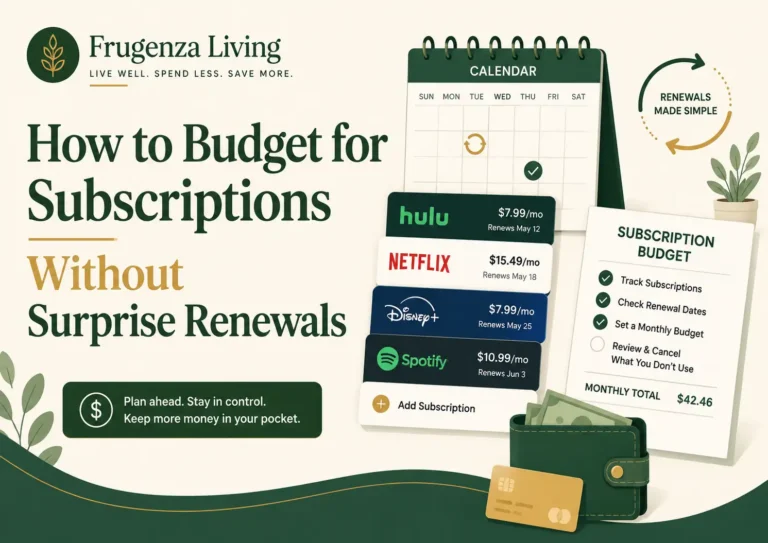
Your subscription stack may appear to cost about $45 a month. Then an annual software plan, a fitness membership, and cloud storage renew within a few weeks, pulling several hundred dollars from the same account.
Learning how to budget for subscriptions requires more than adding the charges that appear each month. You need one total for ongoing affordability and another for the cash that must be ready when renewals arrive.
You also need three dates for every service: the next paid charge, the date by which you want to review it, and the expected date access ends after cancellation. Provider terms differ, so record what actually applies instead of assuming every service works the same way.
A Subscription Budget Needs Two Totals
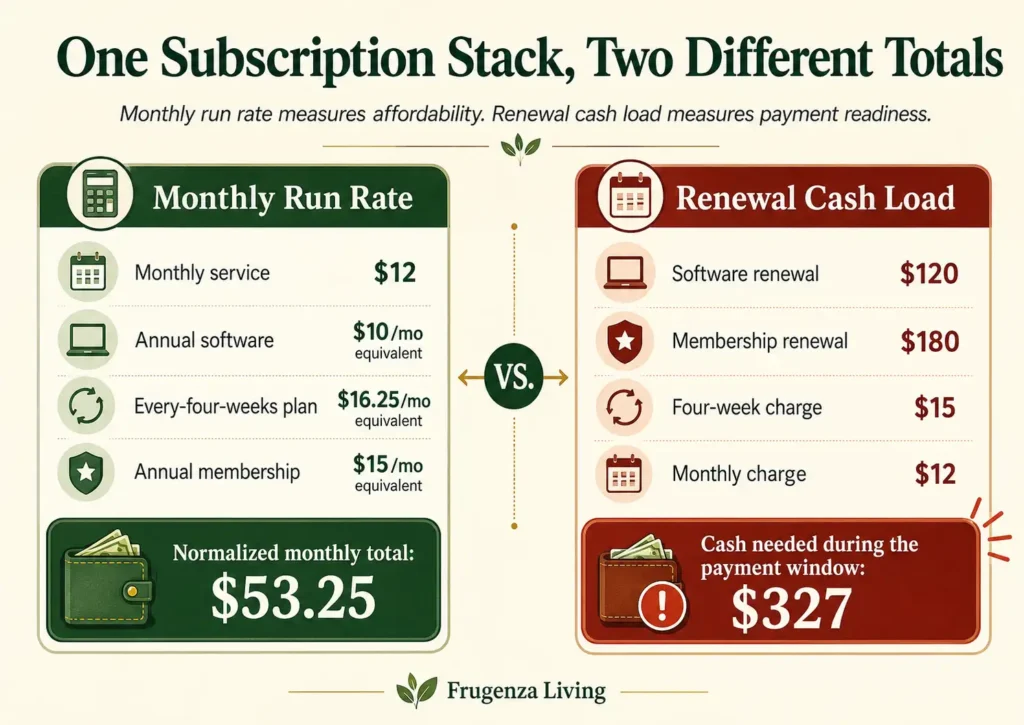
The first total is your monthly run rate. It converts subscriptions with different billing schedules into one comparable monthly amount.
Monthly equivalent = net recurring charge × annualized charges per year ÷ 12
The second total is your renewal cash load. This is the gross amount your account must cover when providers actually charge it.
Consider this illustrative stack:
- Monthly service: $12 each month.
- Annual software renewal: $120.
- Service billed every four weeks: $15.
- Annual membership: $180.
The annual software has a $10 monthly equivalent, but the account still needs the full $120 on renewal day. A four-week plan normally uses 13 charges as its annualized baseline, so $15 every four weeks becomes $195 per year and $16.25 per month. Verify the provider’s actual charge dates because calendar boundaries can vary.
These totals answer different questions:
- Monthly run rate: Does the subscription stack fit the ongoing budget?
- Renewal cash load: Can the account handle the real charges coming next?
A subscription budget is incomplete when one answer is yes and the other is unknown.
If you are not sure where your subscription money is going, start by auditing your subscriptions before setting monthly spending limits.
Find Every Active Subscription Before Setting a Limit
Do not build the list from memory. Review 12–13 months of account activity when available so one annual renewal cycle is visible. When less history exists, review every statement you can access and supplement it with app-store pages, digital wallets, PayPal automatic payments, and email searches for “renewal,” “trial,” “membership,” “receipt,” “subscription,” and “price change.”
Merchant names may differ from product names. Charges can also belong to family plans, subscription boxes, professional tools, newsletters, or offline memberships.
Never copy card numbers, passwords, or sensitive account identifiers into a tracker. You only need the service name, amount, billing cycle, and relevant dates.
Use one parent Subscriptions category if that keeps the monthly budget simple, but maintain an individual record for every service. A separate category may help when a subscription is expensive, essential, reimbursed, work-related, or paid annually.
Normalize Mixed Billing Cycles Correctly
Use the actual statement charge and an annualized billing baseline:
- Weekly: 52.
- Every four weeks: 13.
- Monthly: 12.
- Every two months: 6.
- Quarterly: 4.
- Semiannual: 2.
- Annual: 1.
A $15 charge every four weeks produces this planning estimate:
$15 × 13 = $195 per year
$195 ÷ 12 = $16.25 monthly equivalent
Calling it a $15 monthly subscription understates the usual annualized cost. Confirm the provider’s actual calendar because some years or start dates can create different boundary behavior.
For a shared or family plan, track two amounts:
Gross charge: the full amount paid by the account holder.
Net household cost: the gross charge minus reimbursement that is genuinely reliable.
Use:
Net monthly equivalent = max(0, recurring charge − reliable reimbursement per charge) × annualized charges per year ÷ 12
Suppose a $30 monthly family plan includes a reliable $10 reimbursement. Its net household run rate is $20 monthly, but the account still needs the full $30 when the provider charges it. Record reimbursement separately, and do not assume another person will pay on time unless experience supports that assumption.
See the Next 90 Days, Not Just the Monthly Average
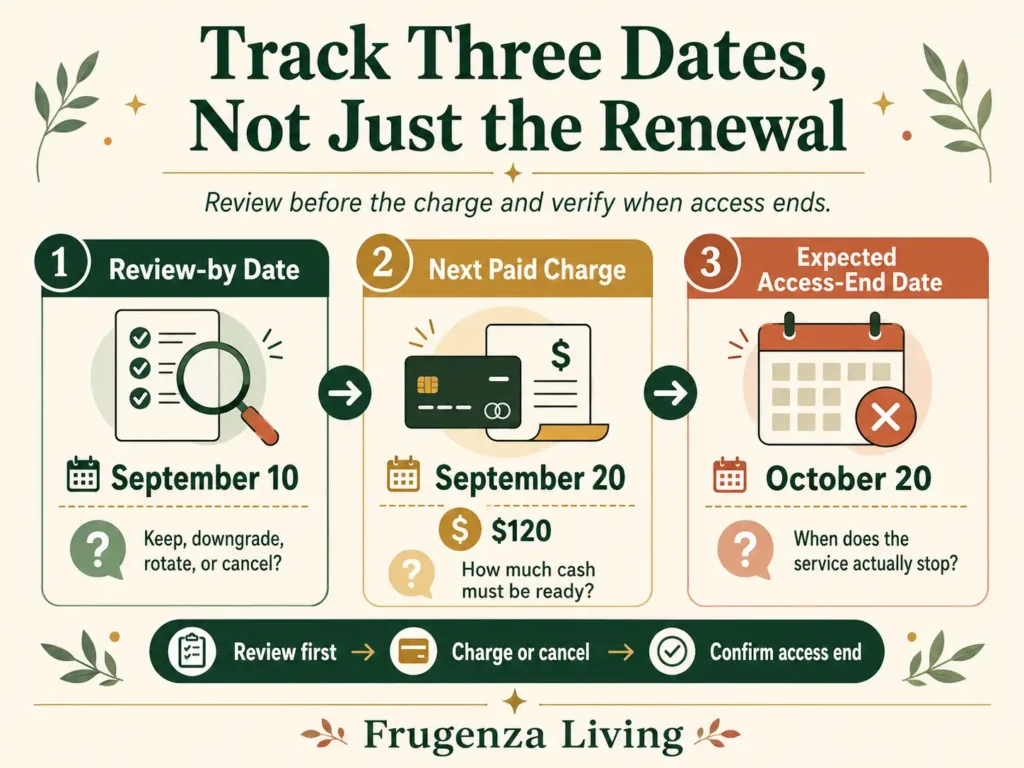
Create a forward view showing:
- Gross charges due in the next 30 days.
- Gross charges due in the next 90 days.
- The largest charge within that 90-day window.
- The nearest review-by date.
- The expected access-end date for any planned cancellation.
The review-by date should leave enough time to inspect value, discuss shared plans, and meet the provider’s current cancellation requirements.
Review-by date = next paid charge date − provider requirement − personal decision time
There is no universal lead time. If you have not verified the provider requirement, leave the review date unset rather than relying on a guess.
Annual renewals can collide even when their monthly equivalents appear affordable. An illustrative $120 software renewal, $180 fitness membership, and $100 cloud-storage renewal create a $400 payment window. Use an annual expenses checklist when those renewals must be coordinated with other non-monthly household costs.
Subscription Budget Control Board
TWO TOTALS • THREE DATESAdd up to ten subscriptions. For trials or promotions, enter both the next paid charge and the regular recurring charge.
Use enough time to review the service and meet its current provider terms.
Summary not calculated.
Subscription Summary
0
—
—
—
—
—
—
Not set
Not set
Net monthly equivalent: max(0, regular recurring charge − reliable reimbursement per charge) × annualized charges per year ÷ 12
Review-by date: next paid charge date − chosen review lead days
Forecast assumption: The 30-day and 90-day totals assume each listed subscription continues on the entered billing cycle. An access-end date is informational and does not automatically remove future charges.
Illustrative example: A $15 charge every four weeks uses 13 charges as an annualized baseline, creating a $195 annual run rate and a $16.25 monthly equivalent.
Forecast dates are planning estimates. Confirm actual renewal dates on provider statements. Renewal cash uses the gross charge because reimbursement may arrive later. This browser-only tool does not save or send entries and is not financial, legal, tax, or provider-specific cancellation advice.
Subscription
Additional pricing and review details
Required for a trial or promotion when the ongoing price differs from the next charge.
Informational only. List only charges you still expect to pay.
Add valid details, then update the summary.
Set a Subscription Limit That Fits Your Priorities
There is no responsible universal percentage for subscription spending. A workable cap depends on income, required bills, minimum debt payments, basic needs, planned savings, and higher-priority goals.
Start with the normalized net monthly total, then decide how much discretionary capacity remains. A cap is a boundary, not a target. You can also set a household rule for overlapping entertainment services or require a review before any annual plan begins.
When an annual renewal is large, reserve the cash gradually in a labeled rollover category or fund.
Decide What Earns Another Billing Cycle
Low usage is useful evidence, but it is not the only measure of value. A backup service, cloud storage, security tool, or occasional professional subscription may matter even when it is not opened daily.
Ask whether the service performs a unique job, duplicates another subscription, prevents a larger replacement cost, serves household members, or still earns its price after an increase.
Possible actions extend beyond cancellation:
- Keep the current plan.
- Downgrade the tier.
- Rotate similar entertainment services.
- Pause when the provider permits it.
- Replace it with a lower-cost option.
- Cancel before renewal.
Use cost per use only when usage count is meaningful. It may help compare entertainment or fitness plans, but it can distort the value of storage, backup, or protection services.
If a service bills every three months, treat it like other quarterly expenses and divide the cost across your monthly budget.
Handle Annual Plans, Free Trials, and Shared Subscriptions
Before switching from monthly to annual billing, calculate:
Break-even usage period = annual price ÷ monthly price
If a plan costs $15 monthly or $120 annually:
$120 ÷ $15 = 8 months
The annual option saves money only when you expect to use it beyond eight months and the upfront payment, flexibility, and renewal terms still fit.
For a free trial, record the next paid charge, regular ongoing price, billing cycle, and review-by date. A zero-dollar trial is not the future subscription cost. For a shared plan, prepare for the gross provider charge and reduce the net household cost only by reimbursement that is reliable.
Put Subscriptions Into a Monthly or Paycheck Budget
Use one parent category for the monthly run rate while keeping item-level renewal records.
Monthly services can come directly from the category. For annual services, transfer the monthly equivalent into a labeled renewal reserve based on the actual charge date, not an imaginary January-to-December schedule.
When subscriptions share an account with rent, utilities, insurance, and debt payments, a complete calendar can show which paycheck must carry each charge. Use a separate guide to build a bill calendar rather than turning this tracker into a full household-bill system.
Run a Short Review Before Renewals
Once a month:
- Scan statements for new or changed recurring charges.
- Check gross cash due in the next 30 and 90 days.
- Review trials and promotions before their next paid charge.
- Update regular prices, reimbursements, and access-end dates.
- Record the decision for each service.
- Confirm annual-renewal reserves still match upcoming charges.
A monthly budget reset routine can handle the wider budget. Keep this review focused on recurring access, price transitions, and renewal timing.
The examples in this article normalize mixed billing cycles for comparison. Your actual budget should use the statement amount, provider terms, next paid charge, regular recurring charge, and reimbursements you can reasonably expect.
The Bottom Line
The practical way to learn how to budget for subscriptions is to track two totals and three dates. Monthly run rate tests ongoing affordability; renewal cash load prepares the account for actual charges. The next charge, review-by date, and expected access-end date support better renewal decisions.
Begin by reviewing recent account activity, adding each active service to one list, and calculating both its normalized monthly cost and its next gross charge.
Frequently Asked Questions
How much should I budget for subscriptions each month?
Add the normalized net monthly equivalent of every active subscription, then set a personal cap only after essential bills, minimum payments, basic needs, planned savings, and higher-priority goals. There is no universal percentage. Check renewal cash separately because annual charges can strain one month even when their monthly equivalents fit.
Should each subscription have its own budget category?
Not necessarily. One parent subscription category can keep the monthly budget manageable, while an individual record preserves each service’s charge, regular price, billing cycle, dates, and status. A separate category may help for a large annual plan, essential tool, reimbursement, or service requiring clear household ownership.
How do I budget for annual subscriptions?
Convert the annual charge into a monthly equivalent to judge affordability, but prepare the full gross renewal amount for cash flow. Save toward it in a labeled sinking fund or rollover category based on the actual renewal date, and set a review-by date early enough to examine current terms.
Is annual billing always cheaper than paying monthly?
Not always in a practical sense. Calculate the break-even period, then consider expected use, upfront cash, cancellation flexibility, and current provider terms. A discounted annual price can still be a poor choice when you stop using the service before reaching the break-even period.
How should I budget for free trials and shared subscriptions?
For a free trial, record the next paid charge, regular recurring price, paid billing cycle, and review date. For a shared plan, prepare for the gross provider charge. Reduce the net household cost only by reliable reimbursement, and confirm that the arrangement follows the provider’s current terms.

The ideas shared here come from real-life experience and practical habits that actually work.
→ Read more about Jeffi
- No Spend Month Challenge for Beginners: A 30-Day Plan - September 24, 2026
- Low Buy Month Challenge: Realistic Rules for 30 Days - September 23, 2026
- How to Stop Buying Groceries You Already Have - September 20, 2026