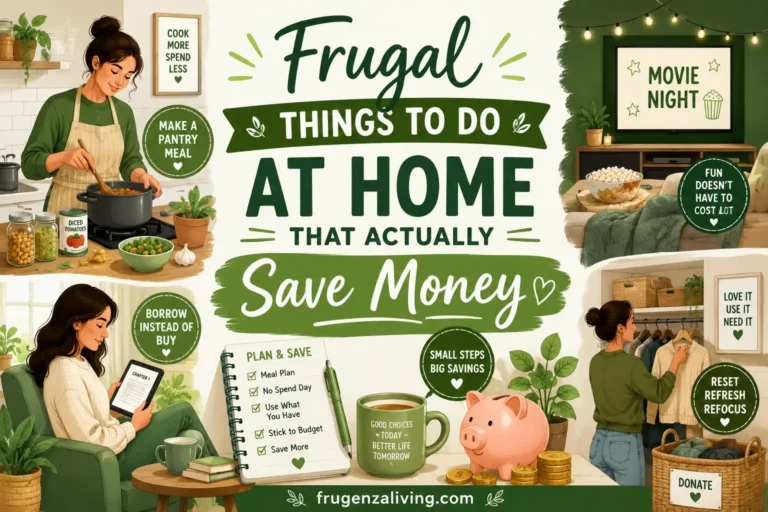
Pick an activity that fits the people, time, and supplies available in your home today. A story game can begin with three words. A drawing session needs paper and a pen. A board game needs the right number of players and a complete set of pieces.
These frugal things to do at home focus on playing, making, and exploring. Each idea includes practical requirements and a backup. The complete 30-minute story game below works for one to four people and requires no new purchase under its stated conditions.
If you need to check household supplies first, use the room-by-room home check. For this activity menu, start by choosing something you would enjoy doing with what is available.
Choose by Time, Participants, and Supplies
Before choosing, confirm three things: who wants to take part, how long you have including setup and putting things away, and whether the necessary supplies are usable now. The durations below are planning estimates; finish earlier or shorten an activity if you prefer.
| Activity | People and time | What to have ready | Backup |
|---|---|---|---|
| Three-word story game | 1–4 people; up to 30 minutes | A place to talk or think; use the three words below | Tell or imagine the story without writing |
| Object clue game | 2–4 people; 15–20 minutes | Ordinary objects already visible in the room | Choose familiar objects from memory |
| Three-panel comic | 1–4 people; about 20 minutes | Paper and a pen or pencil already available | Describe the three scenes aloud |
| Picture detective | 1–2 people; about 20 minutes | An accessible photograph, illustration, or online image | Describe details of an object in the room |
| A game you already own | Use its stated player count; allow setup and a round | Complete pieces, rules, and enough playing space | Use the three-word story game |
| Music guessing game | 2–4 people; 15–20 minutes | An existing device and familiar recordings you can access | Describe a song with clues instead of playing it |
| Change a story’s ending | 1–4 people; 15–20 minutes | A story everyone participating already knows | Use the original three-word story prompt below |
| Indoor picnic | 1–4 people; 30–45 minutes including clearing up | Your planned meal or available snacks, existing dishes, and a suitable place to eat | Use a table or usual eating space; omit extra decorations |
“No new purchase” means the activity can use what is already available. Supplies, food, utilities, and subscriptions can still have costs. A streaming service included in your existing bill is different from a new rental or subscription.
Play a Complete 30-Minute Three-Word Story Game
Participants: one to four people. Supplies: none required. Use a place where everyone can participate comfortably. Writing, drawing, and using an existing clock are optional.
The plan assumes everyone is already at home and available, with no extra travel, paid care, admission, food, equipment, or data purchase needed. Include any added cost if your arrangement differs. You can do the entire activity by speaking, or imagine a story on your own.
Use these three words: umbrella, ticket, moon. Create a story that includes all three. Choose a character, a place, and a problem. The words can appear literally or become part of an invented world.
- Minutes 0–5 — choose the setup: agree on who is participating and read or say the three words. Choose individual stories or one shared story.
- Minutes 5–10 — prepare: think of the character, setting, and problem. For example, a traveler finds a ticket inside an umbrella, but the destination is the moon.
- Minutes 10–22 — make and share the story: use the 12-minute block to tell, write, or imagine what happens. If sharing individual stories, divide the time equally.
- Minutes 22–27 — change the ending: add a different outcome. Perhaps the ticket brings the traveler home instead. For a shared story, each person can contribute a sentence.
- Minutes 27–30 — finish: choose a title and put away any optional materials.
The blocks total 5 + 5 + 12 + 5 + 3 = 30 minutes. The sharing block allows six minutes each for two people, four minutes each for three, or three minutes each for four. Alone, use the block for your own story. Anyone can pass, and you can finish early.
This is an activity plan, not a requirement to perform or produce polished writing. Choose a different prompt if these words do not appeal. No app, printed cards, purchased game, or prize is needed.
How to Run the Other Activities
Object Clues and Three-Panel Comics
For the clue game, one person silently chooses an object visible in the room and gives three clues without saying its name. Others guess, then change the clue giver. Give each person a turn and continue only if there is time. You can name objects from memory without fetching or handling them.
For a comic, divide an existing sheet of paper into three areas. Spend about three minutes choosing a character and problem, 12 minutes drawing a beginning, middle, and ending, and five minutes sharing or finishing. Simple shapes and stick figures work; a new art kit is unnecessary. Use spoken scenes if paper or a pen is unavailable.
Picture Detective
Choose a photograph or illustration already accessible to you. Spend three minutes selecting it, seven minutes finding five details, five minutes inventing a caption, and five minutes reading the real caption or discussing what you noticed.
For an optional online source, the Library of Congress Free to Use and Reuse collections provide themed sets of historical images. Choose a picture and view it on your existing device. This activity needs no printing. Check your connection and data costs; use an existing photo or a room object if online access is unavailable.
Keep observation and invention separate: a building or hat you can see is a detail; a character’s imagined journey is your story. Read the item’s description if you want to learn what the archive actually records.
Owned Games and Music Guessing
Before starting a board or card game, check its player count, pieces, rules, playing surface, and likely session length. Choose a complete game suitable for the people available. The budget game-night guide covers planning a larger gathering.
For music guessing, choose a few familiar recordings through access you already have. Take turns playing a short part while the others guess the title or performer. Stop at your agreed time. Confirm playback, data, and subscription requirements first; use spoken clues if playback is unavailable.
A Different Ending or an Indoor Picnic
Choose a familiar story for the ending game. Allow five minutes to agree where the original ends, five to invent a different outcome, and five to ten to share or discuss it. You can do this alone. If nobody shares a familiar story, use the three-word prompt above.
For an indoor picnic, use a meal you already planned or snacks available for the participants. Use existing dishes and a comfortable eating space; a blanket on the floor is optional. Allow time to set out food, eat, and clear up. Check food quantities and preferences before inviting others, and include any food bought especially for the occasion.
Worked Cost Check: Snacks for Two People
This is a hypothetical US-dollar example for one at-home story-game session with two people. The game itself requires no supplies. The host optionally buys one ready-to-eat snack pack containing six equal portions for $4.80, including applicable tax.
Assume the pack is collected during an already planned shopping trip, with no added travel or other charges. Everyone is already present; existing space and dishes suffice. There are no other purchases or added costs in this illustration. The amount available for new spending on this occasion is $6.
- Checkout payment: the full $4.80 pack price.
- Average payment per participant: $4.80 ÷ 2 = $2.40. This describes the cost allocation, not an agreement that guests owe the host.
- Food used: one portion each. Two portions at $0.80 each allocate $1.60 of the pack cost to food eaten.
- Food remaining: four portions, representing $3.20 of the purchase, available for later use if stored appropriately.
- Money remaining: $6 − $4.80 = $1.20.
The $1.60 value eaten and $3.20 remaining add to the $4.80 purchase. They are not extra charges. Paying $4.80 for the pack cannot be recorded as a $1.60 checkout payment just because only two portions are eaten.
If a $3 delivery charge is added, the new payment becomes $4.80 + $3 = $7.80, exceeding the $6 available by $1.80. Choose the version without that charge, omit the optional purchase, or reconsider the plan within your available funds. Snacks are not required for the story game.
Staying home does not establish a particular saving. To compare it with an outing, identify the outing you would actually have chosen and include the complete costs of both options. These figures illustrate one purchase; they are not the author’s results or a typical household saving.
Use the Printable At-Home Activity Planner
The revised two-page checklist contains the story-game instructions, a small activity menu, the snack-cost example, and a blank planner for participants, time, supplies, costs, and a backup.
Download the printable Frugal Things to Do at Home Checklist (PDF)
This is a manual worksheet for printing or copying into your notes. It does not calculate costs or save entries automatically. You can also use these prompts without downloading it:
- What would everyone taking part enjoy, and how many people are available?
- How much time is available, including setup and putting things away?
- Which supplies, space, and access are already usable?
- What new purchases, fees, or other added costs are required?
- What is the total for the occasion, and does it fit the funds available?
- What is the backup if a person, material, or service is unavailable?
For a quiet personal break, use the frugal self-care ideas. For a longer block of time, the no-spend weekend guide helps you plan beyond one activity.
Frequently Asked Questions
What can I do at home with no new supplies?
Try the three-word story game, change the ending of a familiar story, or give clues about objects already visible. These options can be spoken or imagined. They require a suitable place and available time, with any added access or care costs checked separately.
What works for one person?
You can create a story, make a three-panel comic, examine a photograph, or invent a new ending. Choose the version that fits the materials and time available. A multiplayer game is only an option when its required players are present.
Does using food or a subscription I already have make the activity free?
It may remove the need for a new purchase today. Food, access, and utilities still have costs. Include extra rentals, data, new supplies, or refreshments when comparing alternatives, and keep checkout payments separate from the value of supplies used.
Do these activities guarantee that I will spend less?
No. Your result depends on actual purchases and what you would otherwise have done. An enjoyable activity does not establish an avoided expense. The example amounts are constructed illustrations and do not describe personal savings.

Read about Jeffi and Frugenza Living
- How to Budget a 10-Month Salary Over 12 Months - October 16, 2026
- Pet Adoption Budget Checklist: What You Still Need to Pay - October 16, 2026
- Proportional Bill Split Calculator for Two Incomes - October 15, 2026