The problem is not the envelopes. The session began without a complete cash breakdown or a final reconciliation check.
Cash envelope stuffing for beginners should be more than placing bills into an attractive binder. It is a short money-matching process in which every withdrawn dollar receives a clear job and every new contribution is verified before the session ends.
Quick answer: Complete the budget first, check the cash already left in every envelope, calculate only the new contributions needed before the next payday, plan the bill denominations, withdraw that exact total, stuff one envelope at a time, record the balances, and confirm that the planned contribution, withdrawal, and stuffed contribution totals all match.
Editor’s note: This guide provides general budgeting education, not personalized financial, banking, debt, tax, or investment advice. Adapt the process to your income, household, payment methods, access to cash, and security needs.
Cash Stuffing Starts Before You Touch the Cash
Cash stuffing should follow a written budget. Before withdrawing anything, identify:
- Income already available for the pay period
- Bills due before the next payday
- Savings and debt transfers
- Digital payments that must remain in checking
- Cash categories needed before the next income arrives
- Usable money already inside each envelope
A common first-session mistake is funding an envelope as though it were empty when cash remains inside.
Calculate Each Envelope First
max(0, Amount Needed − Existing Usable Balance)
The contribution can never be negative. If an envelope already contains enough money for the current pay period, add $0 and decide separately whether the extra cash should remain as rollover money or be reassigned.
After calculating every category, add the new contributions together: Cash Withdrawal Total = Sum of All New Envelope Contributions
For example, if groceries need $180 until the next payday and $35 remains in the envelope, the new grocery contribution is $145. If the envelope already holds $200, the new contribution is $0.
Consumer.gov’s Making a Budget guide recommends listing income and expenses before deciding how money will be used. Cash stuffing is the execution step after that planning is complete.
Envelope stuffing becomes much easier when you start with a few cash budget categories that match your actual spending.
Use the Three Totals Rule
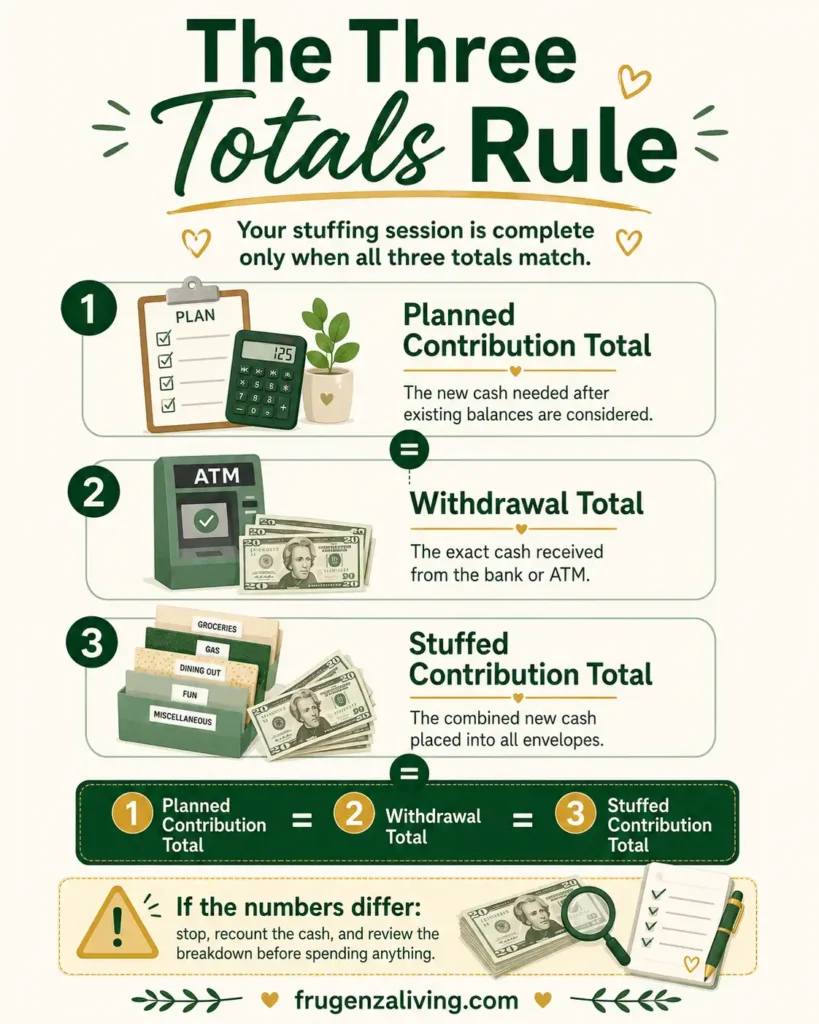
This check prevents skipped categories, incorrect withdrawals, double-funding, and unassigned cash. A withdrawal total can be correct while the bill mix still fails, so plan the envelope amounts and denominations together.
Choose a Stuffing Rhythm That Fits Your Paycheck
Fund the period the cash needs to cover.
- Weekly: useful for weekly income, shorter spending windows, or carrying less cash.
- Biweekly: usually covers about two weeks. Biweekly payroll generally creates 26 paychecks per year, though some calendars may produce 27.
- Twice monthly: follows two fixed paydays, such as the 1st and 15th, and is not the same as biweekly pay.
- Monthly: reduces the number of sessions but may require storing more cash at once.
Choose the schedule that reaches the next income date without forcing you to carry unnecessary cash.
If this method is completely new to you, learn how the cash envelope system for beginners works before withdrawing and dividing your money.
Calculate the Amount and Bill Denominations
Follow this order:
- Protect required bills, savings, debt commitments, and necessary digital payments.
- List only the physical cash categories needed before the next payday.
- Subtract the usable balance already inside each envelope.
- Add the new contributions.
- Confirm the total fits the current pay-period budget.
- Choose bills that can be divided into the planned envelope amounts.
- Do not round the withdrawal upward without assigning the difference.
Match denominations to expected purchases. Larger bills work for larger transactions, while a mix of $20s, $10s, and $5s may be more useful for categories with varied spending. Avoid requesting excessive small bills that make counting harder.
ATM options vary. A teller may be more useful when you need an exact cash breakdown, but denominations are not guaranteed.
Use a paycheck budget template before withdrawing cash so bills, savings, debt, and envelope spending are planned in the right order.
A Realistic $420 Cash Stuffing Example
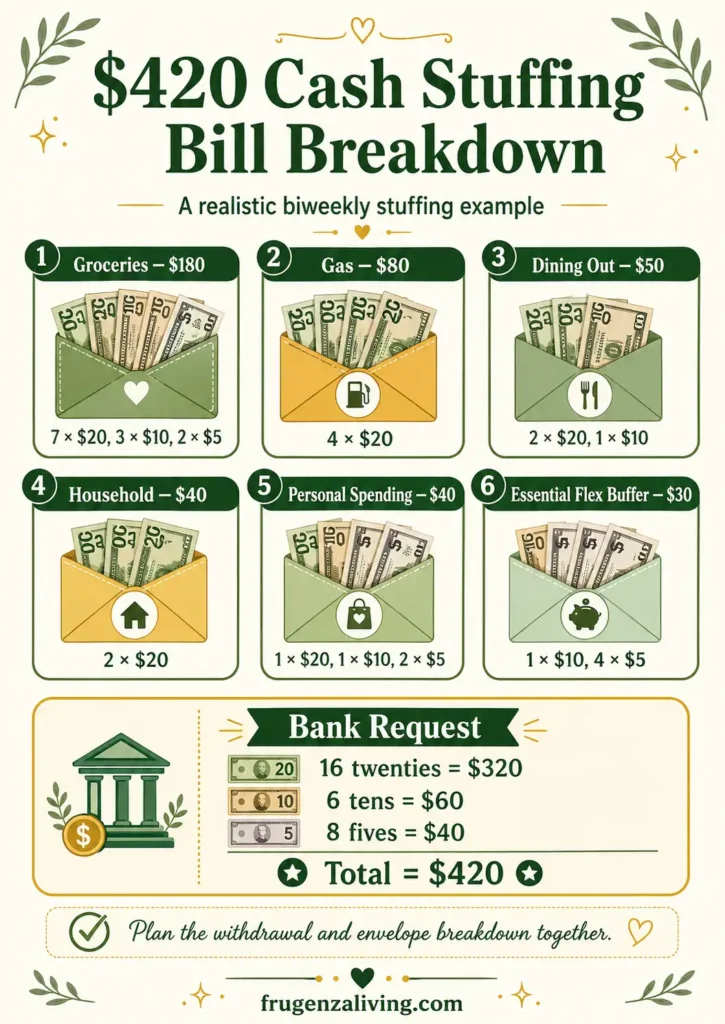
Assume every envelope starts at zero and a beginner has $420 available for cash spending until the next payday.
The Essential Flex Buffer covers small necessary costs that were unknown when the pay-period plan was prepared. It is not extra dining, shopping, or entertainment money. Record every use.
Calculation note: Every category amount and bill denomination in this example was cross-checked so that both the envelope allocations and teller request equal $420.
The bill mix is only an illustration. Choose denominations that fit your likely transactions.
It is safer to allocate income to cash envelopes only after your fixed expenses and savings priorities are covered.
Complete the Stuffing Session
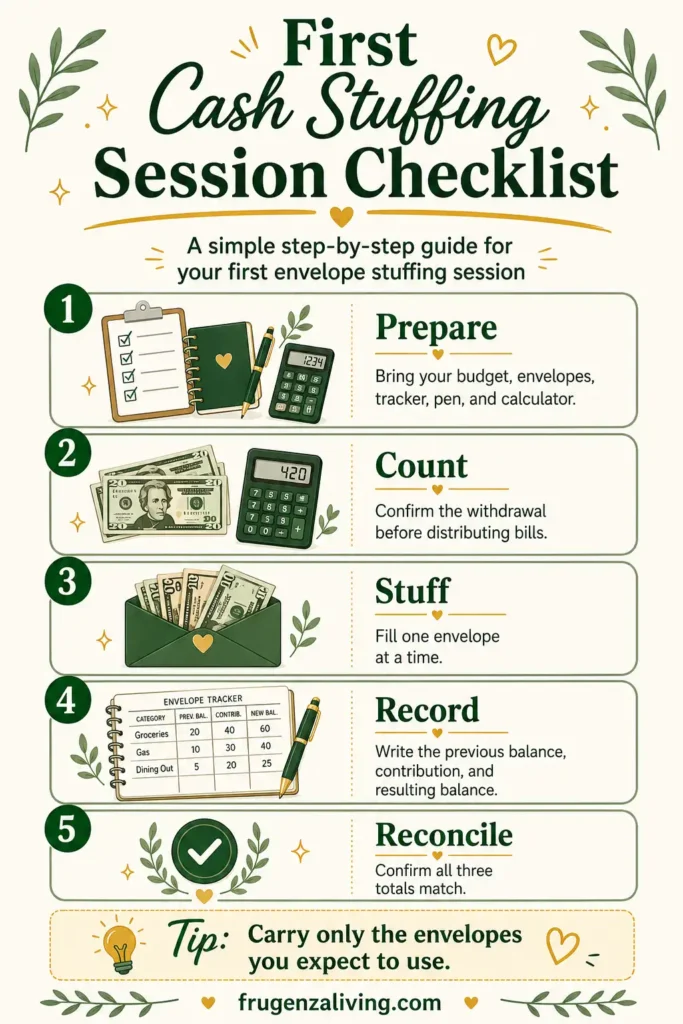
1. Prepare the Workspace
Use a private, uncluttered surface. Have the cash breakdown, labeled envelopes, pen, tracker, and calculator ready.
2. Count the Withdrawal
Confirm the total before distributing any bills. Keep the bank receipt until the session is reconciled.
3. Stuff One Envelope at a Time
Read the category and contribution, count the bills, place them inside, and mark the line complete. Opening several envelopes at once makes misplaced bills harder to find.
4. Record and Reconcile
For each envelope, write:
- Date
- Previous balance
- New contribution
- Resulting balance
- Pay period or short note
Then total only the new contributions and apply the Three Totals Rule. Do not add previous balances to the stuffed contribution total.
5. Store the Cash Intentionally
Carry only the envelopes likely to be used. Keep the remaining cash in a private location rather than carrying the full binder automatically.
Fix Common First-Session Problems
The withdrawal is larger than the plan: Return the extra to checking or assign it deliberately and record the choice.
The envelopes total less than the withdrawal: Check for a skipped category, bills stuck together, incorrect math, or cash placed in the wrong envelope.
The denomination plan fails: Recount how many bills each envelope needs. A correct total does not guarantee a workable bill mix.
Not every category can be fully funded: Protect required expenses and essential categories first. Do not skip bills to make the binder look complete.
An online purchase uses envelope money: Record the purchase immediately and remove or reserve the equivalent cash.
Coins and change accumulate: Return them to the category that produced them unless you use another consistently recorded rule.
Cash Stuffing With Low or Irregular Income
You do not need a full binder. Start with two or three essential variable categories.
For irregular income:
- Budget from money already received.
- Cover urgent bills and required commitments.
- Check existing envelope balances.
- Fund only the categories needed before the next payment.
- Recalculate whenever income changes.
Do not withdraw money that may be needed for electronic bills. A smaller accurate session is more useful than a complete-looking setup that leaves essential payments short.
After the Session: Track, Review, and Store Cash Safely
During the pay period, use the correct envelope, return change, record purchases, and avoid silent transfers. At the next session, review whether the amount and bill mix worked.
Leftover cash can remain as rollover money, reduce the next contribution, or move elsewhere—but record the decision before calculating the next withdrawal.
A decorative binder is optional. Plain envelopes or reusable pouches can work. Keep withdrawal schedules and banking details private, carry only what you expect to use, and store unused cash securely.
How to Know If Your Bill Denominations Worked (Before the Next Session)
The Three Totals Rule confirms that the numbers matched.
It does not confirm that the denomination mix was practical.
A correct withdrawal can still produce friction at the register — too many large bills for a category with small frequent purchases, or not enough small bills for a category where change is rarely given. Both are worth noticing before the next session.
At the end of the pay period, before recounting for the next stuffing, ask one question for each envelope:
Did I ever avoid a purchase, make a purchase from the wrong envelope, or receive unwanted change because the bills inside did not match the transaction?
Three patterns worth noting:
If you consistently paid with a bill larger than the purchase and accumulated change: the denomination for that envelope was too large for how you actually shop. The next session should request more smaller bills for that category — for example, replacing two $20s with four $10s in an envelope used for purchases between $8 and $15.
If you moved cash between envelopes mid-period because one ran out of small bills before the cash itself ran out: the category has a denomination problem, not a budget problem. The total amount may have been correct while the mix was not. Adjust the bill request for that envelope at the next session without changing the contribution amount.
If you avoided a purchase or paid digitally because the only bills left were too large for the transaction: this is the most useful data point. It means the denomination plan did not match your actual purchase sizes. Write down the approximate purchase amount and adjust the bill mix to include bills closer to that amount at the next session.
None of this requires a formal log.
A brief note on the envelope itself — “too many $20s” or “need more $5s here” — written at the end of the pay period is enough to inform the denomination request at the next session.
The bill mix is the one part of cash stuffing that almost always improves between session one and session two. Expecting it to be perfect on the first attempt adds unnecessary pressure. Treating it as information that session one generates for session two is what actually makes the system more accurate over time.
Final Thoughts
A successful cash envelope stuffing for beginners session ends with:
- Existing balances checked
- New contributions calculated correctly
- Useful denominations requested
- Every resulting balance recorded
- No unassigned cash
- Three matching totals
The binder does not make the system accurate. The matching numbers do.
Start with only the categories needed before the next payday, review the results, and expand the setup only when the current process feels clear.
FAQ
What Is Cash Envelope Stuffing?
Cash envelope stuffing places budgeted cash into labeled spending envelopes and records the available balance for each category.
How Much Money Should a Beginner Cash Stuff?
Add only the new cash needed before the next payday after subtracting usable balances already inside the envelopes. Keep money for required digital payments in the bank.
What Bill Denominations Are Best for Cash Stuffing?
Choose denominations according to expected purchases. Larger bills may suit larger transactions, while smaller bills can help with frequent low-cost spending.
What Should I Do If My Cash Does Not Match My Envelopes?
Stop before spending. Recount the bills, check the bank receipt and breakdown, and confirm that no category was skipped or funded twice.
Can I Start Cash Stuffing With a Low Income?
Yes. Begin with two or three essential variable categories and use only money available after required expenses.
How Do I Handle Online Purchases With Cash Envelopes?
Record the purchase immediately and remove or reserve the same amount from the related envelope so the available balance remains accurate.

The ideas shared here come from real-life experience and practical habits that actually work.
→ Read more about Jeffi
- No Spend Month Challenge for Beginners: A 30-Day Plan - September 24, 2026
- Low Buy Month Challenge: Realistic Rules for 30 Days - September 23, 2026
- How to Stop Buying Groceries You Already Have - September 20, 2026