A beginner can label twelve envelopes on day one: rent, utilities, groceries, gas, insurance, gifts, clothing, coffee, medicine, vacation, repairs, and emergencies.
By the second payday, some are untouched, others are empty, and the system feels harder than the old budget.
The problem is often category design. Fixed bills, future savings, and everyday spending have been treated as if they all need the same type of envelope.
The most useful cash envelope categories for beginners are variable expenses where purchases happen repeatedly and overspending is easy.
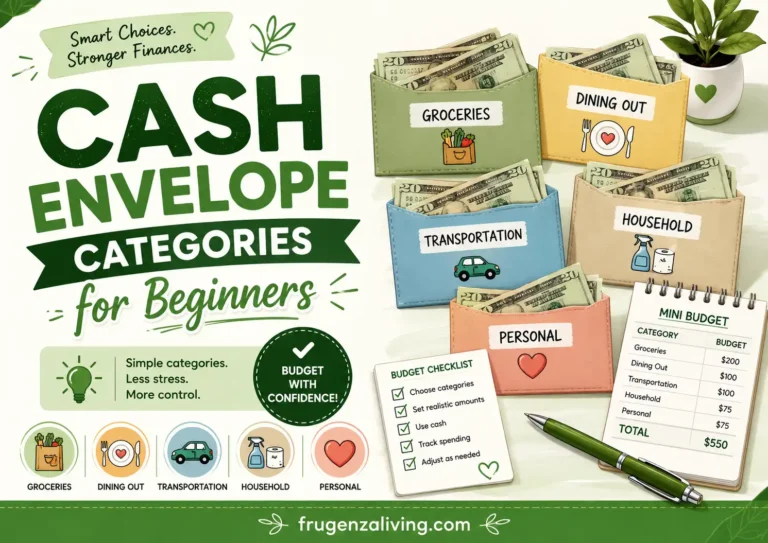
Quick answer: Most beginners should start with 3–5 cash envelopes. Groceries, dining out, transportation, personal spending, and household extras are common starting points, but only choose categories that match your actual spending leaks.
Editor’s note: This article provides general budgeting education, not personalized financial advice. Adapt the examples to your income, household, payment methods, and safety needs.
The Best Cash Envelope Categories for Beginners
Cash envelopes are most useful when they create a visible stopping point.
A strong category usually:
- Changes from month to month
- Includes several purchase decisions
- Is easy to overspend with a card
That is why groceries often work better as a cash envelope than rent. Grocery spending changes and purchases happen repeatedly. Rent is usually fixed and scheduled.
Common beginner cash stuffing categories include:
- Groceries
- Dining out or takeout
- Gas, transit, or transportation
- Personal spending or fun money
- Household essentials
These are options, not a required package. Someone who rarely drives may not need a gas envelope. Someone who already controls grocery spending may gain more from an envelope for takeout, beauty, hobbies, or convenience purchases.
Understanding how the cash envelope system works makes it easier to choose categories without creating too many envelopes at once.
Start with your spending leaks, not someone else’s category list.
Use the Swipe-to-Cash Test
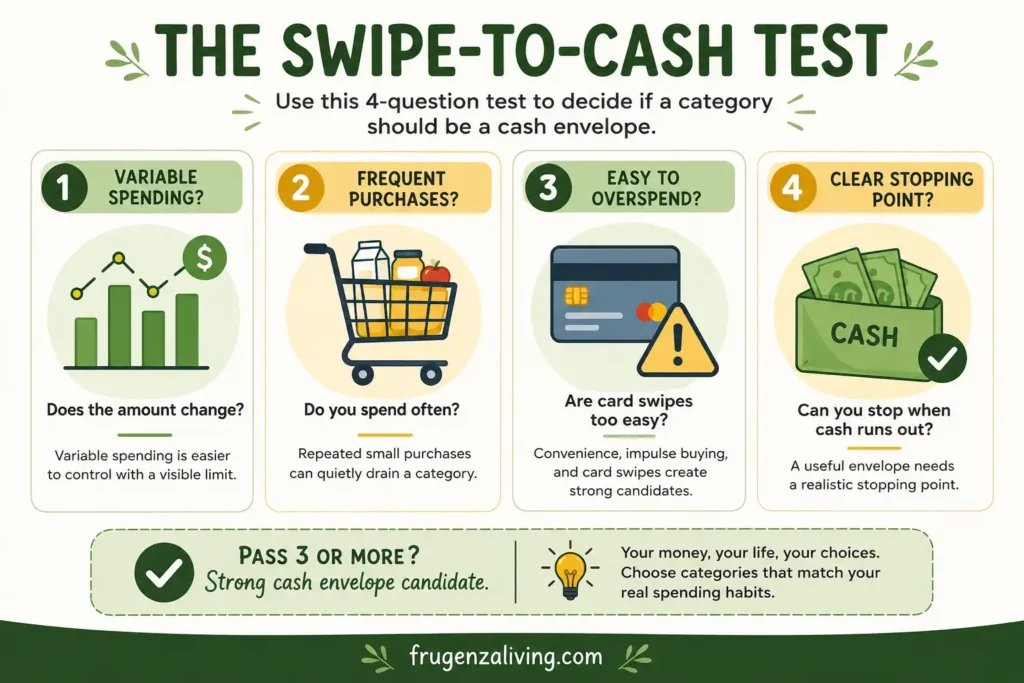
Before turning a budget category into a physical envelope, use this four-question filter.
Category Check
The Swipe-to-Cash Test
Use this quick test before turning a budget category into a cash envelope.
The amount changes depending on choices, timing, or habits.
Small repeated purchases can quietly drain the category.
Impulse buys, convenience, and card swipes make this a strong candidate.
When the cash is gone, you can realistically pause or reduce spending.
This is a practical filter, not a universal rule. Your payment options, local costs, and household responsibilities may lead to a different choice.
A First Citizens Bank guide to envelope budgeting also recommends reviewing and grouping your own expenses before deciding how envelopes should be labeled. Your real spending pattern matters more than a generic list.
A few basic budget categories can help you see which expenses belong in cash envelopes and which should stay outside which expenses belong the system.
Five Smart Categories to Test First
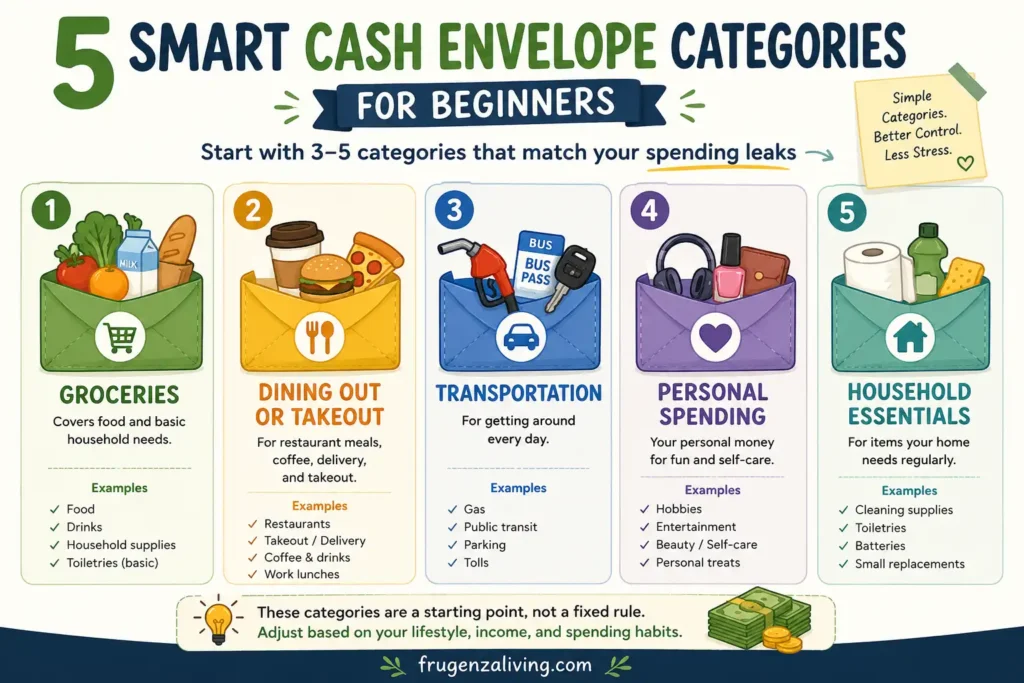
Treat these as a menu. You do not need all five.
1. Groceries
Groceries are often a strong category because spending changes and purchases happen throughout the month.
Combine food and basic household supplies at first. Split them later if toiletries, cleaning products, and paper goods repeatedly use money needed for meals.
2. Dining Out or Takeout
This envelope may cover restaurant meals, delivery, fast food, work lunches, and coffee.
Create a separate dining category when convenience spending repeatedly reduces the money available for groceries. Split coffee later only if it is the main leak.
3. Transportation
A transportation envelope may include gas, public transit, parking, and tolls.
Keep insurance outside it. Registration and major repairs are usually better handled as fixed bills or sinking funds.
4. Personal or Fun Money
This envelope gives you room for hobbies, entertainment, beauty, or small treats without pulling money from essentials.
Couples may prefer separate personal envelopes alongside shared categories.
5. Household Essentials
Define this category in writing. It might include cleaning products, batteries, basic toiletries, and small replacements.
Do not let “miscellaneous” become a hiding place for impulse purchases.
Once your categories are clear, the next step is learning cash envelope stuffing for beginners so each envelope receives the right amount.
Beginner Cash Envelope Category Map
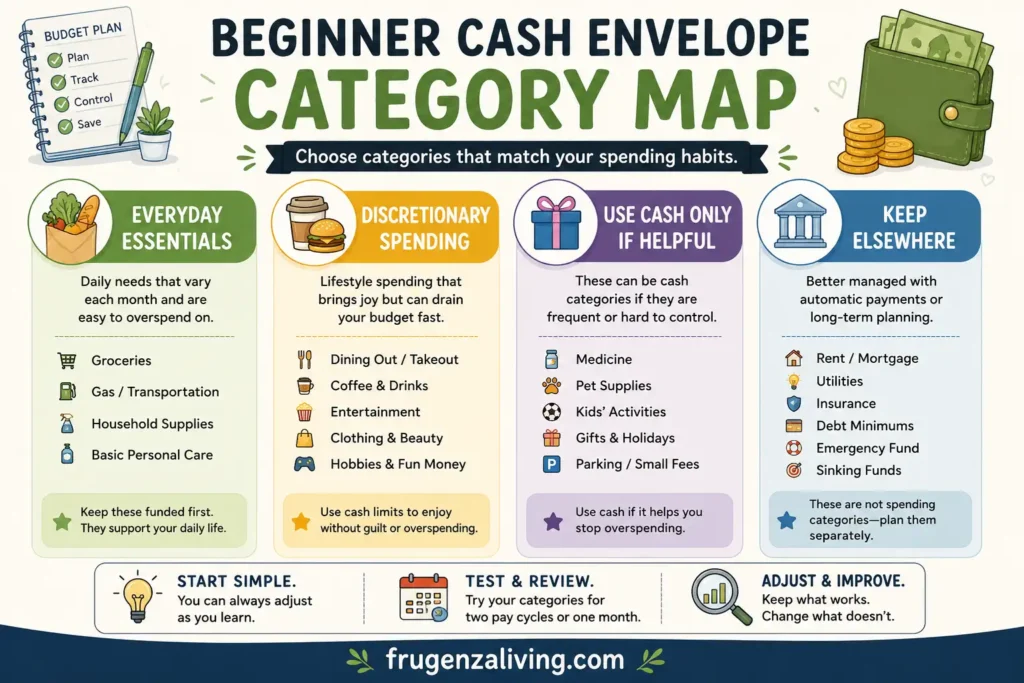
Beginner Guide
Cash Envelope Category Map
Use this map to decide which categories deserve physical cash and which should stay elsewhere.
Groceries, gas, public transit, household supplies, and basic personal care.
Best for: spending that happens often.
Dining out, coffee, entertainment, hobbies, beauty, clothing, and fun money.
Best for: impulse or convenience spending.
Medicine, pet supplies, school extras, gifts, kids’ activities, and parking.
Best for: categories that keep leaking money.
Rent, utilities, insurance, debt minimums, emergency savings, and sinking funds.
Best for: checking, autopay, or savings accounts.
You can allocate income to envelopes only after fixed expenses, savings, and debt payments have been considered.
Which Expenses Should Stay Outside Physical Envelopes?
Physical cash usually adds little value to expenses that are fixed, scheduled, or already assigned elsewhere.
These commonly stay outside physical envelopes:
- Rent or mortgage
- Fixed utilities
- Insurance premiums
- Recurring subscriptions
- Debt minimum payments
- Automatic savings transfers
- Emergency fund contributions
- Retirement contributions
- Predictable annual costs handled through sinking funds
These expenses do not usually involve repeated daily choices. Some people represent fixed bills with digital envelopes, but beginners should prioritize categories where cash creates useful friction.
Broad vs Detailed Cash Envelope Categories
A broad Food envelope is easier to manage because groceries, coffee, and dining out share one limit. This can work well with tight or irregular income.
The weakness is that takeout may consume money needed for groceries.
Separate Groceries, Dining Out, and Coffee envelopes create stronger boundaries but require more tracking.
Start broad. Split a category only when one type of spending repeatedly crowds out another.
In practice, categories usually need to be divided after a pattern appears, not before. If takeout repeatedly leaves too little for food at home, the broader Food envelope is hiding the problem.
A Simple Five-Envelope Budget Example
Suppose you have $600 available for variable spending this month:
- Groceries: $300
- Transportation: $100
- Dining out: $80
- Personal spending: $70
- Household essentials: $50
These are examples, not recommended targets.
Use recent spending, household size, and local prices to set limits. If $300 for groceries is unrealistic, forcing the amount lower will not create a better budget. A useful limit should create awareness without making basic needs impossible to cover.
Before stuffing your envelopes, use a simple paycheck budgeting worksheet to cover bills, savings, debt, and flexible spending in the right order.
How Many Cash Envelopes Should a Beginner Have?
Use these as starting ranges:
- 3 envelopes: a minimal test
- 4–5 envelopes: a practical beginner setup
- 6–8 envelopes: reasonable after the system feels easy
- More than 8: potentially too much tracking for many beginners
Test your categories for two pay cycles—or one full month if you are paid monthly—before expanding.
Then ask:
- Which envelope ran out too early?
- Which stayed untouched?
- Which needed repeated transfers?
- Which purchases still happened on a card?
- Which category reduced overspending?
- Which categories should be combined?
This Two-Pay-Cycle Trial replaces guesswork with real behavior.
Household type may change the categories, but not the selection rule. A low-income household may need only two or three broad essential envelopes. Couples may use shared categories plus separate personal money. Online-heavy households may reserve cash for in-person spending leaks and track the rest digitally.
When to Merge Two Envelopes Into One (And How to Do It Without Losing Control)
The Two-Pay-Cycle Trial sometimes shows that two categories work better as one.
This is not failure. It is the trial doing what it is designed to do — showing you how your spending actually behaves, not how it looked on paper before you started.
The signal that two envelopes should be merged is specific: one envelope consistently has money left while the other consistently runs out, and the spending that depletes the empty envelope could reasonably belong in the other one.
A groceries envelope that ends with $30 left and a household essentials envelope that runs out by week two is a signal that the money is flowing toward household purchases more than expected. Merging both into one broader “Food and Household” envelope gives you a clearer picture of what that combined category actually costs — without trying to maintain a boundary that your actual spending does not respect.
Before merging, ask one question:
Can I name at least three purchases that belong clearly in this envelope but not in the other one?
If yes, the boundary is worth maintaining. The problem may be the allocation amount, not the category separation.
If the honest answer is no — if most purchases could plausibly go in either envelope — the separation is creating decision fatigue without creating useful control. Merge them.
How to set the amount for the merged envelope:
Do not simply add the two previous amounts together.
Look at what the two envelopes actually spent combined over the trial period — not what was allocated, but what was actually used. Use that real number as your starting point for the merged envelope, rounded to the nearest practical amount.
The reason is straightforward: if one envelope consistently had leftover money, the combined allocation was higher than what you actually needed. The merger is also an opportunity to right-size the total, not just combine two labels.
One boundary rule for the merged envelope:
Write a short definition on or inside the envelope — three to five examples of what belongs in it and one example of what does not.
A merged “Food and Household” envelope might read: “Groceries, cleaning products, toiletries, paper goods — not dining out, not clothing.”
Without a written boundary, broader envelopes tend to absorb purchases that should belong somewhere else. The definition keeps the merger from becoming an undefined miscellaneous category under a different name.
What If an Envelope Runs Out?
Pause the spending or move money deliberately from another category and record the change.
If the same envelope repeatedly runs out, review whether the problem is the limit, the category boundary, or the spending behavior. Do not quietly use a card and ignore the envelope.
Category Mistakes to Avoid
Avoid:
- Creating an envelope for every budget line
- Starting with too many categories
- Mixing fixed bills with daily spending
- Leaving “miscellaneous” undefined
- Treating sinking funds as spending envelopes
- Copying categories that do not match your habits
- Moving money without recording it
- Setting limits far below recent spending
- Carrying or storing more cash than necessary
Physical cash can be lost or stolen. Use digital categories where cash creates unnecessary risk or inconvenience.
Choose Your Categories Tonight
- Review the last 30 days of spending.
- Circle categories with frequent purchases.
- Mark where card spending exceeded expectations.
- Remove fixed bills and long-term savings.
- Select 3–5 categories that pass the Swipe-to-Cash Test.
- Set amounts using actual spending data.
- Test them for two pay cycles or one full month.
For complete setup instructions, use the cash envelope system for beginners guide. A digital cash envelope system can help with cashless tracking, while sinking funds for beginners are better for predictable future costs. A paycheck budget template can help decide how much to place in each envelope on payday.
Final Thoughts
The best cash envelope categories for beginners are variable spending categories where purchases happen frequently and overspending is easy.
Start with 3–5 categories, test them, and adjust based on real behavior. Keep fixed bills, emergency savings, and long-term sinking funds outside physical spending envelopes unless another method clearly works better.
The best envelope category is not the one that looks good in a budget binder. It is the one that changes a spending decision before the money is gone.
FAQ
What are the best cash envelope categories for beginners?
Common starting categories include groceries, dining out, transportation, personal spending, and household essentials. Choose the categories where repeated purchases make overspending easy.
How many cash envelopes should a beginner have?
Most beginners can start with 3–5 envelopes. Test them for two pay cycles or one full month before adding more.
Should rent and utilities be cash envelopes?
Usually not. Fixed bills are often easier to manage through checking, autopay, or a bill account because they do not involve repeated spending decisions.
Should groceries and household supplies use the same envelope?
They can share one envelope at first. Separate them if household products repeatedly consume money needed for food.
What should I do when a cash envelope is empty?
Pause the spending, move money deliberately from another category and record it, or adjust the next funding amount based on actual spending.
Can I use cash envelopes for online purchases?
Yes. Record the purchase and remove the same amount from the physical envelope, or manage that category through a digital envelope instead.

The ideas shared here come from real-life experience and practical habits that actually work.
→ Read more about Jeffi
- No Spend Month Challenge for Beginners: A 30-Day Plan - September 24, 2026
- Low Buy Month Challenge: Realistic Rules for 30 Days - September 23, 2026
- How to Stop Buying Groceries You Already Have - September 20, 2026