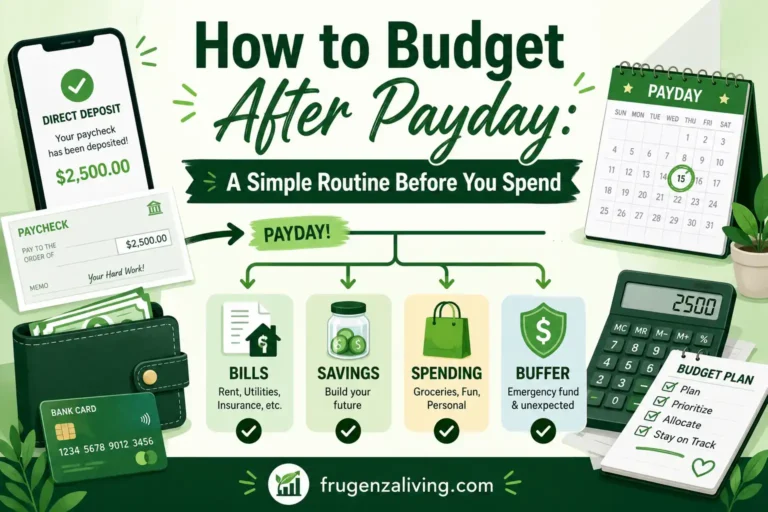
Payday feels good until the money starts disappearing faster than expected.
One bill comes out. Then groceries. Then a subscription you forgot about. Then a few small purchases that did not feel like a big deal at the time. Before long, your paycheck feels smaller than it should.
Learning how to budget after payday is not about making life feel strict. It is about giving your money an order before spending begins.
A simple payday routine helps you decide what needs to happen first: bills, savings, debt, spending limits, buffer money, and leftover cash.
This is general budgeting education, not professional financial advice. If you are dealing with serious debt, missed payments, or legal financial issues, consider speaking with a qualified financial counselor.
Quick Answer: What Should You Do After Payday?
After payday, check your real take-home pay, list the bills due before your next payday, pay or set aside money for those bills, move savings or debt money early, then set a spending limit for groceries, gas, household items, and personal spending.
A good payday routine gives every dollar a job before you start spending from your paycheck.
Why Money Disappears Fast After Payday
Payday can create a false sense of comfort.
Your bank balance looks higher than usual, so it is easy to feel like you have more spending room than you actually do. But that balance may already include money needed for rent, utilities, subscriptions, debt payments, groceries, transportation, or automatic payments.
Most payday problems start when spending happens before planning.
The issue is not always your income. Sometimes, the real problem is the order. If flexible spending comes first, bills and savings have to survive on whatever is left. That is when budgeting starts to feel stressful.
A better after payday budget plan starts with this rule:
Do not treat your full bank balance as spending money.
Some of that money already has a job.
The First 30 Minutes After Payday
The first 30 minutes after payday can decide how stressful the next week or two feels.
You do not need to build a complicated system. You just need a short pause before spending.
Here is what to do first after getting paid:
- Open your bank account.
- Check the real deposit amount.
- Compare it with what you expected.
- List bills due before your next payday.
- Pause non-essential spending until the plan is done.
This is the payday freeze rule: for the first few minutes after payday, freeze non-essential spending. Do not order food, shop online, or make impulse purchases until bills, savings, and spending limits are set.
Think of this as your same-day payday budget routine. You still get to spend money, but only after you know what is actually safe to spend.
If your paycheck is higher than expected because of overtime, tips, or bonuses, do not immediately treat all of it as extra. Give the extra money a job first. It can go toward savings, debt, a bill coming soon, or a small planned treat.
A simple payday budget template can make it easier to organize your income right after it arrives.
What to Do With Your Paycheck After Payday
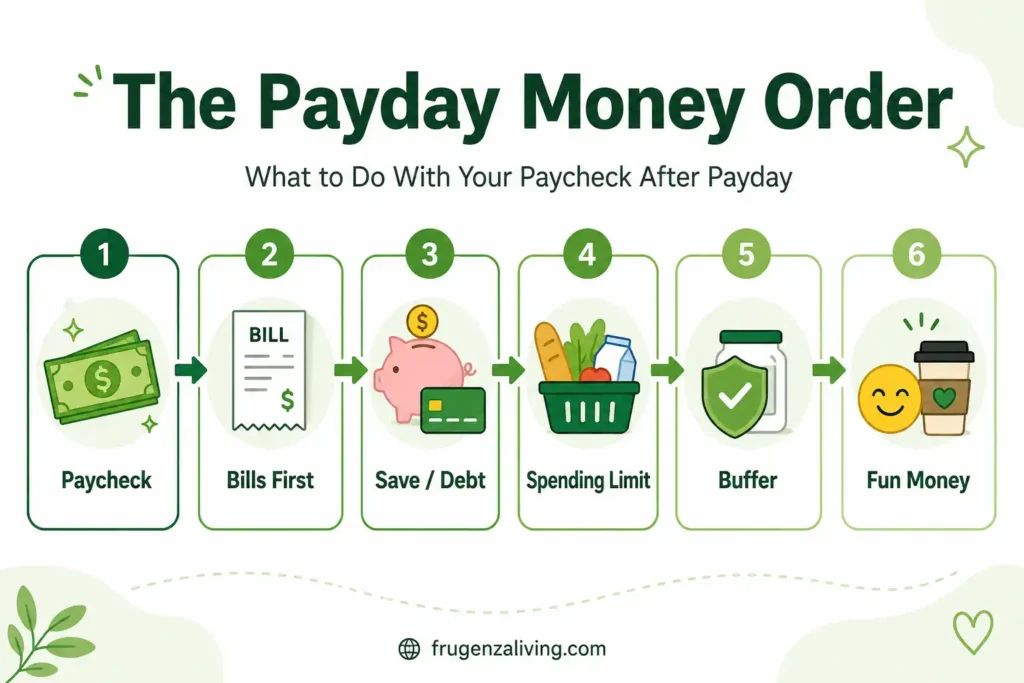
A strong payday budget starts with the right order.
You can think of your paycheck like a line of priorities. The money that protects your life and bills goes first. Flexible spending comes after that.
A simple payday money order looks like this:
- Bills due before next payday
- Rent or mortgage set-aside
- Debt minimums
- Savings or sinking funds
- Flexible spending
- Buffer
- Planned fun money
This does not mean you can never enjoy your money. It just means you stop spending from the wrong pile.
If you get paid every two weeks, learning how to budget biweekly paychecks can help your money last until the next payday.
What to Do When the Paycheck Is Not Enough to Cover Everything
Sometimes you check your deposit and the number is lower than your total bills.
This is not a budgeting failure. It is a triage problem — and it needs a different kind of decision before you move to the next step.
When your paycheck cannot cover everything at once, the order in which you decide what to pay matters more than anything else.
Here is a simple sequence to work through in the first 30 minutes.
First, separate what cannot wait from what can.
Go through your bills and mark each one with one of two labels: due before next payday or due after next payday. Bills in the second group do not need to be funded today. Focus only on what must be handled before the next paycheck arrives.
Second, protect the bills that cannot be missed without immediate consequence.
Not all late payments carry equal weight. A missed rent payment or a bounced utility direct debit creates an immediate problem that compounds quickly. A credit card minimum payment that is three days away from its due date is serious but has slightly more flexibility than a utility that shuts off with 24 hours notice. Rank the must-pays by consequence, not by amount.
Third, reduce one flexible category before touching savings.
If the shortfall is small — within $50 to $100 of what you need — look at your flexible spending first. Groceries, gas, and household spending can usually absorb a short-term reduction without affecting bills or savings. Cutting flexible spending for two weeks is recoverable. Draining a savings buffer to zero creates a new problem for next month.
Fourth, decide what gets delayed — not skipped.
If the shortfall is larger and something must wait, the safest candidates are extra debt payments, sinking fund contributions, and non-essential subscriptions. These can be caught up in the next pay cycle without immediate penalty. Essential minimums, rent, and utility payments should not be delayed unless you have already spoken with the provider about an extension.
The distinction between delayed and skipped matters.
Delayed means you have a specific plan to cover it next payday. Skipped means it disappears from the budget without a resolution date. Only delay things when you can answer the question: which paycheck will cover this?
A short paycheck that is managed with a clear order causes significantly less financial damage than a short paycheck handled by improvising through the month.
Step 1: Check Your Real Take-Home Pay
The first step in any payday budget is to check the money that actually arrived.
Do not budget from your gross pay. Gross pay is the amount before taxes, insurance, retirement contributions, and other deductions. Your budget should start with take-home pay because that is the money you can actually use.
If your income changes from paycheck to paycheck, use the real deposit amount. If it is lower than expected, adjust before spending. If it is higher than expected, avoid treating the extra as free money too quickly.
A simple after payday budget plan starts with one number:
How much money actually landed in your account?
Once you know that, you can decide what the paycheck needs to do.
Step 2: Pay or Set Aside Bills First
Bills should come before flexible spending.
Start with bills that are due before your next payday. If the bill is due soon, pay it now. If it is not due yet but will be due before the next paycheck, set the money aside so it does not get mixed with spending money.
Common bills may include:
- Rent or mortgage
- Utilities
- Phone
- Internet
- Insurance
- Minimum debt payments
- Subscriptions
Autopay can be helpful, but only if the money is ready before the payment hits. If you use autopay, your payday routine should include checking which automatic payments are coming before your next paycheck.
A strong payday plan should feel like a payday money routine, not a stressful task you rebuild from zero each time.
Step 3: Move Savings and Debt Money Early
Savings often disappear when you wait until the end.
That does not mean you need to save a large amount from every paycheck. The point is to move something before the paycheck gets absorbed by everyday spending.
You might move money toward:
- Emergency savings
- Sinking funds
- Extra debt payments
- A planned future expense
Even a small amount can help if it is consistent. For example, moving $25 or $50 on payday is often easier than hoping the same amount is still there later.
Debt works the same way. Minimum payments should be planned early. Extra debt payments can come after bills and basic needs are covered.
After payday, it also helps to follow a monthly budget reset routine so your money stays organized beyond the first week.
Step 4: Set a Payday Spending Limit
After bills, savings, debt, and buffer money, you can decide what is actually available for spending.
This is where many people get payday budgeting wrong. They look at the bank balance and assume that is the amount they can spend. But the real spending amount is what remains after important jobs are covered.
Use this formula:
Available spending = paycheck – bills – savings – debt – buffer
For example:
- Paycheck: $1,800
- Bills: $950
- Savings and debt: $250
- Buffer: $100
- Available spending: $500
That $500 is the amount available for groceries, gas, household items, personal spending, and other flexible categories.
Example Payday Routine for a $1,800 Paycheck
Here is how the routine might look in real life.
Your paycheck arrives: $1,800
Before spending anything:
- Pay or set aside bills: $950
- Move savings and debt money: $250
- Protect a small buffer: $100
- Use the remaining amount for flexible spending: $500
That means the $1,800 in your bank account is not $1,800 of spending money. Only $500 is available for groceries, gas, household items, and personal spending.
This is the difference between seeing money and managing money.
As soon as you get paid, set aside money for the bills assigned to that paycheck before spending on flexible categories.
Step 5: Decide Your “Do-Not-Spend-Yet” Money
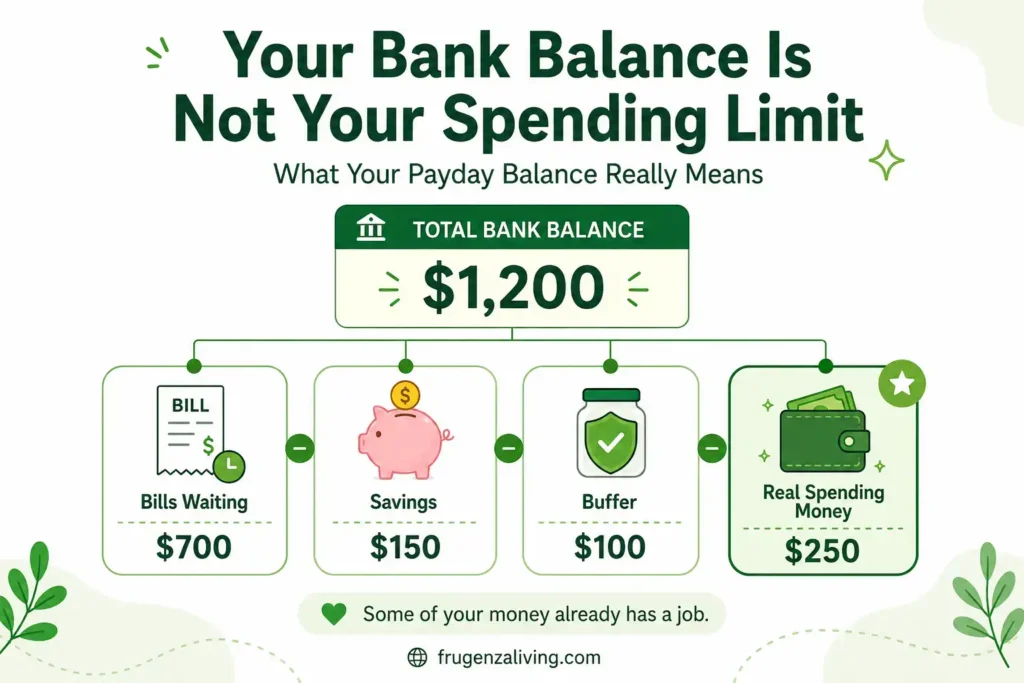
Your bank balance is not your spending limit.
This is one of the most important payday budgeting rules. Some money in your account may already belong to bills, savings, debt, or upcoming automatic payments.
To avoid confusion, mentally label your money:
- Bills waiting
- Savings waiting
- Spending money
- Buffer
For example, if your account shows $1,200 after payday, that does not mean you have $1,200 to spend. If $700 is already needed for bills, your real spending money is much lower.
This simple mindset can prevent a lot of accidental overspending.
Step 6: Plan Small Fun Money Without Breaking the Budget
A payday routine should not make you feel punished.
If your budget only covers bills and restrictions, you may quit after a few pay cycles. Planned fun money can help you stay consistent.
This might be $20, $30, $50, or another amount that fits your situation. The key is that it should come after bills, basic needs, savings, and buffer money.
Fun money is not the problem. Unplanned fun money is usually what breaks the budget.
When you plan it ahead of time, you can enjoy it without wondering if you just spent the electric bill.
If payday always feels messy, a money management plan for beginners can help you make clearer decisions.
Step 7: Review Before the Next Payday
A good payday routine does not end on payday.
A few days before your next paycheck, take 10 minutes to review what happened.
Ask yourself:
- Were all bills paid or set aside?
- Did any category go over budget?
- What surprised me?
- What should change next payday?
- Is there leftover money to roll over, save, or use as a buffer?
This review helps your next payday budget become more accurate. You are not trying to be perfect. You are learning your real spending pattern.
The 3-Account Payday Split
If one checking account makes your money feel confusing, try separating it into three simple places.
You do not need fancy accounts to start. You can use separate bank accounts, digital envelopes, or clear labels in your banking app.
A simple 3-account payday split can look like this:
- Bills account: money for rent, utilities, debt minimums, insurance, and subscriptions.
- Spending account: money for groceries, gas, household items, personal spending, and planned fun money.
- Savings or buffer account: money for emergency savings, sinking funds, and small surprises.
This makes your payday routine easier because your spending money is separated from money that already has another job.
Post-Payday Budget Checklist
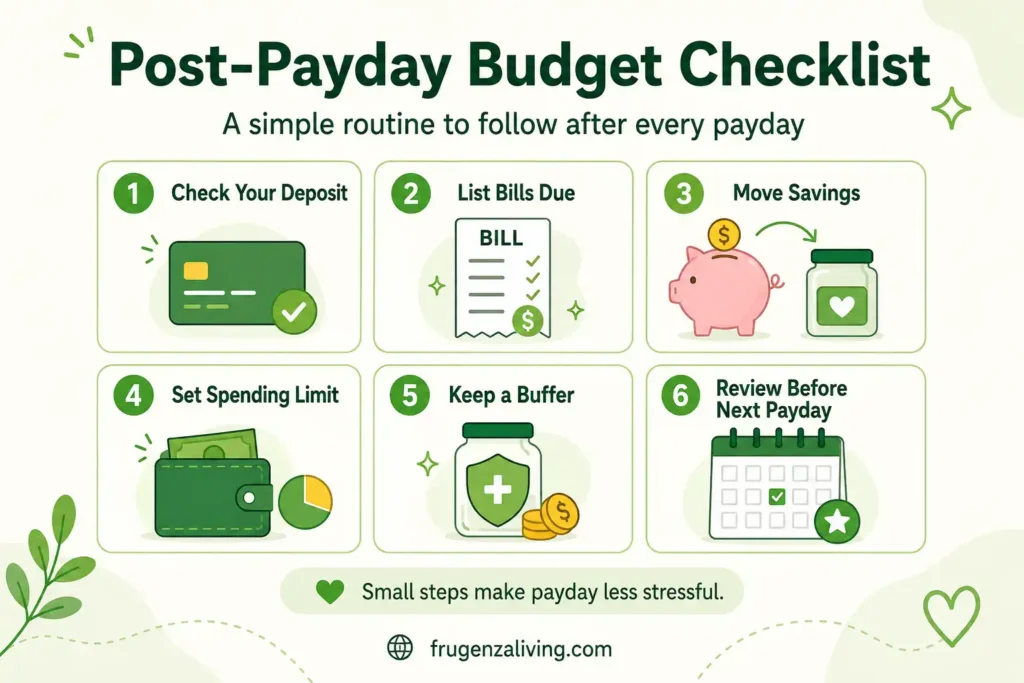
Use this checklist after every payday:
- Check your real deposit.
- List bills due before next payday.
- Pay or set aside bill money.
- Move savings or debt money early.
- Set your payday spending limit.
- Keep a small buffer.
- Give leftover money a job.
- Review before the next payday.
This routine should be simple enough to repeat. If it takes too long, you may avoid it. Start with the basics and improve it over time.
Common Mistakes After Payday
Even a good payday budget can break if a few habits repeat.
Watch for these common mistakes:
- Spending before checking bills: Bills should come before flexible spending.
- Using bank balance as spending money: Your balance may include money already assigned to bills.
- Waiting to save what is left: Savings often disappear if they are not moved early.
- Forgetting subscriptions: Small auto-payments can drain the budget quietly.
- Making the routine too complicated: A payday routine should be simple enough to repeat.
- Ignoring the next payday date: Your plan should last until the next paycheck arrives.
How This Is Different From a Paycheck Budget Template
This article is about your routine after payday.
A paycheck budget template is the worksheet you use to write the numbers down. A payday routine is the order you follow when the money arrives.
Final Thoughts: Budget Before Payday Money Disappears
Learning how to budget after payday is not about making money feel stressful. It is about giving your paycheck a simple order before spending begins.
Start by checking your real deposit. Then pay or set aside bills, move savings or debt money, set a spending limit, keep a small buffer, and decide what leftover money should do.
The routine does not need to be perfect. It just needs to happen before the money disappears into random purchases.
Payday feels better when the money already knows where to go.
FAQ
What should I do first after payday?
The first thing to do after payday is check your real take-home pay and list the bills due before your next paycheck. Do this before non-essential spending so your money has a clear plan.
How do I budget after getting paid?
To budget after getting paid, pay or set aside bills first, move savings or debt money early, set a spending limit for flexible expenses, keep a small buffer, and give leftover money a job.
Should I pay bills right after payday?
You should pay or set aside money for bills that are due before your next payday. If a bill is not due yet but will come before your next paycheck, keep that money protected.
How much money should I keep for spending after payday?
Your spending money should be what remains after bills, savings, debt, and buffer money. Use the formula: paycheck minus bills, savings, debt, and buffer equals available spending.
How do I stop overspending after payday?
Pause before spending, check your bills first, set a payday spending limit, and avoid treating your full bank balance as spending money. Planned fun money can also help reduce impulse spending.

Read about Jeffi and Frugenza Living
- How to Budget a 10-Month Salary Over 12 Months - October 16, 2026
- Pet Adoption Budget Checklist: What You Still Need to Pay - October 16, 2026
- Proportional Bill Split Calculator for Two Incomes - October 15, 2026