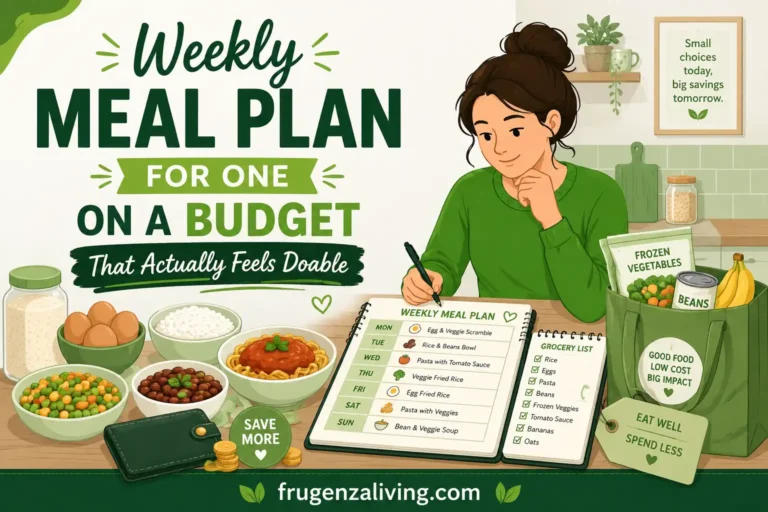
A weekly meal plan for one on a budget works better when every meal has ingredients assigned to it. The plan below covers seven breakfasts, fourteen lunches and dinners, and a daily apple-and-peanut-butter snack. Four cooking sessions also provide meals for later days.
Start with the menu, then check the portion guide and shopping list. This plan assumes access to a stove, refrigerator, and freezer. The prices are illustrative U.S.-dollar inputs, so replace them with local prices before deciding what your shopping trip will cost.
Your 7-Day Meal Plan for One
Each table entry is one meal for one person. A saved portion is already included in the original batch; it does not require another set of ingredients. On a phone, scroll the tables sideways to see every column.
| Day | Breakfast | Lunch | Dinner |
|---|---|---|---|
| Day 1 | Oatmeal, banana, peanut butter, and milk | Bean rice bowl | Tomato-bean pasta: make two portions; eat one |
| Day 2 | Two eggs, toast, banana, and milk | Tomato-bean pasta saved from Day 1 | Chicken rice bowl: make four portions; eat one |
| Day 3 | Oatmeal, banana, peanut butter, and milk | Chicken rice bowl saved from Day 2 | Egg fried rice: make two portions; eat one |
| Day 4 | Two eggs, toast, banana, and milk | Egg fried rice saved from Day 3 | Tomato-bean pasta: make two fresh portions; eat one |
| Day 5 | Oatmeal, banana, peanut butter, and milk | Tomato-bean pasta saved from Day 4 | Chicken rice bowl frozen on Day 2 |
| Day 6 | Two eggs, toast, banana, and milk | Tuna toast with carrots | Egg fried rice: make one fresh portion |
| Day 7 | Oatmeal, banana, peanut butter, and milk | Bean rice bowl | Chicken rice bowl frozen on Day 2 |
Daily snack: one apple with 1 tablespoon (16 g) of peanut butter. On Days 1, 2, 4, and 5, also set aside about 75 g of carrots for snacking. These amounts are included in the shopping list.
Portions That Make the Grocery List Work
Rice and pasta weights below are dry weights; chicken is weighed raw, and beans after draining. Other produce weights are before trimming. Metric package conversions are approximate. These are starting portions, not a calorie target: increase the quantities and budget if you need larger meals.
Two breakfast combinations
- Oatmeal breakfast, four times: 60 g rolled oats, 1 cup milk, one banana, and 2 tablespoons (32 g) peanut butter. Cook the oats according to the package, using the milk and extra water if needed.
- Egg-and-toast breakfast, three times: two eggs, two bread slices, one banana, and 1 cup milk. Allow 1 teaspoon oil for cooking the eggs; cook them until the yolks and whites are firm.
That uses 240 g oats, six eggs, six bread slices, seven bananas, seven cups of milk, and 128 g peanut butter. The daily snacks use another 112 g peanut butter, bringing the week’s total to 240 g.
Five simple lunch and dinner combinations
- Bean rice bowl, two meals: each uses 75 g dry rice, 200 g drained beans, 150 g frozen mixed vegetables, and 1 teaspoon oil. Cook the rice as directed, heat the beans and vegetables thoroughly, and season to taste.
- Tomato-bean pasta, two batches of two meals: each batch uses 170 g dry pasta, 150 g drained beans, one 14.5 oz can of tomatoes, 140 g frozen spinach, and 2 teaspoons oil. Cook the pasta; simmer the tomatoes, beans, spinach, and seasonings until hot and cooked through. Combine and divide into two equal portions.
- Chicken rice bowls, one batch of four meals: use 1.5 lb boneless chicken, 300 g dry rice, 600 g frozen mixed vegetables, and 4 teaspoons oil. Cook the rice and vegetables as directed. Cut the chicken into similar-sized pieces, season, and cook in an oiled skillet to 165°F (74°C). Divide the cooked ingredients equally into four portions.
- Egg fried rice, three meals: each portion uses 75 g dry rice, two eggs, 150 g frozen mixed vegetables, and 1 teaspoon oil. On Day 3, double these amounts; on Day 6, make one portion. Cook the rice, then stir-fry it with the vegetables and eggs until the eggs are fully cooked and the mixture is hot throughout.
- Tuna toast, one meal: use one drained 5 oz can of tuna, two bread slices, 150 g carrots, and 1 teaspoon oil. Season the tuna with the oil and a little pepper, serve on toast, and wash and trim the carrots.
The fourteen main meals use 675 g dry rice, 340 g dry pasta, 700 g drained beans, six eggs, 1.5 lb chicken, 1,350 g mixed vegetables, and 280 g spinach. Together with breakfast, the plan uses exactly one dozen eggs.
A Grocery List Matched to This Menu
Check what you own before buying the packages below. For a broader checklist to reuse in other weeks, see this one-week grocery list for one person. The quantities here are specifically allocated to the menu above.
Price basis: these are example prices for explaining the calculation, not verified store quotes or a national average. Amounts exclude applicable tax and delivery fees. Extra drinks, additional snacks, larger portions, and substitutions must be priced separately.
| Food | Buy | Used in this plan | Package cost | Used cost |
|---|---|---|---|---|
| Rolled oats | 18 oz package, about 510 g | 240 g | $2.00 | $0.94 |
| Eggs | One dozen | 12 eggs | $3.00 | $3.00 |
| Peanut butter | 16 oz jar, about 454 g | 240 g, including snacks | $2.00 | $1.06 |
| Milk | Half gallon: 64 fl oz, eight U.S. cups | Seven cups: 56 fl oz | $2.20 | $1.93 |
| Bananas | Seven | Seven | $2.10 | $2.10 |
| Apples | Seven | Seven | $4.90 | $4.90 |
| Rice | 2 lb bag, about 907 g | 675 g dry | $2.00 | $1.49 |
| Pasta | 16 oz package, about 454 g | 340 g dry | $1.00 | $0.75 |
| Canned beans | Three 15 oz cans; example assumes 720 g drained in total | 700 g drained | $2.40 | $2.33 |
| Canned tomatoes | Two 14.5 oz cans, about 822 g in total | Both cans, including juice | $2.00 | $2.00 |
| Boneless chicken | 1.5 lb, about 680 g | Whole pack, divided into four meals | $5.25 | $5.25 |
| Frozen mixed vegetables | Four 12 oz bags, about 1,360 g in total | 1,350 g | $4.80 | $4.76 |
| Frozen spinach | 10 oz package, about 283 g | 280 g | $1.50 | $1.48 |
| Canned tuna | One 5 oz can | All the drained tuna | $1.00 | $1.00 |
| Bread | One loaf with at least 20 usable slices | Eight slices | $2.00 | $0.80 |
| Carrots | 1 lb bag, about 454 g | About 450 g before trimming | $1.00 | $0.99 |
| Food total | $39.15 | $34.78 | ||
Check the beans: can weight includes liquid, and drained yield varies. The menu needs 700 g after draining. If three cans do not provide enough, add another can; at the example price, that adds $0.80 to checkout. Price a larger chicken pack in full too, even if you only allocate 1.5 lb to this plan.
Oil and seasonings are part of the cost
The recipes allow about 85 mL oil in total: 70 mL across the fourteen lunches and dinners, plus 15 mL for the three egg breakfasts. The seasoning amounts below are small weekly allowances; adjust them to suit your ingredients.
| Item | Example package | Usage allowance | Package cost | Used cost |
|---|---|---|---|---|
| Cooking oil | 16 fl oz, about 473 mL | 85 mL | $2.50 | $0.45 |
| Salt | 26 oz, about 737 g | 6 g | $0.80 | $0.01 |
| Black pepper | 3 oz, about 85 g | 4 g | $2.00 | $0.09 |
| Garlic powder | 3 oz, about 85 g | 6 g | $1.20 | $0.08 |
| Pantry basics total | $6.50 | $0.63 | ||
Shopping Cost vs. Ingredients Used
The example has three different numbers, each answering a different question:
- $39.15 at checkout if you buy all the food packages and already have enough oil and seasonings.
- $45.65 at checkout if you also need all four pantry packages: $39.15 + $6.50.
- About $35.41 of ingredients used across the listed meals and snacks, including the oil and seasonings consumed.
The tables round each usage cost to cents before adding the rows. The used cost is about $5.06 per day; it is an allocation of ingredient value, not a promise that you can buy the whole basket for $35.41.
Example: rice costs $2 at checkout. The plan uses 675 g of a 907 g bag, so its allocated cost is $2 × 675 ÷ 907 = about $1.49. Approximately 232 g remains for another week. You still need the full $2 to buy the bag.
Existing stock changes the bill. If you already have enough oats, rice, and peanut butter, plus the oil and seasonings, remove their $6 package cost from the food basket: $39.15 − $6 = $33.15 to buy the remaining food. The food you use from home still has value.
Check quantities with a pantry inventory checklist for one person. A nearly empty jar does not cover a planned week’s peanut butter just because you technically own one.
For a longer-term allowance, compare several weeks of receipts and use this guide to setting a grocery budget for one person. This sample basket is not a national spending benchmark.
Small-Batch Prep and a Clear Leftover Schedule
On Day 1, drain the beans and measure the 700 g needed. Use 200 g in lunch and 150 g in the first pasta batch. Freeze separate containers of 150 g for Day 4 pasta and 200 g for Day 7 lunch. Freeze any extra drained beans for a future week.
Cook rice in these dry quantities: 75 g on Day 1, 300 g on Day 2, 150 g on Day 3, 75 g on Day 6, and 75 g on Day 7. Follow the package’s water ratio, then divide each batch by its number of meals. There is no batch of refrigerated rice expected to last seven days.
| Cooking day | Batch | Eat and store |
|---|---|---|
| Day 1 | Tomato-bean pasta: two portions | Eat one at dinner. Refrigerate one promptly for Day 2 lunch. |
| Day 2 | Chicken rice bowls: four portions | Eat one at dinner. Refrigerate one promptly for Day 3 lunch. Cool the other two promptly in shallow containers, then freeze the same day for Day 5 and Day 7 dinners. |
| Day 3 | Egg fried rice: two portions | Eat one at dinner. Refrigerate one promptly for Day 4 lunch. |
| Day 4 | Tomato-bean pasta: two portions | Eat one at dinner. Refrigerate one promptly for Day 5 lunch. |
Move the Day 4 beans to the refrigerator on Day 3. Move the frozen chicken bowls to the refrigerator on Day 4 and Day 6 for their next-day dinners, and the Day 7 beans on Day 6. Do not thaw them on the counter.
Freeze spare bread slices early. If bananas ripen before their planned day, peel and freeze them for a later oatmeal breakfast. After the week, the example still has roughly 270 g oats, 232 g rice, 114 g pasta, 214 g peanut butter, twelve bread slices, and one cup of milk, plus most of the pantry seasonings. Plan around that stock before buying replacements.
Keep the storage plan safe
- Refrigerate perishable food promptly and within two hours, or within one hour when the temperature is above 90°F (32°C). Use shallow containers for quicker cooling; do not leave a large pot on the counter to cool.
- Keep the refrigerator at 40°F (4°C) or below and the freezer at 0°F (−18°C) or below.
- Cook raw chicken within one to two refrigerated days, or freeze it promptly. If you shop several days before Day 2, freeze the chicken and thaw it in the refrigerator before cooking.
- Refrigerated cooked leftovers generally have a three-to-four-day window. This plan uses next-day refrigerated portions and freezes the chicken bowls needed later.
- Cook chicken and reheat saved meals to 165°F (74°C), checked with a food thermometer. Do not rely on smell or appearance to establish safety.
Food-handling reference: FoodSafety.gov’s four steps to food safety, including its linked cooking-temperature and storage charts.
Adjust the Plan Without Losing Track of Ingredients
If a day becomes busy, move a batch dinner and its following lunch together. Moving only the dinner can leave tomorrow’s promised lunch uncooked. Keep the frozen chicken bowls available for the days when reheating is easier than starting a new meal.
For substitutions, replace the quantity and price as well as the meal name. A different protein must cover four chicken-bowl portions; a milk alternative must cover seven cups. Different package sizes or dietary choices change the basket total.
Start cost cuts with food already at home, then compare packages you can actually afford and finish. A lower price per ounce does not help if the larger pack exceeds this week’s cash allowance. These ways to save money on groceries when you live alone can help with the shopping decision.
Frequently Asked Questions
Can I cook all seven days of meals at once?
You can batch-cook, but do not keep a full week’s cooked food in the refrigerator. Refrigerate near-term portions promptly and freeze later portions. The schedule above deliberately separates next-day leftovers from the meals needed on Days 5 and 7.
Does the grocery total include snacks?
Yes. It includes seven apples, 112 g peanut butter for their daily snack portions, and the allocated carrot snacks. Extra snacks, drinks, or larger meals increase the quantities and cost.
Why is the used ingredient cost lower than the shopping bill?
You buy whole packages but use only part of some of them. Remaining rice, oats, bread, peanut butter, and seasonings carry into another week. That lowers this week’s allocated ingredient cost without reducing what the store charges for those packages.
Before shopping, check three things: the portions you need, the ingredients already at home, and where each saved meal will be stored. A useful meal plan makes those decisions before you get hungry.

Read about Jeffi and Frugenza Living
- Proportional Bill Split Calculator for Two Incomes - October 15, 2026
- How to Split Grocery Bills With Roommates - October 14, 2026
- First Apartment Kitchen Essentials on a Budget - October 13, 2026