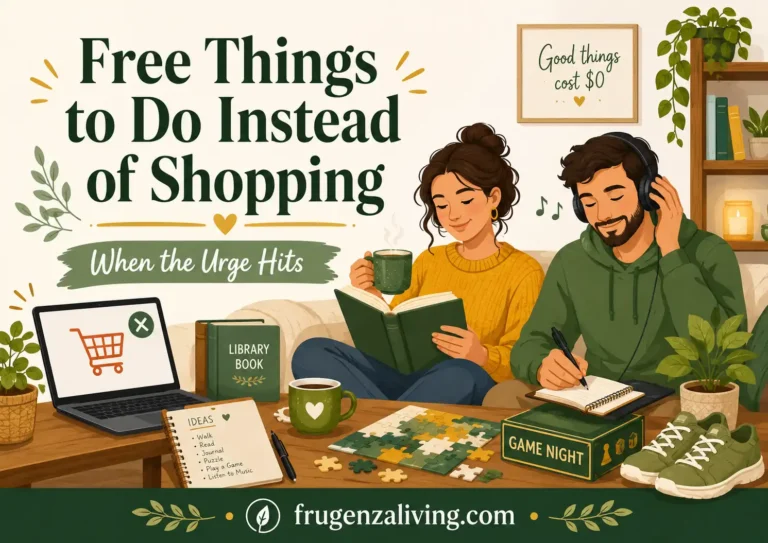
You open a shopping app while sitting on the couch. You were not looking for anything specific, but browsing feels easier than deciding what else to do. Twenty minutes later, several products are in your cart, a sale timer is counting down, and free shipping is only one more item away.
Telling yourself to “just stop shopping” leaves an empty space. Browsing may have been providing novelty, comfort, anticipation, connection, self-expression, or a simple transition after a tiring day. Removing the store without replacing that role can make reopening it feel like the easiest option.
The most useful free things to do instead of shopping are not random distractions. They give you somewhere else to go during the exact moment when an app, product page, advertisement, mall trip, or open cart has become the default plan.
In practice: Close the retailer, ask what you wanted from the browsing session, and choose one alternative that fits your current need, energy, location, and available time.
This guide focuses on discretionary browsing and unplanned purchases. It is not suggesting that you avoid groceries, medication, necessary repairs, essential replacements, or purchases already planned within your budget.
It also does not assume that every shopping decision has an emotional cause. Sometimes you simply notice an appealing product. The goal is to separate noticing from immediately buying.
In this article, “free” generally means no new spending today. Some activities use something already purchased, borrowed, or publicly available. Transportation, parking, food, childcare, mobile data, and local access can still create costs.
Why a Random Distraction Often Does Not Work
A free activity may fail when it does not match what you were looking for.
Cleaning the kitchen may not provide comfort. Watching another short video may not create connection.
A long outdoor activity may be unrealistic when it is late, you are tired, and reopening the shopping app requires one tap.
Shopping is often used as a social activity, but there are many alternatives to spend less on social activities that still give you time to talk and connect.
A useful shopping replacement usually has three qualities:
- It provides something similar to what you were seeking.
- It fits the energy and time you actually have.
- It can begin with less friction than returning to the retailer.
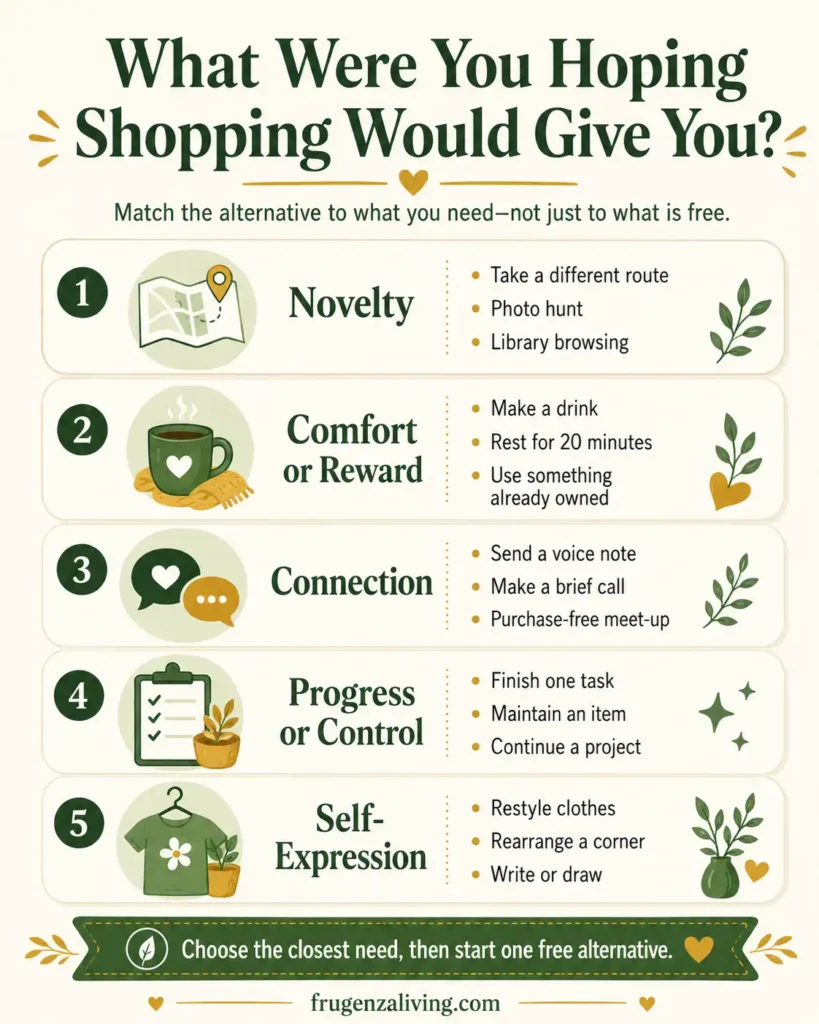
You do not need to analyze the moment perfectly. Start with a few observable questions:
- What was I doing immediately before opening the store?
- Did I want this item before seeing the advertisement?
- Do I want the product, or do I want something new to look at?
- Would rest, conversation, creativity, or visible progress feel more useful?
- Am I interested in owning the item, or in finishing a decision?
The last question matters when browsing has created several nearly identical options. Completing a purchase can feel like completing a task, even when the task did not exist ten minutes earlier.
The purpose of a replacement is not to prove that the product is unnecessary. It is to create enough distance between interest and checkout for a more deliberate choice.
Free activities become more useful when you also reduce online shopping urges instead of keeping tempting products one click away.
21 Free Things to Do Instead of Shopping
When You Want Novelty
1. Walk a Different Route
Choose a nearby street, path, or public space you do not normally use. The point is not exercise performance. It is giving yourself something unfamiliar to notice.
Look for architecture, plants, signs, sounds, or small details you usually pass without seeing. Consider weather, safety, accessibility, and transportation before leaving.
2. Create a Household Photo Hunt
Choose five prompts, such as a shadow, a circle, something blue, an unusual texture, and an overlooked corner.
Photograph them with the phone you already own. A short assignment can make familiar surroundings feel different without directing that desire for novelty toward a store.
3. Browse One Unfamiliar Library Section
Visit a section you normally ignore and leave with no more than two items. A small borrowing limit preserves the pleasure of discovery without turning library visits into another form of accumulation.
Depending on your local library, you may also find magazines, games, community notices, local-history collections, ebooks, audiobooks, or free events.
4. Explore One Free Digital Collection
Choose one virtual museum, public archive, legal public-domain collection, or educational resource rather than opening endless tabs.
The Library of Congress digital collections include photographs, maps, recordings, manuscripts, and historical materials. European readers can explore cultural collections through Europeana.
Follow one subject for twenty minutes. A focused search provides novelty without becoming another scrolling session.
The goal is not only to spend less once, but to change your spending habits by creating a different response to the urge to shop.
When You Want Comfort or a Reward
5. Prepare the Drink You Already Have
Make the coffee, tea, or other drink in your cupboard and serve it deliberately.
Use a favorite cup, sit somewhere comfortable, and avoid drinking it while returning to the product page. The reward comes from the pause and ritual rather than ordering another version.
6. Use the Product You Were About to Replace
Before buying another lipstick, sweater, fragrance, lotion, notebook, mug, or kitchen tool, use the closest item you already own.
This does not prove that you never need a replacement. It helps you see whether the current item still works, whether the new one fills a genuine gap, or whether the browsing session created the feeling of need.
For example, wear the sweater for an afternoon, use the current lipstick combination, or cook once with the kitchen tool you considered upgrading.
7. Take a 20-Minute Rest Without Browsing
Put the phone outside arm’s reach, set a timer, and rest without turning the break into another assignment.
You do not have to clean, exercise, organize, or learn something because you felt tempted to shop. Sometimes the most realistic alternative is allowing yourself to stop.
8. Return to a Familiar Favorite
Reread a chapter, replay a game, rewatch an episode, listen to an album, or revisit a saved recipe you already enjoy.
A reward does not have to be new. A familiar choice can work especially well when you want comfort more than stimulation.
When You Want Progress or Control
9. Finish One Clearly Defined Task
Choose something with a visible end: clear one surface, file one document, answer one message, or put away ten items.
Stop when the defined task is finished. The aim is a small sense of completion, not an exhausting cleaning session that feels like punishment.
10. Maintain Something You Own
Sew on a button, clean a pair of shoes, tighten a loose handle, charge a device, water a plant, or organize the parts of an item you considered replacing.
Maintenance can restore usefulness and help you determine whether a replacement is actually necessary.
11. Complete One Unit of Existing Progress
Finish one chapter, lesson, drawing, game level, puzzle section, language exercise, paragraph, or spreadsheet task.
This option is useful when you want to move forward but do not want another household chore. Select a unit small enough to complete with the time and concentration available.
12. Use One Open Product or Supply
Choose an ingredient, notebook, candle, beauty product, art supply, book, or game that is already open or in progress.
Do not force yourself to finish something unsuitable or unpleasant. The purpose is to notice what is available before adding another item to the same category.
Choosing hobbies that do not require shopping can give your free time a purpose without creating another spending category.
When You Want Connection
13. Send a Specific Voice Note
Instead of sending a generic hello, share a memory, ask a real question, or respond to something the person mentioned previously.
A thoughtful two-minute message may offer more connection than twenty minutes of browsing product pages.
14. Make a Brief Call
Choose someone you would genuinely like to hear from and keep the invitation low-pressure.
You do not need a long conversation or a major update. A ten-minute call can be enough to shift the evening away from automatic shopping.
15. Suggest a Purchase-Free Meet-Up
Invite someone for a walk, coffee made at home, a game, a picnic using food already available, or time in a free public space.
Say clearly that you are looking for a simple no-spend plan. This reduces the chance that the alternative quietly becomes a café, restaurant, or shopping trip.
16. Replace Your Next Mall Plan With a Free Event
Libraries, parks, cultural organizations, schools, museums, and community groups may offer genuinely free programs.
This is not always an immediate substitute for a cart that is already open. It works better as a replacement for a future shopping-centered outing.
Check transportation, parking, reservations, accessibility, and whether purchases are expected after arrival. A “free” event that requires expensive travel or food may not fit the purpose.
When you feel tempted to visit a store out of boredom, keep a list of simple activities that cost nothing that you can start immediately.
When You Want Self-Expression or Something New
17. Shop Your Closet With One Constraint
Create three outfits around one forgotten item, one color, one pair of shoes, or one jacket.
Photograph combinations you like so the activity creates a useful reference. The goal is not to prove that you own too much. It is to test whether a new combination can satisfy the desire for a different look.
18. Restyle One Small Area
Rearrange a shelf, tabletop, wall display, desk, or small corner using objects already present.
Keep the boundary narrow. Redesigning an entire room may trigger décor shopping, whereas one limited area can provide visible change without creating a larger project.
19. Make Something From Available Materials
Write a short scene, sketch an object, photograph a theme, make a playlist, or create a digital collage using your own images, public-domain works, or assets licensed for reuse.
The result does not need to be polished, shared publicly, sold, or turned into a long-term hobby. The purpose is expression rather than production.
20. Choose One Neglected Item to Use Today
Select one overlooked shirt, book, ingredient, beauty product, game, tool, or craft material and use it today.
This is an immediate action rather than a formal no-buy challenge. If you enjoy it, you can repeat the idea during the week without adding strict rules.
When Shopping Is Simply the Default Tab
21. End the Browsing Loop for Ten Minutes
Close the retailer, place the phone outside arm’s reach, and avoid immediately replacing the store with social-media scrolling.
You do not have to select another activity right away. Let ten minutes pass, notice what you feel like doing next, and decide whether returning to the item still makes sense.
Four Shopping Moments and What to Do Next
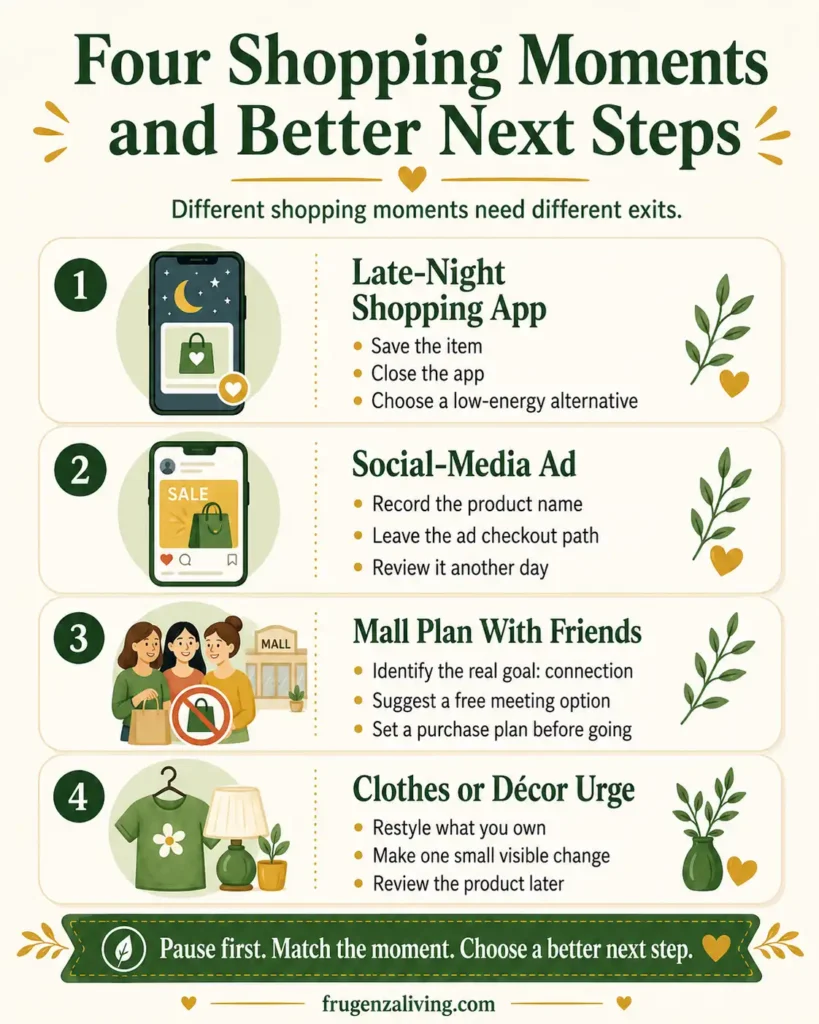
The same list will not work equally well in every situation. A practical alternative must fit the moment in which shopping appears.
Late-Night App Browsing
Late at night, choose the lowest-friction response available.
Write down or screenshot the item, close the app, move the phone away, and choose something quiet: make a drink, read two pages, listen to a familiar album, or rest.
Do not choose an ambitious workout, deep-cleaning session, or complicated creative project. If the alternative requires more energy than you have, the retailer will remain easier.
A Product Appears in a Social-Media Advertisement
Ask whether you knew the product existed before the advertisement appeared.
Save the product name without following the checkout link. Then inspect or use the closest alternative you own. Review the item later through a normal search rather than through the advertisement’s urgency, countdown, or influencer discount.
Do not make the purchase decision inside the advertisement’s checkout path. That environment was designed to keep the recommendation and purchase close together.
Friends Suggest Going to the Mall
The social plan may matter more than the stores.
Suggest a walk, home coffee, library visit, free event, game night, or public meeting space. If the group still chooses the mall, decide beforehand whether you are joining for the social activity, browsing, or purchasing one planned item.
You do not have to avoid the mall completely for the decision to be intentional. The objective is to prevent “spending something” from becoming the entry fee for time together.
Clothes or Décor Promise a “New” Feeling
Use self-expression before acquisition.
Create three outfits, restyle one corner, photograph a new combination, or move existing objects into a different arrangement.
Do not begin by emptying the entire closet or redesigning a whole room. A large reset can make everything look inadequate and create more reasons to shop.
If the product still fills a clear gap later, evaluate it within the appropriate budget category.
Use a 10-Minute Bridge Before Deciding
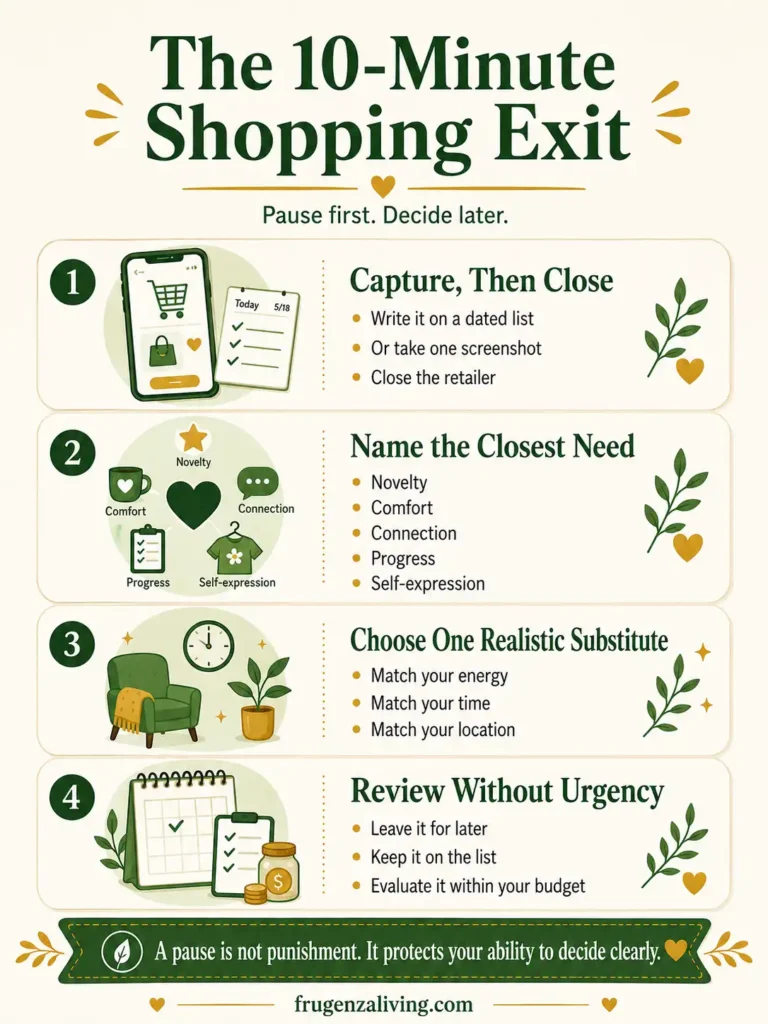
A rule such as “I can never buy this” may create resistance. A short bridge gives you distance without demanding a permanent answer.
The bridge can begin after a shopping-app notification, promotional email, influencer recommendation, social-media advertisement, store display, or spontaneous mall visit.
“`htmlThe 10-Minute Shopping Exit
Step away from the checkout path before deciding what happens next.
What if You Still Want the Item?
After completing the bridge, evaluate the product itself:
- Did you plan to look for it before today?
- Is there a working substitute at home?
- Does it fit the correct budget category?
- Where will it be stored?
- Will it require refills, maintenance, subscriptions, or accessories?
- Would you still choose it without a sale timer or free-shipping threshold?
- Does it solve a repeated problem or only the current moment?
A dated list prevents the product from disappearing without forcing you to keep reopening the store.
A simple entry might look like this:
June 18 — navy jacket — discovered through an advertisement — closest substitute is the blazer already owned — review on June 21.
When the review date arrives, you can compare the item with your wardrobe, budget, and actual need rather than relying on your memory of the advertisement.
Necessary, useful, and planned purchases do not need to be treated as failures.
For stronger checkout barriers and online purchase rules, read how to avoid impulse buying online.
Build a Personal Instead-of-Shopping Menu
A short prepared menu works better than searching through 100 activities while the cart is already open.
Include:
- At least two low-energy choices
- One screen-free option
- One connection option
- One activity possible from the same chair or room
- One late-night option
- One option outside the home
- More enjoyable activities than chores
Example: Low-Energy Couch-Browsing Menu
Five minutes: Put the phone in another room, make tea, and read two pages.
Twenty minutes: Send a voice note, listen to one album, shop the closet, or continue a familiar game.
One hour: Watch a saved movie, continue a book, work on an existing project, or call someone without multitasking.
Example: Mall-With-Friends Menu
Quick alternative: Suggest a walk or coffee made at home.
Shared indoor option: Visit a library, play a game, or meet in someone’s home.
Planned outing: Choose a genuinely free event or public space and check transportation costs beforehand.
Your menu does not need to include activities that sound impressive. It should contain options you would realistically choose in the situations where browsing normally begins.
A list made entirely of cleaning, paperwork, and responsibilities will be easy to ignore.
Save it:
- On the phone’s home screen
- Beside the computer
- Near the couch
- In a wallet
- On the refrigerator
Make the Alternative Easier to Reach
Put one useful alternative within reach and place the retailer one additional step away.
Keep a current book, notebook, puzzle, walking shoes, or project visible near the place where browsing usually begins. Move shopping apps away from the home screen, turn off unnecessary retail alerts, and log out when appropriate.
These changes do not make spending impossible. They make it less likely that shopping becomes the first action simply because it is the easiest one.
For a more complete setup involving notifications, checkout friction, and online buying rules, use the dedicated impulse-buying guide rather than turning this article into a technical blocking tutorial.
How This Fits Into Frugal Living
Use frugal things to do at home when you want a broader selection of low-cost activities that can be done mainly at home.
Use frugal hobbies at home when you want a repeatable, longer-term interest rather than an immediate shopping replacement.
Use the online impulse-buying guide for checkout barriers, retail notifications, and purchase rules.
For a broader balance between enjoyment and spending, read how to save money without cutting everything.
About this guide: Each alternative was screened according to the need it may replace, how quickly it can begin, its energy requirement, its location requirements, and whether it creates new spending. Activities requiring mandatory purchases or complicated preparation were excluded.
Final Thoughts
The most useful free things to do instead of shopping do not merely fill time. They replace the role shopping was playing long enough for you to make a clearer decision.
Choose an alternative that matches your need, energy, location, and available time. Keep wanted products on a dated list and review them later without treating a thoughtful purchase as a failure.
One closed tab and one intentional alternative are enough for today.
The goal is not to fill every free moment. It is to give yourself somewhere else to go before the cart becomes the plan.
Frequently Asked Questions
What Can I Do Instead of Shopping When I Am Bored?
Try a short walk, library browsing, a household photo challenge, a game you already own, calling someone, or completing part of an existing project. Choose something that begins quickly and provides novelty or engagement without creating another purchase.
What Are Good Free Things to Do Instead of Shopping Online?
Close the retailer, record the product on a dated list, and choose a low-friction alternative such as reading, stretching, making a drink, using an existing product, sending a message, or placing the device out of reach for ten minutes.
What Can I Do Instead of Going to the Mall With Friends?
Suggest a walk, library visit, confirmed free event, home coffee, game night, picnic using food already available, or a clothing-restyle session. Weather, local access, transportation, and parking costs can affect whether an outing is genuinely free.
What if I Still Want the Item After Doing Something Else?
Review whether the item was planned, useful, affordable, storable, and still wanted without a sale timer or checkout urgency. The purpose of the alternative is to create decision space, not to automatically reject every purchase.
How Do I Create an Instead-of-Shopping List?
Choose several activities you genuinely enjoy and group them by time, energy, location, and need. Include low-energy, screen-free, social, late-night, at-home, and outdoor options. Keep the menu short enough to use without creating another difficult decision.
When Should I Seek Additional Help With Shopping?
Shopping that feels uncontrollable, causes serious debt, damages relationships, or creates significant distress may deserve additional support. A qualified financial counselor or mental-health professional can help you examine the situation without assuming a diagnosis.

Read about Jeffi and Frugenza Living
- No Spend Month Challenge for Beginners: A 30-Day Plan - September 24, 2026
- Low Buy Month Challenge: Realistic Rules for 30 Days - September 23, 2026
- How to Stop Buying Groceries You Already Have - September 20, 2026