FRUGENZA LIVING · PAYDAY RESET
Protect the next payment. Then plan the next day.
Payday is supposed to feel like relief. But sometimes the money hits your account, bills go out, groceries still need to be bought, gas is low, and your balance already feels uncomfortable.
If that sounds familiar, you are not alone. Many people search for budgeting tips when broke after payday because the problem does not always feel like careless spending. Sometimes it feels like your paycheck disappears before you even get a chance to breathe.
You may still be paying your bills, but your usable money disappears too early.
The goal is not to build a perfect budget today. The goal is to stop the cash-flow panic, protect what matters most, and make your money last until the next payday.
Being broke after payday can reflect bill timing, a one-off expense, or income that does not cover required costs. Check which problem the numbers show before choosing a fix.
Editor’s note: This article is for general budgeting education only. It is not personalized financial, debt, tax, or investment advice. If you are behind on essential bills or debt payments, consider contacting your provider, lender, or a qualified nonprofit credit counselor.
Why You Feel Broke After Payday
If you feel broke right after payday, check these possible pressure points.
Your fixed bills may be clustered too close to payday. Debt payments may take most of the paycheck before food, gas, or household basics are funded. Automatic subscriptions may quietly drain your account. Groceries and transportation may cost more than you planned.
For example, you might pay rent, a car payment, insurance, and two subscriptions within three days of payday. On paper, you “paid the bills.” In real life, you still need groceries, gas, medication, and basic household items before the next paycheck.
That gap is the broke-after-payday problem.
The problem is not always that you have no budget. Sometimes the budget ends on payday, but real life continues until the next paycheck. That is why you need a short-term reset, not another complicated spreadsheet.
If you often feel broke right after getting paid, the first step is learning how to organize money after payday before spending starts.
Is This a One-Time Problem or a Repeating Pattern?
The way you use the rest of this article depends on one thing: whether this month is unusual, or whether this is how most months end up feeling.
That difference matters because the fix is different.
A one-time problem — an unexpected bill, a month with extra costs, or an unusual pay date — needs short-term stabilization. The 7-day reset below helps you identify what is covered and what still needs funding.
A repeating pattern — where most months feel like this within a week of payday, regardless of what happened that month — needs something different. The 7-day reset will still help this week, but the underlying structure will keep producing the same result unless something structural changes.
Two questions can help you tell which one you are dealing with.
Question 1: Would this month feel different if one specific thing had not happened?
Think about the last two or three paydays. Was there one particular expense — a car repair, a medical bill, a higher-than-normal grocery month, a one-time cost — that made this payday harder than usual?
If yes, the unusual expense may explain this cycle. Check the ordinary income and essential costs too; one unexpected bill can expose an underlying shortfall.
If you cannot point to one specific unusual thing — if most months feel roughly like this regardless of what happened — that is the signal that the structure itself needs attention, not just this month’s spending.
Question 2: Is there money available for next month’s version of this same problem?
If your car needs another repair in six weeks, is there a place for that money to come from? If a bill goes up next quarter, is there room in the current pattern to absorb it?
If there is no margin in the regular pattern, compare reliable take-home income with required bills and living costs. A 72-hour pause only frees cash if there was optional spending to stop; it cannot create income or erase an essential bill.
You do not need to solve the structural version today. But knowing which situation you are in changes how you read the steps below.
For a one-time problem: use the reset to plan the gap. A payment arrangement, assistance, or another funding source may still be needed.
For a repeating pattern: check both the dates and the total. If reliable income covers the total, earlier funding or an agreed due-date change may help. If required costs exceed income, moving dates alone will leave a shortage.
Budgeting Tips When Broke After Payday: Start With Triage
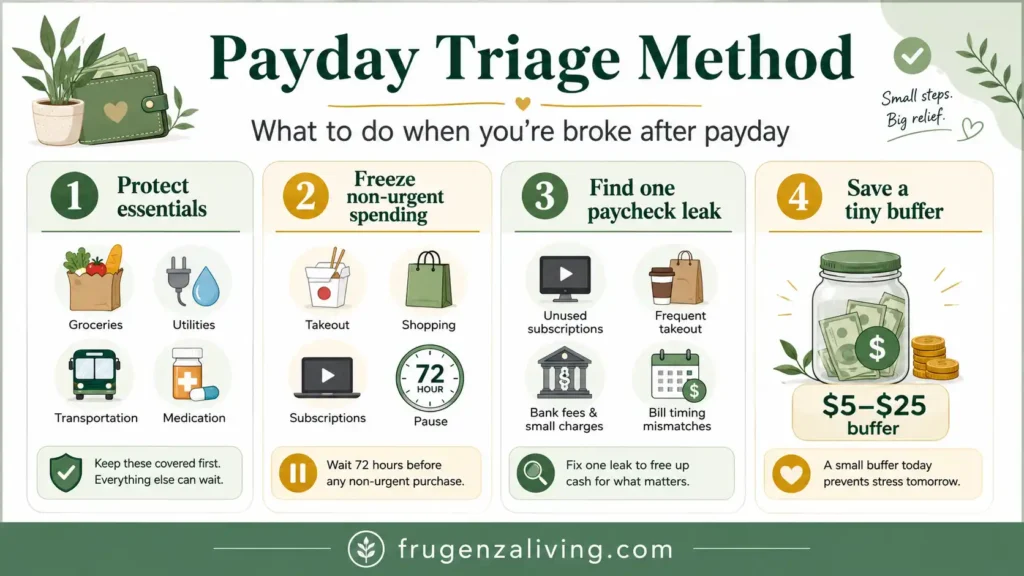
When money is tight, the first goal is not optimization. The first goal is stabilization.
That is where the Payday Triage Method helps.
Triage means you do not try to fix everything at once. You decide what needs attention first, what can wait, and what would create the most damage if ignored. When money is tight after payday, that order matters more than a perfect monthly budget.
The Payday Triage Method has four steps:
- Protect essentials.
- Pause non-urgent spending.
- Find one paycheck leak.
- Build a small next-payday buffer only when essentials are funded.
One way to stop feeling broke after payday is to split paycheck before spending instead of using one mixed balance.
ACTION 01
Step 1: Protect the Next 7 Days First
When you are broke right after payday, start by checking the next 7 days, then extend the list through the next confirmed usable deposit. A seven-day reset is a review schedule, not permission to leave days 8–14 unfunded.
Ask one question:
What must be covered before the next payday?
List the basics:
- food, housing, and necessary insurance
- gas or transportation
- medication
- utilities due soon
- childcare or school needs
- bank fees or overdraft risks
- required minimum payments when essentials are already protected
If the days until the next usable deposit are not covered, keep the shortage visible. List actual amounts and funding deadlines, including minimum debt payments once. If not everything can be paid, consider the consequences for housing, work, insurance, health, and legal obligations, and contact affected providers. The CFPB’s Prioritizing bills tool (PDF) explains that approach.
ACTION 02
Step 2: Create a Bare-Minimum Payday Plan
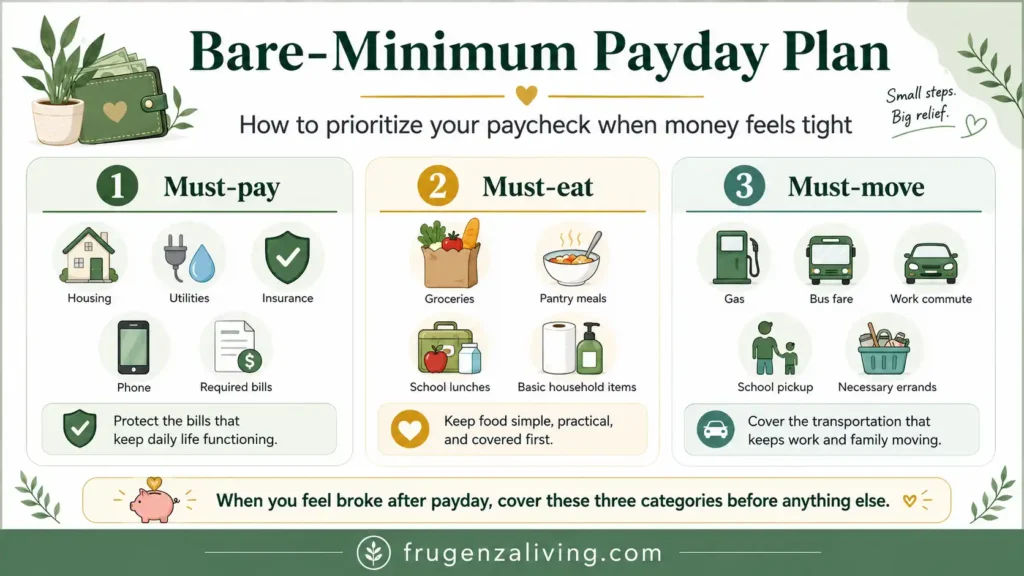
A bare-minimum payday plan is not your forever budget. It is a temporary plan for tight weeks.
Use the must-pay, must-eat, must-move framework.
This keeps your payday budget simple when your brain is already stressed.
If your paycheck disappears too quickly, a simple paycheck budget template can help you separate bills, savings, debt, and spending money.
HYPOTHETICAL · U.S. DOLLARS · JANUARY 2027
How a $1,200 paycheck becomes $180 remaining
Assume $0 opening cash and a $1,200 take-home deposit usable on January 8 before the listed payments. It covers January 8–21: 14 days. The next deposit is assumed usable before any spending on January 22. These are illustrative costs, not living-cost benchmarks or the author’s records.
January 8 net deposit:
$1,200
January 8 rent payment:
$650
January 9 utilities:
$100
January 10 minimum on existing debt:
$80
January 11 groceries for January 8–12:
$120
January 12 transport for January 8–12:
$70
$1,200 − $650 − $100 − $80 − $120 − $70 = $180 remaining on January 13.
That $180 still has to cover $45 of gas on January 16 and $135 of food for January 13–21. Total pay-cycle costs are $1,020 already paid plus $180 still needed = $1,200. Optional spending, new savings, and a checking cushion are all $0.
The debt minimum is counted once and relates to existing debt, separate from these food and transport costs. Assume there are no other unpaid bills, fees, pending debits, or nonmonthly costs needing money before January 22. In a real plan, add insurance, medicine, childcare, renewals, and any other obligations that apply. Existing reserves for unrelated goals are outside this example.
A balanced total still needs a calendar. A bill that needs money on January 20 cannot be funded by a January 22 deposit. Check when payroll is actually usable and when each payment leaves, including same-day payment order.
ACTION 03
Step 3: Use a 72-Hour Spending Freeze
A spending freeze does not have to be extreme. It just needs to be short and clear.
For the next 72 hours, pause nonessential takeout, online orders, payday reward purchases, new subscriptions, and non-urgent upgrades. Keep necessary food, medication, transport, and other essentials funded. Check cancellation terms rather than assuming an existing charge will stop immediately.
This is not punishment. It is breathing space.
The first few days after payday are when money can disappear fast. A short freeze helps you see what is actually left after essentials, instead of letting the paycheck leak through small purchases.
ACTION 04
Step 4: Find One Paycheck Leak
Do not try to fix your entire budget at once. Find one leak this payday.
Check one specific transaction or mismatch: an unused subscription, avoidable fee, unplanned optional purchase, or a bill that needs funding before income arrives. Necessary food, transport, and required debt payments are obligations to plan for, not automatically waste.
For a separate hypothetical example, replacing $60 of takeout with $20 of additional groceries reduces spending by $40 for that weekend. Count those replacement groceries once; do not call the full $60 a saving.
If your problem is bill timing, ask whether one due date can be moved and when that change takes effect. If an unused subscription is the issue, check its renewal and cancellation terms. For food spending, check what you already have and price a few practical meals before shopping again.
One fixed leak is better than ten ideas you never use.
It becomes easier to stay in control when you divide your income for budgeting into bills, savings, debt, and flexible spending.
ACTION 05
Step 5: Call Before You Miss a Payment
If you cannot cover an essential bill, call before the due date when possible.
You may be able to ask about a payment plan, due date change, short extension, hardship option, lower-cost plan, or downgrade.
Not every company will say yes, but asking early gives you more options than waiting until the payment is already missed.
If they offer an extension or payment plan, ask whether there are fees, interest, late marks, or service interruptions. Write down the date, the name of the representative, and the agreement details.
For credit-card payment difficulty, the Consumer Financial Protection Bureau recommends contacting the card company and explaining what you can afford and when normal payments could resume. An arrangement is not in place until the provider confirms it.
The goal is not to avoid responsibility. The goal is to reduce damage and make a realistic plan.
ACTION 06
Step 6: Make Your Paycheck Last Until Next Payday
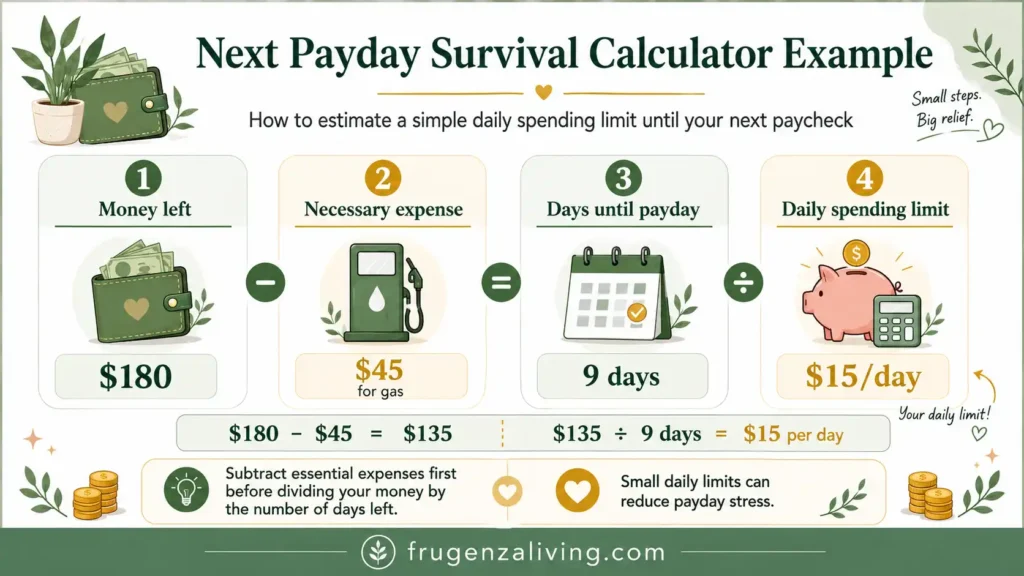
Protect dated payments and other amounts first, then divide the remainder across the days it must cover. If groceries or other necessities still come from that remainder, the daily amount is their budget, not extra discretionary money.
In the dated illustration above, January 13–21 covers nine days before the deposit is assumed usable on January 22, 2027. There is $180 left, and $45 of gas is needed on January 16. Dividing $180 by nine first would give $20 a day while leaving that gas unfunded.
So if gas will cost $45, the real math is:
$180 – $45 = $135
$135 ÷ 9 days = $15 per day
Here, the $15 per day is the planned food amount: $135 ÷ 9. It is not $15 for optional purchases on top of food. The $45 gas amount is protected separately and stays in the balance until January 16.
Use the calculator below to divide the amount left after the costs you protect. It does not decide whether that amount is sufficient or whether a bill comes before payday.
Open the nine-day balance check
For this arithmetic illustration, food is spent at $15 each day. A larger grocery shop on one date needs its own dated allocation, not nine assumed small payments. There are no other transactions.
JANUARY 13
$15 food.
Balance after payment:
$165
JANUARY 14
$15 food.
Balance after payment:
$150
JANUARY 15
$15 food.
Balance after payment:
$135
JANUARY 16
$15 food + $45 gas.
Balance after payment:
$75
JANUARY 17
$15 food.
Balance after payment:
$60
JANUARY 18
$15 food.
Balance after payment:
$45
JANUARY 19
$15 food.
Balance after payment:
$30
JANUARY 20
$15 food.
Balance after payment:
$15
JANUARY 21
$15 food.
Balance after payment:
$0
Lowest projected balance: $0 on January 21, before the next deposit. This illustration just covers the listed costs and leaves no checking cushion. Moving money to savings would create a gap unless another funded amount changed.
When the estimate stops working
Higher necessary cost: if gas costs $75 instead of $45, the remaining nine-day needs are $75 + $135 = $210 against $180 cash: a $30 deficit. With the same $15 daily food spending, the projected balance first falls below $0 on January 20 and reaches −$30 on January 21. A smaller calculated daily amount does not establish that food needs have fallen.
Lower take-home pay: if the January 8 deposit had been $1,100 with the same $1,200 required costs, the cycle would be $100 short. Use the net deposit and actual available cash, not gross pay, a best-paycheck estimate, or an annual monthly average.
Delayed income: if the January 22 deposit is not usable until January 25, three more days at $15 for food require another $45. The original plan ends at $0 and does not fund that extension. Do not count unreceived wages, overtime, tips, or a hoped-for deposit as current cash. Check the new date and amount, then rebuild the uncovered window.
THE NEXT-PAYDAY CHECK
Next Payday Survival Calculator
Divide usable cash after the expenses you protect. This is an arithmetic check, not a payment calendar or a promise that the remaining money is enough.
Cash available now for this window. Exclude credit, pending income, and unrelated reserves. Do not subtract a payment here and include it again below.
Unpaid bills, required minimums, and other costs or funded reserves you want to remove before dividing the remainder. Include each amount once. Use 0 if none apply.
Count today through the day before the next deposit is usable. Enter 1–366 whole days. Include payday too if the deposit arrives after that day’s spending or debit.
Enter dollar amounts without $ or commas, using a decimal point if needed. Blank fields are incomplete; 0 is an explicit zero. If your account is already overdrawn, resolve that gap in the written plan rather than entering a positive balance here.
Result based on your inputs
—
Usable cash:
—
Protected expenses or reserves:
—
Remaining balance:
—
Days to cover:
—
Check the needs and dates in your written plan.
The tool has no automatic saving or export function. Changing an input hides the previous result until you calculate again.
JavaScript is needed for this calculator. Manually subtract protected expenses from usable cash, then divide a nonnegative remainder by the days to cover. Keep any negative balance visible as a funding gap.
You can also separate grocery money from bill money, use a no-spend list, and plan meals around food already available. Protect a mini buffer only if doing so leaves required needs funded.
ACTION 07
Step 7: Build a Tiny Next-Payday Buffer
If essentials or required payments are underfunded, a new savings contribution may need to be $0 this cycle. The example above has no room for a new buffer without another funded change.
When there is genuine room after required costs, choose an affordable amount. These are options, not minimum targets:
- $5 per payday
- $10 per payday
- $25 per payday
- leftover grocery money
- one skipped takeout meal
Even a small funded buffer can help with an unexpected cost. The Consumer Financial Protection Bureau’s emergency fund guide describes a reserve for unplanned expenses or financial emergencies. Keep known bills in their own plan; moving existing money into a buffer is an allocation, not proof of lower spending.
A small buffer does not repair a recurring income shortfall. Build it from verified surplus, not money still needed for food or a required payment. After skipping a purchase, account for any replacement cost before reserving the difference.
If you are not sure why your money disappears, start by learning how to track expenses easily for a few weeks.
What Not to Do When You Are Broke After Payday
Avoid these common mistakes.
Do not ignore bills and hope they disappear.
If you cannot pay, contact the provider early.
Do not use credit cards for comfort spending.
Credit cards may help in emergencies, but using them for emotional relief can make next payday harder.
Do not start a complex budget you cannot maintain.
When money is tight, simple is better.
Do not cancel every joy item and rebound-spend later.
Extreme restriction can backfire. Keep the plan realistic.
Do not compare your budget to someone else’s.
Your rent, income, debt, family size, and bills are not the same as theirs.
Do not rely on payday loans as a routine solution.
If you are considering a payday loan, pause and look for lower-cost options first, such as a payment plan, local assistance program, employer advance policy, credit union alternative, or nonprofit credit counseling. High-cost short-term borrowing can make the next payday even harder.
A Simple 7-Day Reset Plan When You Are Broke After Payday
Use this reset when payday already feels stressful.
DAY 1
Write the real window
Record usable cash, the next confirmed deposit date, every unpaid funding deadline, and food and transport needed through that date. Contact a provider today if a deadline is imminent; do not wait for Day 4.
DAY 2
Protect the required amounts
Give bills and living costs distinct lines. Record a debt minimum once. Mark already-paid costs so you do not subtract them again. Note any deficit rather than forcing a zero.
DAY 3
Check the 72-hour pause
Keep essentials paid while reviewing nonurgent purchases. Count any replacement food or transport costs. A postponed purchase is not a lasting saving.
DAY 4
Confirm one arrangement
Follow up on a payment or due-date request if needed. Write down the amount, effective date, fees, and confirmation. Keep the original deadline in your plan unless a change is approved.
DAY 5
Recalculate from today
Match the plan to cleared transactions and outstanding payments. Update the remaining cash, needs, and days; do not reuse the original daily amount after circumstances change.
DAY 6
Choose a funded next step
If required needs are covered, decide whether any verified surplus can become a small buffer. If not, keep the gap visible and look at provider options, assistance, costs, or reliable income.
DAY 7
Check the next cycle
Record what remains and what it is already assigned to. Map the next paycheck to its deadlines, including bills due before that deposit. Repeating shortages need a broader review of both totals and dates.
This is a reading and action plan, not an interactive checklist. Repeat the checks sooner whenever income, a deadline, or an essential cost changes.
Your rule might be simple: buy groceries before optional takeout, check bills before shopping, or wait 72 hours before a payday reward purchase. Keep $10 untouched only if the rest of the plan is funded.
Where This Fits in Your Bigger Budget
This reset is for the moment when payday already feels tight.
Once the next 7 days are protected, choose one tool for the problem you keep repeating. If payday feels chaotic, build a simple payday routine. If you need structure, use a paycheck budget template. If bills are scattered across the month, a biweekly paycheck budget may help.
If daily spending is the leak, a cash envelope system can help. If predictable expenses keep hurting you, sinking funds may be the better next step.
Final Thoughts
Being broke after payday is a reason to check the dates, obligations, and income together. A better order can help with timing, but some budgets also need lower costs, additional reliable income, or assistance.
Start with essentials. Pause non-urgent spending. Check one avoidable cost or timing mismatch. Call before missing important payments. Build a tiny buffer only when the money is available after required needs.
The goal is not a perfect budget. The goal is to make the next payday less stressful than this one.
FAQ
Why am I broke after payday?
Bills may cluster early, an unusual expense may have occurred, or required costs may exceed take-home income. Compare both dates and totals. Moving a due date can improve timing but cannot fund a recurring income gap.
What should I pay first when I am broke after payday?
Pay essentials first: housing, utilities, food, transportation, medication, insurance, and required payments when possible. Non-urgent spending should wait until these are protected.
How do I budget when I have no money left after bills?
Start with a bare-minimum plan. Cover must-pay, must-eat, and must-move expenses first. Then look for one paycheck leak, such as subscriptions, food spending, fees, or bill timing.
How can I survive until next payday?
List usable cash, unpaid bills, and essential needs through the next usable deposit. Protect amounts once, then divide any remainder over those days. A daily average does not move a payment deadline. If the totals show a shortage, seek a funded change rather than assuming a spending freeze will cover it.
Should I save money if I am broke after payday?
Only if required needs and payments are funded. A $0 contribution is appropriate when a new savings transfer would create an essential shortfall. If there is room, choose a small affordable amount; $5–$25 is an illustration, not a requirement.
How do I stop being broke after every payday?
Map the dates and amounts, protect essentials, and investigate one avoidable cost or funding mismatch. If required costs exceed reliable income, address that gap rather than relying on a calendar change alone. Build a buffer only when affordable and connect the reset with a regular paycheck budget.

Read about Jeffi and Frugenza Living
- Recipe Cost Calculator for Home Cooking - November 10, 2026
- How to Save for a Car Insurance Deductible - November 9, 2026
- How to Rebuild an Emergency Fund After Using It - November 4, 2026