A budget can look perfect on paper and still fall apart in real life.
You plan a grocery limit. Then a few extra snacks, one takeout order, and a quick shopping trip quietly push your spending higher than expected. The problem is not always that you are careless. Sometimes your money is just too easy to spend without noticing.
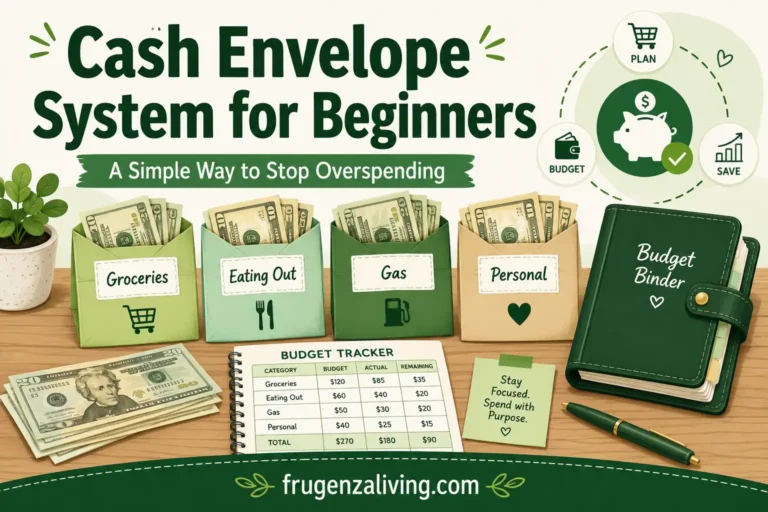
The cash envelope system for beginners is a simple budgeting method that makes spending limits more visible. Instead of keeping every flexible category inside one bank balance, you divide money into envelopes for things like groceries, eating out, gas, and personal spending.
This guide will show you how to start cash envelope budgeting without making it complicated. You will learn which categories to use, how much cash to put in each envelope, when to refill, what to do when an envelope runs out, and how to use a hybrid system if you do not want to use cash for everything.
This is general budgeting education, not professional financial advice.
Quick Answer: What Is the Cash Envelope System?
The cash envelope system is a budgeting method where you divide money into envelopes based on spending categories. When an envelope is empty, spending in that category stops or must be adjusted intentionally.
It works best for flexible categories like groceries, eating out, gas, household items, and personal spending. Fixed bills usually do not need cash envelopes.
Why Cash Envelopes Work for Beginners
Debit cards and credit cards can make spending feel invisible.
You swipe, tap, or click, and the money leaves quietly. That can be convenient, but it also makes it easy to underestimate how much you have already spent.
Cash envelopes make limits physical. If your eating out envelope has $40 left, you can see it. If your personal spending envelope is empty, you know the limit has been reached.
The point is not to make money harder to use. The point is to make overspending harder to ignore.
Cash envelope budgeting can be especially helpful if your budget keeps leaking in the same places every month. For many beginners, those places are groceries, restaurants, gas, shopping, beauty, household items, and small personal purchases.
If carrying cash feels inconvenient, you can try a digital cash envelope system instead.
The Beginner Cash Envelope Rule
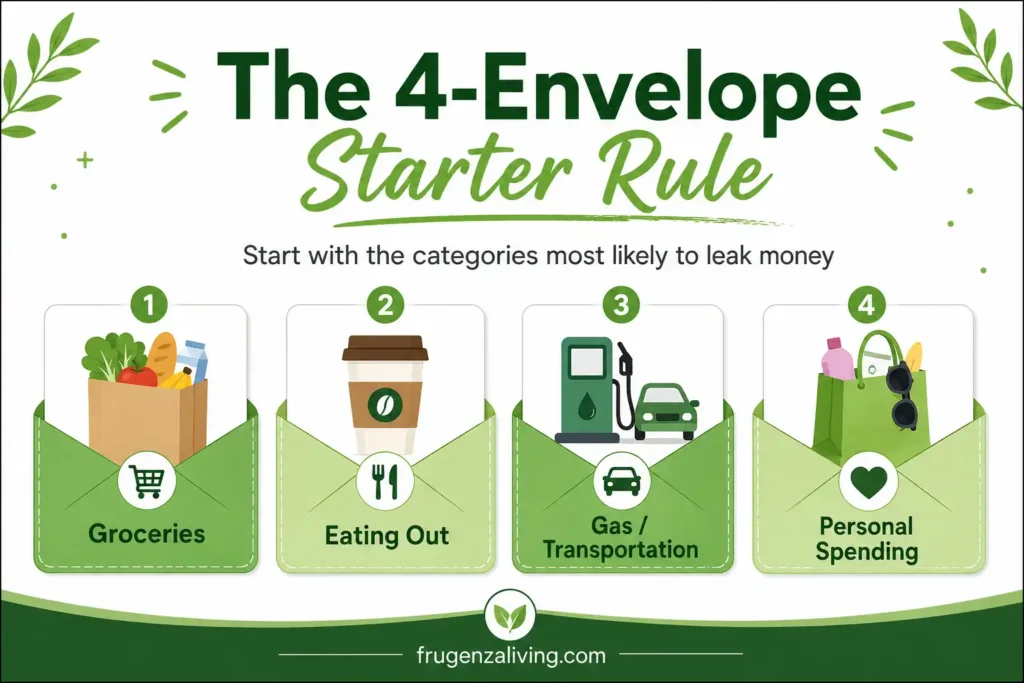
The biggest mistake beginners make is starting with too many envelopes.
You do not need 15 categories on day one. You also do not need a full budget binder envelope setup to begin. Four simple envelopes are enough for your first week.
Use the 4-Envelope Starter Rule:
Fixed bills like rent, mortgage, insurance, debt minimums, subscriptions, and utilities usually work better through bank transfer, autopay, or your normal bill system.
Use envelopes for spending you can choose in the moment, not bills that are already fixed.
Your cash envelope system becomes easier when you organize your budget categories before payday.
Your First 7 Days With Cash Envelopes
Do not try to master the whole cash stuffing system in one month.
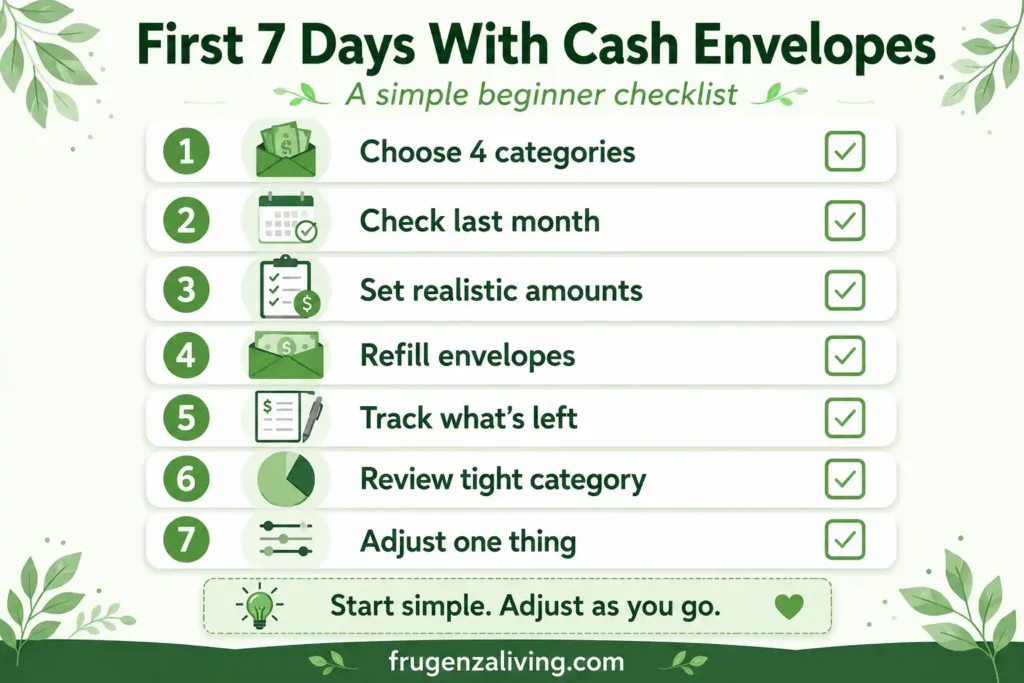
For your first week, keep it simple:
- Day 1: Choose four envelope categories.
- Day 2: Check last month’s spending in those categories.
- Day 3: Set realistic envelope amounts.
- Refill day: Add cash or digital amounts to each envelope.
- During the week: Track what is left.
- Day 7: Review which envelope felt too tight.
- Next refill: Adjust one thing, not everything.
This makes the system easier to start because you are not trying to become perfect immediately. You are building a habit.
Step 1: Choose the Right Envelope Categories
Your first cash envelope categories should match your real spending problems.
Do not create categories just because they look good in a binder. Choose the areas where money disappears too easily.
Good cash envelope categories include:
- Groceries
- Eating out
- Gas or transportation
- Personal spending
- Household items
- Kids or family spending
- Fun money
- Gifts
- Beauty or clothing
Categories that usually do not need cash envelopes include rent, utilities on autopay, insurance, subscriptions, debt payments, and emergency savings.
A beginner cash envelope budget should feel simple enough to use on a normal week. If it requires too much sorting, tracking, and transferring, you may stop using it before it helps.
Step 2: Decide How Much Cash Goes in Each Envelope
Do not pick random numbers.
If you spent $620 on groceries last month, setting your grocery envelope to $350 may look impressive, but it probably will not last. A better first step is to reduce the amount gradually.
For example:
- Groceries last month: $620 → start envelope: $560
- Eating out last month: $210 → start envelope: $150
- Personal spending last month: $180 → start envelope: $120
The goal is not punishment. The goal is awareness and control.
A realistic envelope amount gives you a chance to succeed. Once the system feels normal, you can adjust the numbers during your next budget review.
Before withdrawing cash, choose the right cash envelope categories for beginners so each envelope has a clear purpose.
Step 3: Choose Weekly or Monthly Envelope Refills
Many beginners struggle because they put too much cash into an envelope at once.
If you give yourself a full month of grocery money on the first day, it may disappear too quickly. Weekly cash envelopes can be easier because they create smaller limits.
Use this simple rule:
If you spend too fast, refill weekly. If you forget to refill, refill by paycheck.
A monthly cash envelope system can work if you are already disciplined. But for beginners, weekly refills often make spending easier to control.
If you are paid every two weeks, refill your envelopes after each paycheck. You can pair this with a simple payday routine so your bills, savings, and envelopes are handled in the right order.
Once your categories are ready, the next step is to split income for budgeting before you start spending.
Cash Envelope System Example for Beginners
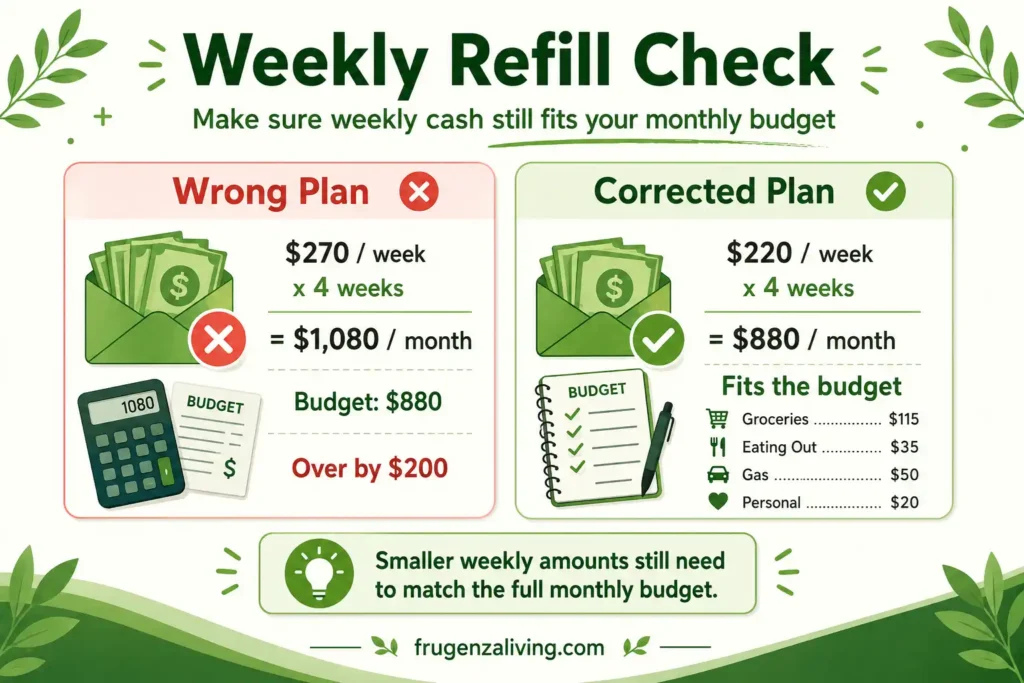
Let’s say your monthly flexible spending budget is $880.
At first, you plan these weekly refills:
- Groceries: $140/week
- Eating out: $40/week
- Gas: $60/week
- Personal: $30/week
That equals $270 per week.
Over four weeks, that becomes $1,080.
That is a problem because your monthly flexible spending budget is only $880.
A corrected weekly cash envelope budget might look like this:
- Groceries: $115/week
- Eating out: $35/week
- Gas: $50/week
- Personal: $20/week
Now the weekly refill is $220.
Over four weeks, that equals $880.
This is why weekly envelopes need to match your monthly budget. Smaller weekly numbers are helpful, but they still need to fit the bigger plan.
Step 4: Track Spending Without Making It Complicated
Tracking does not need to be fancy.
You can write the starting amount on the envelope, subtract purchases, and note what is left. You can also keep receipts inside each envelope and add them up once a week.
The main number you need is simple:
How much is left?
If tracking becomes too detailed, you may avoid it. Keep the system light enough to repeat.
If you get paid regularly, a paycheck budget template can help you decide how much cash goes into each envelope
Step 5: What to Do When an Envelope Runs Out
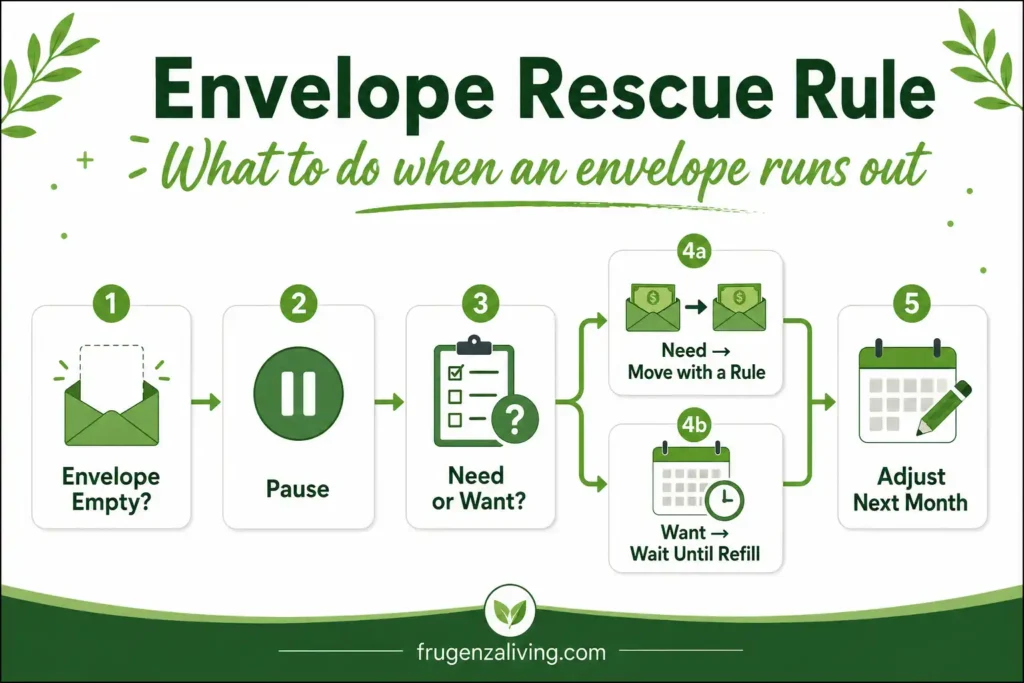
An empty envelope is not a failure. It is a signal.
Use the Envelope Rescue Rule:
- Pause spending in that category.
- Ask if the next purchase is a need or a want.
- If it is essential, move money from a lower-priority envelope.
- If it is a want, wait until the next refill.
- If the envelope runs out every month, adjust the amount.
Do not secretly borrow from other envelopes without thinking. Moving money is allowed, but it should be intentional.
Use the Envelope Transfer Rule when you move money: write down where the money came from, where it went, and why you moved it. That short note helps you see whether the category needs a higher budget or whether the spending was avoidable.
If the same envelope runs out first for three weeks in a row, that envelope is not just empty. It is giving you data.
Step 6: Use a Hybrid Cash Envelope System
You do not have to use cash for everything.
A hybrid cash envelope system is often more realistic for modern budgeting.
You might use:
- Cash for groceries, eating out, gas, and personal spending
- Autopay for rent, utilities, insurance, and debt
- Digital envelopes for online shopping or subscriptions
- A spreadsheet or notes app to track non-cash categories
This matters because many purchases now happen online. Cash stuffing for beginners can still work, but it needs to fit your real life.
A digital cash envelope system can be as simple as separate bank buckets, a budgeting app, or a spreadsheet. The method matters less than the rule: every category needs a clear spending limit.
Step 7: Review and Adjust After 30 Days
Your first month with cash envelopes does not need to be perfect.
After 30 days, review:
- Which envelope ran out too quickly?
- Which envelope had money left?
- Which amount felt unrealistic?
- Which category needs to be split?
- Which category can be reduced?
This is where the system becomes personal.
Maybe groceries need more money, but eating out can be reduced. Maybe gas is steady, but personal spending needs a weekly limit. Maybe cash works for food, but digital envelopes work better for online purchases.
You can also pair this with a monthly budget reset so your envelope amounts improve over time.
When You Are Ready to Add a Fifth Envelope (And How to Choose Which One)
The 4-envelope starter rule is designed to get the system working without overwhelming you.
But it is not meant to be permanent.
At some point — usually after one or two months where the four envelopes feel manageable — a fifth category starts to feel like it would actually help rather than complicate things.
The right time to add an envelope is not when you feel motivated. It is when three specific things are true at the same time.
First: At least three of your four envelopes are not running out before the refill date consistently.
If grocery, eating out, and personal spending envelopes are regularly reaching the next refill with cash still left, your baseline is stable. Adding a fifth category will not disrupt a system that is still fragile. If envelopes are still running out most weeks, the four-envelope system needs more time before expanding.
Second: You have one spending area that keeps appearing in your bank statement but has no envelope.
Not a new category you want to control — one that is already happening. Household supplies, kids’ activities, beauty, clothing, or online shopping showing up as uncategorized spending is a sign that category needs a container. You are not adding an envelope because it sounds responsible. You are adding it because the spending is already real and currently invisible.
Third: You can fund the new envelope without reducing an existing one below a workable amount.
A new envelope that is funded by cutting another envelope too aggressively solves one problem by creating another. If adding a $40/month household envelope means dropping the grocery envelope below what actually covers your groceries, the math is not ready yet.
When all three conditions are true, adding one envelope is the right next step.
How to choose which envelope to add:
Do not add the category that sounds most useful. Add the one where your spending is most unpredictable right now.
Look at your last two months of bank or card statements. Find the spending category outside your four envelopes that had the most variation — the one that was $20 one month and $90 the next. That unpredictability is what an envelope solves most directly. Stable, predictable spending outside your envelopes can wait. Variable spending that keeps surprising you is where an envelope creates the most immediate control.
Add one. Run it for a full month before deciding whether to add another.
Common Cash Envelope Mistakes Beginners Make
Watch for these beginner mistakes:
- Starting with too many envelopes: More categories can make the system harder to keep up with.
- Using random numbers: Your envelope amounts should come from real spending, not wishful thinking.
- Putting fixed bills in cash envelopes: Use cash envelopes mainly for flexible categories.
- Refilling too much at once: Weekly cash envelopes may be easier for beginners.
- Borrowing from envelopes without a rule: Moving money is okay, but it should be intentional.
- Forgetting online spending: Use a digital or hybrid envelope for online categories.
- Quitting after one messy month: Adjust the system before giving up.
Cash Envelope System Pros and Cons
The cash envelope method has real strengths, but it is not perfect.
Pros:
- Makes spending visible
- Helps reduce impulse spending
- Works well for flexible categories
- Simple for beginners
Cons:
- Cash can be inconvenient
- Online spending needs a digital option
- Carrying too much cash may feel unsafe
- Fixed bills usually work better digitally
Final Thoughts: Start Small So You Actually Keep Going
The cash envelope system for beginners works best when it stays simple.
Start with four envelopes. Choose realistic amounts. Refill weekly if you tend to spend too fast. Track what is left without making the process exhausting. Use a hybrid envelope system if full cash does not fit your life.
Cash envelope budgeting is not about having the prettiest binder or the most categories. It is about making your spending limits easier to see and harder to ignore.
The best cash envelope system is not the one with the prettiest binder. It is the one you can actually keep using.
FAQ
How does the cash envelope system work for beginners?
The cash envelope system works by dividing money into envelopes based on spending categories. Beginners can start with groceries, eating out, gas, and personal spending, then stop or adjust spending when an envelope runs out.
What categories should I use for cash envelopes?
Good beginner cash envelope categories include groceries, eating out, gas or transportation, personal spending, household items, gifts, and fun money. Fixed bills like rent, utilities, insurance, and debt payments usually work better digitally.
How much money should I put in each cash envelope?
Start with your real spending from the previous month, then reduce gradually if needed. Avoid choosing numbers that are too strict, because unrealistic envelope amounts are harder to follow.
What happens if a cash envelope runs out?
If a cash envelope runs out, pause spending in that category. If the purchase is essential, move money from a lower-priority envelope intentionally. If it is a want, wait until the next refill.
Can I use the cash envelope system without cash?
Yes. You can use a digital or hybrid cash envelope system with bank buckets, a budgeting app, spreadsheet, or notes. The important part is giving each spending category a clear limit.

Read about Jeffi and Frugenza Living
- How to Budget a 10-Month Salary Over 12 Months - October 16, 2026
- Pet Adoption Budget Checklist: What You Still Need to Pay - October 16, 2026
- Proportional Bill Split Calculator for Two Incomes - October 15, 2026