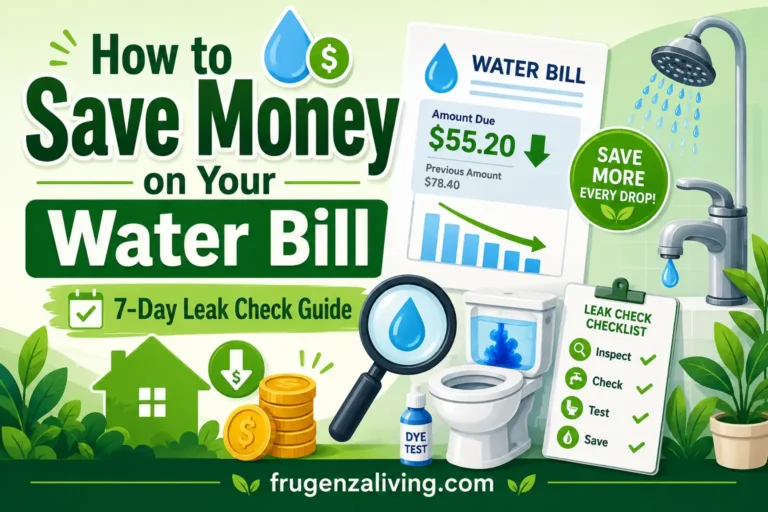
A water bill can feel confusing because you may not see where the money is going.
You might blame long showers, but the real issue could be a silent toilet leak, outdoor watering, a longer billing period, sewer charges, a meter reading issue, or small habits repeating every day.
If you are wondering how to save money on water bill costs, start by checking hidden water waste before making your home uncomfortable. This article focuses on water-bill-specific savings, not broad frugal living advice.
The Fastest Way to Save Money on Your Water Bill
The fastest way to save money on your water bill is to check for leaks first, reduce repeat water waste, run full loads, improve bathroom habits, and review the bill for usage, days, rates, and sewer charges.
Start with the places where water can quietly disappear:
- toilet leaks
- dripping faucets
- shower habits
- laundry and dishwasher loads
- outdoor watering
- water and sewer charges
Small water habits matter, but a hidden leak can waste more than a slightly longer shower. That is why the first step is not guilt. It is diagnosis.
Water costs are part of your home budget, so it helps to manage household expenses one bill at a time.
Why Is My Water Bill So High All of a Sudden?
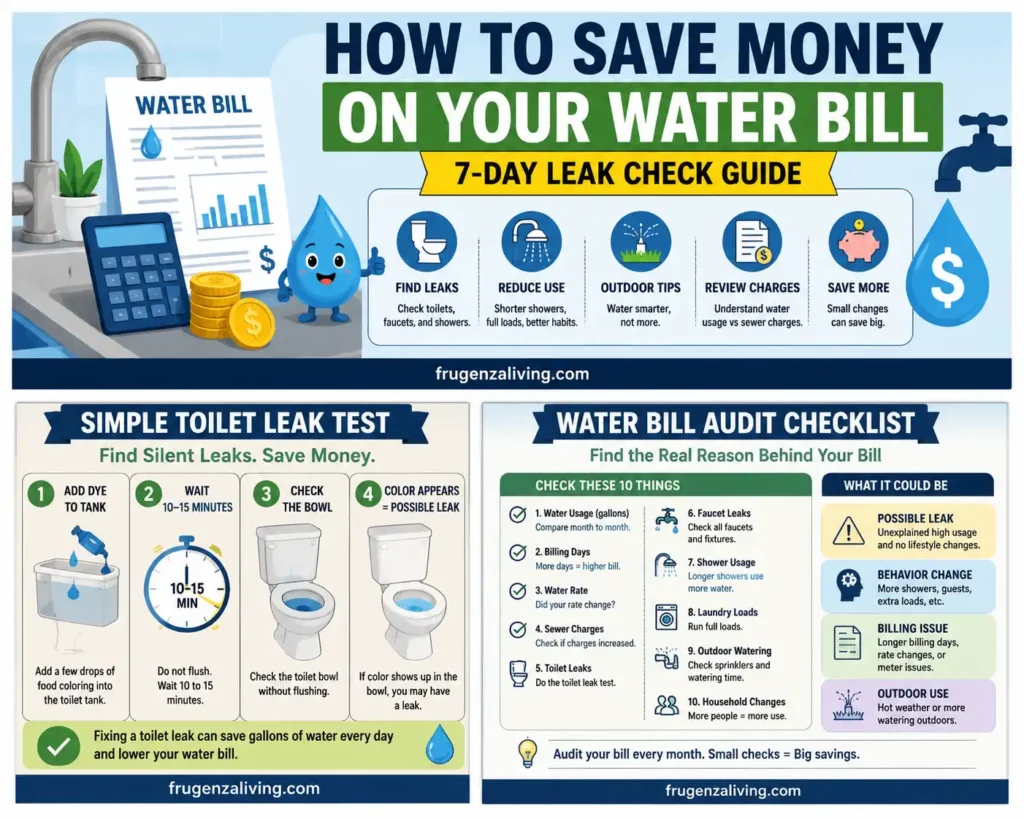
If your water bill is suddenly high, compare usage, billing days, rates, and sewer charges first.
If usage increased, check for leaks, outdoor watering, guests, or behavior changes.
If usage stayed similar, the issue may be rates, sewer charges, fees, or the billing period.
A sudden high water bill can come from:
- a toilet leak
- a faucet or shower leak
- irrigation or lawn watering
- guests or more people at home
- a longer billing cycle
- rate changes
- sewer charges
- seasonal water use
- a meter reading issue
If your bill looks unusually high but nothing changed at home, check whether the bill was estimated, corrected, or based on a different meter reading period.
This matters because your water and sewer bill may rise even when your daily habits feel the same.
Check for Leaks Before Cutting Comfort
Do not start by making everyone in the house uncomfortable.
Start by checking silent water waste.
EPA WaterSense explains that the average household’s leaks can waste more than 9,300 gallons of water every year, and some homes have leaks that waste 50 gallons or more per day. Fixing easily corrected household water leaks can save homeowners about 10% on water bills.
That is why the first step is not to take colder showers or make everyone uncomfortable. The first step is to find water that is being wasted when nobody is even using it.
Start with:
- toilet dye test
- dripping faucet check
- showerhead drip check
- water meter movement when everything is off
- under-sink check
- outdoor spigot check
A toilet leak is especially important because it can be quiet. You may not hear anything, but the tank may still be losing water.
You do not need a major lifestyle change to save money at home easily when small habits are repeated daily.
Simple Toilet Leak Test
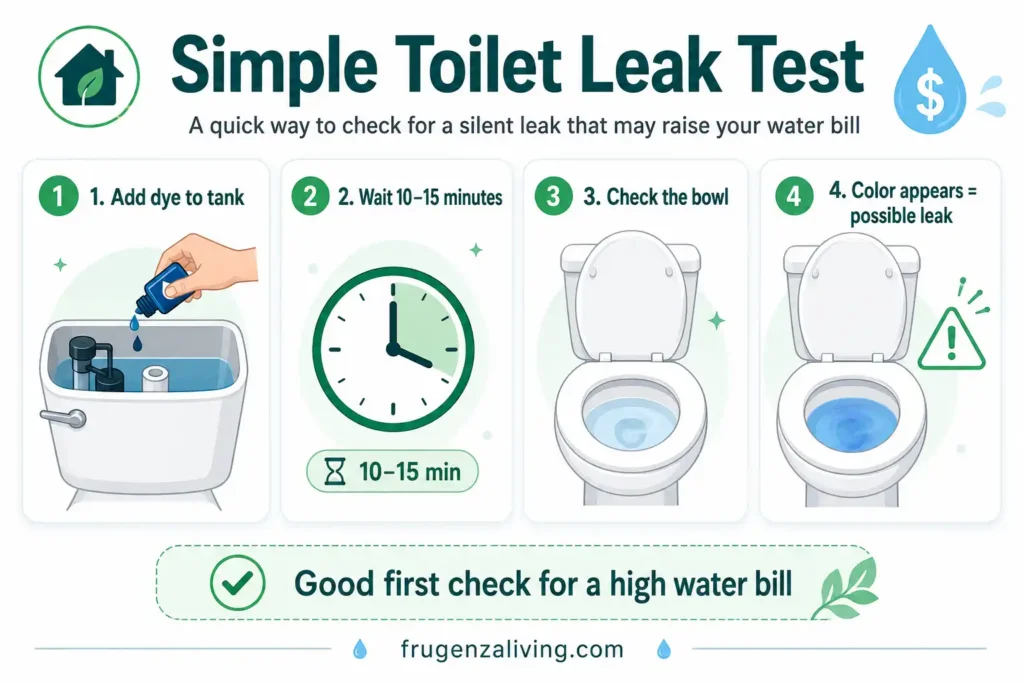
Try this quick test before blaming showers or laundry.
- Put a few drops of food coloring in the toilet tank.
- Do not flush.
- Wait 10 to 15 minutes.
- Check the toilet bowl.
- If color appears in the bowl, water is leaking from the tank.
EPA WaterSense also recommends this dye test and notes that color appearing in the bowl after about 10 minutes can indicate a leak. (epa.gov)
A silent toilet leak can raise your water bill because water may keep moving from the tank to the bowl even when nobody is using it.
Water use and cleaning products both affect the total cost of maintaining a home, so an efficient cleaning routine can help with both.
The Big 6 Water Bill Drivers to Check First
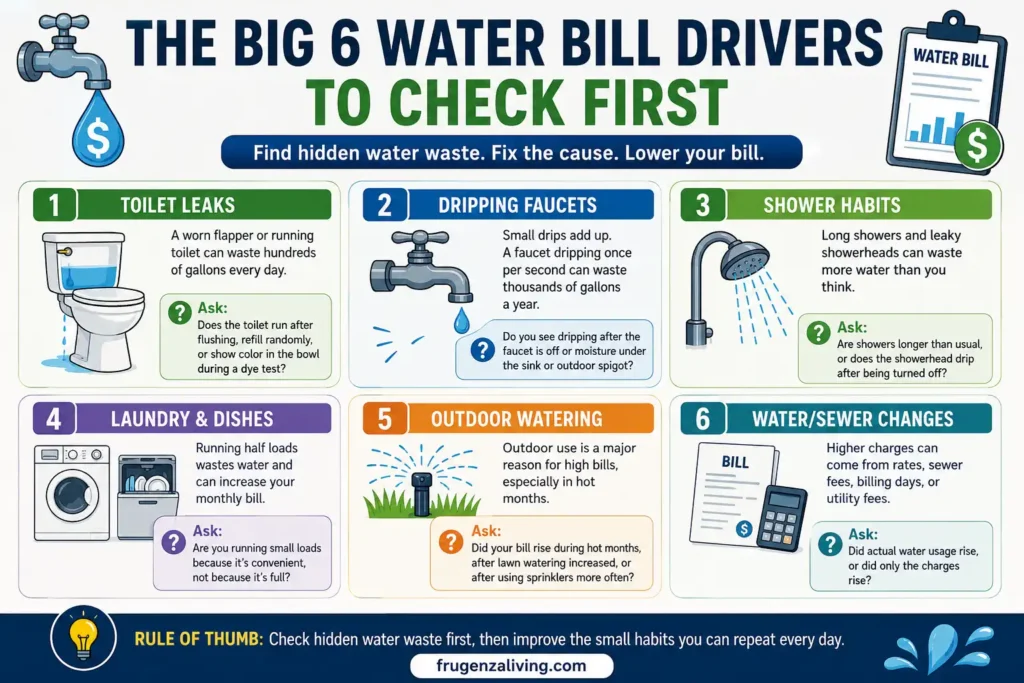
1. Toilet leaks
Toilets are one of the first places to check because leaks can be silent.
A worn flapper, running toilet, or tank issue can waste water every day.
Ask: Does the toilet run after flushing, refill randomly, or show color in the bowl during a dye test?
2. Dripping faucets
A small drip may not feel urgent, but repeated dripping adds up over time.
EPA WaterSense says a faucet dripping once per second can waste more than 3,000 gallons per year.
Ask: Do you see dripping after the faucet is fully turned off, moisture under the sink, or a slow drip from an outdoor spigot?
3. Shower habits
You do not need to stop showering comfortably.
But slightly shorter showers, fixing a leaky showerhead, and using a low-flow showerhead can help reduce water use.
Ask: Are showers longer than usual, or does the showerhead drip after being turned off?
4. Laundry and dishwasher loads
Running half loads can waste water.
Full laundry and dishwasher loads are simple habits that help reduce water usage at home.
Ask: Are you running small loads because the machine is convenient, not because it is full?
5. Outdoor watering
Outdoor water use can create summer bill spikes.
Lawn watering, garden hoses, sprinklers, and outdoor leaks should be checked during warmer months.
Ask: Did your bill rise during hot months, after lawn watering increased, or after using sprinklers more often?
6. Water and sewer billing changes
Sometimes the issue is not only water use.
Sewer charges, rate changes, billing days, or utility fees can also make the bill higher.
Ask: Did actual water usage rise, or did only the charges rise?
After reducing water use, you can also look for ways to reduce utility bills in other areas of your home.
High-Impact Ways to Lower Your Water Bill
Use this quick guide as a priority map. Start with the items that can waste water without you noticing, then move to daily habits and outdoor use.
Water Bill Savings Guide
Start With Hidden Water Waste
Lower your water bill by checking leaks, daily habits, full loads, and outdoor water use before buying expensive upgrades.
Leak Check
First stepCheck toilets, faucets, showerheads, under-sink areas, outdoor spigots, and meter movement when water is off.
Bathroom Habits
Daily useShorten showers slightly, turn off taps while brushing, and fix small drips before they repeat every day.
Laundry & Dishes
Easy winRun full laundry and dishwasher loads, scrape plates instead of pre-rinsing, and avoid small water-heavy cycles.
Outdoor Watering
Seasonal leakWater early, avoid overwatering, check hoses and sprinklers, and reduce lawn watering during cooler or rainy periods.
Bill Tracking
Know the causeCompare water usage, billing days, rates, sewer charges, and household changes before assuming your habits are the only problem.
Check hidden water waste first, then improve the small habits you can repeat every day.
Water Bill Audit Checklist
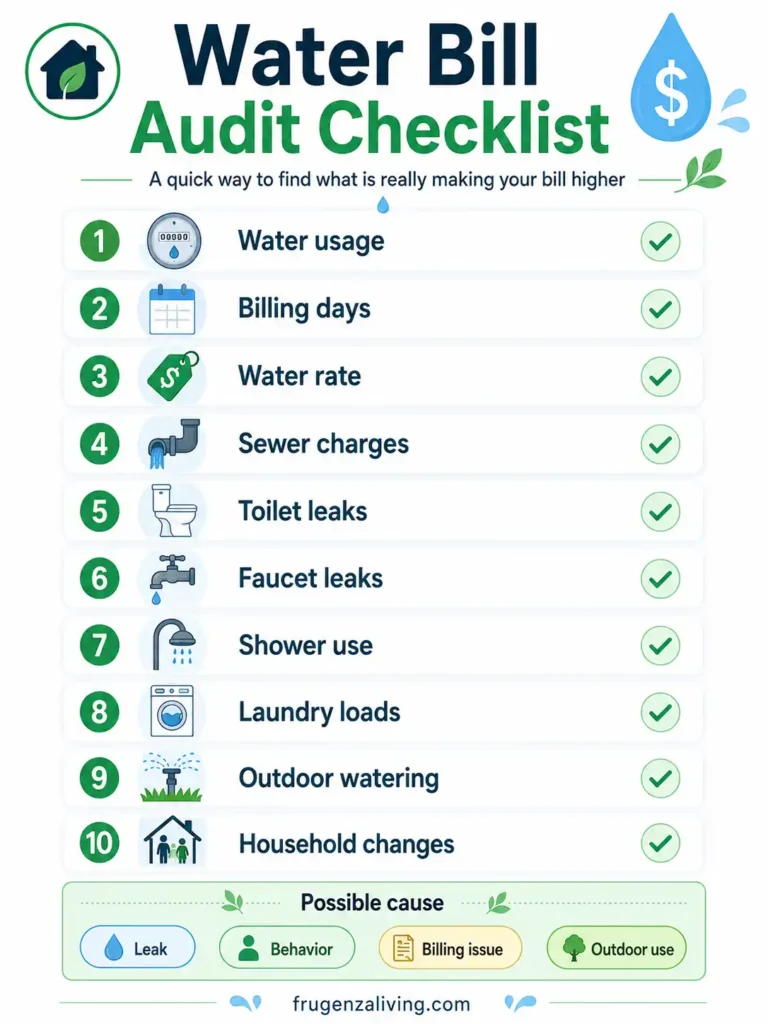
Do not guess why the water bill is high.
Check:
- water usage
- billing days
- water rate
- sewer charges
- toilet leaks
- faucet leaks
- shower use
- laundry and dishwasher loads
- outdoor watering
- guests or household changes
At the end of the audit, label the likely cause:
- normal usage
- possible leak
- behavior change
- billing or rate issue
- outdoor use issue
This makes the next step clearer. If it looks like a leak, fix the leak first. If it looks like outdoor use, review watering habits. If usage is normal but the bill is higher, check rates, fees, and sewer charges.
Fixing small leaks and habits can help you manage everyday spending before it turns into a higher bill.
Water Usage vs Sewer Charges: Why the Bill Can Rise Even If Habits Stay the Same
Your water bill may include more than water usage.
Depending on your utility, it may include:
- water consumption
- sewer or wastewater charges
- fixed service fees
- stormwater fees
- taxes or local charges
- billing period changes
That is why you should compare usage and charges separately.
For example, if your water use stayed close to last month but the bill total increased, check whether the sewer charge, fixed fee, rate, or billing period changed.
If water usage stayed similar but the bill increased, the issue may be rates, sewer charges, fees, or billing days instead of your daily habits.
No-Cost, Low-Cost, and Upgrade-Later Water Saving Actions
No-cost actions
No-cost actions are best when you need to reduce water waste this week.
Start with:
- take slightly shorter showers
- turn off taps while brushing
- run full laundry loads
- run full dishwasher loads
- check toilet leaks
- water plants early
- track water usage
Low-cost actions
Low-cost actions are best when a small part or fixture helps stop repeated waste.
Consider:
- faucet aerator
- low-flow showerhead
- toilet flapper replacement
- hose nozzle
- rain barrel if allowed and suitable in your area
If you decide to upgrade later, WaterSense labeled products such as toilets, faucets, and showerheads can help reduce water use without relying only on daily habits.
Once you have reduced water costs, review other recurring household bills such as internet service and equipment fees.
Upgrade-later actions
Upgrade-later actions are best after you know the problem is real and repeated.
These may include:
- WaterSense toilet
- efficient washing machine
- irrigation system repair
- professional leak inspection
You do not need to buy everything first. Start with leaks and habits.
How Outdoor Watering Can Raise Your Water Bill
Outdoor watering can make a water bill jump during hot months.
Check:
- sprinkler leaks
- broken hose nozzles
- watering during hot afternoon hours
- watering after rain
- watering sidewalks or driveways
- lawn watering that runs too long
- hose connections at outdoor spigots
EPA WaterSense notes that an irrigation system leak as small as 1/32 inch can waste about 6,300 gallons of water per month, and it recommends checking irrigation systems and garden hoses for leaks.
If your bill spikes in summer, outdoor use should be checked before blaming only showers or laundry.
A Realistic Example: How Water Savings Can Add Up
Here is a realistic example of how one household might save money on water bill costs, especially if there are leaks, outdoor watering habits, or inefficient fixtures.
- $10 from shorter showers and turning off taps
- $15 from fixing small leaks
- $10 from full laundry and dishwasher loads
- $20 from outdoor watering changes
- $15 from low-cost fixtures like aerators or showerheads
Total: up to about $70/month in a household with leaks, outdoor watering, or inefficient fixtures.
This is only an example, not a promise.
Water costs vary by location, utility rates, household size, sewer charges, outdoor use, and home condition.
A 7-Day Water Bill Reset
Day 1: Compare your last water bills
Look at usage, billing days, rates, and sewer charges.
Day 2: Check toilets for silent leaks
Use a dye test or listen for running water.
Day 3: Check faucets, showerheads, and under sinks
Look for drips, moisture, or slow leaks.
Day 4: Run only full laundry and dishwasher loads
Avoid small water-heavy cycles when possible.
Day 5: Shorten showers slightly and turn off taps
Do not make the home uncomfortable. Just reduce repeated waste.
Day 6: Review outdoor watering and hoses
Check sprinklers, hoses, outdoor spigots, and watering schedules.
Day 7: Choose 2 habits and 1 repair to keep
Do not try to change everything. Pick the easiest habits to repeat.
How to Confirm Your Leak Is Fixed Before the Next Bill Arrives
After the 7-day reset, most people wait for the next bill to see if anything changed.
There is a faster way.
Your water meter can tell you within two hours whether a leak is still running — even a small one that does not drip visibly and did not show up in the toilet dye test.
Here is how to use it.
The two-hour stillness test:
Choose a two-hour window when no water will be used in the home — no flushing, no running faucets, no washing, no dishwasher, no ice maker. Before the window starts, find your water meter and write down the exact reading, including all digits.
Wait the full two hours without using any water.
At the end of the window, check the meter again.
If the number is identical, no water moved through the meter during that period. You have confirmed there is no active hidden leak in the main lines.
If the number changed even slightly, water moved somewhere in the home even though nothing was turned on. That is a signal that a leak is still present — a toilet flapper that is not fully seated, an outdoor spigot with a slow drip, or a supply line with a small seep that is not yet visible.
EPA WaterSense recommends checking the water meter as part of leak detection, specifically by reading the meter before and after a period of non-use to identify whether any movement occurs.
Using the meter to verify habit changes:
Beyond leak detection, you can use the meter to roughly confirm that your new habits are reducing usage — without waiting for the billing cycle.
Pick a consistent 24-hour window each week — say, from Monday evening to Tuesday evening — and record the meter reading at the start and end. Do this for two consecutive weeks using the same window.
If week two shows a lower reading than week one for the same period, the habit changes are showing up in actual usage. If the reading is similar, the changes may need to go further before they show up meaningfully on the bill.
This does not replace the official bill comparison. But it gives you early signal about whether the reset worked — which is useful when the next bill is still three weeks away and you want to know whether to keep going or adjust something further.
Renter-Friendly Ways to Lower Water Bills in an Apartment
Renters may not be able to replace toilets, repair plumbing, or change irrigation systems.
But renters can still:
- report leaks
- use shower timers
- turn off taps
- run full loads
- ask the landlord about repairs
- use removable aerators if allowed
- track bill changes
- avoid permanent fixture changes without permission
If you rent, document leaks with photos or notes before reporting them.
Include the date, where the leak appears, and whether it is constant or occasional.
A small leak may not look serious, but it can affect your monthly utility bill.
What Not to Do When Trying to Save on Water Bills
Do not save water in ways that create health, safety, or plumbing problems.
Avoid these mistakes:
- do not ignore leaks
- do not skip hygiene
- do not stop drinking enough water
- do not make plumbing changes you are not allowed to make
- do not ignore sewer charges
- do not assume one high bill is your fault before checking usage and rates
The goal is to reduce waste, not make your home harder to live in.
My Simple Rule for Saving Money on Your Water Bill
At Frugenza Living, we used to look at utility bills only after they felt high.
The bigger shift came from checking usage patterns, leaks, and repeat habits before assuming the bill was normal.
Utility awareness was one small part of a broader saving system that helped us save over $15,000 in a year across multiple categories.
That number did not come from one trick. It came from combining many small and medium changes over time.
Water bill savings were only one small part of that process, but checking utility bills taught us to stop treating repeat costs as normal without reviewing them.
Your numbers may look different, but a water bill audit can still show where water and money quietly disappear.
FAQ
What is the fastest way to save money on water bill?
The fastest way to save money on water bill costs is to check for leaks first, especially toilet leaks, then reduce repeat water waste, run full loads, improve bathroom habits, and review usage, billing days, rates, and sewer charges.
Why is my water bill suddenly high?
Your water bill may be suddenly high because of a toilet leak, faucet leak, shower leak, outdoor watering, guests, a longer billing cycle, rate changes, sewer charges, seasonal use, or a meter reading issue.
How do I know if I have a toilet leak?
A simple toilet dye test can help. Put a few drops of food coloring in the toilet tank, wait 10 to 15 minutes, and check whether color appears in the bowl without flushing. If it does, there may be a leak.
Can a toilet leak make my water bill high?
Yes. A toilet leak can raise your water bill because water may keep moving from the tank to the bowl even when nobody is using it. A dye test can help you check for a silent leak.
Do shorter showers really lower water bills?
Shorter showers can help lower water usage, especially in larger households. The savings depend on your showerhead, water rate, sewer charges, and how often people shower.
Does running full laundry loads save water?
Yes, running full laundry loads can reduce water waste compared with frequent small loads, especially in households that wash clothes often.
Can renters save money on water bills?
Renters can save money on water bills by reporting leaks, turning off taps, running full loads, using removable aerators if allowed, tracking bill changes, and avoiding permanent fixture changes without permission.
What is the difference between water usage and sewer charges?
Water usage is the amount of water your household uses. Sewer charges are fees for wastewater service and may be tied to water usage, local rates, or utility billing rules. A bill can rise because of sewer charges even if water habits feel similar.
Why is my sewer charge high on my water bill?
Sewer charges may be based on water usage, local utility rates, fixed fees, or billing rules. If your water use stayed similar but the bill rose, compare sewer charges, rates, and billing days.
How often should I check my water bill?
Check your water bill every month. Compare usage, billing days, rates, sewer charges, and household changes so you can catch leaks or unusual patterns early.
Final Thought: Fix Hidden Water Waste First
Saving money on your water bill does not have to mean making your home uncomfortable.
Start with leaks.
Check usage patterns.
Run full loads.
Review outdoor water use.
Track water and sewer charges.
Fix hidden water waste first, then keep the small habits that are easy to repeat.

Read about Jeffi and Frugenza Living
- How to Budget a 10-Month Salary Over 12 Months - October 16, 2026
- Pet Adoption Budget Checklist: What You Still Need to Pay - October 16, 2026
- Proportional Bill Split Calculator for Two Incomes - October 15, 2026