Cooking for one gets harder when the fridge is empty, takeout feels easier, and your pantry is full of random ingredients that do not turn into real meals.
You may have a bag of flour, three sauces, half-used pasta, and a can of something you bought “just in case.” But when you are tired, none of it feels useful.
That is why choosing the right cheap pantry staples for one person matters.
The goal is not to build a huge pantry. The goal is to keep a small set of affordable staples that can turn into simple meals quickly.
A good pantry for one person should help you spend less, waste less, and avoid ordering food when you already have something easy at home.
What Are the Best Cheap Pantry Staples for One Person?
The best cheap pantry staples for one person are flexible, affordable, long-lasting, and easy to combine.
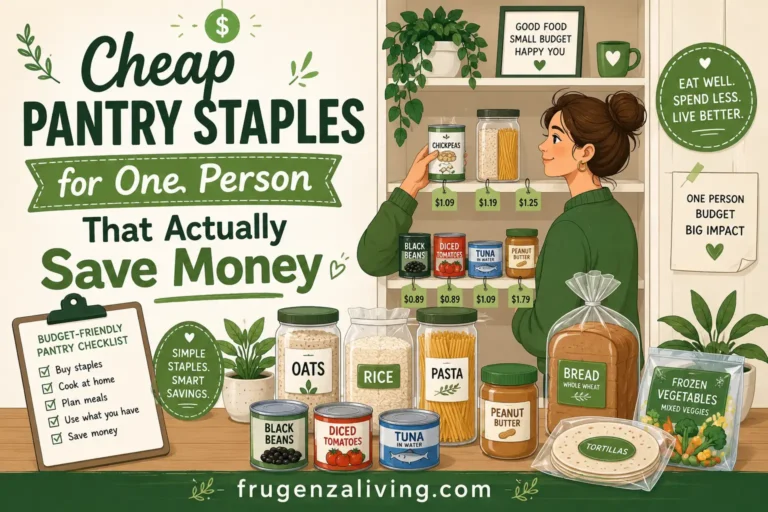
Good staples include oats, rice, pasta, beans, canned tomatoes, tuna, peanut butter, tortillas or bread, frozen vegetables, basic sauces, and simple spices.
Think of these as pantry essentials for one person: low-cost foods that last long and can turn into more than one meal.
Rice can turn into a bowl, fried rice, or soup. Pasta can work with tomato sauce, tuna, frozen vegetables, or beans. Oats can become breakfast, a snack, or a low-cost backup meal.
The best pantry staples are not the fanciest ones.
They are the foods you actually know how to use.
Why a One-Person Pantry Should Stay Small
One person does not need a giant family-size pantry.
A huge pantry can look smart at first, but it can also become clutter. You buy bulk grains, random sauces, specialty ingredients, and canned goods you rarely touch. Then cooking feels harder, not easier.
Cheap food is not cheap if it expires, gets ignored, or takes over your shelves.
A helpful rule for one person is the one-shelf rule: if your pantry basics no longer fit on one small shelf or one clear bin, pause before buying more staples.
A one-person pantry should make meals easier.
It should answer the question:
“What can I make quickly with what I already have?”
If your pantry cannot answer that, it may need fewer items, not more.
Choosing the right pantry staples makes it much easier to save money on groceries without buying random ingredients.
The Solo Pantry Core
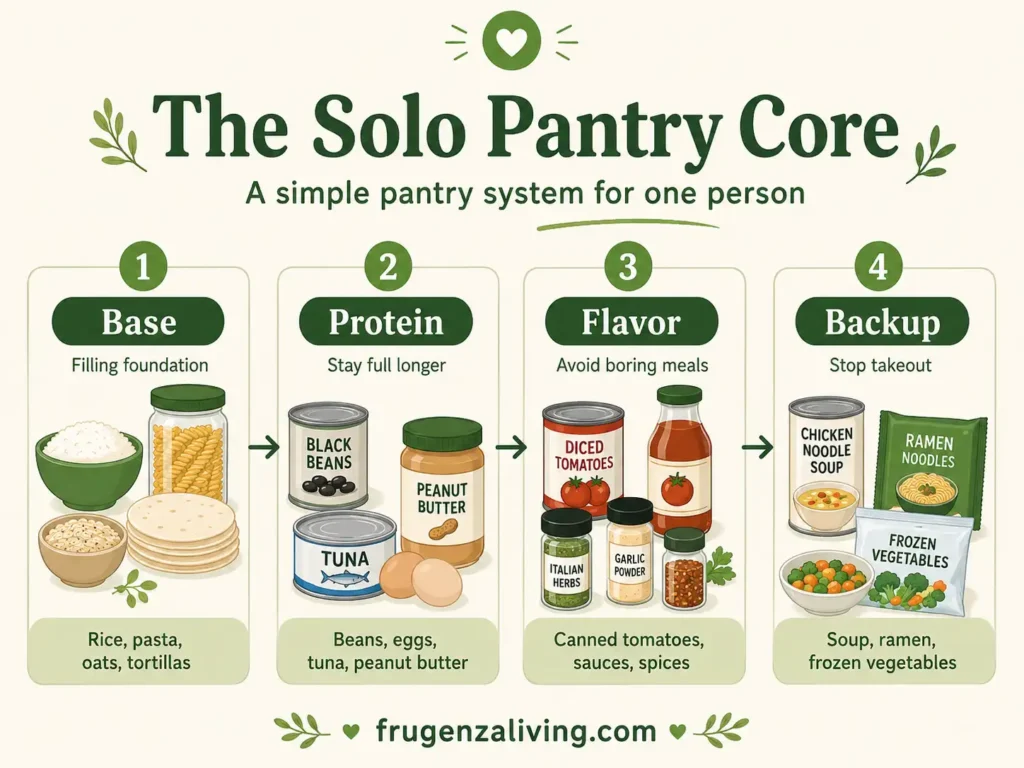
Use this simple pantry system:
Base → Protein → Flavor → Backup
This keeps your pantry useful instead of crowded.
You do not need every cheap pantry item. You need enough to build meals without starting from zero.
Buy These Pantry Staples First
Start with foods you already know how to cook.
For a simple pantry list for one person, use these categories.
Base:
- rice
- pasta
- oats
- tortillas or bread
Protein:
- canned beans
- lentils
- eggs
- tuna
- peanut butter
Flavor:
- canned tomatoes
- basic sauce
- garlic powder
- chili flakes
- soy sauce or vinegar
Backup:
- soup
- ramen
- frozen vegetables
- canned beans
- shelf-stable broth
These shelf-stable foods for one person work best when they match meals you already like.
You do not need all of these at once.
Pick one or two from each category first.
That is enough to create cheap pantry meals without filling your shelves with food you may not use.
Pantry staples work best when you use them inside a weekly meal plan for one on a budget.
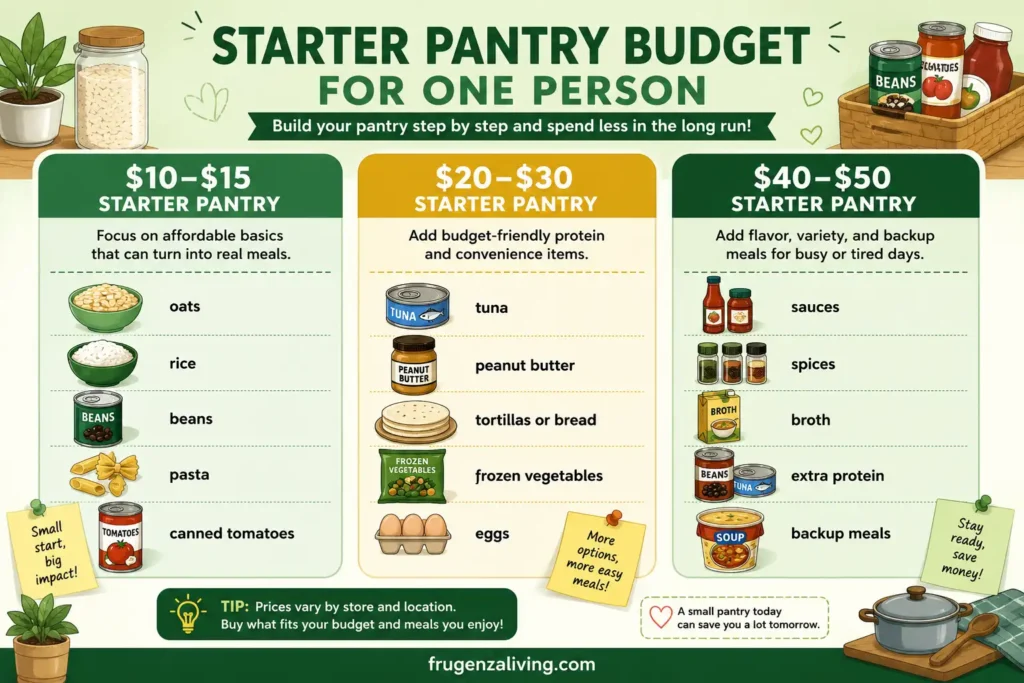
Starter Pantry Budget for One Person
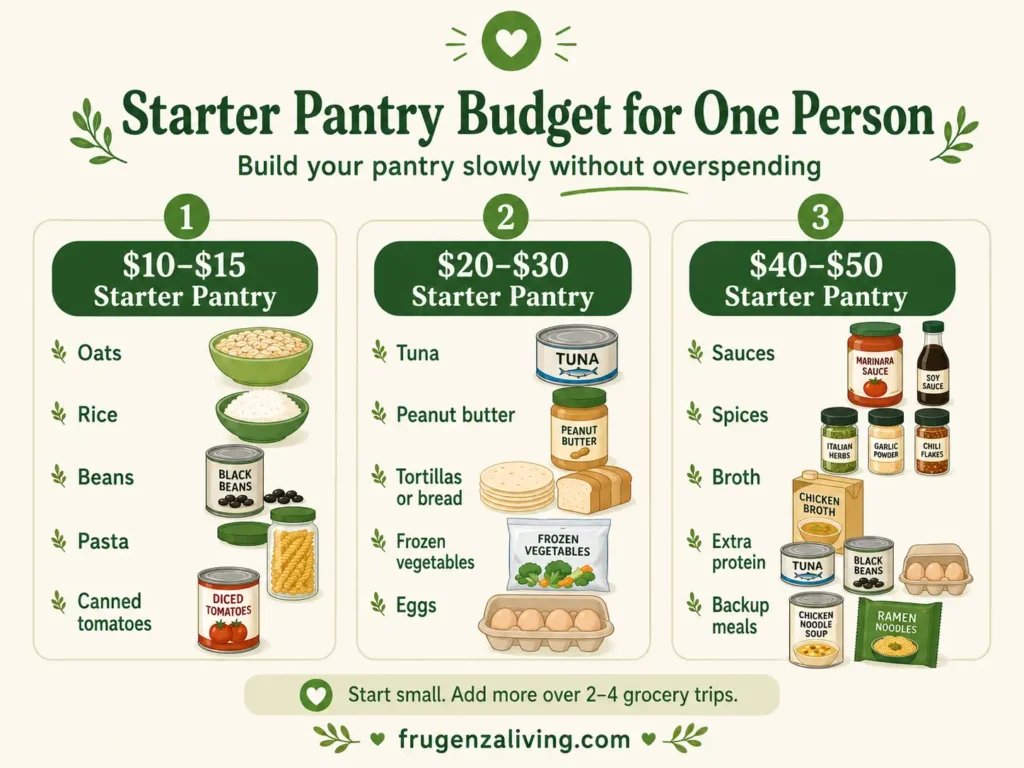
A budget pantry does not have to be built in one trip.
Build it slowly over two to four grocery trips.
$10–$15 starter pantry:
- oats
- rice
- beans
- pasta
- canned tomatoes
$20–$30 starter pantry:
- tuna
- peanut butter
- tortillas or bread
- frozen vegetables
- eggs
$40–$50 starter pantry:
- sauces
- spices
- broth
- extra protein
- backup meals
Prices will vary by store and location, but the principle stays the same.
Start with the cheapest foods that become real meals.
Then add variety later.
Pantry staples are especially helpful when you want to save money as a single person without cooking complicated meals.
Buy First, Buy Later, Skip for Now
A pantry becomes expensive when everything feels like a good deal.
Use a simple filter before buying.
Buy first: foods that make meals immediately.
Examples: rice, eggs, beans, oats, pasta.
Buy later: extras that add variety once your basics are covered.
Examples: sauces, spices, broth, canned fish, tortillas.
Skip for now: ingredients that sound useful but do not match how you actually cook.
Examples: specialty grains, expensive condiments, bulk items you cannot finish, or niche ingredients for one recipe.
This is especially important when cooking for one.
A bulk bag is only a deal if you have the space, the plan, and the habit to use it.
For a staple you already use regularly, this bulk-buying break-even check shows how much of the larger pack needs to become food you actually eat before the purchase beats buying smaller packs.
Buying staples is only helpful if you know how to make groceries last longer and avoid waste.
Simple Pantry Meal Formula for One
The easiest pantry meal formula is:
Base + Protein + Flavor + Vegetable
You can repeat this formula in many ways:
- rice + beans + egg + sauce
- pasta + canned tomatoes + frozen vegetables
- oats + peanut butter + banana
- tuna + toast or tortilla + seasoning
- soup or broth + beans + vegetables
This is where budget cooking for one gets easier.
You are not trying to invent a new recipe every night. You are mixing a few pantry basics in different ways.
A small pantry becomes powerful when each item has more than one job.
Cheap Pantry Meals You Can Make From Staples
Here are simple pantry meals for one that do not need many ingredients.
- Bean and rice bowl: Rice, beans, sauce, and any vegetables you have.
- Egg fried rice: Rice, egg, frozen vegetables, and soy sauce.
- Tuna toast: Tuna, bread, seasoning, and a simple side.
- Pasta with tomato sauce and frozen vegetables: Pasta, canned tomatoes or sauce, and frozen vegetables.
- Peanut butter oats: Oats, peanut butter, and banana if you have one.
- Bean tortilla wrap: Tortilla, beans, sauce, and any greens or vegetables.
- Ramen with egg and frozen vegetables: Ramen, egg, frozen vegetables, and seasoning.
- Soup with beans and vegetables: Broth or soup, beans, and frozen vegetables.
These are not fancy meals.
They are useful meals.
And useful meals are what stop takeout from becoming the easiest option.
For more ideas, you can look for pantry staple recipes that use shelf-stable basics and freezer ingredients, then choose only the ones that fit your real routine.
Pantry staples become more useful when you turn them into simple meal prep using pantry staples.
Pantry Staples That Help Reduce Takeout
The best cheap pantry items are the ones that save you on tired nights.
If you have pasta, sauce, tuna, frozen vegetables, eggs, soup, or rice, you have a backup before ordering food.
That matters because takeout often happens when there is no easy decision at home.
A good pantry reduces decision fatigue.
It gives you a simple answer when you are tired:
“I can make something quick.”
That one moment can save more money than buying a dozen ingredients you never use.
Common Pantry Mistakes When Cooking for One
A pantry should make cooking easier, not more confusing.
Common mistakes include:
- buying too many “healthy” ingredients you do not enjoy
- buying bulk food without storage or a plan
- stocking five grains but no protein
- buying sauces that only work for one recipe
- ignoring frozen vegetables
- not checking what you already have
The goal is not to own the perfect pantry.
The goal is to keep enough budget pantry staples to make meals you will actually eat.
If an ingredient does not fit your real routine, it is probably not a staple yet.
How to Tell If Your Pantry Is Actually Working
A pantry that looks stocked is not the same as a pantry that is working.
After a few weeks of building your staples, it is worth asking one honest question:
Is this pantry actually stopping me from ordering takeout, or am I still ordering at the same rate as before?
If the answer is “about the same rate,” the pantry has a use problem, not a stock problem.
Here is a simple three-signal check to run once a month:
Signal 1: Are the same items sitting in the same position?
Open your pantry and look at what has not moved in two to three weeks. An untouched bag of lentils or an unopened can of chickpeas is not a pantry success — it is a sign that those items do not actually fit your cooking habits, regardless of how budget-friendly they are. Move them to the front, plan to use them this week, or replace them with something you reach for more naturally.
Signal 2: How many times did you open the pantry and still order food?
Think back over the last two weeks. On the nights you ordered takeout, was it because the pantry was genuinely empty, or because nothing in it felt like a quick enough option at that moment? If the pantry had food but still did not stop the order, the issue is usually one missing component — often a protein that runs out faster than expected, or a flavor element that makes the meal feel complete.
Signal 3: Are you restocking the same five things, or different things each week?
A working pantry creates a short, predictable restock list. If your grocery list changes dramatically every week, your pantry has not yet settled into a real system — you are still rebuilding from scratch rather than topping off what you use. Stability in what you restock is one of the clearest signs that your pantry is actually doing its job.
A pantry that passes all three signals does not need to be changed.
A pantry that fails one of them needs a single adjustment — not a complete rebuild.
The goal is not a perfect pantry. The goal is a pantry that reliably answers “what can I make right now?” before that question turns into an order.
My Simple Rule for Pantry Staples for One
I stopped building a pantry like I was feeding a family.
I started building one around repeatable solo meals.
That changed a lot.
I bought fewer random ingredients. I used more rice, eggs, beans, frozen vegetables, pasta, oats, and simple sauces. I kept backup meals for nights when I knew I would be tempted to order food.
It was not glamorous, but it worked.
Keeping simple pantry staples, reducing takeout, and wasting less food became some of the habits that helped me save over $15,000 in a year.
Your numbers may look different, but building a small pantry around foods you actually use can still make saving money feel easier.
How This Fits Into Your Save Money System
Cheap pantry staples work best when they support the rest of your food system.
If you want a full plan, a weekly meal plan for one on a budget can help you turn staples into a repeatable week of meals.
If you need more ideas, cheap meals for one person can give you simple meals using low-cost ingredients.
If grocery spending feels messy, save money on groceries for one person can help you shop with more intention.
If food keeps going bad, how to make groceries last longer can help you reduce waste after shopping.
FAQ
What are cheap pantry staples for one person?
Cheap pantry staples for one person include rice, pasta, oats, beans, lentils, tuna, peanut butter, canned tomatoes, tortillas or bread, frozen vegetables, eggs, basic sauces, and simple spices.
How do I stock a pantry for one person?
Stock a pantry for one person by starting small: choose one base, one protein, one flavor item, and one backup meal. Add more only after you know what you actually use each week.
What pantry staples should I buy first?
Start with staples that make meals immediately: rice, oats, pasta, beans, eggs, canned tomatoes, peanut butter, and frozen vegetables. Add sauces, spices, broth, and backup meals later.
How do I stock a pantry on a tight budget?
Stock a pantry slowly over several grocery trips. Start with low-cost basics like oats, rice, beans, pasta, and canned tomatoes. Then add protein, frozen vegetables, sauces, and backup meals when your budget allows.
What cheap meals can I make from pantry staples?
You can make rice and beans, egg fried rice, tuna toast, pasta with tomato sauce, peanut butter oats, bean wraps, ramen with egg and vegetables, or soup with beans and frozen vegetables.
How do I avoid buying too many pantry items?
Avoid buying too many pantry items by choosing foods you already know how to use. Skip specialty ingredients, bulk items you cannot finish, and sauces that only work for one recipe.
How can pantry staples help me save money?
Pantry staples help you save money by making quick meals easier, reducing takeout, preventing emergency grocery trips, and helping you use the food you already have at home.
Final Thought: Build a Pantry You Actually Use
A good pantry for one person does not need to be huge.
It needs a few flexible foods that turn into real meals.
Start small.
Buy what you use.
Build around your repeatable meals.
The best cheap pantry staples are the ones that keep you fed before takeout becomes the easiest option.

Read about Jeffi and Frugenza Living
- Pet Adoption Budget Checklist: What You Still Need to Pay - October 16, 2026
- Proportional Bill Split Calculator for Two Incomes - October 15, 2026
- How to Split Grocery Bills With Roommates - October 14, 2026