
Not every frugal habit is worth keeping.
Some habits look smart on the surface, but they save only a few cents while costing too much time, energy, or stress. Others are simple enough to repeat and quietly save money every week.
That difference matters.
If you want frugal habits that actually save money, the goal is not to do every money-saving trick you see online. The goal is to choose habits that are realistic, repeatable, and useful enough to keep doing.
A frugal habit is only helpful if it saves money, reduces waste, or prevents future spending without making your life harder than necessary.
This article is not about extreme frugality.
It is about the habits that actually leave more money in your life.
What Frugal Habits Actually Save Money?
Frugal habits that actually save money include planning meals from what you already have, delaying non-essential purchases, removing spending triggers, cooking simple repeat meals, using what you own before buying more, repairing before replacing, buying fewer but better basics, and setting small automatic savings.
What Makes a Frugal Habit Actually Worth It?
A frugal habit is worth keeping when it does at least one of these things:
- saves money repeatedly
- prevents future spending
- reduces waste
- is easy enough to repeat
That last point is important.
A habit that saves money once but feels exhausting every week may not last. A habit that saves a smaller amount but repeats easily can be more powerful.
The Best Frugal Habits Pass the Repeat Test
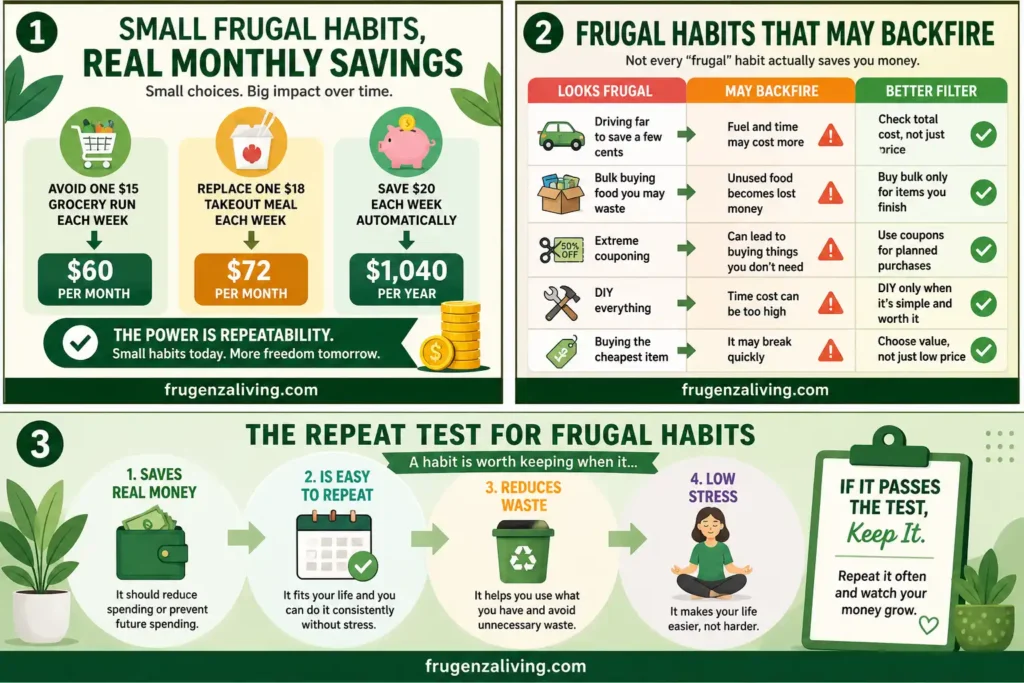
The best frugal habits pass what I call the Repeat Test.
A habit should not only save money one time. It should be realistic enough to repeat without making your life feel harder.
For example, driving 30 minutes to save $2 might not pass the test. But checking your pantry before grocery shopping probably does.
A habit that saves $5 every week is often more powerful than one that saves $20 once.
That is the quiet power of frugal habits that work.
They reduce spending again and again, usually without needing much motivation.
If a habit saves money once but makes your life harder every week, it may not be worth keeping.
Frugal Habits That Actually Save Money at a Glance
Here are practical frugal habits that are worth testing:
| Habit | Why It Saves Money | Realistic Savings Signal |
|---|---|---|
| Shop from what you already have | Prevents duplicate purchases | Fewer random grocery trips |
| Delay non-essential purchases | Reduces impulse buying | More items never get bought |
| Remove spending triggers | Stops temptation early | Less browsing and fewer sale buys |
| Cook simple repeat meals | Reduces takeout | One less takeout meal per week |
| Use a no-spend waiting list | Separates wants from needs | Fewer emotional purchases |
| Buy fewer but better basics | Reduces repeat replacement | Less clutter and longer use |
| Repair before replacing | Extends useful life | Fewer unnecessary replacements |
| Automate small savings | Removes decision fatigue | Savings happen before spending |
The best habit is not always the one that looks most impressive.
It is the one you can repeat.
If you want daily frugal habits that save money, start with the habits that reduce spending without needing much motivation.
These are usually the high impact frugal habits because they work quietly in the background and help you save money every month.
The best habits are the ones that help you live frugally without feeling deprived.
The 3 Frugal Habits I Would Start With First
If you feel overwhelmed, do not start with all eight habits.
Start with three:
- Shop from what you already have
- Delay non-essential purchases
- Automate small savings
These three habits work well together.
The first reduces waste.
The second prevents impulse spending.
The third makes sure some money is saved before it disappears.
That combination is simple, repeatable, and realistic for busy weeks.
Frugal habits work better when you also learn how to build better money habits that fit your daily life.
1. Shop From What You Already Have First
One of the simplest money saving frugal habits is checking what you already own before buying more.
This applies to more than groceries.
Check your fridge, pantry, freezer, closet, toiletries, cleaning supplies, and storage areas.
A lot of spending happens because we forget what we already have.
Maybe you buy another pasta sauce when two jars are already in the pantry. Maybe you buy shampoo when there is one half-used bottle under the sink. Maybe you order food because you forgot there were leftovers in the fridge.
This habit saves money because it prevents duplicate purchases and reduces waste.
A realistic example:
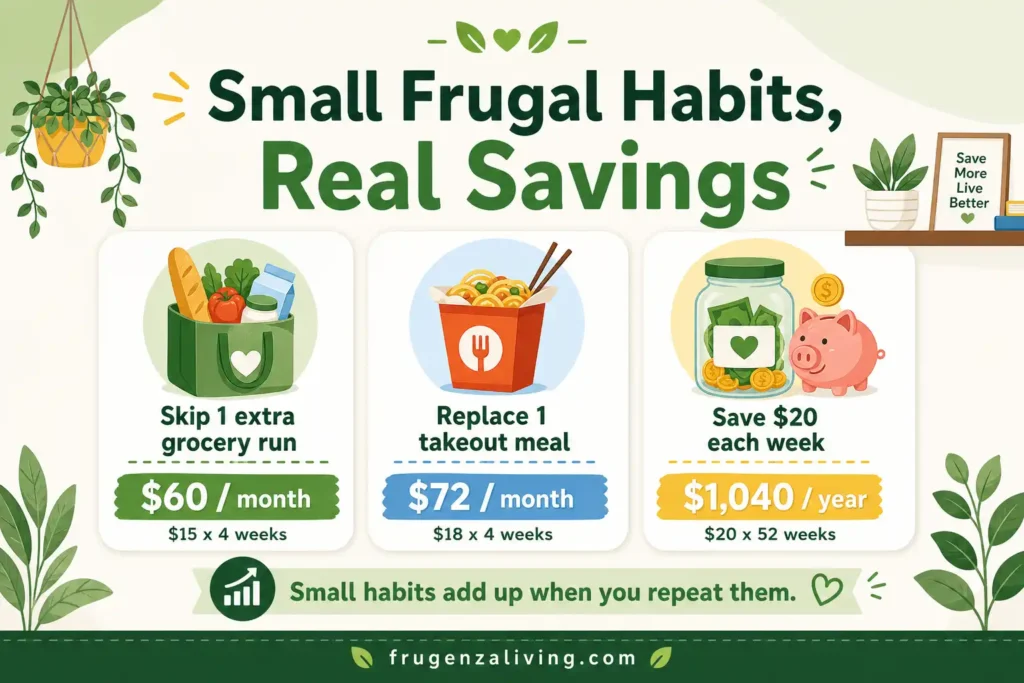
Avoiding just one unnecessary $15 grocery run each week can save about $60 per month.
That is not dramatic.
But it is repeatable.
2. Delay Non-Essential Purchases
Delaying purchases is one of the most practical frugal habits because it does not require you to say “never.”
It only asks you to wait.
When you want something that is not urgent, add it to a buy-later list and wait 24–48 hours.
If you still want it and it fits your budget, you can decide calmly. But many wants fade once the emotion passes.
This habit works especially well for online shopping, sale items, home decor, clothes, gadgets, and small “I deserve it” purchases.
The point is not to shame yourself for wanting things.
The point is to stop buying at the peak of emotion.
If impulse buying is a common issue, learning how to control spending habits can help you build a stronger pause before purchases.
3. Remove Spending Triggers Before They Reach You
Many frugal lists tell you to “use willpower.”
But willpower is not always reliable when you are tired, bored, stressed, or scrolling at night.
A better frugal habit is removing spending triggers before they reach you.
That might mean:
- unsubscribing from sale emails
- turning off shopping app notifications
- removing shopping apps from your home screen
- avoiding online stores when bored
- not saving your card on every website
This saves money because it prevents temptation before you need discipline.
You are not trying to win a battle every day.
You are making the battle appear less often.
That is why this is one of the frugal habits that actually save money: it reduces exposure to spending before the decision even begins.
4. Repeat a Few Simple Meals You Actually Like
You do not need complicated meal planning to save money.
You need a few simple meals you can repeat when life gets busy.
For example:
- eggs and toast
- rice bowls
- pasta with simple sauce
- soup and bread
- chicken with vegetables
- sandwiches and fruit
- stir-fried leftovers
The goal is not to eat boring food forever.
The goal is to make takeout less automatic.
Replacing one $18 takeout meal each week with a simple meal at home can save about $72 per month.
Again, the power is repetition.
A simple repeat meal that saves money every week is better than an ambitious meal plan you quit after five days.
One practical habit that can save money quickly is learning how to reduce grocery spending without making meals complicated.
5. Create a No-Spend Waiting List
A no-spend waiting list is different from telling yourself you can never buy anything.
It is simply a place to write down things you want instead of buying them immediately.
You can review the list once a week or once a month.
Some items will still feel useful.
Many will not.
This habit helps because it separates real needs from temporary wants.
It also gives you a record of your impulses. You may notice patterns: maybe you want to shop when you are stressed, bored, or comparing yourself to others.
These habits become easier to maintain when you turn them into a simple frugal routine you can follow every day.
That awareness can save more money than one-time couponing.
A waiting list is simple, but it can quietly stop dozens of unnecessary purchases over time.
6. Buy Fewer but Better Basics
Being frugal does not always mean buying the cheapest option.
Sometimes cheap becomes expensive when the item breaks, wears out, or needs replacing too often.
This is especially true for things you use regularly:
- shoes
- work clothes
- kitchen tools
- bags
- basic furniture
- reusable containers
- everyday appliances
The goal is not luxury.
The goal is usefulness.
A “cheap once” purchase may feel like saving money today, but a useful item that lasts for years can be the better frugal choice.
This habit also helps reduce clutter because you stop buying several weak versions of the same thing.
Buy fewer.
Use longer.
Replace less often.
7. Repair Before Replacing
Repairing before replacing can save real money, but only when the repair makes sense.
Not everything is worth fixing.
Use a simple repair test:
Repair it if it is cheaper, simple, and still useful.
Examples include:
- sewing a loose button
- cleaning shoes properly
- replacing a small part
- maintaining a bike
- fixing a zipper if the item is still good
- doing basic home or item maintenance
This habit saves money by extending the life of things you already paid for.
But it should not become extreme.
If the repair costs almost as much as replacement, or the item is no longer useful, replacing it may be the better choice.
Frugality is not about fixing everything.
It is about making the smarter choice.
8. Automate Small Savings Before You See the Money
Saving can be hard when you wait until the end of the month.
There is often nothing left.
That is why small automatic savings can be a powerful frugal habit.
Even $10, $15, $20, or $25 per week can build momentum.
For example:
$20 per week = $1,040 per year
That may not sound life-changing in one week, but over a year, it becomes real money.
Automation helps because it removes the daily decision.
You do not have to feel motivated every time.
The habit happens before the money gets absorbed into random spending.
This is one of the simplest frugal habits for beginners because it does not require a big lifestyle change.
These habits become more powerful when you can stay consistent with a budget over time.
Frugal Habits That Look Smart but May Not Be Worth It
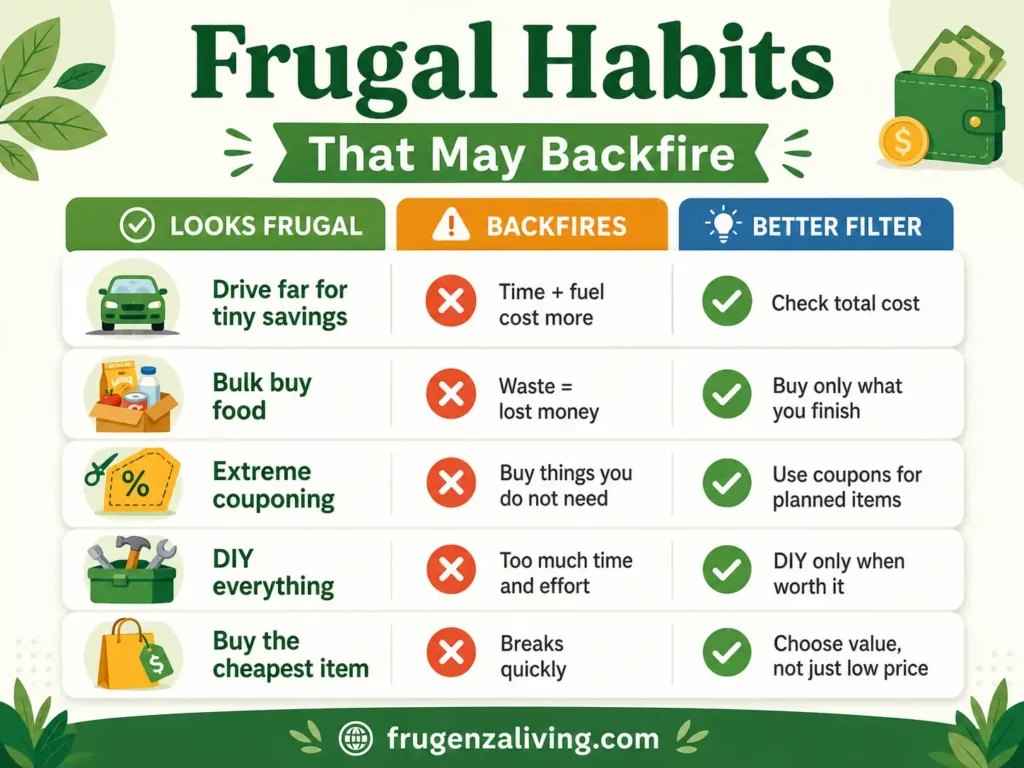
Some habits look frugal but do not always save much in real life.
Use this table as a filter:
| Habit | Why It Can Backfire | Better Filter |
|---|---|---|
| Driving far to save a few cents | Fuel and time may cost more | Check total cost, not just price |
| Bulk buying food you may waste | Unused food becomes lost money | Buy bulk only for items you finish |
| Extreme couponing | Can lead to buying things you do not need | Use coupons for planned purchases |
| DIY everything | Time cost can be too high | DIY only when it is simple and worth it |
| Buying the cheapest item | It may break quickly | Choose value, not just low price |
This is where many people misunderstand frugality.
The goal is not to look frugal.
The goal is to actually save money.
What I Noticed After Keeping Only the Habits That Worked
At one point, I tried too many frugal tricks.
Some helped. Some made life more complicated than necessary.
The real progress started when I stopped trying to do everything and kept only the habits that were repeatable.
I checked what I had before buying more.
I delayed purchases.
I reduced spending triggers.
I made savings automatic.
Those habits were not dramatic, but they kept working quietly.
Over time, focusing on repeatable habits instead of random tricks became one of the foundations that helped me save over $15,000 in a year.
The real improvement came from keeping habits I could repeat even on busy weeks.
It was not because every habit was dramatic.
It was because the useful ones kept working quietly.
How to Choose Your Own Frugal Habits
Use this simple filter:
Save → Repeat → Reduce Stress
Ask:
- Does this habit save real money?
- Can I repeat it without hating it?
- Does it make my life easier or harder?
If a habit saves money but makes your life miserable, it may not be the right habit.
If it saves a little, repeats easily, and reduces waste, it may be worth keeping.
Start with one habit.
Let it become normal.
Then add another.
That is how frugal habits become part of your life instead of another project you abandon.
Why Frugal Habits Stop Working (And How to Catch It Early)
The hardest part of a frugal habit is not starting it.
It is noticing when it quietly stops.
Most frugal habits do not fail in the first two weeks. That is when motivation is still high and the change feels deliberate. They tend to fail around the two to three month mark — after the habit has become routine enough that you stop paying attention to it, but before it is automatic enough to run without any conscious input at all.
This is sometimes called habit decay: the gradual erosion of a behavior that once felt solid.
It rarely announces itself.
Instead, it looks like this:
- The 24-hour delay on purchases starts shrinking to a few hours, then to “I’ll think about it while I check out”
- The pantry check before grocery shopping becomes a quick glance instead of an actual scan
- The automatic savings transfer gets paused “just this month” and then stays paused
- Simple repeat meals get replaced with takeout more often, but not all at once
None of these feel like failure in the moment. Each feels like a reasonable exception. But over several weeks, the exceptions become the new default.
There is a simple way to catch this before it fully reverses.
Once a month — not once a week, which creates too much pressure — ask one question for each habit you have been building:
“Am I still doing this the way I originally set it up, or have I been quietly adjusting it to require less effort?”
If the answer is the second one, that is not a reason to restart from zero. It is a signal to reset one small part of the habit before the decay becomes a full reversal.
Frugal habits do not need to be perfect every week. But they do need a monthly check to catch the small drifts before they become large ones.
A habit that saves money quietly for two years is more valuable than one that saves money intensely for six weeks and then disappears
FAQ
What frugal habits actually save money?
Frugal habits that actually save money include checking what you already have before shopping, delaying non-essential purchases, removing spending triggers, repeating simple meals, repairing before replacing, buying fewer but better basics, and automating small savings.
What is the most effective frugal habit?
The most effective frugal habit is the one you can repeat consistently. For many people, checking what they already have before buying more and delaying impulse purchases save the most money because they prevent unnecessary spending before it happens.
Do small frugal habits really add up?
Small frugal habits can add up when they repeat. Saving $5 once may not matter much, but saving $5 every week becomes meaningful over time. A habit that reduces spending repeatedly is often more powerful than a one-time money-saving trick.
What frugal habits are not worth it?
Frugal habits may not be worth it if they save very little but cost too much time, stress, or energy. Driving far to save a few cents, buying bulk food you waste, or choosing cheap items that break quickly can backfire.
How do I make frugal habits stick?
To make frugal habits stick, choose habits that save real money, are easy to repeat, and do not make life harder. Start with one habit, repeat it until it feels normal, then add another. Simple habits are easier to maintain than extreme rules.
Conclusion
Not every frugal habit is worth keeping.
The best ones are repeatable.
They save money more than once. They reduce waste. They prevent impulse spending. They make your money feel easier to manage.
You do not need extreme habits to become more frugal.
Start with one useful habit.
Check what you already have. Delay one purchase. Remove one spending trigger. Automate one small saving.
Then repeat.
The best frugal habits are not the loudest.
They are the ones that quietly save money every time you repeat them.

The ideas shared here come from real-life experience and practical habits that actually work.
→ Read more about Jeffi
- No Spend Month Challenge for Beginners: A 30-Day Plan - September 24, 2026
- Low Buy Month Challenge: Realistic Rules for 30 Days - September 23, 2026
- How to Stop Buying Groceries You Already Have - September 20, 2026