You notice that clothing purchases have become automatic.
One possible rule is:
I can buy one planned clothing item this month.
Another is:
I will buy no new clothing for 30 days.
Both target the same problem, but they change your behavior in very different ways. One keeps the spending decision open under tighter limits. The other temporarily removes that decision.
That is the useful question behind low buy vs no buy: not which challenge sounds more disciplined, but which rule changes the behavior you actually want to change without creating unnecessary friction elsewhere.
Use the least restrictive rule that reliably changes the spending behavior you actually want to change.
One terminology note matters before comparing them. People do not use no-buy and no-spend in exactly the same way. Here, no-buy means temporarily stopping new purchases in a targeted discretionary category. A broader freeze across most new discretionary spending is better treated as a no-spend challenge.
One Practical Way to Compare Them: Decision Cost vs Restriction Cost
A low-buy rule still allows some discretionary spending.
You might permit one clothing purchase, set a restaurant limit, or allow replacements without expanding what you own.
That usually creates lower restriction cost because more flexibility remains.
But you still have to make decisions:
- Does this fit the rule?
- Is this really a replacement?
- Is this worth using my allowance?
- Should I wait?
That is decision cost.
A no-buy rule does the opposite. For the targeted category, the answer is predetermined for a period: no new purchases except clearly defined exceptions.
That can reduce decision cost because you stop reopening the same purchase question. But the restriction itself becomes stronger.
This is a practical comparison framework, not formal behavioral-science terminology.
In 2017 research, the Consumer Financial Protection Bureau found that consumers often wanted to manage spending but could spend more than intended, and that budgets or plans were not always used at the actual moment of purchase.
The CFPB did not study low-buy or no-buy challenges. The relevant takeaway is narrower: a spending rule is only useful if it helps when the decision actually happens.
If limited discretionary spending genuinely needs to remain, the full low buy month challenge shows how to build boundaries without turning every category into a ban.
Strictness Has Three Levers
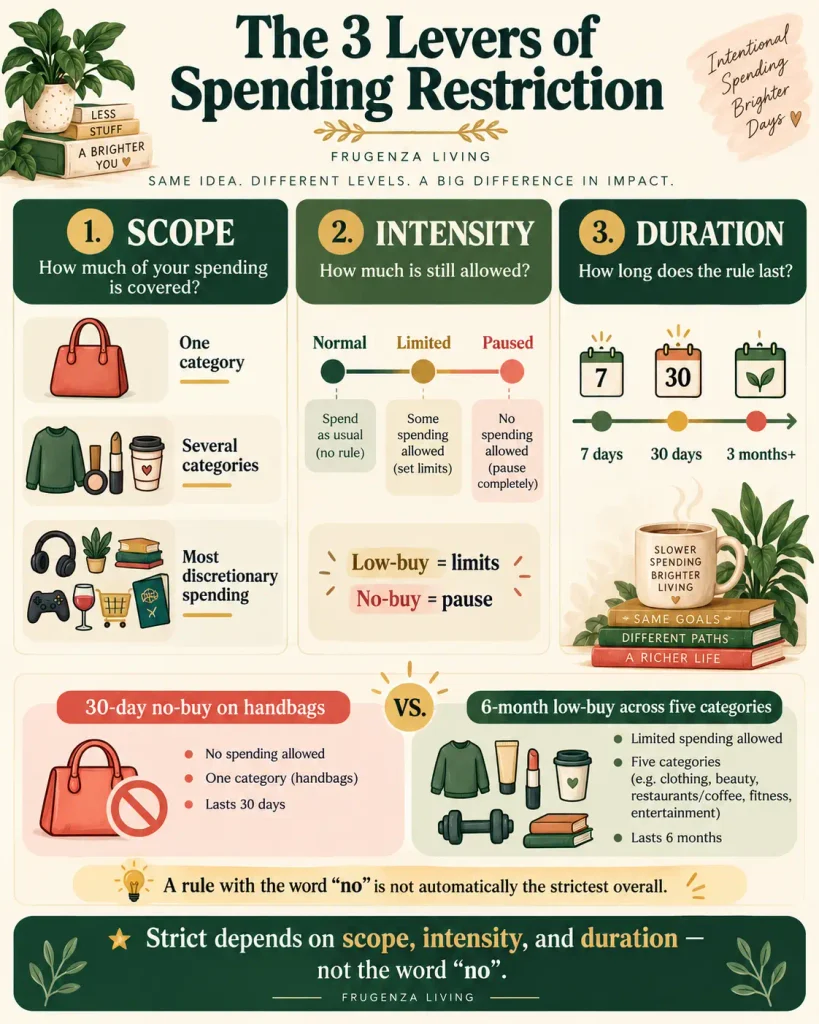
“No-buy is stricter” sounds obvious, but practical strictness depends on more than whether the word no appears in the rule.
There are three levers:
Scope — How many categories does the rule cover?
Intensity — How much spending remains possible inside each covered category?
Duration — How long does the restriction last?
A 30-day no-buy on handbags may be less restrictive overall than a six-month low-buy covering clothing, restaurants, hobbies, beauty, and entertainment.
Instead of asking:
Which challenge is stricter?
ask:
How broad is the rule, how strong is the restriction, and how long will it last?
Low Buy vs No Buy Decision Compass
Use this as a routing tool, not a scorecard. There is no universal winner.
Here, low-buy means limiting purchases; no-buy means temporarily pausing new purchases in a targeted category.
Low Buy vs No Buy Decision Compass
Here, low-buy means limiting purchases. No-buy means temporarily pausing new purchases in a targeted category.
Low-Buy
Lean this way when:- some spending genuinely needs to remain;
- a measurable limit is useful;
- moderation does not become constant negotiation.
No-Buy
Lean this way when:- the category can realistically pause;
- repeated decisions are part of the problem;
- each allowed purchase tends to reopen the habit.
Category Hybrid
Consider this when:- different categories need different rules;
- one category needs a pause;
- another still deserves limited spending.
| Comparison | Low-Buy — Limit | No-Buy — Pause |
|---|---|---|
| Default | Limited yes | Temporary no |
| Flexibility | Higher | Lower |
| Decision load | Higher | Lower |
| Main risk | Rule negotiation | Overrestriction or rebound |
| Useful when | Spending needs boundaries | The decision needs removing |
The name matters less than what the rule still lets you decide. Look at what remains allowed, what gets paused, and how often you still have to negotiate with yourself.
When repeated decision-making itself is the problem, a broader temporary freeze may be easier to follow than a collection of small allowances. The no spend month challenge for beginners covers that implementation in depth.
Use the Minimum Effective Restriction
The best rule is not automatically the toughest one.
Suppose books are your problem category. If “one new book only after finishing something I own” reliably changes the pattern, a total ban may add friction without adding much benefit.
Clothing might behave differently.
Imagine setting a two-item allowance and spending the month asking:
“Does this count?”
“Can this be an exception?”
“I still have one purchase left—should I use it?”
In that case, flexibility may be preserving the negotiation rather than solving it.
The Minimum Effective Restriction principle is simple:
Use enough restriction to change the behavior, but no more than the problem requires.
Watch for Signs the Rule Is Mismatched
A low-buy may be too loose when:
- limits repeatedly turn into loopholes;
- unused allowance feels like something that should be spent;
- every purchase starts another negotiation;
- spending stays close to the old pattern.
A no-buy may be too rigid when:
- you stockpile before starting;
- the category repeatedly needs legitimate exceptions;
- the rule is much broader than the actual problem;
- the restriction ends in immediate catch-up spending.
One imperfect purchase does not prove the method failed. Look for repeated friction.
Also notice what keeps bringing the purchase back. If shopping is mainly serving stress, boredom, comfort, or reward, changing the spending rule may leave the deeper trigger untouched. The guide on stopping spending money to feel better addresses that problem directly.
Different Categories Can Use Different Rules
You do not have to choose one identity for your entire financial life.
One household could use:
No-buy: new home decor.
Low-buy: two planned restaurant meals per month.
Normal spending: groceries, medicine, bills, and other genuine needs.
That is not a third complicated challenge system. It is simply using different levels of restriction for different problems.
It also explains why the method that produces the lowest spending during the challenge is not automatically the most useful.
A no-buy could create very low spending for one month and then a large rebound. A low-buy could allow more spending during the experiment but produce a boundary that remains useful afterward.
The better question is:
Did the rule change the unwanted behavior without creating a larger problem somewhere else?
Switch When the Rule Gives You Evidence
Move one category from low-buy toward temporary no-buy when the cap is constantly renegotiated, spending barely changes, or one permitted purchase repeatedly leads to another.
Move from no-buy toward low-buy when legitimate purchases keep requiring exceptions, the restriction covers more than the actual problem, or ending the challenge creates strong catch-up spending.
Changing the rule is not failure. It is information about what level of restriction actually works.
If you are still unsure, a seven-day no-spend week challenge can act as a short diagnostic before you commit to a longer restriction.
Low-buy and no-buy are not competing identities.
They are different tools for different decision problems.
Choose the least restrictive rule that reliably solves the problem in front of you.

Read about Jeffi and Frugenza Living
- How to Lower Your Cell Phone Bill Without Switching Carriers - September 29, 2026
- Low Buy vs No Buy: How to Choose the Right Rule - September 27, 2026
- No Spend Month Challenge for Beginners: A 30-Day Plan - September 24, 2026