
To lower your cell phone bill without switching carriers, start with four checks: remove charges you do not use, verify discounts you may qualify for, compare cheaper plans on the same account, and protect device credits or features that could disappear after a change. For U.S. mobile accounts, compare what you will actually pay after installments, credits, add-ons, taxes, fees, and any benefit you would replace with your own money.
Also record how many months remain on each device payment and promotional credit. The cheapest choice today may not be the cheapest choice over the next year.
Using the same network through an MVNO or sister brand is still a provider change, so it is outside this guide.
Start With the Decision Your Account Actually Needs
Start with the condition that matches your account.
| If your account looks like this | Check this first |
|---|---|
| You pay for an add-on you no longer use | Confirm removal will not affect a promotion, then ask for the new account total |
| You may qualify for a discount | Ask about eligibility, verification, stacking rules, and the total after it is applied |
| You still receive device credits | Find the credit amount, months remaining, and eligible-plan requirements before changing plans |
| Your phone is paid off and no credit remains | Compare plans against the features and data you actually use |
| You have several phone, watch, or tablet lines | Check each line’s need, device balance, and effect on the whole-account price |
| Every alternative costs more after adjustments | Keep the current setup and choose the next date when the math could change |
A cheaper service tier can eliminate a larger credit. Removing one line can change multi-line pricing. Canceling a useful perk can create a replacement expense.
If the phone bill is only one part of the pressure, you can review your other household bills separately without turning this decision into a full household audit.
Build a Baseline Before You Ask for a Better Price
Open your two most recent bills and separate the recurring amount into service, device installments, promotional credits, add-ons, extra or connected lines, and taxes or fees. Comparing two statements can reveal a new charge or an expired credit.
Then check several months of data and hotspot use if available. Lower usage matters only if it gives you access to a cheaper suitable plan or avoids a usage-based charge. More Wi-Fi does not by itself reduce the price of a fixed unlimited plan.
On one note, record your recurring bill, remaining device balance, months left on payments, monthly promotional credit, months left on that credit, and features you must keep. Do not assume the installment and credit end together unless the terms show that they do.
Unused add-ons can be a clean target, but verify what they do before canceling them. For device protection, compare the premium and deductible with your ability to replace the device.
Check AutoPay and paperless billing separately: plan eligibility, qualifying payment methods, start date, and whether the quoted price already includes the discount.
Also ask the carrier to check employer, teacher, military, age-based, or other affiliation discounts that may apply. Availability and stacking vary. Ask what proof is required, whether existing credits change, and what the full account total becomes.
Compare the Whole Bill Over the Same Period
Start with the recurring carrier bill:
Recurring carrier bill = service + device installments + add-ons + taxes/fees − credits and discounts that still apply.
Then keep monthly and one-time costs on the same time scale.
Recurring monthly savings = monthly carrier-bill reduction − recurring replacement costs you will actually pay.
Net savings over a chosen period = total cost without the change over that period − total cost after the change over the same period.
The after-change total should include replacement costs and relevant one-time charges, minus relevant one-time credits. If a price, payment, discount, or credit changes during the period, calculate each stage separately and add the stages. Do not count a fee or credit again if it is already included in a quoted total.
Your no-change baseline must also follow time. If a device payment and its credit would end four months from now anyway, that automatic drop is not entirely savings created by a plan change.
This one-line example uses a $65 service charge after existing service discounts, a $30 device installment, a $22 device credit, a $12 unused add-on, and $5 in taxes/fees. A cheaper plan would reduce service to $50 but make the $22 credit ineligible.
Whole-bill example
$90 Bill, Three Choices While the Credit Continues
Illustrative example — USD; not a carrier offer. The 12-month comparison assumes the listed device payment and credit continue for at least 12 months.
- Service
- $65
- Device installment
- $30
- Device credit
- −$22
- Optional add-on
- $12
- Taxes/fees
- $5
Total: $90/month
Baseline
- Service
- $65
- Device installment
- $30
- Device credit
- −$22
- Optional add-on
- $0
- Taxes/fees
- $5
Total: $78/month
Save $12/month; $144 over 12 months
- Service
- $50
- Device installment
- $30
- Device credit
- $0
- Optional add-on
- $0
- Taxes/fees
- $5
Total: $85/month
Save $5/month; $60 over 12 months
Why B wins for this period: C lowers service by $15 but loses a $22 device credit, leaving C $7 per month above B. B and C are alternatives, so do not add their savings.
Before approving a quote: confirm total account cost, credits kept or lost, months remaining, discount expiration, effective date, and one-time charges.
Need a copy beside your bill? Use your browser’s Print or Save as PDF command. Final print layout depends on your browser and site theme.
A lower plan price matters only after you know what disappears, what you would replace, and how long each number lasts.
Now suppose the $30 installment and $22 credit both have only four months left. Keeping B all year costs $78 for four months and $70 for eight months, or $872. Downgrading immediately to C costs $85 for four months and $55 for eight months, or $780.
A staged strategy is cheaper under the same assumptions: remove the add-on now, keep the eligible plan and credit for four months, then move to the $50 plan when the credit ends. That costs $78 for four months plus $55 for eight months, or $752—$28 below C and $120 below keeping B all year.
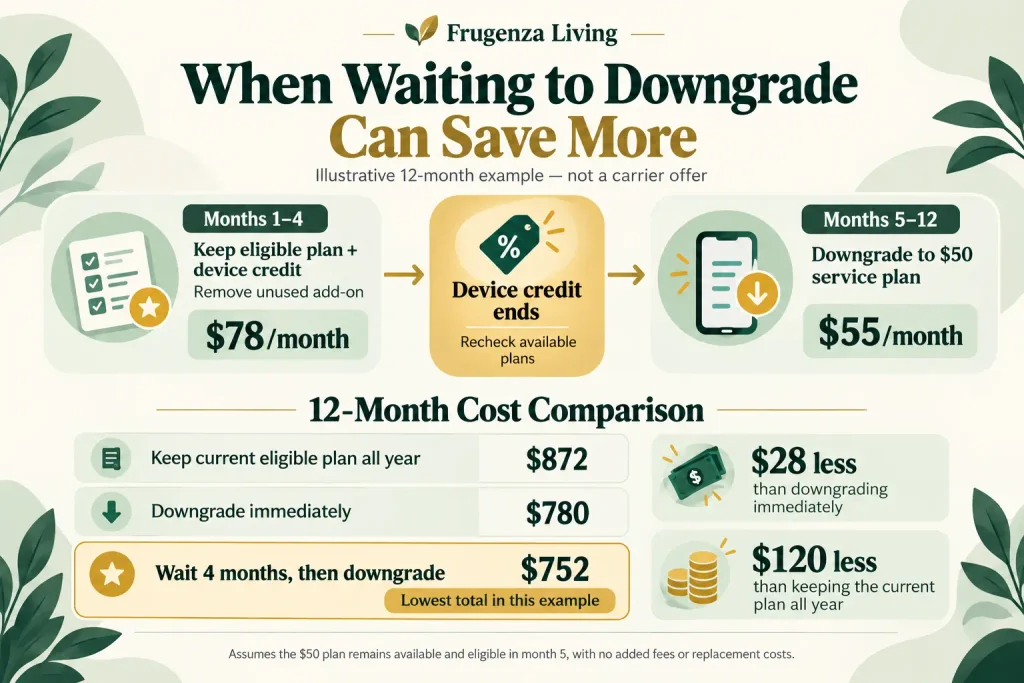
This assumes the $50 plan is still available, the account remains eligible, the change starts in month five, and no new fee or replacement cost appears. Future offers are not guaranteed. The decision is therefore not just which plan, but when to change it. Recheck available offers when the credit ends.
Verizon illustrates why timing matters: its device-promotion terms say credits can stop if eligibility is no longer met, including certain plan changes or paying off a qualifying device agreement early. Requirements vary by promotion, so check your own deal: Verizon device deals and promotions FAQ.
Protect Useful Features Without Paying for Value You Do Not Use
Use recent data and hotspot history to judge plan fit. If hotspot access is needed for work, losing it may create another expense. If a bundled perk sits unused, its advertised retail value should not protect an expensive plan. The goal is to cut costs while keeping what you use, not preserve every feature by default.
For multi-line accounts, ask whether an unused phone, watch, or tablet line can be removed without changing device obligations or promotions. Also ask whether your account allows different plan tiers by line and what that would do to the total and each credit. Do not assume every carrier or legacy plan supports mixed tiers.
When a device is paid off, keeping it can preserve the lower bill rather than automatically starting another installment. Treat a new phone as a new purchase decision, not the default next step.
If wireless and home internet are bundled, review the internet side of the bundle before unbundling. A lower wireless charge is not a net saving if another bill rises by more.
Moving from postpaid to prepaid under the same brand is more than a routine downgrade. Treat it as a service migration and verify device balances, promotion consequences, features, and billing terms separately.
Prepare the Account Before You Contact the Carrier
Before contacting support, make sure the account owner or an authorized user is available to complete verification and approve changes. Keep the note you built earlier in front of you.
Start with one request:
“I’d like to stay with this carrier. Please check my account for ways to lower the recurring total without adding a line or buying a device. Before changing anything, please show me the new total.”
When an option appears, verify it:
“Please include device installments, credits, taxes and fees or their estimate, and any one-time charges. Which credits or perks would change, how long does the discount last, and when does it take effect? Please don’t apply the change until I approve those details.”
A loyalty or retention offer is not automatically cheaper. Put it through the same period-based comparison, keeping one-time credits separate from recurring reductions.
If no option beats your current setup after lost credits and replacement costs, doing nothing is a valid result. Choose the event that will trigger another comparison.
Verify the Bill and Set the Next Decision Date
Save the chat transcript, order summary, or reference number. Check the first affected bill and the next full bill against the quote. The first statement can contain proration or catch-up credits, so compare recurring line items, not just the final total.
Confirm the service price, device payment, promotional credit, removed add-on, new discount, and any one-time adjustment. If something differs, use the saved quote and reference number when asking the carrier to explain or correct it.
Once the recurring amount is confirmed, update your monthly budget with the amount that actually appears.
Then set one review trigger: the month a device payment or promo credit ends, a temporary discount expires, or your usage changes enough to make another plan relevant. Run the comparison again at that point.
Lowering a cell phone bill without switching carriers is not about finding the lowest plan price once. It is about choosing the lowest relevant cost for the period ahead, protecting credits worth more than an immediate downgrade, and changing course when the account economics change.

Read about Jeffi and Frugenza Living
- How to Lower Your Cell Phone Bill Without Switching Carriers - September 29, 2026
- Low Buy vs No Buy: How to Choose the Right Rule - September 27, 2026
- No Spend Month Challenge for Beginners: A 30-Day Plan - September 24, 2026