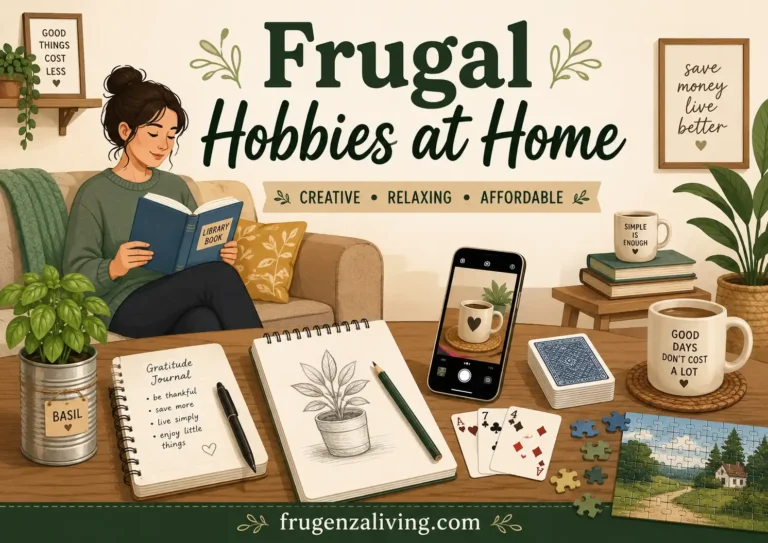
A $19 beginner craft kit can look like an affordable way to spend your evenings. Two weeks later, the hobby seems to need better tools, more colors, storage boxes, replacement supplies, and a paid class.
The hobby was cheap to enter, but it was not cheap to maintain.
The best frugal hobbies at home are not necessarily the activities with the lowest advertised starter price. They are activities you can enjoy repeatedly without turning every session into another shopping decision.
A genuinely affordable hobby should fit your available energy, space, time, and existing supplies. It should also remain enjoyable when you use the basic version rather than the most polished or expensive setup.
This guide focuses on repeatable hobbies you can return to over time—not one-time free activities, weekend plans, or self-care routines.
Quick answer: Good frugal hobbies at home include library reading, journaling, creative writing, sketching, reused-paper crafts, smartphone photography, pantry cooking projects, mending, plant propagation, bodyweight movement, free skill practice, and games you already own.
Editor’s note: This article provides general frugal-living education. Costs, library access, physical ability, living space, and available materials vary by household and location.
What Makes a Home Hobby Truly Frugal?
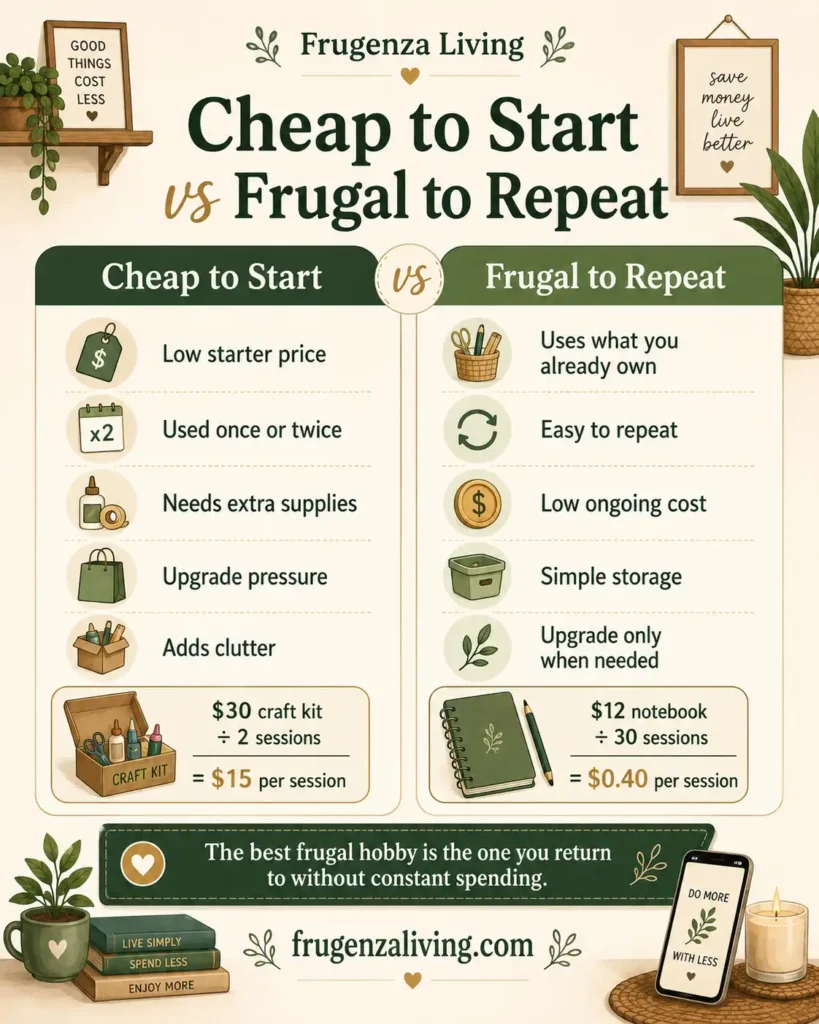
A low startup cost is useful, but it does not tell you whether a hobby will remain affordable.
Some activities are inexpensive during the first week because the beginner version requires only one item. The ongoing version may introduce recurring supplies, subscriptions, storage, replacement parts, classes, or the feeling that better equipment is necessary.
Look at four types of cost:
- Startup cost: What must you buy before the first session?
- Repeat cost: What must be replaced or renewed regularly?
- Storage cost: How much space will equipment and finished projects require?
- Upgrade pressure: How quickly does the hobby encourage more advanced gear?
A practical way to compare hobbies is:
Cost per enjoyable session = Total hobby spending ÷ Number of sessions actually completed
A $30 craft kit used twice costs about $15 per session. A $12 notebook used for 30 writing sessions costs about $0.40 per session.
This is a rough comparison rather than complete accounting. It does not include resale value, electricity, equipment shared across hobbies, or useful items created during the activity. Its purpose is to shift attention from the purchase price to actual use.
A free activity and a frugal hobby are also different.
Rearranging a shelf may fill one afternoon. Watching a free documentary may occupy one evening. Those can be worthwhile activities, but they do not automatically become hobbies.
A hobby involves some form of return. You read another book, improve another recipe, write another page, repair another item, or practice another skill.
Repeatability is what makes a hobby part of your routine rather than simply something free to do once.
If you are not ready to commit to a new hobby, start with a few frugal things to do at home and notice which activities you naturally want to repeat.
Will supplies, ingredients, or subscriptions be needed regularly?
Are better tools being promoted before current ones limit you?
Can everything fit in one drawer, folder, basket, or digital file?
Choose a Hobby by Your Real Constraint
The best hobby on paper may be a poor fit for your real life.
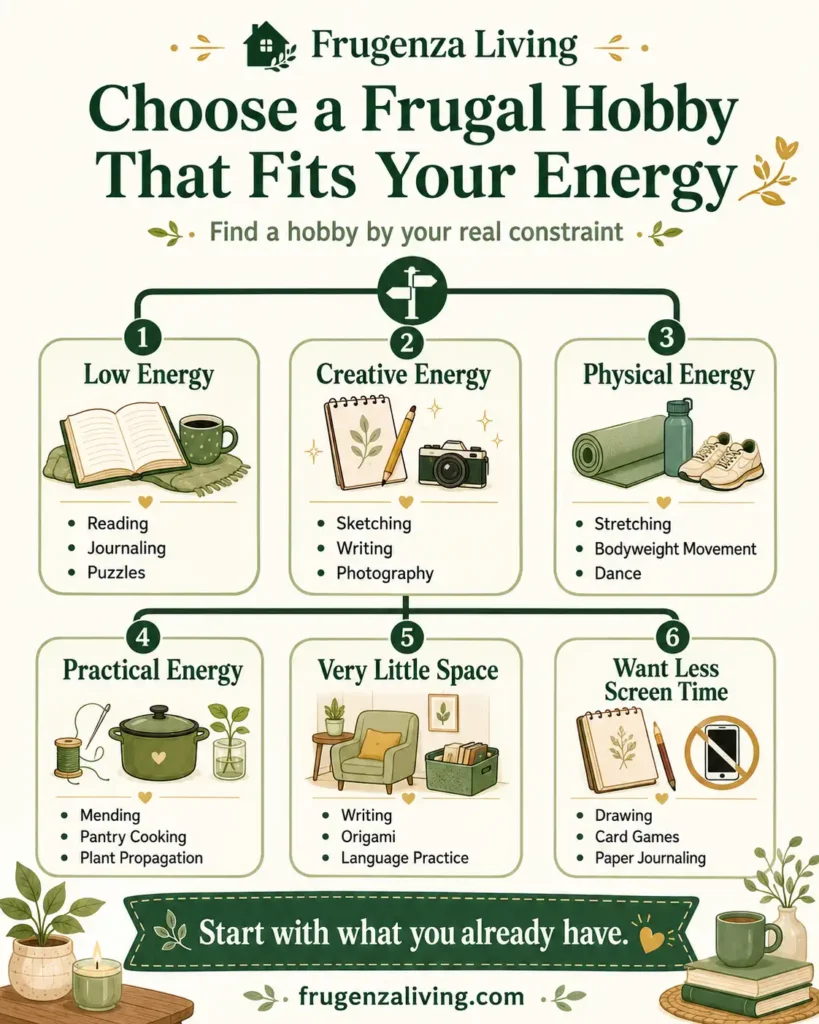
An activity can be inexpensive but still fail because it needs more concentration, space, cleanup, or uninterrupted time than you usually have. Instead of choosing from a giant list, begin with the condition that is most likely to stop you.
If you often feel tired after work, choose a hobby that can begin without preparation. Reading, journaling, coloring, and puzzles may be easier to return to than a project that requires setting up several tools.
If you want a creative outlet, sketching, writing, and smartphone photography give you room to improve without demanding a large collection of supplies.
If you want movement, stretching, dance, or bodyweight exercises may suit a small indoor space. The simplest version can begin before you buy equipment.
If you enjoy practical results, mending, pantry cooking, and plant propagation combine leisure with a useful skill. Their value comes from learning and repetition, not merely from completing a household chore.
People with very limited space may prefer writing, language practice, origami, reading, or photography because the materials can fit in a drawer or digital folder.
For less screen time, paper journaling, sketching, physical books, cards, and simple repair projects can create a clearer break from phones and computers.
Each idea below was screened against five practical limits:
- Required equipment
- Repeat costs
- Storage demand
- Upgrade pressure
- Ability to begin at home
Activities that generally require paid venues, specialist facilities, large dedicated equipment, or frequent travel were not included.
If your weekends often lead to unnecessary spending, try a few budget-friendly weekend activities built around hobbies you already enjoy.
12 Frugal Hobbies at Home Worth Trying
Quiet Hobbies for Slower Evenings
Quiet hobbies work well when you want something engaging without a complicated setup. They can also be paused and resumed easily, which matters when your free time is unpredictable.
1. Library Reading
Reading becomes especially frugal when you borrow rather than collect.
Start with one book and read for 20 minutes. Do not build an ambitious reading schedule immediately. The purpose of the first session is simply to see whether you want to return tomorrow.
Depending on local services, a library may offer printed books, ebooks, audiobooks, magazines, or digital learning platforms. Availability varies, so check what your own library provides.
For older works in the public domain, Project Gutenberg offers free legal ebooks.
The main spending trap is buying every recommended book before finishing the ones already borrowed or owned. A reading list is free. A rapidly growing unread bookshelf is not.
2. Journaling or Keeping a Commonplace Book
Journaling does not require a premium notebook or a carefully designed system.
Use an unfinished notebook, loose paper, index cards, or a simple digital document. You might record daily observations, memories, useful quotes, reading notes, questions, or ideas you want to revisit.
A commonplace book is particularly useful for people who do not enjoy writing about their emotions. Instead of producing a diary entry, you collect information and thoughts that interest you.
Begin with one page. Do not spend the first session choosing fonts, color codes, stickers, or layouts.
The spending risk is allowing decorative supplies to replace the writing itself. A plain notebook used regularly is more valuable than an expensive journal you are afraid to spoil.
Before buying new hobby equipment, try to enjoy a weekend without spending money and see whether the activity still holds your interest.
3. Creative Writing
Creative writing can begin with tools already available: paper, a basic word processor, or a notes application.
Write a short scene, poem, personal essay, fictional letter, or family story. A useful first exercise is describing a familiar room from the viewpoint of someone entering it for the first time.
The activity becomes a hobby when you return to the same story, build a collection of short pieces, or practice a specific technique.
Courses, specialized software, and writing memberships may become useful later. They are not required before you know whether you enjoy the actual work of writing.
The most common cost trap is purchasing instruction to create the feeling of progress before establishing a writing routine.
Creative Hobbies That Need Few Supplies
Creative hobbies often become expensive because supplies feel exciting even when they are not yet necessary. The goal is to choose a version where practice matters more than equipment.
Some hobbies can also become frugal self care ideas, especially when they help you slow down, create something, or spend less time scrolling.
4. Sketching and Doodling
You can begin sketching with an ordinary pen, pencil, and scrap paper.
Choose one household object and draw it for 20 minutes. Do not worry about producing a finished piece. Pay attention to shape, shadow, proportion, and texture.
Using the same object more than once can make improvement easier to notice. You may discover that observation, rather than better tools, is the first skill you need.
Professional pencils, markers, paper, and storage systems can improve certain kinds of artwork. Wait until your current materials clearly prevent you from trying a technique you already practice.
Buying art supplies is not the same as making art.
5. Origami and Clean Reused-Paper Crafts
Origami and simple paper crafts are useful for people who want a finished object without creating a large supply collection.
Begin with clean scrap paper, old magazines, or reused gift wrap. Choose one simple fold or project that can be completed during a short session.
This hobby works particularly well in small spaces because the supplies and finished pieces can remain limited.
Avoid using dirty food packaging or materials that are difficult to handle safely. Reused does not have to mean unsuitable.
Specialty paper may become worthwhile if you continue practicing more advanced folds. The cost rises when collecting patterned paper becomes more frequent than folding it.
A hobby can make your free time more meaningful, but you can also explore free things to do instead of shopping before buying any new supplies.
6. Smartphone Photography Projects
Smartphone photography is one of the most accessible creative hobbies because many people already own the main tool.
Instead of taking random pictures, give each session a small project:
- Photograph one object from five angles
- Follow one color throughout the house
- Practice window lighting
- Document ordinary household textures
- Capture one moment each day for a week
A defined project turns casual phone use into a repeatable practice.
You do not need a new camera to learn composition, framing, light, distance, or visual storytelling. Upgrading equipment makes sense only when you have identified a specific limitation that prevents the kind of photography you already do.
Practical Hobbies With Useful Results
Practical hobbies can feel rewarding because they produce something you can eat, repair, grow, or use. However, they remain hobbies only when the learning process itself is enjoyable.
7. Pantry Cooking Projects
Cooking dinner is a household task. A pantry cooking project becomes a hobby when you deliberately practice a technique, improve a recipe, or explore how familiar ingredients work.
You might:
- Improve one low-cost staple recipe
- Learn one basic sauce
- Find three uses for the same ingredient
- Compare two methods of cooking beans, rice, or vegetables
- Create a personal recipe notebook
Begin with food you would normally buy. This keeps the hobby connected to the household budget rather than creating a separate category of novelty ingredients.
The spending trap is buying specialty appliances, decorative tools, or ingredients that appear in only one recipe.
The skill should grow faster than the kitchen equipment.
8. Mending and Simple Upcycling
Mending can begin with a loose button, a small tear, or a hem that needs a simple repair.
Learn one technique at a time. Basic hand sewing may cover more everyday repairs than a beginner expects, and a small needle-and-thread kit requires little storage.
The satisfaction comes from understanding how an item is constructed and gradually becoming more confident with repairs.
Upcycling can also remain simple. You might shorten a garment, reuse fabric as a cleaning cloth, or repair a bag rather than redesigning an entire wardrobe.
Avoid buying a sewing machine, large fabric collection, or extensive tool set before you regularly complete basic repairs.
9. Plant Propagation or Windowsill Herbs
A small plant project can be affordable, but gardening is not automatically free.
Different plants require different propagation methods. Some cuttings grow in water, while others need soil, a particular season, or a different level of care. Check the needs of the specific plant before beginning.
You can start with one cutting from an existing plant or one herb you already use in cooking. A clean reused container may work when it is suitable for the method and has any drainage the plant requires.
Keep the project small enough to observe and learn from.
Decorative pots, rare varieties, fertilizers, grow lights, and plant collecting can quickly increase the cost. One healthy project teaches more than several neglected purchases.
Movement, Learning, and Play
These hobbies work well for people who want activity, mental challenge, or shared entertainment without collecting many physical supplies.
10. Bodyweight Movement or Stretching
Bodyweight movement can begin with available floor space and reputable free guidance.
Choose a short routine appropriate for your current ability. The first goal is not intensity. It is finding a form of movement you are willing and able to repeat.
You might practice basic mobility, gentle stretching, balance, or a short bodyweight sequence. Adapt the session to your physical condition and stop if a movement causes pain.
People with injuries, ongoing pain, or significant limitations should seek appropriate professional guidance before beginning unfamiliar exercises.
Mats, clothing, equipment, and memberships may support an established routine. They are not proof that the routine will happen.
11. Free Language or Skill Practice
Learning can become a hobby when you enjoy the process rather than treating every lesson as a productivity requirement.
Use library materials, public educational resources, free lessons, or tools you already have. Possible starting points include:
- Basic vocabulary in another language
- Typing practice
- Drawing fundamentals
- Spreadsheet skills
- Local history research
- A public-library tutorial
Complete one 15- or 20-minute lesson and write down three things you learned. That small record gives the next session a clear starting point.
The major cost risk is stacking courses and subscriptions. Finish or actively use one resource before adding another.
12. Puzzles, Cards, or Games Already Owned
Games become frugal when the focus remains on playing rather than collecting.
Revisit a deck of cards, unfinished puzzle, or board game already in your home. Solitaire, solo puzzle games, and single-player board games also count, so the hobby does not require a group.
Couples or families can rotate which person chooses the game. You might also borrow from friends or check whether a local library offers games.
To increase repeatability, create a small challenge: improve your time, learn a new card game, complete a puzzle section each evening, or revisit a game you have not played for a year.
A growing collection is not necessary for variety when the games you already own are barely used.
Hobbies That Need Spending Boundaries
Some hobbies are frequently described as cheap even though their cost can vary widely.
Crochet and knitting may begin with one hook or pair of needles, but yarn can become a collection. Baking may use ordinary ingredients, yet specialty pans and decorating supplies add up. Gardening can require soil, containers, tools, and ongoing plant care. Gaming may involve new hardware, subscriptions, downloadable content, or in-game purchases.
Photography, art, home improvement, and crafts have similar patterns. There is always a more advanced tool, a new material, or a better storage system available.
That does not make these hobbies financially irresponsible.
The important question is whether spending supports an activity you already do or substitutes for doing it.
A hobby stops being frugal when shopping for the hobby becomes more frequent than doing the hobby.
Useful boundaries include:
- Buy supplies for one active project
- Keep a written list of materials already owned
- Finish or abandon a project before replacing it with several new ones
- Wait before major upgrades
- Avoid buying storage to support unnecessary accumulation
- Set a monthly spending amount when repeat materials are essential
A paid hobby can still be frugal when the cost is planned, affordable, and connected to frequent enjoyment.
Try the Hobby Before Building the Setup
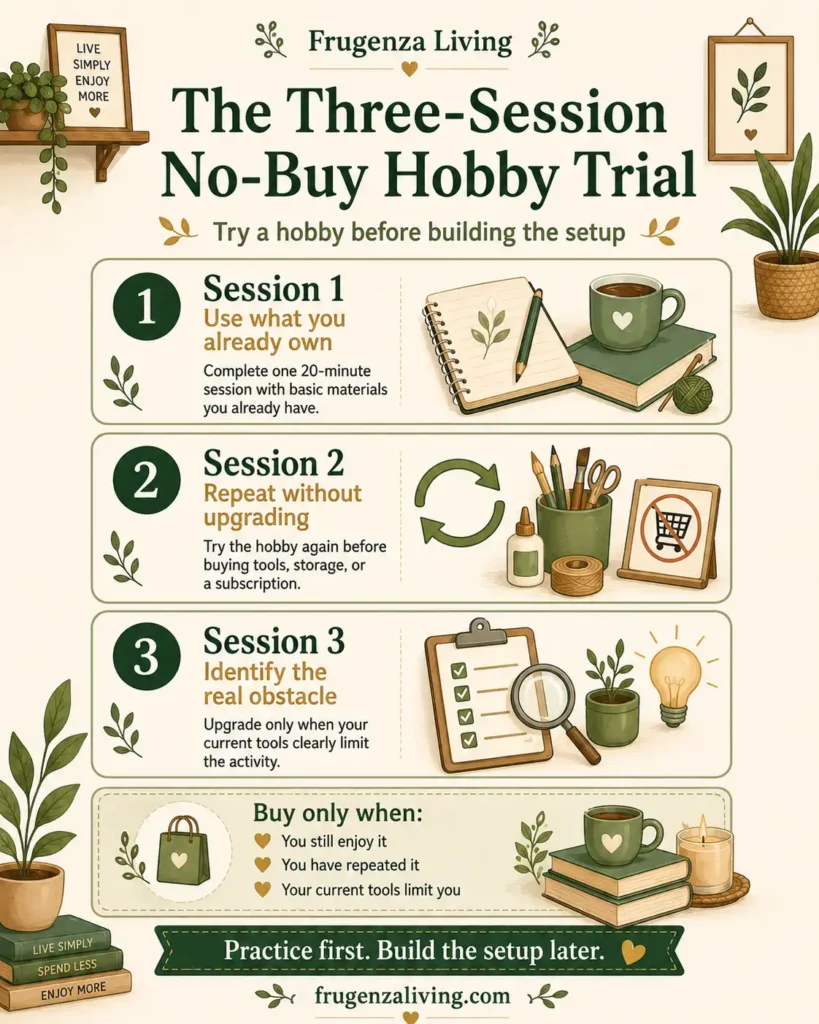
Many people shop first because purchasing supplies feels like commitment. In reality, commitment is demonstrated by returning to the activity.
A three-session trial creates enough experience to judge whether you enjoy the process without demanding a long-term promise.
The trial does not mean you can never spend money. It helps separate a real need from beginner excitement.
After three sessions, ask:
- Did I enjoy the activity while doing it?
- Do I know when I will do it again?
- Is one specific limitation getting in the way?
- Can I borrow, reuse, or buy secondhand before buying new?
- Will the purchase improve repeated use or only make the setup look more complete?
How to Keep a Frugal Hobby Frugal
A hobby often becomes expensive gradually rather than through one large purchase.
One new notebook, one subscription, or one tool may seem harmless. Over time, unused supplies accumulate and the hobby begins to require storage, maintenance, and attention.
Give physical supplies one defined boundary, such as a drawer, basket, shelf, or folder. When that space is full, use, donate, sell, or remove something before adding more.
Finish consumable supplies before replacing them. Borrow equipment when possible, especially for a trial. Consider secondhand tools when condition and safety are appropriate.
Use a waiting period before upgrades. A delay gives you time to see whether the need remains after another few sessions.
Review subscriptions regularly. Learning platforms, apps, software, and digital memberships can be easy to forget because they do not create visible clutter.
If the hobby genuinely requires ongoing supplies, create a modest monthly allowance. Planned hobby spending is not a failure of frugality. Money spent intentionally on an activity you repeatedly enjoy may provide better value than frequent impulsive entertainment.
Do not monetize a hobby unless you genuinely want the change.
Selling your work may introduce deadlines, customer expectations, platform fees, packaging, inventory, tax responsibilities, and pressure to produce. A hobby does not need to become a side hustle to justify its place in your life.
Which Hobby Should You Start Tonight?
Do not spend another week searching for the perfect hobby.
Choose one that matches what you have available tonight.
- List three useful resources already in your home.
- Decide whether you want quiet, creativity, movement, learning, play, or a practical skill.
- Choose an activity that fits within 20 minutes.
- Remove any requirement to produce a perfect result.
- Complete the first session without shopping.
- Decide when the second session will happen.
- Wait until repetition reveals a genuine limitation before spending.
For example:
- A notebook and pen can become journaling, creative writing, or sketching.
- A smartphone can support photography or language practice.
- A needle and thread can begin a mending habit.
- A library card can support reading and learning.
- A deck of cards can create solo or shared play.
- Basic pantry ingredients can become a cooking project.
Couples can share cooking challenges, puzzles, photography walks around the home, or language practice. Families can choose age-appropriate versions of games, drawing, or cooking projects. People living alone can build meaningful hobbies independently without treating solitude as a problem that must be fixed.
The goal is not to choose a hobby you will keep forever. The goal is to complete one honest session.
On nights when you do not feel like committing to a full hobby session, try one of these free nighttime activities at home instead.
Where Frugal Hobbies Fit in a Frugal Life
Affordable leisure is part of sustainable frugality.
A financial plan that removes every enjoyable activity can become difficult to maintain. Frugal living works better when it protects meaningful enjoyment while reducing spending that adds little value.
A broader frugal living for beginners approach can help you balance hobbies with other priorities. These realistic frugal living tips provide practical ways to set spending boundaries, while saving money without cutting everything explains why an affordable life does not need to feel empty.
If you want a one-time alternative to shopping or paid entertainment rather than a repeatable practice, these frugal things to do at home may be a better fit.
Frugal hobbies can also reduce the pressure to treat boredom as a shopping problem. Instead of browsing for something new, you return to a book, project, skill, game, or routine that already has a place in your home.
About this guide: These ideas were screened for repeatability, required equipment, ongoing cost, storage demand, home accessibility, and upgrade pressure—not simply because their starter price looks low.
Final Thoughts
The best frugal hobbies at home are not the hobbies with the most impressive supplies or the lowest advertised starter price.
They are activities you can return to without needing constant purchases, additional storage, or a more advanced setup every few weeks.
Choose a hobby that matches your energy, space, and interests. Use what you already own, complete three sessions, and spend only when a real limitation becomes clear.
You do not need to monetize the result, become highly skilled, or create something worth displaying.
Enjoying the process is enough.
A frugal hobby should give you more sessions than shopping decisions.
Frequently Asked Questions
What Are the Best Frugal Hobbies at Home?
Good options include library reading, journaling, creative writing, sketching, smartphone photography, pantry cooking projects, mending, bodyweight movement, and games already owned. The best choice is one you can repeat with little ongoing cost and minimal pressure to upgrade.
What Hobbies Can I Start With Things I Already Own?
You may be able to begin reading, journaling, creative writing, sketching, smartphone photography, card games, simple mending, pantry cooking projects, or free skill practice using materials and devices already available at home.
How Do I Keep a Cheap Hobby From Becoming Expensive?
Use existing supplies, limit storage space, borrow before buying, finish materials before replacing them, delay upgrades, review subscriptions, and buy only when your current tools create a specific and repeated obstacle.
What Are Good Low-Energy Hobbies at Home?
Reading, journaling, simple puzzles, coloring with existing materials, borrowed audiobooks, commonplace books, and quiet card games can work well when you want an activity that requires little preparation or cleanup.
What Are Some Screen-Free Frugal Hobbies?
Screen-free options include paper journaling, sketching, writing by hand, mending, origami with reused paper, cards, puzzles, physical library books, plant care, and gentle stretching.
Do I Need to Monetize a Hobby for It to Be Worthwhile?
No. A hobby can be worthwhile because it provides enjoyment, curiosity, practice, rest, or a sense of progress. Turning it into a side hustle may add costs, deadlines, administrative work, and pressure that change the experience.

Read about Jeffi and Frugenza Living
- No Spend Month Challenge for Beginners: A 30-Day Plan - September 24, 2026
- Low Buy Month Challenge: Realistic Rules for 30 Days - September 23, 2026
- How to Stop Buying Groceries You Already Have - September 20, 2026