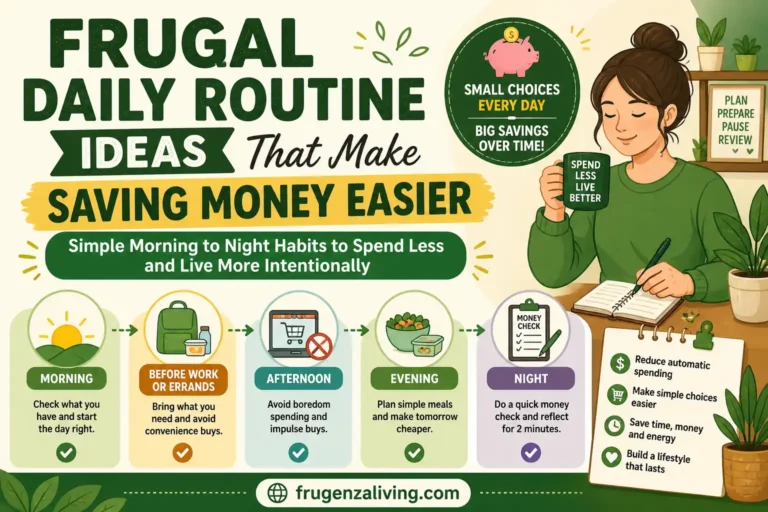
Spending often happens because the day gets busy.
You forget to plan lunch, so you buy something quickly. You scroll online when you feel tired, so a small purchase looks tempting. You get home with no dinner idea, so delivery feels easier than cooking.
That is why frugal daily routine ideas can be more useful than another long list of random tips.
A frugal routine does not need to be strict or extreme. It is simply a daily rhythm that helps you avoid automatic spending before it happens.
The goal is not to control every minute of your day.
The goal is to make the cheaper choice easier.
What Are Good Frugal Daily Routine Ideas?
Good frugal daily routine ideas include checking what you already have, planning simple meals, bringing lunch or snacks, avoiding impulse browsing, using a spending pause, and reviewing money briefly at night. These small daily actions reduce automatic spending without making frugal living feel extreme.
A Frugal Routine Is About Reducing Money Decisions
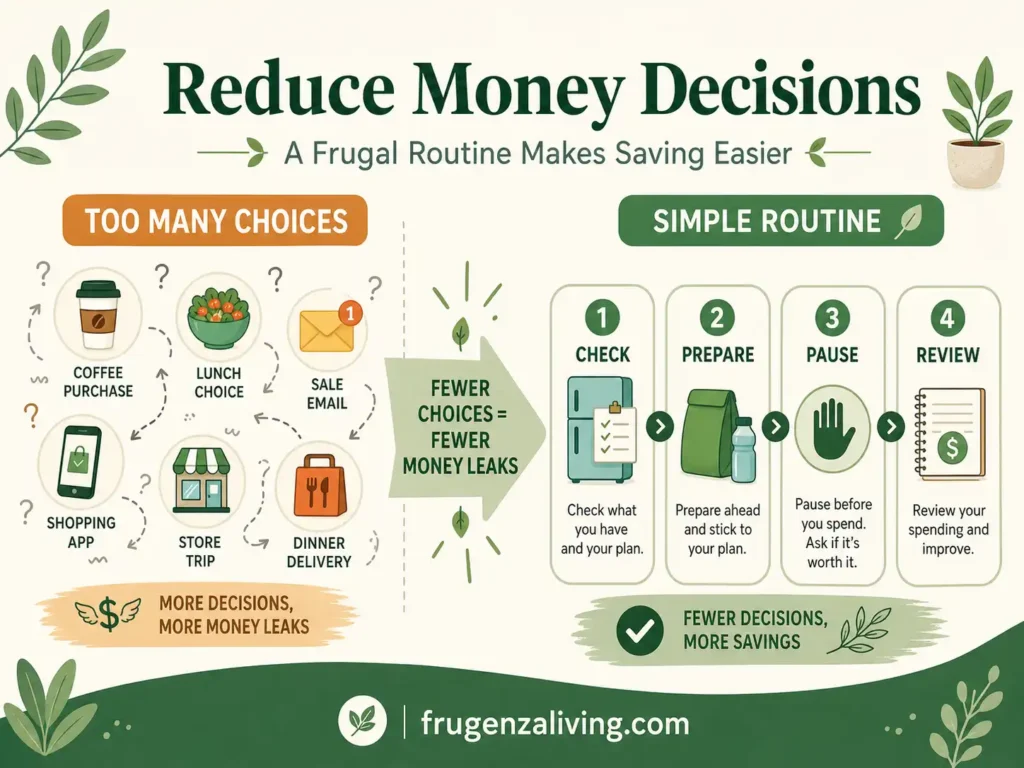
Most people do not overspend because they planned to. They overspend because the day creates too many small choices at the worst possible moments.
Should I buy coffee? Should I order lunch? Should I click this sale email?
Each choice feels minor. But when every small decision depends on willpower, frugal living becomes exhausting by midday.
Research on decision fatigue consistently shows that the more choices a person makes, the lower the quality of each subsequent decision. By the afternoon, your resistance to a $14 delivery order is genuinely weaker than it was at 8 AM — not because you care less about saving money, but because your brain has already spent energy on dozens of smaller calls.
A daily routine works differently from a list of habits.
Habits are behaviors you build one at a time. A routine is a structure that removes the decision before it even arrives. If coffee is already made, you do not decide whether to buy coffee. If lunch is already packed, you do not debate ordering at noon. If tomorrow’s dinner has a simple plan, you do not face an empty fridge at 7 PM when tiredness wins.
That is the specific job a frugal daily routine does — and what a list of habits alone cannot.
Frugal Daily Routine at a Glance
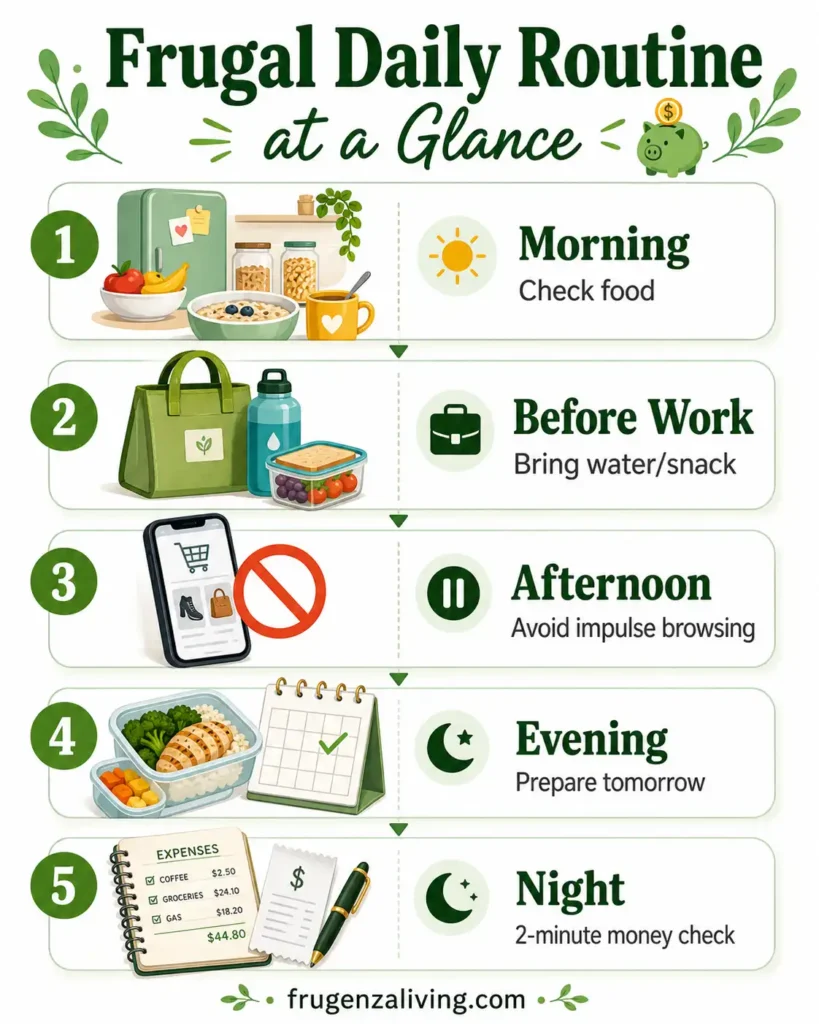
Here is a simple daily routine for frugal living:
| Time of Day | Frugal Routine Idea | Why It Helps |
|---|---|---|
| Morning | Check food and make coffee or breakfast at home | Reduces unplanned food spending |
| Before work or errands | Bring water, snack, lunch, or reusable bag | Prevents small convenience buys |
| Afternoon | Avoid browsing sales when tired or bored | Reduces impulse purchases |
| Evening | Prepare one simple idea for tomorrow | Avoids next-day panic spending |
| Night | Do a two-minute money check | Keeps awareness without guilt |
Think of this as a money saving daily routine, not a strict schedule.
You can adjust it based on work, school, family, or your normal routine.
Morning: Start With What You Already Have
The morning is where the day’s spending pattern gets set, not just where breakfast happens.
Most unplanned food spending starts here — not because people are careless, but because mornings are rushed. When you leave without a plan, you arrive somewhere hungry and unprepared. The nearest convenient option wins, and it almost always costs more than what you had at home.
A frugal morning routine does not need to be elaborate. It needs to answer one question before you leave: what do I already have?
- Make coffee or breakfast at home
- Check the fridge or pantry for what needs to be used
- Decide if last night’s leftovers can become today’s lunch
- Pack one thing — water, a snack, a container — before leaving
This habit prevents spending caused by forgetting, not spending caused by wanting. That distinction matters because the fix is a glance at the fridge, not more discipline.
Over time, these small habits can turn into a simple weekly saving routine that feels easy to maintain.
Before Work or Errands: Remove One Convenience Cost
The gap between home and wherever you are going is where small convenience spending lives.
A drink because you forgot your bottle. A snack because you left hungry. An extra stop because you did not group errands. A small delivery fee because you did not prepare.
None of these feel serious in the moment. Each is a decision made under mild pressure — slightly hungry, slightly rushed, slightly unprepared. That combination reliably produces the most expensive version of a simple problem.
Before you leave, remove one of those pressure points:
- Bring water
- Pack a snack or lunch
- Carry a reusable bag
- Group errands into one trip instead of several
You do not need to prepare everything. Just prepare the one thing that most often becomes an unplanned purchase.
Afternoon: Avoid Boredom Spending
Afternoon spending is not really about shopping. It is about energy.
By 2 or 3 PM, most people are running low. Tiredness, mild stress, and boredom create a specific kind of craving — not for a product, but for a small mood lift. An online store, a sale notification, or a food delivery app fills that craving with a dopamine response that feels like relief but arrives with a receipt.
This is why afternoon is when impulse purchases are most likely to happen — not because you want the item more, but because your resistance is lower and your need for a small reward is higher.
The frugal routine response is not “stop using your phone.” It is to interrupt the pattern before it completes:
- Create a 24-hour rule for non-essential items over a set amount
- Move shopping apps off your home screen — one extra tap is enough friction to break the automatic open-browse-buy loop
- Unsubscribe from sale emails; they are timed specifically for afternoon fatigue
- Replace the default response: a short walk, a glass of water, five minutes away from the screen
The goal is not to eliminate the urge. It is to not act on it automatically.
Evening: Make Tomorrow Cheaper
Evening is the leverage point most frugal routines miss.
What you do tonight directly determines what tomorrow costs.
If you go to bed with no plan, tomorrow morning starts rushed. Rushed mornings skip breakfast. Skipped breakfasts produce expensive lunches. Evenings with no dinner idea become delivery orders. The spending does not happen in the evening — it happens the next day, as a consequence of tonight’s inaction.
A frugal evening routine does not take long. It only needs to solve tomorrow’s most predictable problem:
- Pick one simple meal idea for tomorrow so you are not deciding tired
- Move leftovers to the front of the fridge so they get used, not forgotten
- Set out lunch containers so packing takes thirty seconds instead of five minutes
- Check tomorrow’s schedule so you can group any errands into one trip
- Write one small note if something needs to be handled — outsource the memory, not the money
You are not planning a perfect day. You are removing one predictable moment where spending usually wins.
Night: Do a Two-Minute Money Check
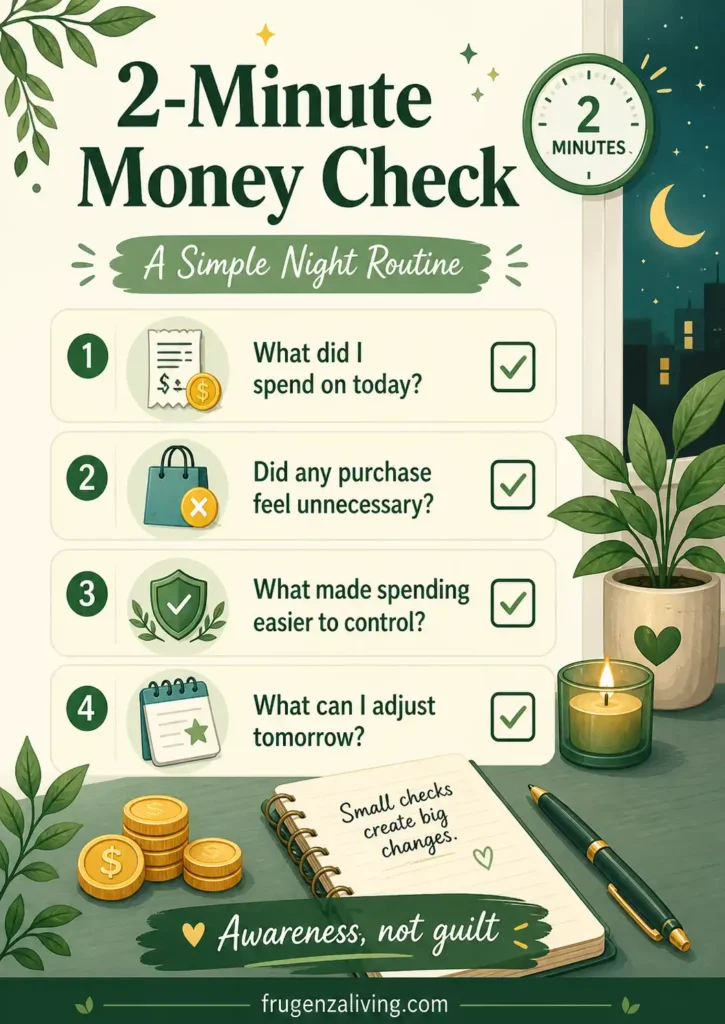
The night check has one job: keep awareness without creating guilt.
Most people avoid looking at their spending because the review feels like a verdict. The two-minute check works differently — it is not an audit, it is a pattern scan.
Ask four questions, then stop:
- What did I spend on today?
- Did any purchase feel automatic rather than intentional?
- What made the cheaper choice easier today?
- What is one thing I can prepare tonight to reduce tomorrow’s spending?
Write nothing down unless you want to. No spreadsheet required.
The reason this works over time is not because you catch every mistake — you will not. It is because patterns become visible before they become invisible habits. A delivery order on Monday feels like a one-time thing. Four delivery orders in a week only become visible if you looked.
Two minutes is short enough to do on a bad day. That consistency is what makes it valuable
A Simple Frugal Day Example
The routine looks different depending on your day. Here are two realistic versions.
If you work outside the home:
- 7:00 AM: Check the fridge, make coffee at home, pack lunch and a water bottle
- 8:00 AM: Leave with snacks so a mid-morning vending machine is not the only option
- 12:00 PM: Eat the lunch you packed instead of buying — even if it is simple
- 3:00 PM: Notice if you are tempted to browse or buy something out of tiredness; pause for ten minutes before deciding
- 6:00 PM: Use what is already in the kitchen; decide the meal before checking delivery apps
- 9:00 PM: Two-minute money check, set out tomorrow’s lunch container
If you work from home:
- 8:00 AM: Make coffee or breakfast before sitting down to work — do not start the day already behind
- 10:00 AM: Close shopping tabs and turn off notification banners before your energy dips
- 12:00 PM: Cook or reheat something simple; the kitchen is ten steps away and there is no excuse to order
- 3:00 PM: This is your highest-risk hour — recognize it and take a non-screen break instead of scrolling
- 6:00 PM: End-of-work transition: close the laptop before deciding what to eat, not during
- 9:00 PM: Two-minute money check, quick note on tomorrow’s dinner
Neither version is extreme. Both simply add small decision points before the predictable expensive ones arrive.
The 5-Minute Frugal Reset for Busy Days
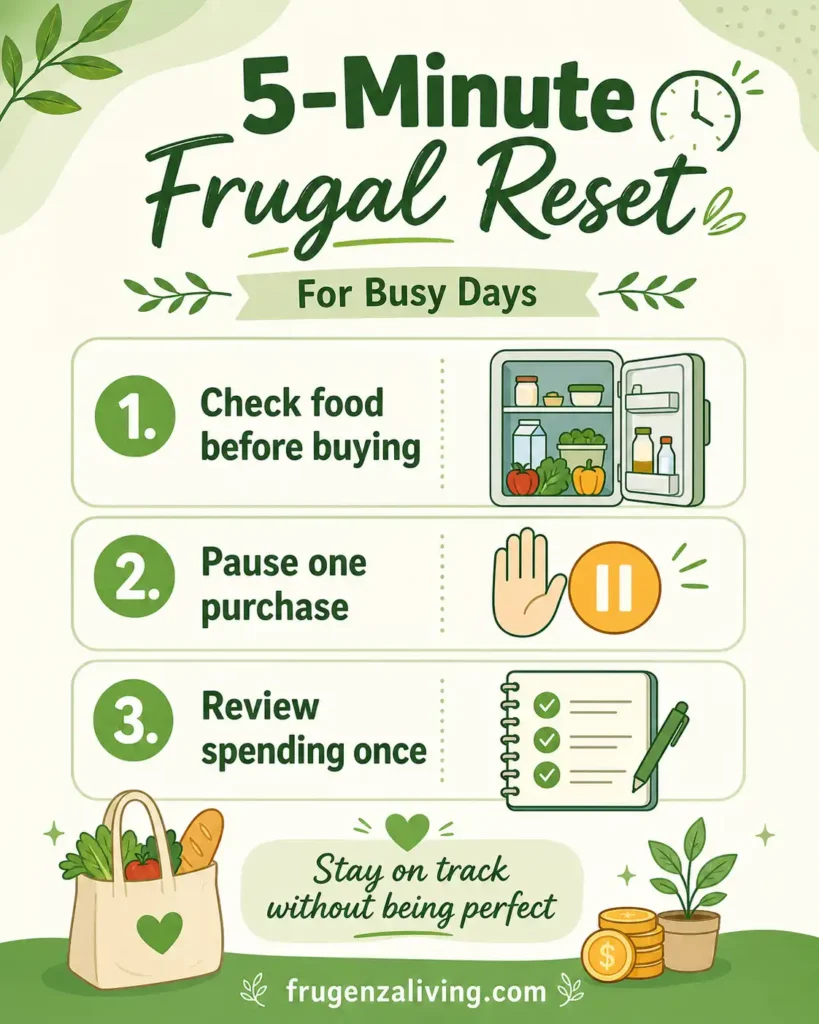
Some days will not follow any routine. That is not failure — it is just a busy day.
The problem is not the busy day itself. The problem is what happens after it: the routine feels broken, so you stop doing any of it, and the spending that the routine was preventing comes back all at once.
The five-minute frugal reset exists for this reason. It is not the full routine. It is the minimum version that keeps the habit alive when everything else is off.
Do only three things:
1. Check food before buying anything
Before ordering delivery or stopping at a store, open your fridge and pantry for thirty seconds. Not to cook an elaborate meal — just to see if something simpler already exists. Many delivery orders happen when there is food at home that would have taken ten minutes.
2. Pause one purchase
Pick one non-essential purchase you are about to make and wait until tomorrow. Not every purchase — just one. This keeps the “pause before buying” habit alive even when everything else fell apart today.
3. Do a sixty-second money check instead of two minutes
Ask only: what did I spend on today? That is all. One question. You are not reviewing the full week or calculating damage. You are just keeping the awareness habit connected.
The five-minute reset does not save as much as a full routine day. But it prevents the gap that grows when busy days turn into three weeks of no routine at all.
A bad day followed by a reset is better than a bad day followed by “I’ll start over Monday.”
What I Noticed After Using a Daily Frugal Routine
When I started using a daily frugal routine, the biggest change was not dramatic.
I simply had fewer random spending moments.
I bought less food out of panic. I had fewer “I forgot I already had that” purchases. I noticed boredom spending sooner.
Frugal living felt easier because I was not relying on motivation all day.
The routine carried some of the weight for me.
Over time, small daily routines like these became one of the foundations that helped me save over $15,000 in a year.
The biggest change was not that every day became perfect. It was that fewer small decisions turned into unnecessary spending.
It was not one dramatic cut.
It was the repetition that made the difference.
Common Mistakes With Frugal Daily Routines
1. Trying to Change the Whole Day at Once
Do not redesign your entire life in one day. A routine built from too many new actions at once will collapse the first time your schedule changes. Start with one time of day — morning or night — and let it stabilize before adding another.
2. Making the Routine So Strict It Cannot Survive a Bad Day
A routine that only works on perfect days is not a routine — it is a plan. The five-minute reset exists precisely because real routines need a minimum viable version for when life gets busy. If your routine has no simplified fallback, one hard week can break three weeks of progress.
3. Turning the Night Check Into a Guilt Session
The two-minute money check is a pattern scan, not a verdict. If it consistently makes you feel bad rather than informed, you are using it wrong. Keep it short, keep it neutral, and stop the moment it starts to feel like punishment. A check you dread is a check you will skip.
How to Build Your Own Frugal Daily Routine
A frugal daily routine is built around three time points, not a list of habits.
Before the day starts → Remove one decision
What will you eat? What will you bring? What convenience cost can you eliminate before the day creates pressure?
During the day → Interrupt one automatic moment
Pick one predictable point — afternoon browsing, a vending machine stop, an impulse click — and interrupt it before it completes. You do not need to catch every moment. Just one, consistently.
At the end of the day → Solve one tomorrow problem
What made today expensive? What simple preparation would have prevented it? Do that one thing tonight.
Notice that this is not about building ten habits at once.
It is about structuring three moments in your day so that the most predictable spending problems do not get a chance to appear.
Start with whichever time point has the most room. Add the others only when the first feels automatic.
How This Fits Into Your Frugal Living System
This article focuses on daily rhythm — the structure of your day and how timing affects spending decisions.
If you want to understand the broader foundation, frugal living for beginners covers the starting mindset and first steps.
If you want the individual behaviors that pair with this routine, frugal habits that actually save money covers the specific actions in more detail.
If routines start feeling too strict, how to live frugally without feeling deprived can help you keep things sustainable.
If you want to see what a frugal day looks like in real life across different situations, frugal lifestyle examples in real life gives practical context.
If impulse spending is the main issue, how to avoid impulse buying online can help you build stronger pauses before purchases. ✅
FAQ
What is a frugal daily routine?
A frugal daily routine is a simple set of money-aware actions you repeat during the day. It may include checking food before buying, packing snacks or lunch, avoiding impulse browsing, making simple meals, and doing a quick money check at night.
What are simple frugal daily routine ideas?
Simple frugal daily routine ideas include making coffee at home, checking the fridge before shopping, bringing water or snacks, using leftovers, pausing before online purchases, preparing one thing for tomorrow, and reviewing spending briefly at night.
How can I be frugal every day?
You can be frugal every day by reducing automatic spending. Start with small actions: check what you already have, avoid impulse browsing, use simple meals, bring one item from home, and review your spending for two minutes at night.
What should I do in the morning to live frugally?
In the morning, check what food you already have, make coffee or breakfast at home, and decide whether leftovers can become lunch. A simple frugal morning routine helps prevent unplanned food spending later in the day.
How do I make a frugal routine stick?
To make a frugal routine stick, start small and repeat one action until it feels normal. Use the loop Notice → Prepare → Pause → Review. A routine works best when it fits your real life instead of feeling strict or complicated.
Conclusion
A frugal daily routine does not need to be extreme.
It does not need to control your whole day.
It only needs to reduce automatic spending in small moments.
Check what you have. Prepare one thing. Pause before buying. Review briefly at night.
Start with one part of the day.
Repeat until it feels normal.
A good frugal routine does not make your day harder.
It makes the cheaper choice easier.

The ideas shared here come from real-life experience and practical habits that actually work.
→ Read more about Jeffi
- No Spend Month Challenge for Beginners: A 30-Day Plan - September 24, 2026
- Low Buy Month Challenge: Realistic Rules for 30 Days - September 23, 2026
- How to Stop Buying Groceries You Already Have - September 20, 2026